
Treat your adhesions to treat your voice
VOICE CLINIC
An old operation, far from the throat, can take away part of the voice. What a phoniatrician, a physiotherapist and an osteopath do about it.
INTERVIEW
A singer who speaks without difficulty and can no longer sing
A professional singer comes to a lesson. She speaks without difficulty. She can no longer sing, her range has shrunk, and she cannot say what happened to her. She has seen doctors, including abroad, very good ones. Nothing was found on her vocal folds, and no one mentioned anything else.
During support work, Adeline Toniutti places her hands on the singer’s abdomen and feels a scar. Have you had an operation? Yes: an ectopic pregnancy. After a few sessions of massage around the incision area, the voice came back and the singer was able to return to the studio.
Adeline Toniutti discussed this with Dr Bruno Coulombeau, phoniatrician in Lyon. A subject rarely raised in singing lessons: what scars and adhesions do to the voice, and what can be done about it.
KEY IDEA
An old operation, even one far from the throat and with no apparent link to the voice, should be mentioned to the phoniatrician, the ENT specialist and the singing teacher.
IN CONSULTATION
What no one mentions in consultation
The starting point of the conversation is an observation from the studio. Students do not talk about their operations, because they do not make the connection.

Adeline Toniutti
They don’t say it. For them, it has no bearing. That’s why I want to do prevention work. This singer saw very good doctors, and no one told her there could be a correlation between that operation and the fact that her voice was no longer as stable as before.
Dr Bruno Coulombeau
You’re right. Perhaps even I don’t ask enough questions. When I systematically ask about operations, there are times when people don’t mention them.
This sentence from the doctor gives the measure of the problem. The information exists, it is simply absent from the consultation, because neither the patient nor, sometimes, the practitioner thinks of linking an abdominal scar to a loss of high notes. The consequence is concrete: the cause is sought in the larynx, nothing is found, and the singer leaves without an explanation.
THE MECHANISM
One adhesion, one degree of freedom less
Adeline Toniutti has observed the phenomenon for years in singers who had surgery for an ectopic pregnancy or for endometriosis. The loss of voice is sometimes immediate. So is the return of the voice after massage of the incision area with Estelle Moltenis, physiotherapist, who works on adhesions with the team. The very precise work of Jean-Marie Legé, osteopath, completes this care.
Adeline Toniutti
Where the scar has adhered, it takes voice away from singers instantly. And once we’ve massaged the place where the incision was, we get voice back in a way that’s almost unbelievable. How can an adhesion in the abdomen itself take voice away? Is it a matter of fascia?
Dr Bruno Coulombeau
You would have to ask Jean-Marie Legé, the osteopath, whether he agrees with that. But to recruit muscle groups properly, in the abdominal region for instance, they need degrees of freedom, of mobility. They have to be able to move. If you have scar adhesions that stop them having the freedom they had before, they still move, but not as before.
The reasoning fits into one image. An abdominal muscle does not work only by contracting, it works by sliding against its neighbours. Scar tissue glues these layers together. The muscle stays alive, it keeps responding, and it loses range of travel. In everyday life, this goes unnoticed. For a vocal gesture that demands expiratory support adjusted to the gram, it can be heard.
“To recruit muscle groups properly, they need degrees of freedom, of mobility.”
KEY IDEA
An abdominal muscle needs degrees of freedom, of mobility, to support singing. Scar adhesions, like a kind of guy wires, reduce this freedom without removing the muscle.
THE THYROID
The thyroid: the nerves are intact, the voice has changed all the same
This is the example Dr Coulombeau chooses to explain the mechanism, and it is probably the most useful one for readers who have had neck surgery.
After thyroid surgery, the check focuses on the nerves: the inferior laryngeal nerves, known as the recurrent nerves, and the superior laryngeal nerves. If they are intact, the patient is reassured and told they can go ahead.
Dr Bruno Coulombeau
Once we know that the inferior and superior laryngeal nerves have not been directly injured, we tell people: “No, it’s fine, you can go ahead.” We must not forget that when the thyroid is removed, especially when it extends more or less deeply into the chest, the area where the thyroid used to be, the thyroid bed, “the hole that’s left”, fills in with scar elements, with adhesions. At that point, below the larynx, when it wants to move, there are something like guy wires that stop it rising or falling as it did before.
The word guy wire says it all: the ropes that hold a mast in place. The larynx is a mobile organ: it rises, it falls, it tilts, and this mobility is part of the vocal gesture. When the bed left empty by the gland fills with scar tissue, the larynx finds itself moored from below. The doctor adds a point he is keen to make clear: during this surgery, some of the extrinsic muscles of the larynx, those that suspend and move it, are approached, and they are sometimes cut and then sutured, which adds to the limits on the larynx’s mobility. The page Laryngeal suspension describes this apparatus.
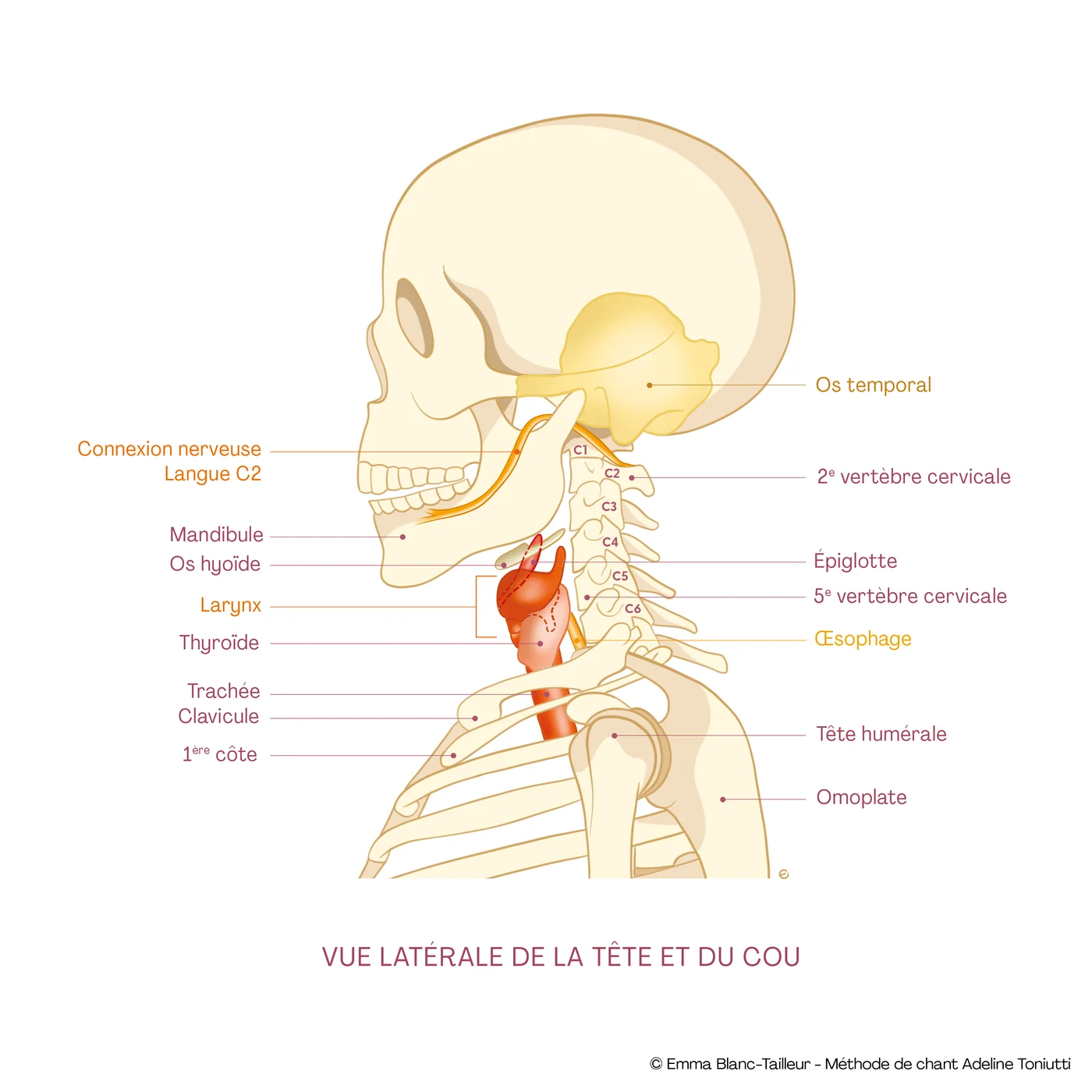
Illustration © Emma Blanc-Tailleur, Anatomie du Chant, Adeline Toniutti
The doctor then insists on a point that explains why these patients are often sent home without a solution: the speaking voice reveals very little. We speak over a relatively narrow range, sometimes a very narrow one, and the loss of suppleness is almost inaudible there.
Dr Bruno Coulombeau
When it comes to the singing voice, we’re no longer playing in the same league. Over two octaves, sometimes even three, we’re no longer in the same reasoning.
A patient who speaks normally can therefore be declared cured while their singing voice remains blocked, and there is no reason to doubt what they feel.
KEY IDEA
After thyroid surgery, intact laryngeal nerves are not enough to guarantee the return of the singing voice. The scar tissue that fills the thyroid bed, and the extrinsic muscles cut and then sutured, can hold the larynx back.
THE ABDOMEN
Liposuction and abdominoplasty: the wall that loses its elasticity
Adeline Toniutti sees more and more singers going through cosmetic surgery of the abdomen, often after one or more pregnancies. The reason for consulting is almost always the same: less voice afterwards.
Adeline Toniutti
What I notice is that sometimes there’s less voice afterwards. Is it because it hurts and there’s less abdominal support because of the pain? Or does removing fat do something in the body?
Dr Bruno Coulombeau
Good question. The matter of pain, for at least the first few months, I think so, yes. And liposuction means there is healing going on. Healing means collagen fibres settling in, scar fibres that may retract like a normal scar, and that can reduce the elasticity of the abdominal wall.
The doctor pins down the point of anatomy that matters: scar fibres are strong fibres, without the elasticity of the tissues they replace. An abdominal wall that has lost some of its elasticity still holds the abdomen in. It performs less well the elastic work that sung exhalation needs.
Two useful answers complete the picture. The first concerns intubation, which many singers fear after a general anaesthetic. Dr Coulombeau does not hold it as the usual explanation for these losses of voice: intubations are done better and better, and anaesthetists are even more careful when they know they are putting a singer to sleep. What anaesthetic drugs do to the muscles, and why the vocal fold surgeon needs them, is explained by Dr Marie Mailly on the page Botulinum toxin.
The second concerns the period when the patient is wearing a compression garment and comes to sing anyway.
Adeline Toniutti
They come to the lesson, they’ve had liposuction, they’re wrapped in a compression garment, and they come to record in the studio like that. I tell them we’re not in the best conditions to do anything. There’s a time for everything, there’s a time to have surgery, and then there’s also a time to sing. People forget that singing is a big performance.
Dr Bruno Coulombeau
If it means singing and hurting yourself, telling yourself you can’t do it, hurting yourself psychologically, it’s better to avoid it.
This advice also applies to preparing a recording or a tour. A studio date set three weeks after abdominal surgery cannot be made up for with energy.
DIETS
Diets, rapid weight loss and fatigue
The conversation then widens to what often goes with these surgeries. Adeline Toniutti observes a loss of voice in people who lose weight very quickly, in particular with the weight-loss treatments of which Ozempic is the best-known name, and wonders whether the loss of muscle mass is the cause.
Dr Coulombeau does not settle the question and sets out several possible mechanisms. Muscle loss, first of all: it can play a part, since the sung vocal gesture needs available muscles. Then a metabolic mechanism, which he frames as an open question: these treatments stimulate insulin secretion and lower blood sugar, and he wonders whether episodes of hypoglycaemia are not involved.
Above all, he adds a cause that is overlooked and that runs through the whole subject.
Dr Bruno Coulombeau
People who have an abdominoplasty or a liposuction are probably on a diet too, and some diets are tiring, quite apart from the operation, which is itself very tiring. Liposuction is not minor surgery. It causes fatigue, and that fatigue is thoroughly harmful to the sung vocal gesture.
Adeline Toniutti
To have a fine vocal gesture, one that lets you deliver certain performances, speak for hours or hold real stage shows, you need a body that is healthy overall, not in calorie deficit, not in exercise deficit. You need a balanced body.
Dr Bruno Coulombeau
Balanced and not tired. And that gets forgotten in many situations.
KEY IDEA
The aftermath of major surgery and a diet tire the body. This fatigue is harmful to the sung vocal gesture, regardless of the state of the vocal folds.
THE LOWER ABDOMEN
Ectopic pregnancy, endometriosis: an abdomen that is no longer available
The case reported at the opening of this article belongs to this family. An operated ectopic pregnancy, operated endometriosis, leave a scar and, often, adhesions in an area that is precisely the area of support.
Dr Coulombeau’s reasoning on degrees of freedom applies here unchanged: if adhesions stop the muscle working as it worked before, it works, but differently. And this is where he places the intervention.
Dr Bruno Coulombeau
If you need breath support, abdominal respiratory support, and you have adhesions that stop the muscle working as it worked before, the work of physiotherapists and osteopaths is essential.
A neighbouring mechanism, concerning periods, is reported by Adeline Toniutti from Jean-Marie Legé, osteopath who works with the team: when the whole lower part of the abdomen is inflamed, the intestine and the uterus swollen, the breathing mechanics lose their ease, in connection with the crura of the diaphragm.
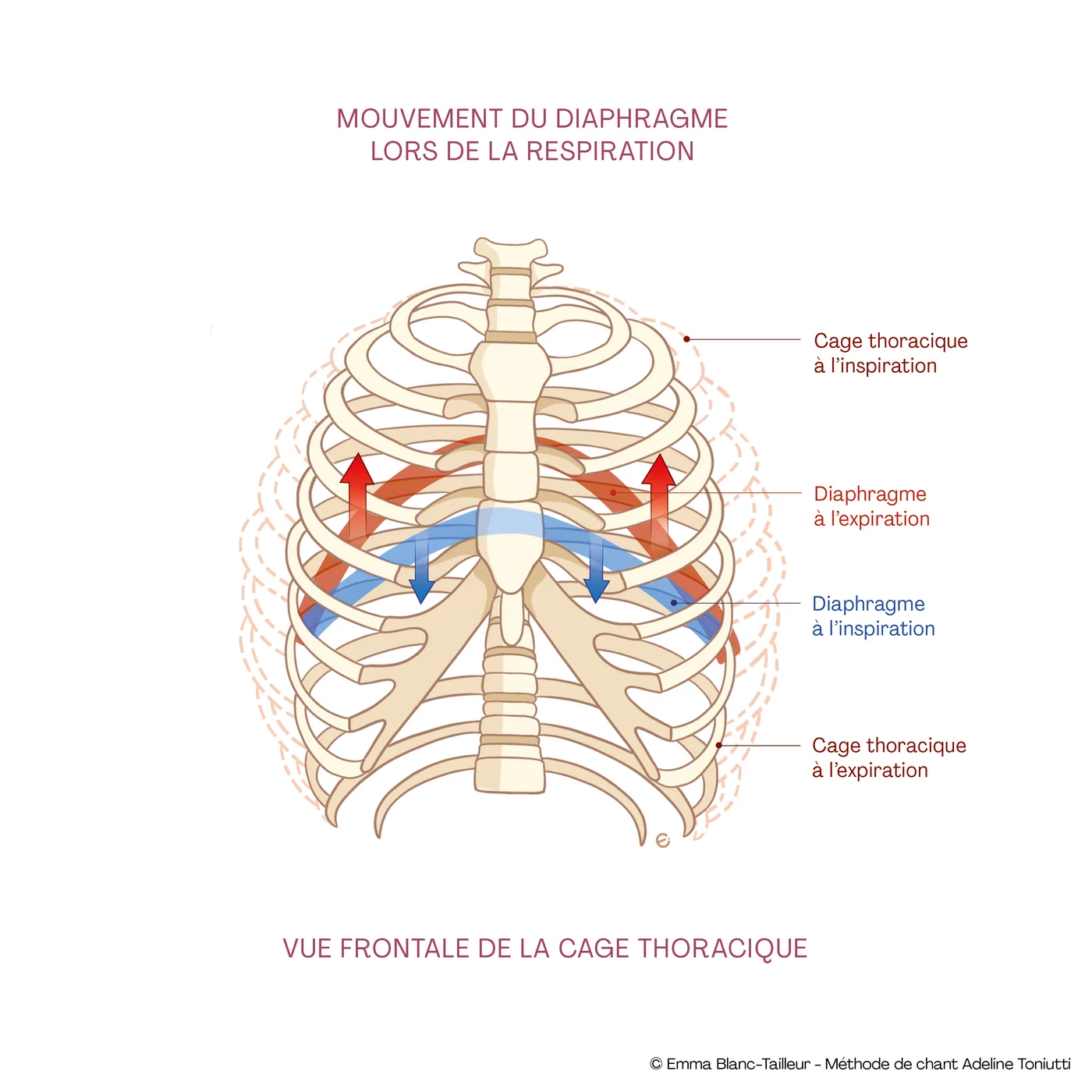
Illustration © Emma Blanc-Tailleur, Anatomie du Chant, Adeline Toniutti
Dr Coulombeau confirms the correlation and suggests placing the blocking point elsewhere.
Dr Bruno Coulombeau
I completely agree with him. All I’m saying is that I’m not sure the diaphragm is the problem. When it starts pressing on the contents of the abdominal cavity, through the crura and through all of its activity, the abdominal cavity answers: “Calm down, I’m not operational.”
In other words, the diaphragm may be perfectly competent and meet, beneath it, abdominal contents that are painful, swollen or fixed by adhesions, which limit its travel. For a singer living with endometriosis, this distinction changes what to do: the work bears on the abdomen, on its mobility and on the pain, as much as on breathing itself.
AFTER CHILDBIRTH
Caesarean, vaginal delivery, diastasis
A caesarean is abdominal surgery and comes under everything above: the muscle has been cut, and abdominal support is what takes longest to come back. Even after a vaginal delivery, the pelvic floor has been stretched and support is lacking. All of this is developed, with recovery times, on the page Pregnancy and the voice. One point concerns this page directly, because it is a matter of an abdomen that does not close again.
IN THE WORDS OF DR MARIE MAILLY
“In both cases there is the possibility of a diastasis, a failure of the abdominal muscles to close, which sometimes has to be operated on, because it does not necessarily resolve on its own.”
Dr Marie Mailly · ENT, voice and botulinum toxin specialist, Paris
An observation shared by Adeline Toniutti and Dr Coulombeau deserves to be known before a pregnancy or before a planned operation: the singers who were least muscular beforehand are the ones who sing again least quickly afterwards. A body trained beforehand recovers better.
THE VOCAL FOLD
The scar can also be in the vocal fold
On another scale, the same logic applies to the larynx itself. After almost all vocal fold surgery, a healing process comes into play. The aim, of course, is to keep it to a minimum and reduce its impact. For example, the surgeon sometimes performs a mucosal elevation, that is, opens the mucosa to reach a lesion deeper down, a cyst for instance. In that case, Dr Coulombeau explains that Dr Romain Pérouse, phonosurgeon, with whom he operates as a pair, places hyaluronic acid fibres in gel form inside the fold: the fibres take up water, hydrate and form an interface between the layers.
The vocabulary is different, the principle is the same: preserve the sliding between layers that must remain free of one another. The vocal fold vibrates because its mucosa ripples over the deeper layers. An adhesion at that spot can cost a great deal vocally.
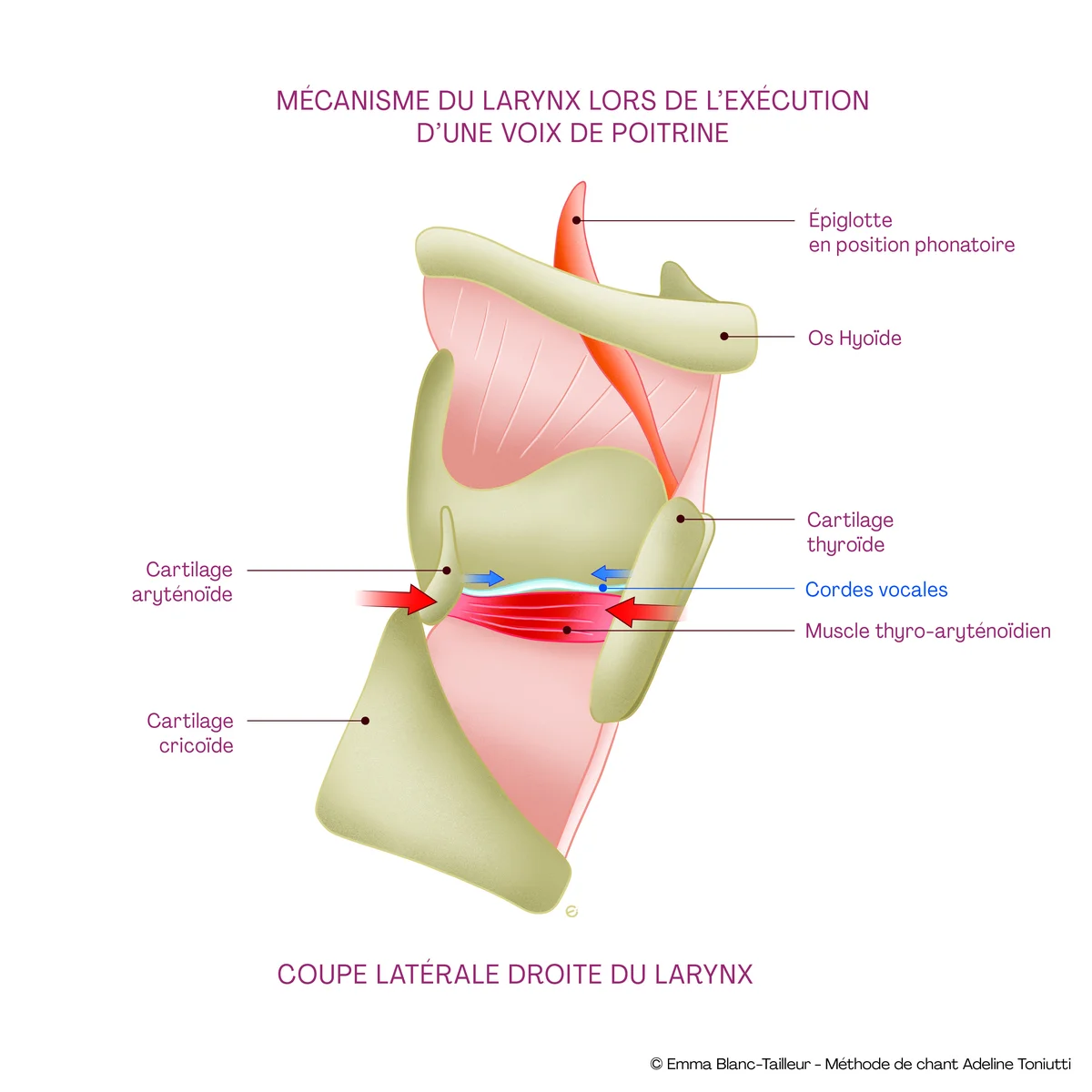
Illustration © Emma Blanc-Tailleur, Anatomie du Chant, Adeline Toniutti
The recovery time after vocal fold surgery is at least a month and a half to two months, often even three months for singers, and it is discussed case by case with the surgeon.
WHAT CAN BE DONE
What can be done
The subject is not an anatomical curiosity. It leads to a practical course of action, which comes down to a few points.
- Mention your operations, all of them. Thyroid, caesarean, ectopic pregnancy, endometriosis, appendicitis, hernia, liposuction, abdominoplasty, back or neck surgery. Including the old ones. Including those that seem unrelated to the throat. This is the first piece of information the phoniatrician or the ENT specialist can link to an unexplained loss of voice.
- Have the neck and the abdomen examined, not only the vocal folds. A normal laryngeal examination in someone who no longer sings as before is a piece of information, not a conclusion. The mobility of the larynx, the suppleness of the operated area, the quality of abdominal and pelvic floor support are part of the assessment.
- Work on the scar with a physiotherapist or an osteopath. Massage of the adhesions is the gesture that, in the cases followed in lessons, allowed the voice to be recovered. Dr Coulombeau describes this work as essential whenever adhesions hinder muscle function. After childbirth, pelvic floor rehabilitation is added to the list.
- Resume vocal work at the right time, and resume it technically. Singing in a compression garment, a few days after major surgery, exposes you to failure and its psychological burden. Once resumption is possible, technical work gives the body back the coordination that surgery and immobilisation have made it lose.
- Prepare the body beforehand, when the operation or the pregnancy is planned. A body trained beforehand recovers better afterwards. This is the most consistent observation, and it holds for a caesarean as much as for cosmetic surgery. Read Prepare your body to prepare for the stage.
KEY IDEA
Massage of the adhesions by a physiotherapist, the work of the osteopath and vocal technique work are carried out together, not one after the other.
An unexplained loss of voice after an operation is neither a fate nor a whim. It has identifiable mechanical causes, and it can be worked on. The first step is to talk about it, in consultation as in singing lessons.
The cases cited are anonymised. This article does not replace a consultation: if your voice changes in a lasting way, see an ENT specialist or a phoniatrician.
CALYP
A voice that does not come back after an operation
At CALYP, the phoniatrician’s assessment, massage of the adhesions by the physiotherapist, the work of the osteopath and vocal technique move forward together.
GO FURTHER
The Voice Clinic Interview series
Frequently asked questions
Can a scar on the abdomen take away part of the voice?
Yes. Scar adhesions reduce the degrees of freedom and mobility of the abdominal muscles, which keep contracting but no longer as before. For finely adjusted expiratory support, this can be heard, whereas it goes unnoticed in everyday life.
After thyroid surgery, why does the singing voice not come back when the nerves are intact?
Because the bed left empty by the gland fills with scar tissue, which holds the larynx back from below like guy wires, and because some extrinsic muscles of the larynx may have been cut and then sutured. The speaking voice, over a narrow range, does not reveal it; the singing voice, over two or three octaves, does.
Does liposuction or abdominoplasty change the voice?
It can. The pain of the first months reduces support, and healing lays down collagen fibres that can reduce the elasticity of the abdominal wall. The fatigue of the operation and of the diet that often goes with it is harmful to the vocal gesture.
What should you do when adhesions hinder the voice?
Work on them with a physiotherapist or an osteopath, at the same time as vocal technique. Dr Coulombeau describes this work as essential whenever adhesions hinder muscle function. Massage of the incision area allowed the voice to be recovered in the cases followed at CALYP.
How long should you wait before singing again after vocal fold surgery?
At least a month and a half to two months, often three months for singers, case by case with the surgeon. After a mucosal elevation, the surgeon may place a hyaluronic acid gel to preserve the sliding of the mucosa.