
Laryngeal suspension
PIVOT POINT 2
Hidden though it is behind the skin of the neck, the larynx is the place that houses our precious vocal folds.
MY METHOD IN 5 PIVOT POINTS
Trigger the right laryngeal movement
"Lower your larynx!" "Put the larynx down!" "Open your throat by yawning!" Adeline Toniutti has heard plenty of striking, and false, statements about the famous larynx. Hidden though it is behind the skin of the neck, it is the place that houses our precious vocal folds.
Misled by a discourse that is too reductive or not nuanced enough, singers can lose a fifth in the upper range in a flash, artificially lower their timbre, or even create a lesion in record time. In trying to apply a piece of advice properly, they unbalance the laryngeal organ to the point of hurting themselves, because they have not respected the anatomical mechanisms of laryngeal suspension.
A FREE MOVEMENT
The larynx follows the movement of the air
The second pivot point consists in identifying the best movements for your larynx, in order to give you a richer palette of colors and to guarantee you a healthy practice.
The freedom of movement of the larynx must be made easier, in order to encourage the movements of the vocal folds and their vibration. When singing, a great improvement is observed when the laryngeal movement goes in the direction of the exhaled air, upwards.
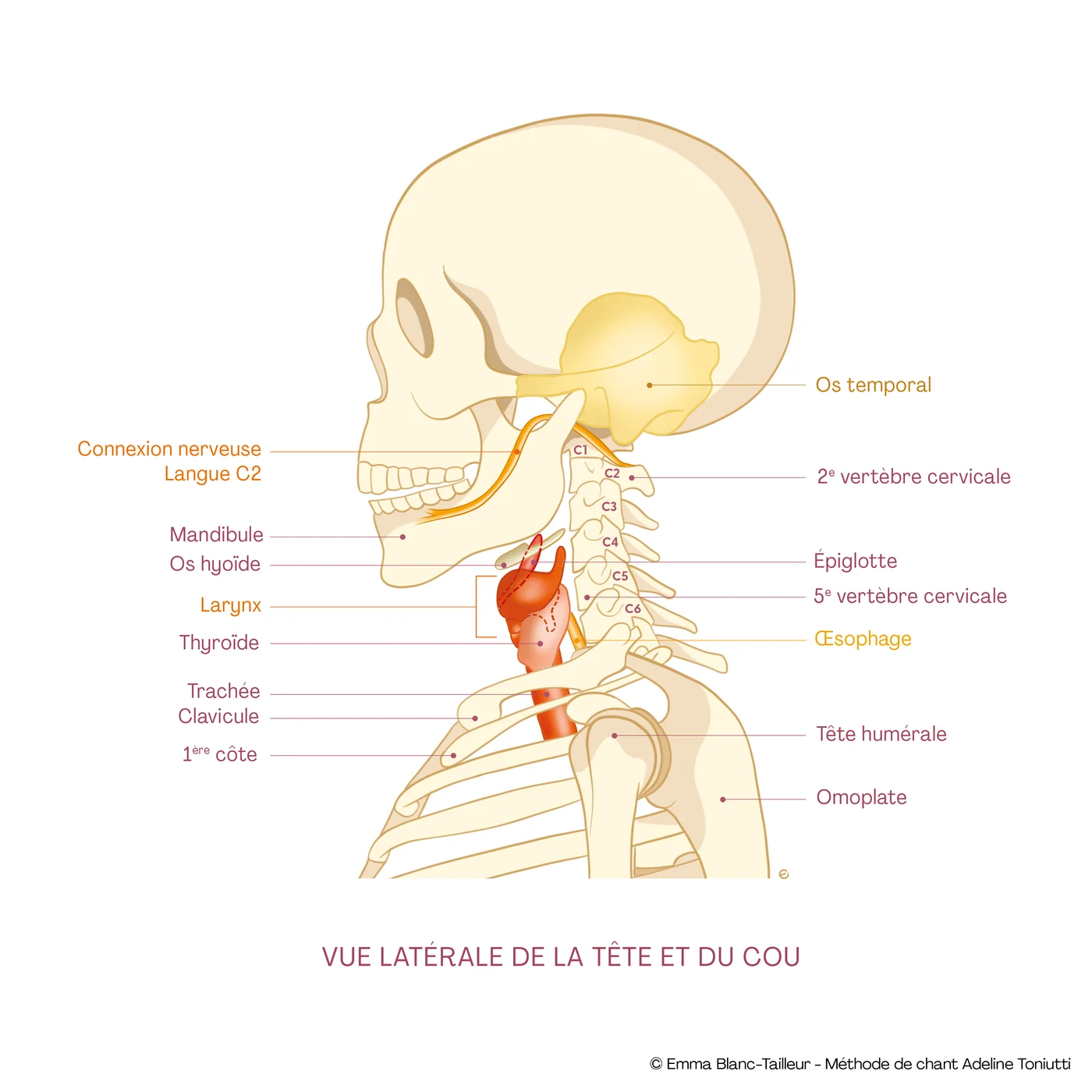
Illustration © Emma Blanc-Tailleur, Anatomie du Chant, Adeline Toniutti
PLEASE NOTE
By "not putting the larynx down", we do not mean "blocking it up high" either. It must make very supple movements, supported by refined management of the respiratory system and its muscles. This advice holds true for every type of singing.
THREE MARKERS
Identifying the right movement
To make sure of a good laryngeal movement, one that respects laryngeal suspension and the direction of the exhaled air, check the following three points.
The movements of the larynx are free and follow the movement of the exhaled air. You can place your hands around the larynx, rather on the lower rings, and feel the movements. You can also observe it with the naked eye by looking at yourself in the mirror. The larynx is not blocked down low.
The sternal notch is nicely free. The larynx does not try to occupy the area of the sternal notch. Singing and active breathing must go on happening naturally, without causing you any discomfort.
The base of the tongue does not block down low. The tongue is attached to the larynx by the hyoid bone, and it plays a part in the proper suspension of the larynx. You can feel the base of your tongue moving upwards, coming closer to the soft palate, without sticking to it, otherwise you produce an entirely nasal sound.
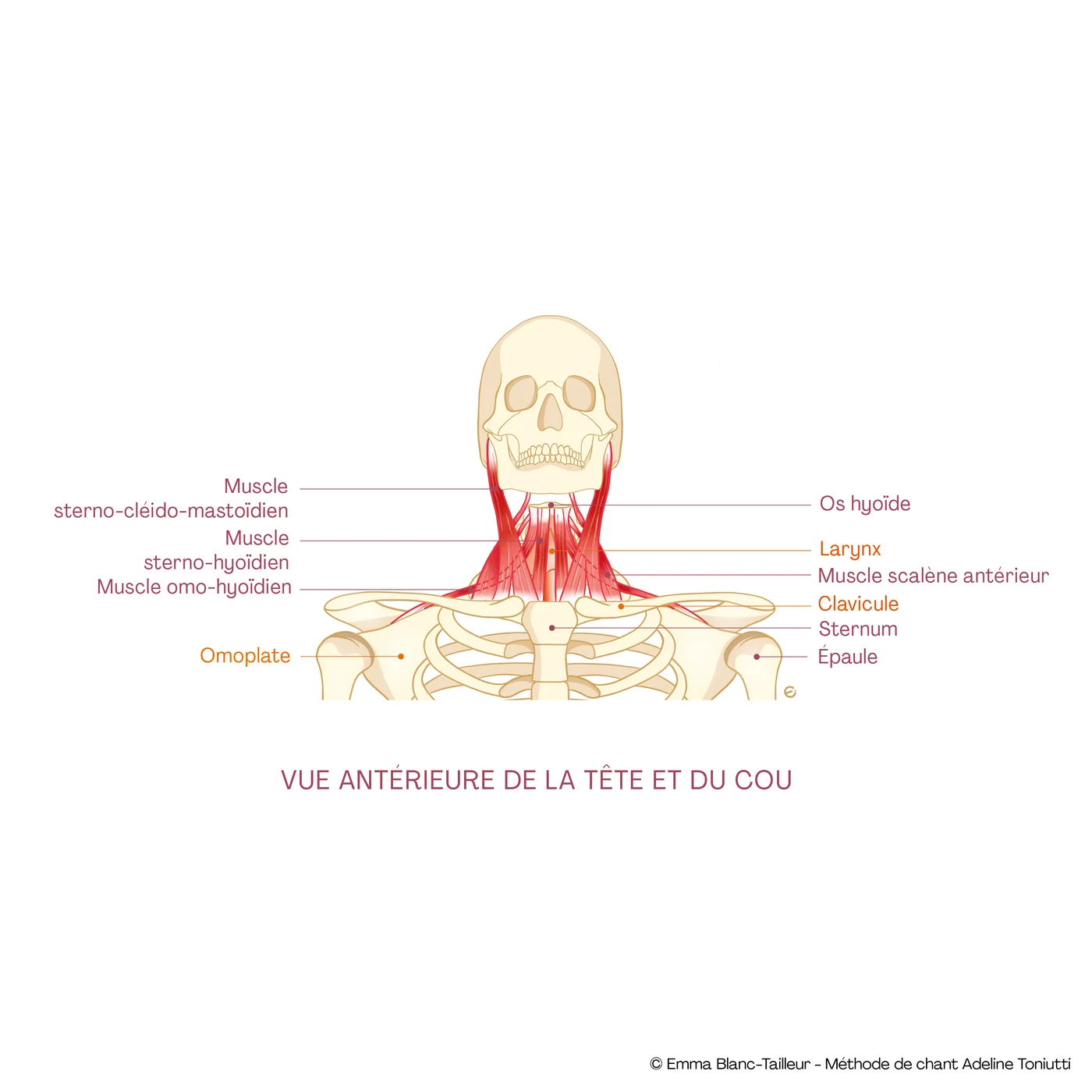
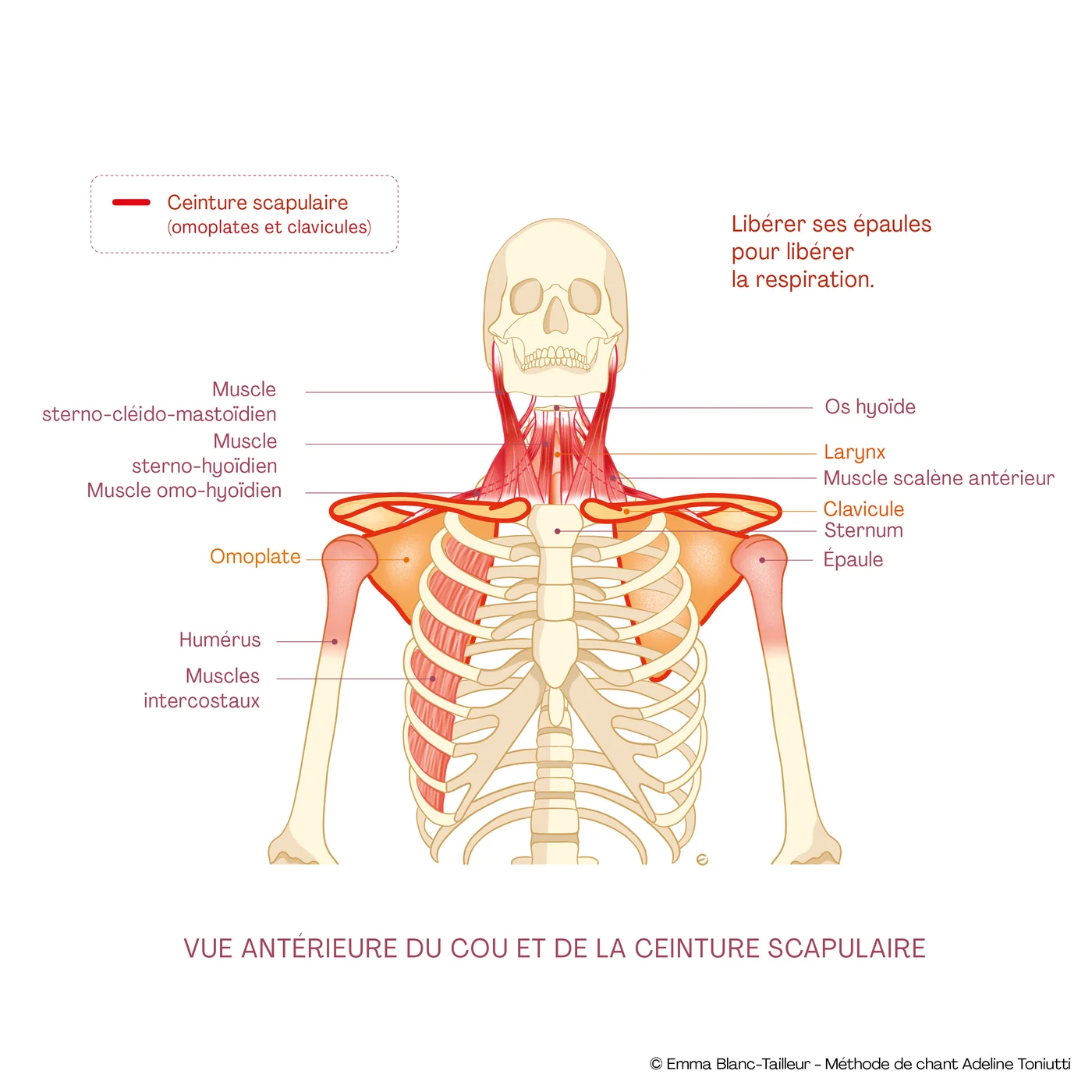
Illustrations © Emma Blanc-Tailleur, Anatomie du Chant, Adeline Toniutti
EXERCISE
Placing the hand under the mandible
Aim: check the correct movement of the larynx.
- Place your thumbs on both sides of your mandible, just behind the bone, in the space between the larynx and the mandible.
- If you feel your tongue coming to meet your thumbs and blocking against the mandible as you sing, then the movement is not correct. On the contrary, if you feel your tongue moving away from your fingers as it moves, with the impression that it is heading towards the soft palate, that is the best gesture.
- Under no circumstances should the tongue stay frozen in one position, nor come to press on your fingers. You must be able to sing with your thumbs under the mandible without discomfort, and feel your tongue making movements.
EXERCISE
Saying "no"
Aim: make a beautiful onset of the sound.
- Turn your head at the moment of the sound onset, to free the cervical spine and encourage laryngeal suspension.
- A simple and effective exercise, especially with beginners.
THE TONGUE-LARYNX TANDEM
The larynx's inseparable partner
The larynx's inseparable partner is the tongue. The tongue is linked to the larynx by the hyoid bone, with which it moves as one, because a large number of its muscles attach to it. Developing awareness of the movements of the tongue and of the larynx in order to make them coordinate helps to free the vocal gesture.
One of the roles of the tongue is to turn sounds into language: it takes an active part in the articulation of consonants and in the formation of vowels. Its work must be fine enough to help the work of the vocal folds in producing sounds and amplifying them, and not to hinder it.
The tongue and the larynx are an inseparable tandem, a little like the prima ballerina with her lead dancer in a ballet.
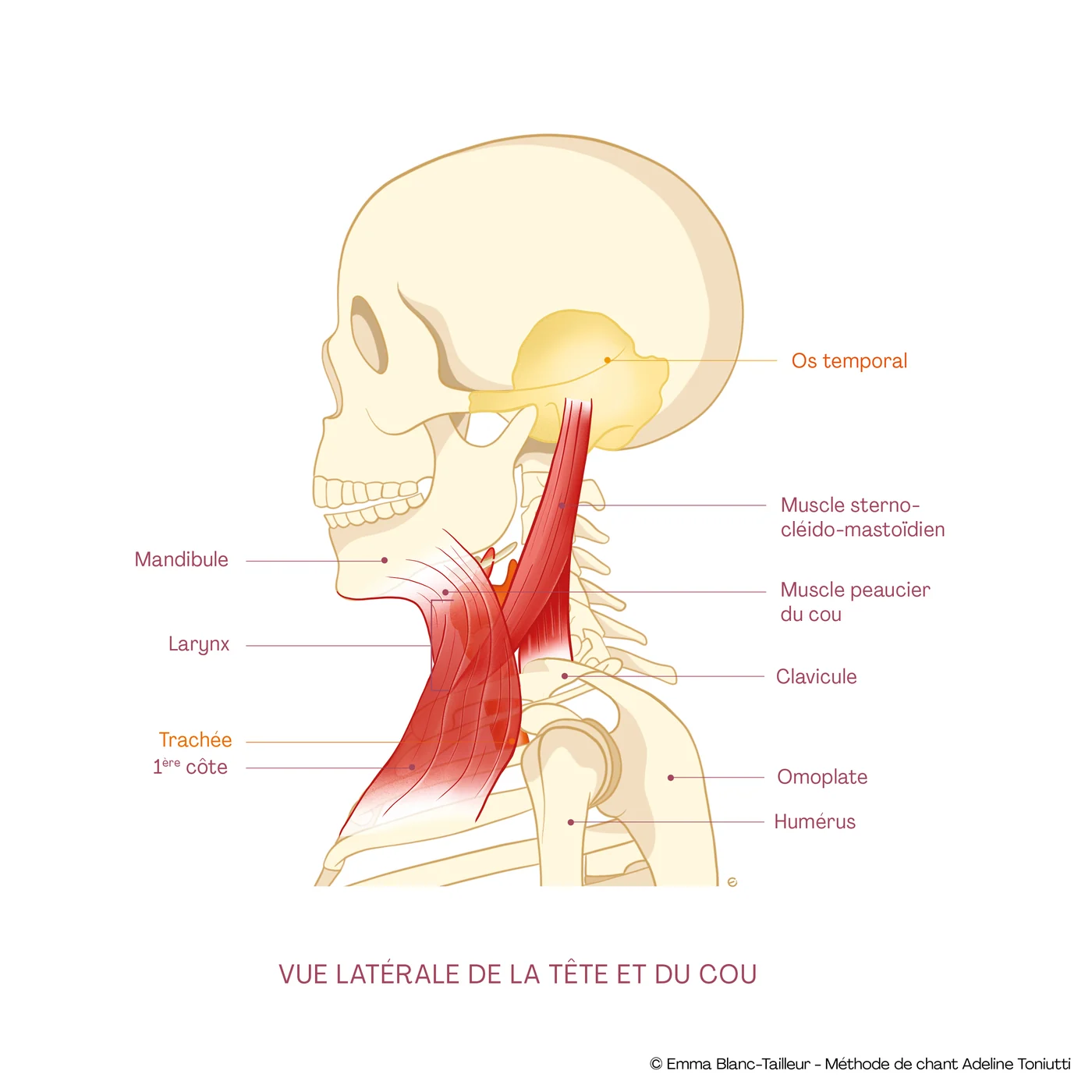
Illustration © Emma Blanc-Tailleur, Anatomie du Chant, Adeline Toniutti
The bel canto technique makes it possible to understand just how complex the movements of the tongue are: an opera singer has to tame their tongue to obtain all the sounds this art demands. The necessary starting point is to respect laryngeal suspension. Once that has been taken on board, a multitude of pieces of advice can be unfolded to enter into the goldsmith's work that concerns the movements of the tongue.
THE CROSSROADS
The pharynx, crossroads of breathing and digestion
The pharynx is a crossroads between breathing and digestion. It is a hollow organ, like a pipe. The epiglottis acts as a switch to send food into the esophagus or air into the trachea.
The pharynx is made up of three parts: the nasopharynx, also called the rhinopharynx, that is to say the back part of the nose; the oropharynx; and the hypopharynx, the lower part of the pharynx. The larynx, for its part, is the organ specialized for the voice, and it is surrounded by the pharynx.
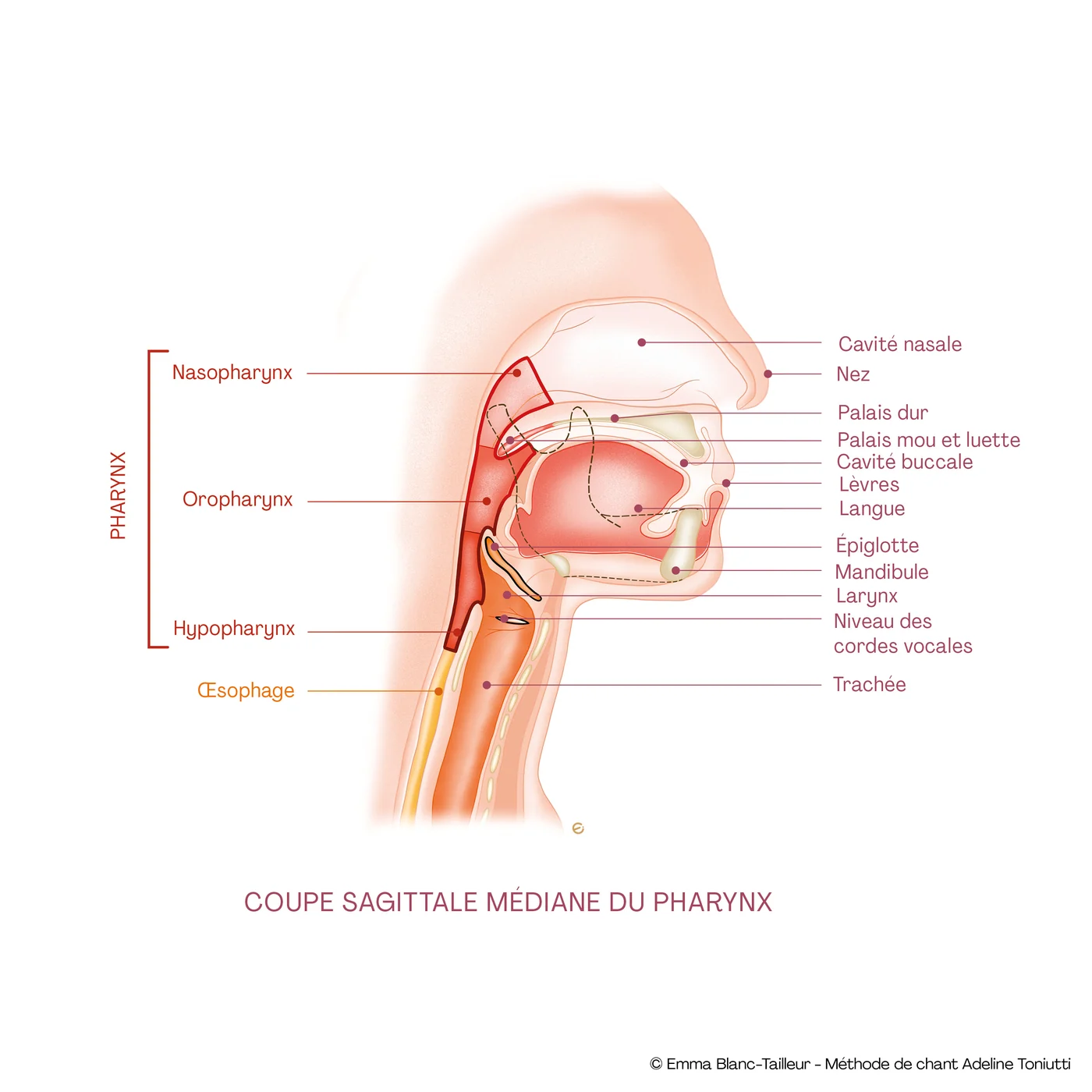
Illustration © Emma Blanc-Tailleur, Anatomie du Chant, Adeline Toniutti
Frequently asked questions
Should you lower your larynx to sing?
No. « Lower your larynx » is one of those overly simplistic pieces of advice that unbalance the laryngeal organ. On the contrary, a great improvement is observed when the laryngeal movement goes in the direction of the exhaled air, upwards. That does not mean locking it up high either: the larynx must perform very supple movements.
What is laryngeal suspension?
It is the whole set of anatomical mechanisms that hold the larynx in the neck while leaving it its freedom of movement. The tongue takes part in it, because it is attached to the larynx by the hyoid bone. Failing to respect these mechanisms can make you lose a fifth in the high range, artificially lower the timbre, or create a lesion.
How can I check that my larynx is moving correctly?
Place your thumbs on both sides of your mandible, just behind the bone, in the space between the larynx and the mandible. If your tongue comes to meet your thumbs and locks against the mandible as you sing, the movement is not correct. If it moves away from your fingers, with the impression that it is going towards the soft palate, that is the best gesture.
What is the link between the tongue and the larynx?
The tongue is connected to the larynx by the hyoid bone, with which it is integral, since a large number of its muscles insert onto it. The tongue and the larynx are an inseparable duo, rather like the prima ballerina with her lead dancer in a ballet.