
Menopause, andropause, presbyphonia: what age and hormones change in the voice
VOICE CLINIC
My voice has dropped since the menopause, is that normal? My husband can no longer hold his high notes, is it the andropause? Two voice doctors answer.
INTERVIEW
Questions that come in every week
The questions come in every week at CALYP and reach Adeline Toniutti’s ears. My voice has dropped since the menopause, is that normal? My 62-year-old husband can no longer hold his high notes, is it the andropause? Do I need hormone treatment to preserve my voice? Adeline Toniutti spoke with Dr Bruno Coulombeau, phoniatrician in Lyon, to shed light on these subjects. Dr Marie Mailly, ENT and voice specialist in Paris, gives her perspective on the same questions.
BEFORE THE MENOPAUSE
The voice evolves well before the menopause
Dr Coulombeau’s first observation concerns a continuous evolution, unrelated to any specific hormonal event. “Listen to the voice of a young girl, of a young woman of 25, of a woman of 45, even before the menopause. They are often ‘distinguishable’ by ear in their ‘maturity’.” Three mechanisms combine: the evolution of the body and the resonators, which makes a voice mature; muscular evolution; and hormonal status, which also plays a part, through longer exposure, monthly variations or pregnancies in women. Even in men, the duration of hormonal exposure probably plays a role.
In the speaking voice, and among non-singers, a trend appears around the age of 70: women’s voices drop a little in pitch, men’s voices rise a little, so that the average pitch of the two draws closer. It should be made clear that this convergence concerns speaking voices.
In the opera world, something else is observed. Tenors such as Placido Domingo, the Spanish tenor and one of the great operatic voices of the late twentieth century, become baritones at the end of their careers. Some voices become higher, others lower, depending on the case.
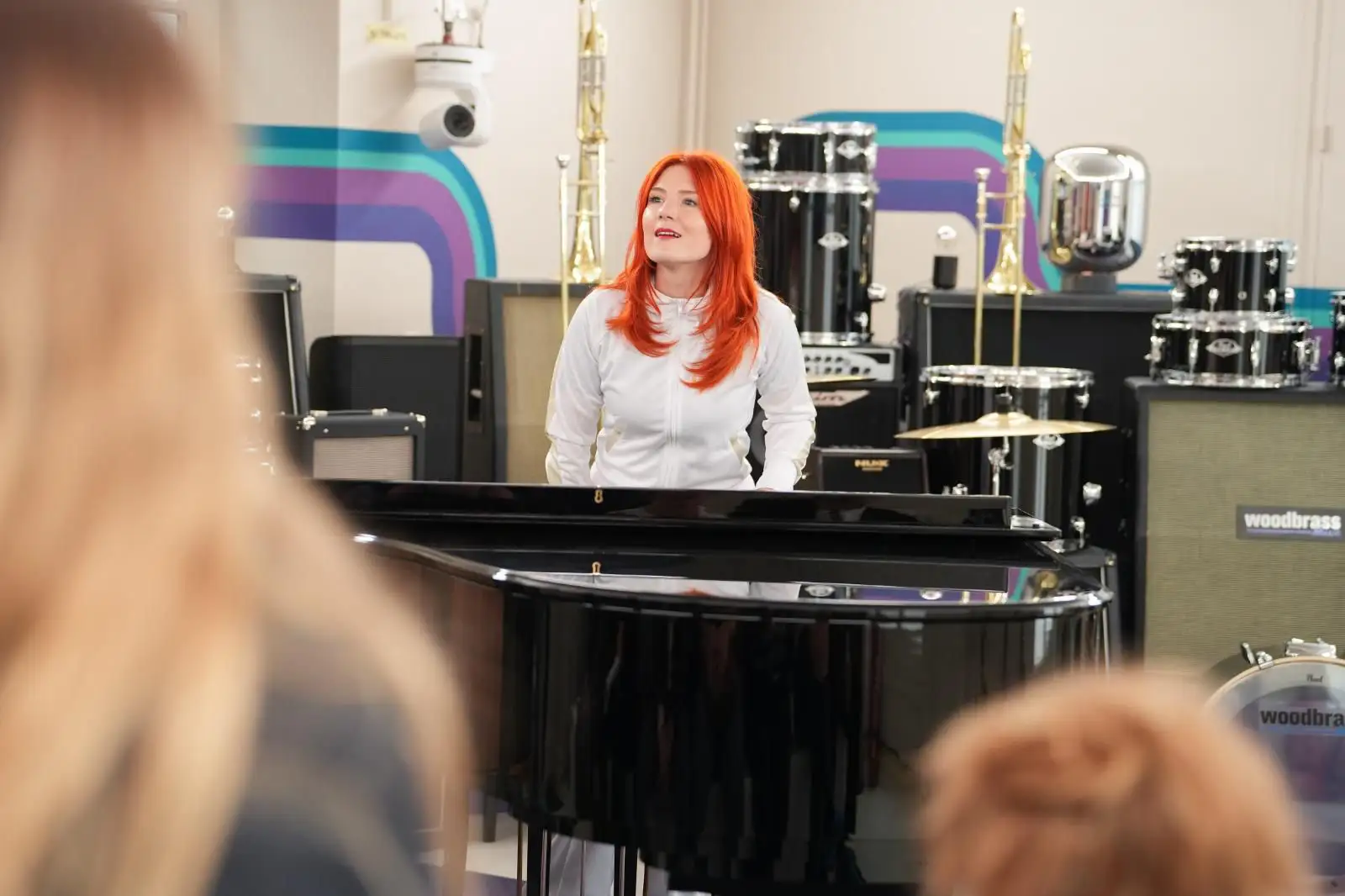
Adeline Toniutti
Many tenors I know, who had real careers, including my teachers, moved to baritone at the end. Placido Domingo did that too.
Dr Bruno Coulombeau
Don’t you think it could rather be a muscular question? When you hear tenors who really let it out, you have to be there muscularly.
Adeline Toniutti
I agree with you. My question was: is it the vocal folds that change, or is it an ageing of the body that leaves less abdominal support, less supple membranes? Will vocal folds like Domingo’s get thinner, become finer?
Dr Bruno Coulombeau
As for Domingo, I set him aside, I have never seen him in consultation. What we often see is that the general appearance of the folds changes little. As a rule, they change little. We rather have the impression that muscular factors come into play. Less tone, less capacity to maintain high pressure.
“There are the mechanisms of menopause which, because of a drop in hormones, make the voice deeper.”
“The general appearance of the folds changes little. We rather have the impression that muscular factors come into play.”
KEY POINTS
In most people who age, examination of the vocal folds shows few changes. What goes first is tone and the pressure available. Muscular work is therefore part of caring for the voice after 50.
THE LARYNX
What the menopause changes in the larynx
Hormonal status changes, and the vocal folds perceive it. “The vocal folds are a receptor for sex hormones,” Dr Coulombeau reminds us: oestrogens, progesterone and androgens bind to them. The expected changes concern hydration, with probable drying of the mucous membranes, muscle tone, and above all the elasticity of the tissues.
On examination, there are “no things that are necessarily visible”. No spectacular thinning, no transformation in the length or weight of the vocal folds mechanically accompanies the menopause. Sometimes, more or less significant changes in the morphology of the folds can occur. This is the case in presbyphonia, which we will discuss further on.
What women report most often: an impression that the pitch has dropped overall, sometimes a narrowing of the range, which becomes a little less wide. The doctor insists on the status of this observation. “It is a trend we observe. It cannot be generalised.” Sopranos and menopausal singers can keep a range that is entirely comparable to the one they had before.
Dr Marie Mailly describes the mechanism and the list of symptoms as they arrive in consultation.
IN THE WORDS OF DR MARIE MAILLY
“The mechanism is the combined drop in oestrogen and progesterone, which leads to significant laryngeal changes: a drop in the fundamental frequency, so a voice that becomes slightly lower, sometimes a loss of the upper part of the range; increased vocal instability; reduced respiratory capacity; loss of lubrication of the vocal folds; weakness of the vocal muscle; increased vocal fatigue, with thinning and dryness of the vocal folds.”
“In concrete terms: hoarseness, dryness of the pharynx and larynx, vocal fatigue, reduction of the vocal range, especially in the high notes, which are harder to reach, slower vocal recovery after use.”
“I think you should always seek a consultation, to talk it over with the ENT, to make sure there is nothing else that is easy to treat: strain, reflux. It is difficult to really tell the difference between menopause and perimenopause.”
Dr Marie Mailly · ENT, voice and botulinum toxin specialist, Paris
KEY POINTS
The menopause does not make a vocal fold “lose” half its weight. It acts on tissue elasticity, hydration and tone. A voice that changes during this period deserves an assessment by a phoniatrician or an ENT, if only to rule out strain or reflux, followed by suitable technical work, without waiting for the discomfort to set in.
HORMONES
Hormone replacement therapy and the voice
Both doctors answer, and their answers complement each other.
Adeline Toniutti
For you, hormone treatments are not something we would give to improve the voice? It is not something recommended for the voice?
Dr Bruno Coulombeau
No, not for the voice. They may have an indication that will be set by gynaecologists for other reasons, in particular bone-related ones. You know that a woman’s skeletal system becomes fragile with age. Osteopenia leads to osteoporosis which, at the slightest fall, could cause fractures a little too easily. There, certain treatments are put in place, including hormone treatments, to try to avoid that. But on the vocal level, it is very unlikely that putting in place hormone replacement therapy will have a lasting impact on the voice.
On the vocal effect itself, the doctor describes an unpredictable result: “Sometimes hormone replacement therapy helps, sometimes not at all. I do not recommend it for vocal reasons, because we are not at all sure it will work.”
Adeline Toniutti asked the opposite question, the one many singers dread: can these treatments damage the voice? “There, actually, I don’t think so,” answers Dr Coulombeau, who does not recall a patient coming to describe vocal deterioration attributed to replacement therapy. He adds the necessary nuance: “It would not be very logical. But sometimes there are unusual reactions.”
Dr Mailly, for her part, sees patients in consultation for whom the treatment changes things.
IN THE WORDS OF DR MARIE MAILLY
“Taking hormone replacement therapy is always up for discussion, and according to some patients it improves things a great deal.”
Dr Marie Mailly · ENT, voice and botulinum toxin specialist, Paris
KEY POINTS
Hormone replacement therapy is discussed with the gynaecologist, for indications that are first of all bone-related and general. No vocal benefit can be promised: some patients describe a clear improvement, others none. No harmful effect on the voice has been reported to Dr Coulombeau. The useful lever for the voice remains the assessment and vocal work.
In men, age and androgens
What has been described in men comes down to age and muscle: a speaking voice that rises slightly in pitch around the age of 70; a presbyphonia that affects men as well as women; top notes in chest voice that become harder and harder to hold, with less pressure available; and, when the vocal folds really lose a substantial part of their mass, a vocal evolution that follows. “That is with age. It can affect men as well as women.”
Dr Mailly clarifies the vocabulary, and what happens in the vocal fold of an ageing man.
IN THE WORDS OF DR MARIE MAILLY
“Medically, we do not speak of andropause, because in men there is not, as in women at the menopause, an abrupt halt in testosterone secretion. It is more gradual in men. We rather speak of functional hypogonadism. But this decrease in testosterone with age also induces muscle loss, with thinning of the vocal folds, and therefore a more unstable, more breathy voice. Often, they lose their low notes.”
Dr Marie Mailly · ENT, voice and botulinum toxin specialist, Paris
A point of medical history sheds light on the hormonal question in men. In the 1970s, elderly people losing strength and energy with age-related muscle wasting had been put on androgens, men and women alike. The trial was quickly stopped in women, whose voices lost a fourth or a fifth in a short time, which is considerable, with body hair appearing. In men, this practice is no longer carried out today.
Dr Bruno Coulombeau
We know that androgens will cause the vocal pitch to drop. We know how to do that. Conversely, in men, raising the vocal pitch convincingly, it is very rare for that to work.
Do the hormonal mechanisms of the menopause and the andropause affect M1 (chest voice) or M2 (head voice) more? Dr Mailly answers cautiously: “It is not at all obvious, but I would rather say mechanism 1,” that is, M1 (chest voice). This matches what Dr Coulombeau describes: it is the top notes in chest voice, those that cost the most pressure, that become the hardest to hold.
KEY POINTS
The only predictable hormonal effect on the pitch of the voice comes from androgens, which lower it. A woman who sings and who is offered a treatment containing androgens would do well to mention it to her prescriber, and to have a vocal check-up before starting. In men, the gradual drop in testosterone thins the folds and causes the low notes to go; what can be worked on is the muscle.
PRESBYPHONIA
Presbyphonia, an age-related evolution
This is the only mechanism in which the vocal folds visibly change. Dr Coulombeau describes it as “a kind of atrophy, but without stiffness”: the muscle seems to draw back, the vocal fold becomes slightly hollowed, in men as in women.
Three clarifications matter. First, this evolution does not affect everyone: studies mention 12 to 35% of the population over 60. Second, it affects the population as a whole and not only singers, even if the impact felt is far heavier for them. Finally, it is age-related: hormonal changes are not its cause. It is diagnosed mostly from the sixties onwards, and is rarely seen before 65 or 70.
IN THE WORDS OF DR MARIE MAILLY
“Added to this is presbyphonia, which affects both sexes, and which is simply the physiological ageing of the larynx: loss of elasticity, ossification of the cartilages, respiratory weakening.”
Dr Marie Mailly · ENT, voice and botulinum toxin specialist, Paris
The diagnosis must also be distinguished from other appearances of atrophic or abnormal vocal folds, which have nothing to do with age: atrophies linked to taking inhaled corticosteroids, or malformations such as vergetures. Dr Coulombeau takes the example of a voice known to the general public, whom he never had in consultation: Guy Béart probably had “unusual” vocal folds, with an atrophic appearance called a vergeture, which gives a slightly high, veiled voice, nonetheless entirely compatible with singing. This configuration has always existed in the person. Vergetures and presbyphonia are different situations, distinguished by laryngeal examination.
Adeline Toniutti
I had a menopausal singer to whom you had given this diagnosis. She took it badly, because people take it badly: it means that old age can be seen in the vocal folds, even if it is not constant. For a singer, that is very hard.
Dr Bruno Coulombeau
I understand that they take it badly, it would happen to me, I don’t think I would take it very well. But at the same time, it is an evolution we observe in a certain number of people.
What vocal work can do
The question was asked directly: does rehabilitation improve presbyphonia? The answer comes down to one word, “yes”, then qualified.
Adeline Toniutti
With people who had presbyphonia, by doing work to rebuild the peripheral muscles, we still managed to obtain things. Vocal technique work, for you, can help to correct or to compensate?
Dr Bruno Coulombeau
Correct, I don’t know whether I would use that term, but compensate, that seems right to me. To make up for it. You make up for the fact that there is a change in the vocal folds by the fact that, technically, you improve the use of the instrument. Since the appearance of the folds does not change, it is a bit illusory to tell yourself that you will get back to what it was before. Things can be improved. Compensating muscularly for what is mechanically difficult to do.
IN THE WORDS OF DR MARIE MAILLY
“Yes, the first treatment is to work on posture, on the respiratory muscles, to call on the vocal folds to keep them muscular. But there is a genetic component which means that sometimes, despite this, the voice remains of poor quality.”
Dr Marie Mailly · ENT, voice and botulinum toxin specialist, Paris
Suppleness, agility, colour: these gains remain within reach, with sustained work. For muscular maintenance itself, read Preparing your body to prepare for the stage.
Augmentation: injections into the vocal fold
In some cases, a medical procedure complements the rehabilitation. “Augmentation”, or “volumisation”, is the fashionable term, Dr Coulombeau points out. It consists of trying to give back to the vocal fold, in its depth, the mass it has lost, with the most supple product possible.
- Fat is the product favoured by Drs Pérouse and Coulombeau. It requires a general anaesthetic, and it does not hold in everyone.
- Hydroxyapatite can be injected in the consulting room, without putting the person fully to sleep. This substance is reabsorbed, which means it has to be repeated every eighteen months to two years.
- Hyaluronic acid in gel form is reabsorbed even faster: “six months later, there is none left”.
IN THE WORDS OF DR MARIE MAILLY
“What can then be offered is either to plump up the vocal folds, by injecting fat or hyaluronic acid into them, or, increasingly, to inject PRP, platelet-rich plasma.”
Dr Marie Mailly · ENT, voice and botulinum toxin specialist, Paris
Botulinum toxin has no place in this chapter: it paralyses a muscle, it does not plump it back up. It has its own page: Botulinum toxin, spasmodic dysphonia, dystonias.
KEY POINTS
Presbyphonia is diagnosed mostly from the sixties onwards and does not necessarily depend on hormones. The appearance of the vocal folds does not return to what it was. Vocal work makes it possible to compensate, with a real gain in suppleness, agility and colour, and that is what makes the voice usable again. Augmentation is then discussed, case by case, with the doctor who carried out the examination.
MUSCLE
Muscle, the central question of the second half of vocal life
Muscle is the factor that explains the most.
Dr Bruno Coulombeau
To hold the tenor’s top notes, you need pressure, you need the thoraco-abdominal muscles to be physically there. If the muscles start to become a little difficult to call on, it gets complicated.
The doctor then describes a phenomenon of instability, with a telling image. Arm held out horizontally: if the tone of the shoulder muscles holds, then drops for a moment, the arm falls, the person catches it very quickly, and an oscillation appears. “The same thing can happen in the muscles of the diaphragm, the muscles of the abdominal belt or the larynx, and produce a kind of instability in the voice.” It can be recognised in a vibrato that widens over the years, or in singers whose speaking voice remains almost normal and who can no longer hold a stable tone as soon as they sing.
Adeline Toniutti
For me, it comes from the muscles. For sure.
Dr Bruno Coulombeau
Those muscles, yes, we agree.
General condition counts as much as training. Asked what a fine vocal gesture requires, the doctor answers: “Balanced and not tired. And that is forgotten in many situations, diets.” Periods of rapid weight loss, convalescence and post-operative recovery build up a fatigue that is “entirely harmful to the sung vocal gesture”. Asked about the voice loss observed in artists on weight-loss treatment, he mentions two hypotheses, loss of muscle mass and a possible role of the drop in blood sugar, presenting them as avenues to explore.
KEY POINTS
High notes cost pressure, and pressure is paid for in muscle. After 50, maintaining the body is part of vocal technique in the same way as vocal exercises. A period of rapid weight loss or convalescence is a bad time to expect a performance from your voice.
THE CYCLE
The menstrual cycle: real, variable, rarely taken into account
The menstrual cycle is a useful preamble to the menopause. During menstruation, it is not uncommon to observe increased vascularisation of the vocal folds, without true oedema, with swelling and saturation of the tissues.
Dr Bruno Coulombeau
Some people will tell you: “There, I have a great voice during my period,” and others: “I have no voice at all.” A singer who tells me “I have no voice”, sometimes she has lost a third at the top, that is already a lot. She sings, but with the impression, certainly a correct one, that her voice does not respond at all the way it would normally.
Variability between women is the rule: headaches and sensitivity to light for some, abdominal pain that doubles them over for others, tender breasts, or nothing at all. “These are interindividual differences that are not always easy to understand and to address.”
IN THE WORDS OF DR MARIE MAILLY
“In all women, there is clearly a premenstrual syndrome at the level of the voice. As it is difficult to measure objectively, it is scientifically controversial, but personally, all the singers tell me that three days before their period, their voice is heavier.”
Dr Marie Mailly · ENT, voice and botulinum toxin specialist, Paris
The whole body takes part. Adeline Toniutti put to the doctor the analysis of Jean-Marie Legé, osteopath, on the belly and the diaphragm.
Adeline Toniutti
There is a correlation, because the intestine is swollen. In fact, women report intestinal problems when they have their period. The uterus is in an inflammatory state. All these viscera, larger in volume and more tense, would disrupt both the movements of the diaphragm, for breathing in and breathing out, and the freedom of the crura of the diaphragm.
Dr Bruno Coulombeau
I completely agree with him. All I am saying is that I am not sure it is the diaphragm that is the problem. When it starts pressing on the contents of the abdominal cavity, through the crura, but even through the whole of its activity, the abdominal cavity tells it: “Listen, calm down a bit, I am not operational.”
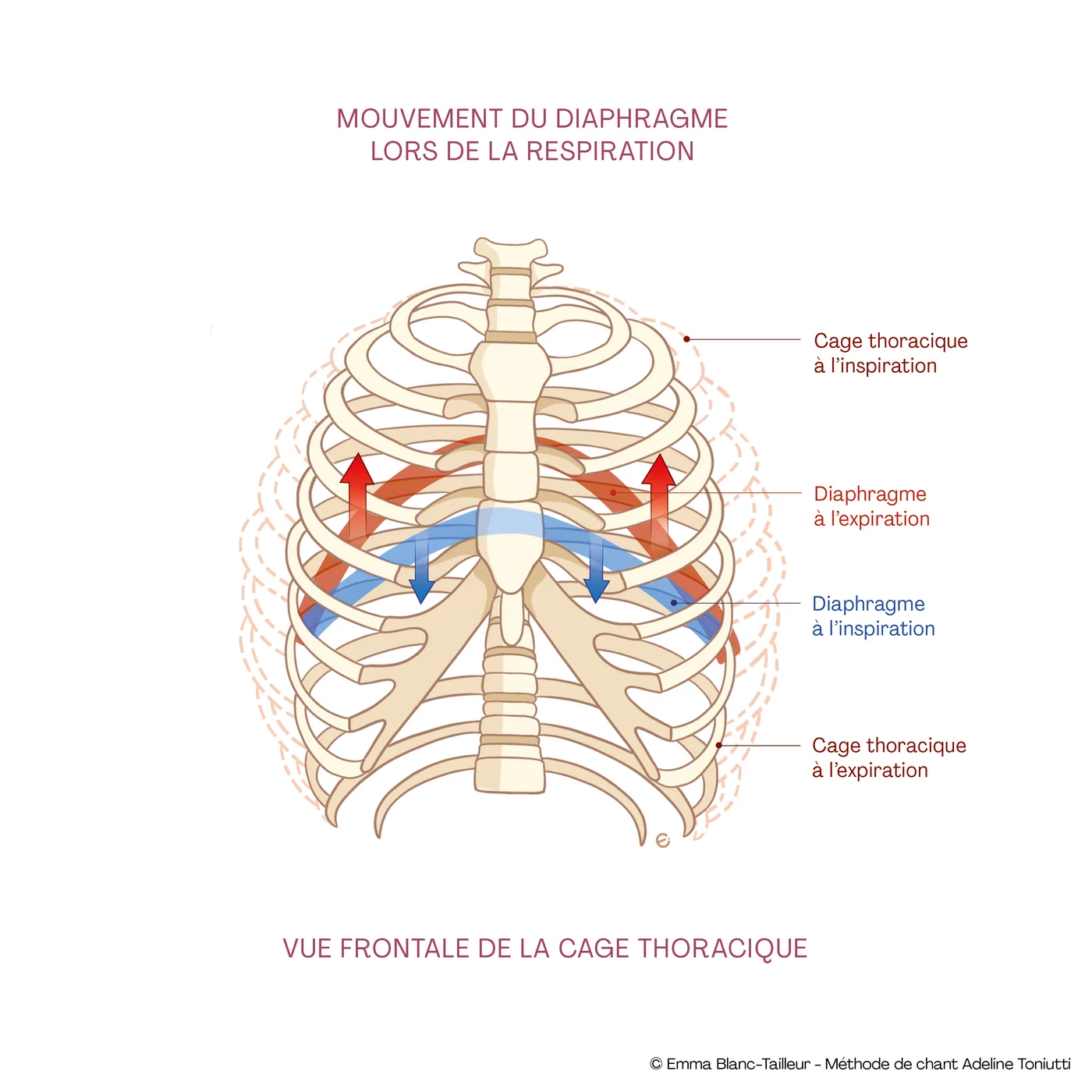
Illustration © Emma Blanc-Tailleur, Anatomie du Chant, Adeline Toniutti
Adeline Toniutti
I was told that Teresa Berganza, one of the greatest Spanish opera singers, apparently, when she had her period, was not in a state to sing. It is a rumour that supposedly goes around in Spain. There are singers for whom arrangements can be made, and others not at all. It is very hard when you are a professional singer, because we are not granted any excuse for periods.
Dr Bruno Coulombeau
It is even worse for top-level singers like the ones you mention, because they work with a Formula 1, and the differences in performance will be more obvious than in a person who does not sing or who sings at a low level.
Contraception can smooth out these variations. This point is developed on the page Pregnancy and the voice.
What opera singers say about it
A France Musique report gathered the accounts of several soloists on this subject. They match the observations made in consultation, and above all they describe what to do.
The soprano Elsa Dreisig recounts the surprise that comes back every month: “Every month I am surprised that things work less well with my voice. I forget and I wonder: but why can’t I sing? When in fact, it is just my period.” In the worst case, she feels that her vocal folds “no longer want to come together”. Her answer is technical: “The ease and the naturalness go during the period, which does not prevent singing, but adds a lot of stress because normally everything works. But there, you really have to go back over the technical gestures and warm up your voice even more.” Prepare the voice for longer, drink a lot, and give up forcing: “You have to accept losing blood and not try to make up for that loss with force, or attempt something the voice could not respond to. On those days, you sing with the present moment.”
Eva Zaïcik describes the same mechanism in a technician’s words: “Closure is difficult, the vocal folds are less supple, the high notes less round, there are holes in the voice, meaning that the harmonic spectrum is not there and the voice is not complete.”
Julie Fuchs places the difficulty in her general condition: “Everything that is more delicate becomes harder to do,” the high notes, the pianissimo, with a less agile voice and a “weaker physical state”. Her line of conduct: “Deal with it and carry on.”
The report notes one last point, useful to singing teachers. These singers talk about it first to their teachers, often the first to perceive the change from the voice alone, and far less to professionals in the field. Eva Zaïcik mentions it to young conductors and keeps quiet with older ones. Julie Fuchs rather mentions her tiredness.
KEY POINTS
Vocal discomfort linked to the cycle is physiological and varies greatly from one woman to another. Losing a third at the top is noticed immediately in a lesson. On those days, the warm-up gets longer, the technical gestures are consciously gone over again, and forcing makes the situation worse. The singing teacher must be told, and the doctor consulted if the discomfort extends beyond the period.
A MYTH
A myth to correct
A claim circulates in the singing world: the mucosa of the vagina and of the ectocervix is supposedly the same as that of the vocal folds. Both doctors correct it without ambiguity. For Dr Coulombeau, the two tissues are indeed stratified squamous epithelia, but the comparison stops there.
IN THE WORDS OF DR MARIE MAILLY
“It is false. The only thing they have in common is that they are hormone-dependent mucosae, meaning that their appearance varies according to the level of hormones circulating in the blood.”
Dr Marie Mailly · ENT, voice and botulinum toxin specialist, Paris
The exact point that this comparison distorts: the mucosa of the vocal folds does indeed belong to the mucosae sensitive to sex hormones, oestrogens, progesterone and androgens. That is what explains the variations observed over the cycle and at the menopause.
SEEKING ADVICE
When to consult, and what for
Adeline Toniutti
If we see that our voice is starting to go, we come to you and you carry out an assessment. Is that what we should advise people?
Dr Bruno Coulombeau
We carry out an assessment. In these cases I quite readily prescribe work with a speech and language therapist.
Two markers stand out. A vocal disorder that lasts more than a month justifies a laryngeal examination, whatever the age. And a vocal change that sets in after 60 deserves a precise diagnosis, because the management is not the same depending on whether it is presbyphonia, an atrophy of another origin or a loss of muscle tone.
In all cases, the medical assessment and vocal work go together. The doctor seeks to establish what has changed in the larynx. This is not always possible, in particular because there is rarely a reference examination, done before the voice changed. Technical work rebuilds what can be rebuilt, in tone, support and coordination. Dr Coulombeau’s sentence holds for the menopause, for the andropause and for presbyphonia.
“To sing, it is not enough to have vocal folds.”

The accounts of Elsa Dreisig, Eva Zaïcik and Julie Fuchs come from the France Musique report “Comment les chanteuses lyriques vivent-elles leurs règles ?” (How do opera singers live with their periods?) (radiofrance.fr). This article is intended for information and prevention. It does not replace a consultation. Any persistent vocal discomfort should lead to an examination by a phoniatrician or an ENT.
CALYP
Take stock of your voice after 50
An assessment by a voice doctor, then work on tone, support and coordination: at CALYP, the two move forward together.
GO FURTHER
The Voice Clinic Interview series
Frequently asked questions
Does the menopause lower the voice?
Often a little, without it being general. The combined drop in oestrogen and progesterone lowers the fundamental frequency, dries the mucous membranes, reduces tissue tone and elasticity, and can narrow the range in the high notes. Menopausal singers nevertheless keep a range comparable to the one they had before. On examination, the vocal folds change little.
Does hormone replacement therapy protect the voice?
It is not prescribed for the voice. It is discussed with the gynaecologist for bone-related and general reasons. Some patients describe a clear vocal improvement, others none, and no harmful effect on the voice has been reported to Dr Coulombeau. The reliable lever remains the assessment and vocal work.
Does the andropause exist for the voice?
Medically, the term is rather functional hypogonadism: testosterone drops gradually, without an abrupt halt. This drop induces muscle loss, thinning of the vocal folds, a more unstable and breathier voice, and often a loss of the low notes. Added to this is presbyphonia, which affects both sexes.
What is presbyphonia?
The physiological ageing of the larynx: a kind of atrophy without stiffness, with loss of elasticity, ossification of the cartilages and respiratory weakening. It affects 12 to 35% of people over 60 according to studies, is diagnosed mostly from the sixties onwards, and does not necessarily depend on hormones.
Can presbyphonia be improved?
Yes, by compensating: posture, respiratory muscles, calling on the vocal folds to keep them muscular. The appearance of the folds does not return to what it was, but suppleness, agility and colour come back. When that is not enough, vocal fold augmentation (fat, hydroxyapatite, hyaluronic acid, or increasingly PRP) is discussed with the doctor.
Do hormones act more on the chest voice or the head voice?
More on M1 (chest voice), answers Dr Marie Mailly, while pointing out that it is not obvious. It is the top notes in chest voice, which cost the most pressure, that become the hardest to hold with age.
Is the mucosa of the vocal folds the same as that of the vagina?
No. Both are stratified squamous epithelia and hormone-dependent mucosae, whose appearance varies according to the level of circulating hormones, but the comparison stops there.