
Voice change at puberty: what really changes in a child’s voice
VOICE CLINIC
A phase that can disrupt a young singer’s life. What two voice doctors say about it, and what we do about it at CALYP.
INTERVIEW
A phase that deserves the whole team’s attention
Adeline Toniutti talked with Dr Bruno Coulombeau, a phoniatrician in Lyon with whom she regularly works, so that he could clarify the most important questions about the voice change. Dr Marie Mailly, an ENT specialising in the voice in Paris, gives her view on the same questions.
The voice change is a phase that can disrupt a child’s life, especially when the child sings a lot. The phase is no cause for worry, but it deserves the full attention of the coaching team and of the music school the child attends.
Sometimes a child sang very well with a child’s voice, went to auditions, was a soloist. During the voice change, the child may face contradictory instructions: stop singing, choose between head voice and chest voice, wait for it to pass, or even be turned away by institutions that no longer accept children once the voice has changed, especially in the classical world.
IN THE WORDS OF DR MARIE MAILLY
“I think it is a bad thing to make him stop singing, if he enjoys singing. It is stigmatising, and above all the voice change is in no way a contraindication to singing. It is not dangerous to sing while your voice is changing. The only problem is that the young man is lost in his range.”
“I had a patient who was singing a leading role at the Opéra-Comique, and right at the start of the performances, he felt his voice beginning to change. It was a disaster for him, and his conductor handled it really well, which reassured him. I think it is an extremely difficult period for young men. We have to stop putting pressure on them. It is up to the institution to adapt.”
Dr Marie Mailly · ENT, voice and botulinum toxin specialist, Paris
THE TRAJECTORY
The path to the adult voice: one trajectory, several periods
It is hard to speak of a precise age: there are many differences between individuals. It is an extremely gradual phenomenon, running from birth to the end of the vocal fold’s development: around 18 to 20 in girls, around 25 in boys. Within this long evolution, there is a faster, more audible moment. And that is the moment everyone calls “the voice change”. It belongs to a much longer maturation, which continues well after the voice has “finished changing” to the ears of those around.
| Stage | Approximate age |
|---|---|
| Structuring of the vocal ligament | From birth to about 10-12 years |
| Faster, more audible moment | Usually between 10 and 15, varying from child to child |
| End of vocal fold development, girls | Around 18-20 |
| End of vocal fold development, boys | Around 25 |
These markers are orders of magnitude, not a calendar. Variation from one child to the next is the rule.
Dr Marie Mailly, for her part, gives the duration and age of the most audible moment, and what happens in the boy’s larynx at that time.
IN THE WORDS OF DR MARIE MAILLY
“It can last from 8 months to 3 or 4 years, but on average a year, around 12.5-13.5 years of age. In boys as in girls, the larynx grows. So girls go through the voice change too, but it is very subtle, you do not feel it.”
“In boys, under the effect of testosterone, the larynx almost doubles in volume, the vocal folds lengthen and thicken, the thyroid cartilage changes shape and the Adam’s apple appears. The range drops by about an octave.”
Dr Marie Mailly · ENT, voice and botulinum toxin specialist, Paris
Girls go through the voice change too. It is talked about much less because the change in pitch is less spectacular, but the vocal fold transforms according to the same logic. Dr Mailly places this moment “about 8 months after the first period”.
WHAT CHANGES
Four things evolve at the same time
1. The size and mass of the vocal folds. They grow and gain weight, while the larynx and its cartilages increase in volume. This growth happens under the effect of growth hormone. The story of the castrati illustrates it well: they had large vocal folds because they had had a normal secretion of growth hormone, with a very low secretion of androgens, which explains part of the characteristics of their voice.
2. The structure of the vocal fold. In children, the vocal folds are rich in water and cells. On examination, they look more globular. For this reason they are very sensitive to oedema: they swell easily. The vocal ligament, for its part, is barely distinct in very young children. It structures and differentiates progressively, especially between nine or ten and fourteen: the fold loses water and cells, and gains fibres, notably collagen fibres. During operations on fifteen or sixteen-year-olds, one still finds a poorly defined ligament, less fibrous than that of an adult man or woman.
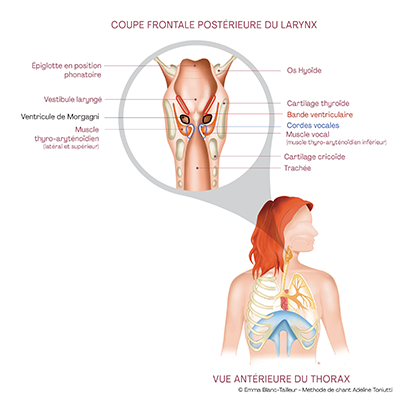
Illustration © Emma Blanc-Tailleur, Anatomie du Chant, Adeline Toniutti
3. The resonators. We think about them much less, yet they matter just as much. A boy of 1.30 m or 1.40 m becomes, a few years later, a young man of 1.80 m. The pharynx, the mouth, the larynx itself, meaning the laryngeal cavity: everything has changed in size. And in the voice, the resonator cannot be separated from the sound produced. Part of what parents hear as a change of voice does not come from the vocal folds at all. The rib cage, for its part, is not strictly speaking a resonator. That said, its changes in size play a role in breath management.
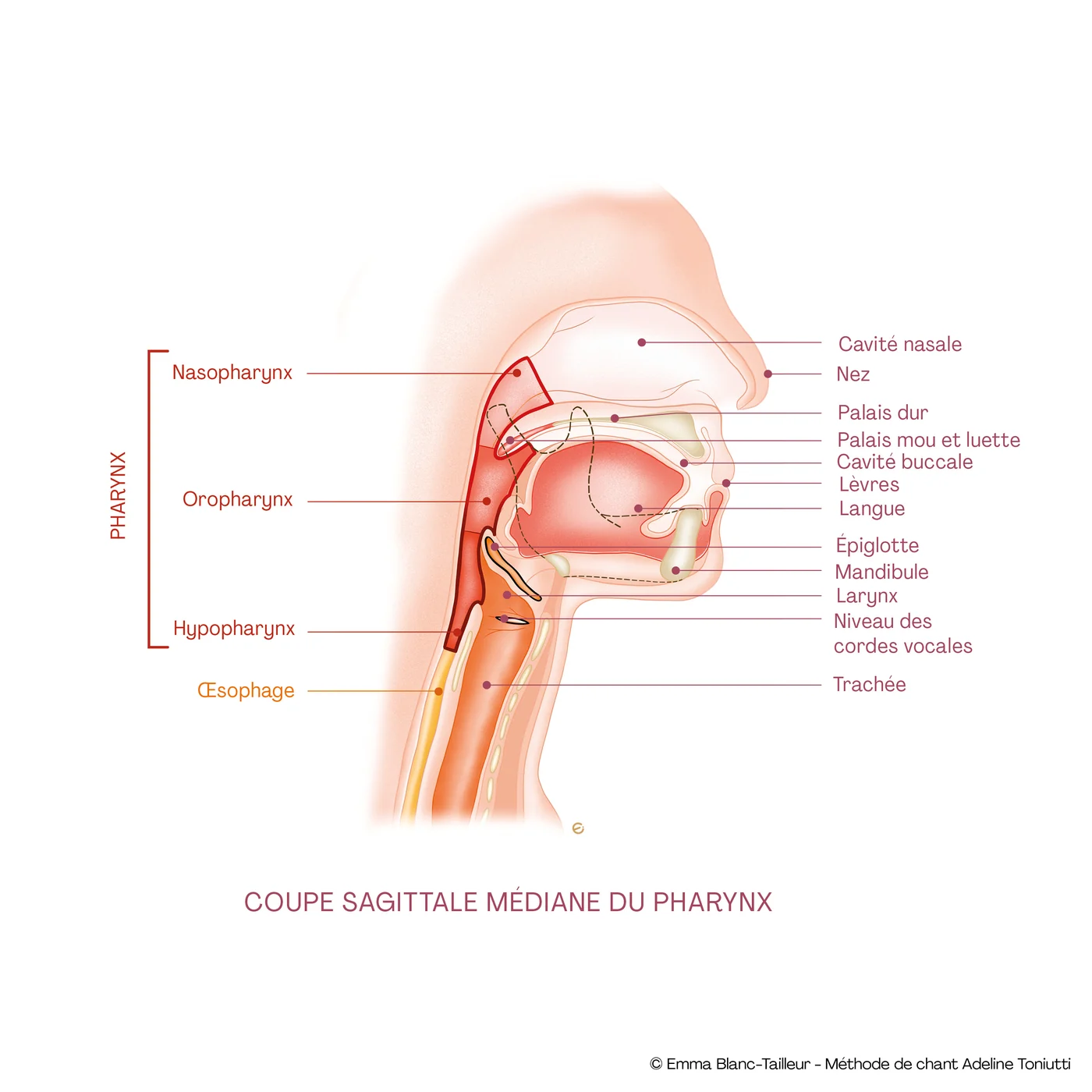
Illustration © Emma Blanc-Tailleur, Anatomie du Chant, Adeline Toniutti
4. The hormonal sensitivity of the mucosa. The vocal folds are among the mucous membranes that are receptive to sex hormones: oestrogens, progesterone and androgens. This is what makes the voice sensitive to hormonal changes, at this age as later in life. What these hormones do to the adult woman’s voice is developed in the pages Pregnancy and the voice and Menopause, andropause, presbyphonia.
THE TWO MECHANISMS
M1 (chest voice) and M2 (head voice)
M1 (chest voice) is the heavy mechanism: the folds vibrate through their whole thickness. M2 (head voice) is the light mechanism, the one used by child soloists in classical singing. In other styles, children also use M1 (chest voice).
What happens in the larynx between the two deserves to be explained with the diagrams. In M1 (chest voice), the vocal muscle, inside the fold, is active, and the fold vibrates through its whole mass. In M2 (head voice), the cricothyroid muscles engage, the thyroid cartilage tilts forward, the vocal folds lengthen and come under tension: they become thinner, and only their superficial layer vibrates. It is this tilt, and not a sound that would “rise into the head”, that produces the high notes. The page How to sing high notes details the gesture.
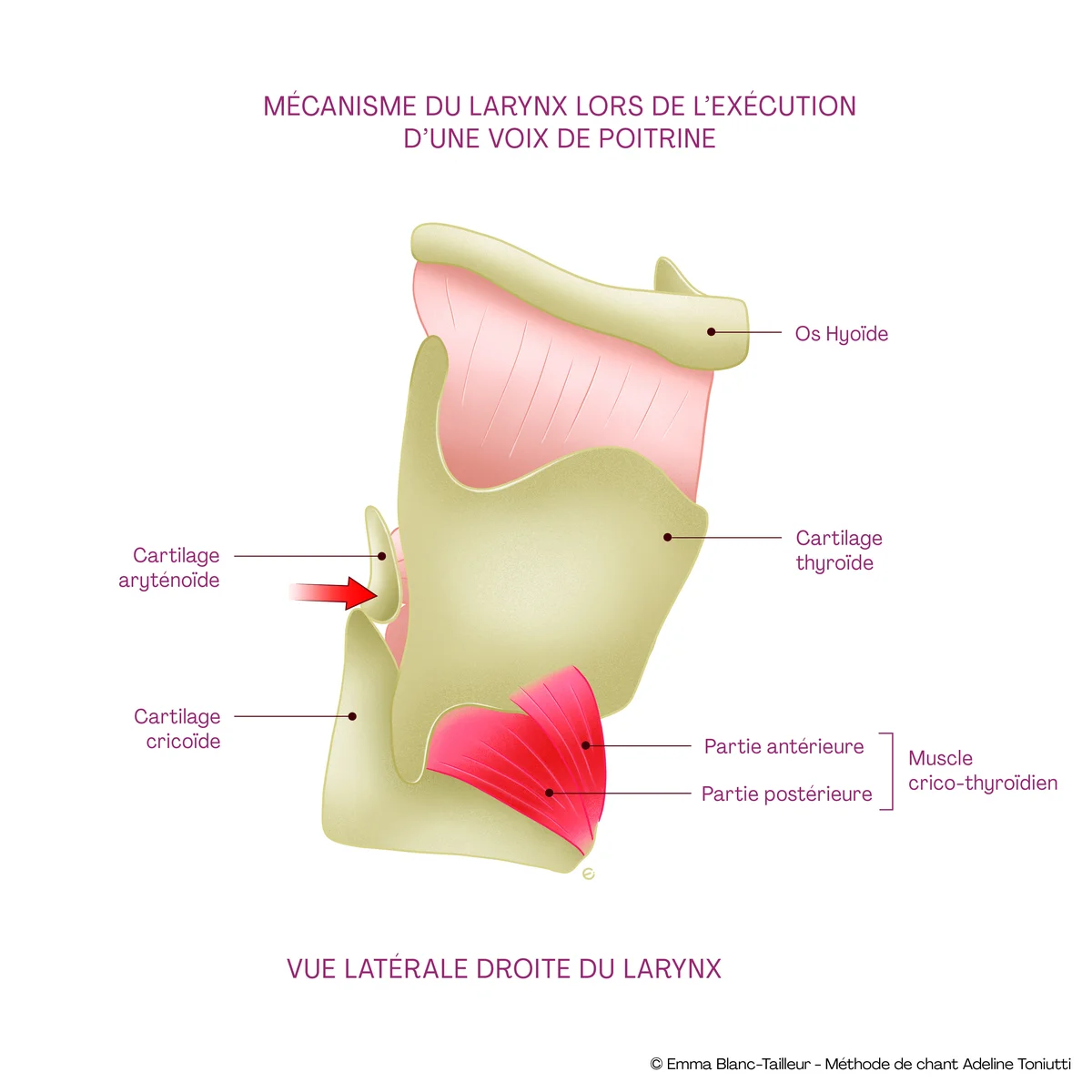
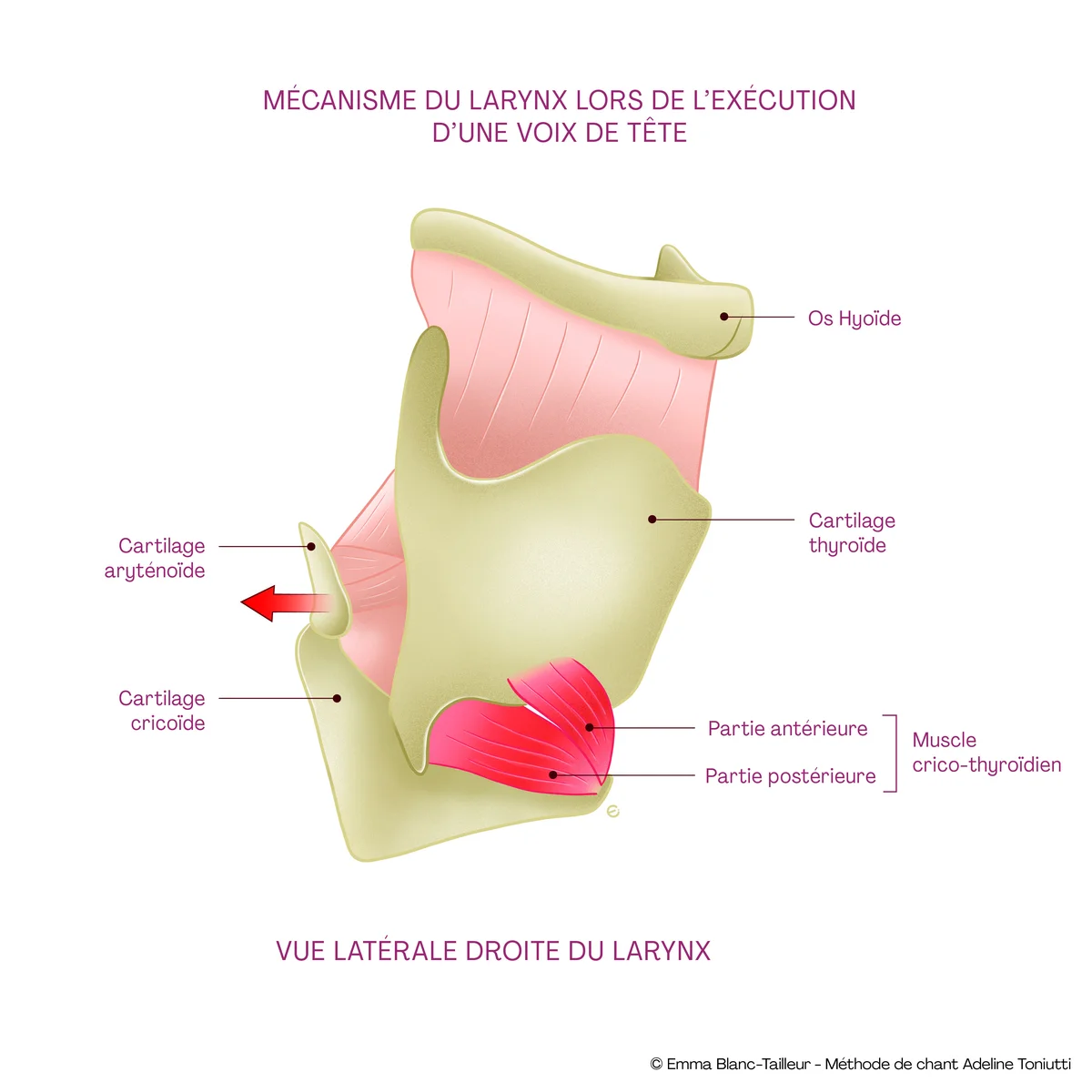
Illustrations © Emma Blanc-Tailleur, Anatomie du Chant, Adeline Toniutti
After the voice change, M2 (head voice) is still there. A boy whose voice has changed can perfectly well sing in head voice. But these are no longer the same vocal folds, and no longer the same resonators.
“You cannot keep the same M2 (head voice) before and after the voice change.”
In the same movement, M1 (chest voice) gains mass and body. It is often the moment when we discover, in a fourteen-year-old boy, a magnificent M1 (chest voice) that he will be able to use.
The example of great adult voices shows it well: a coloratura soprano has the same very high notes as a child in a choir school, and yet we do not hear a child’s voice, because she has an adult larynx and adult resonators. This is also why we cannot expect from a child’s voice the breadth and richness of timbre of an adult voice.
THE QUESTION EVERYONE ASKS
Should you stop singing during the voice change?
On this point, the two doctors agree, with two shades of tone. Dr Coulombeau wants to stay open: it is not imperative to stop singing, the work must be done with flexibility. And if some children want to take a break, why force them?
“It is not imperative to stop singing. Perhaps some children will want to: why force them?”
Dr Mailly is more categorical about what the current consensus says.
IN THE WORDS OF DR MARIE MAILLY
“Never stop singing. The current consensus is clearly to keep singing throughout the voice change, but adapting the range downwards as it descends, rather than keeping him artificially in the high register. The old practice of the 19th and 20th centuries, which consisted of keeping boys as sopranos throughout puberty, is now discouraged.”
“More and more choir schools and conservatoires are creating special groups for boys whose voices are changing. They sing among themselves, and I think that is very good.”
Dr Marie Mailly · ENT, voice and botulinum toxin specialist, Paris
Should one choose between head voice and chest voice, as is sometimes said in certain programmes? No, not that either. Working both mechanisms in the same lesson is good practice.

Adeline Toniutti
I am convinced that with a boy, if his M1 (chest voice) is starting to arrive, we do both in the same lesson, and that way we keep a balanced larynx.

Dr Bruno Coulombeau
Of course. Since a different M2 (head voice) is settling in, we might as well work both.
One can understand where the instruction to choose comes from. The underlying idea is that a student specialised in M2 (head voice) would risk, by working his M1 (chest voice), losing the habits that make the quality of his M2 (head voice). It is precisely working both mechanisms that allows this radical transition, where what is true at one moment may no longer be so three months later, to be crossed more gently.
It is also important to reassure about what comes next. M2 (head voice) does not disappear. With regular work and no bad habits, it can develop beautifully.
DR MARIE MAILLY’S ADVICE
Five reference points for supporting a boy whose voice is changing.
- “Adapt the repertoire to the current range, not the other way round: follow the boy’s usual speaking range and slide the sung repertoire downwards in parallel.”
- “Avoid forcing in the transition zone: during the voice change, the boy often has two distinct functional registers, the old prepubertal high register and the new emerging low register, with no reliable bridge between the two. Forcing phonation in this transition zone risks inducing laryngeal tension and compensatory hyperfunction.”
- “Inform and normalise: explaining clearly to the boy what is happening physiologically reduces anxiety, lowers the risk of compensatory habits, and increases the likelihood that he will keep singing during this period rather than giving up out of embarrassment.”
- “Vocal training does not break the developing larynx: guided vocal training adapted to the range, breathing exercises, work on the onset of the sound, remains beneficial throughout puberty.”
- “Watch out for puberphonia, the incomplete voice change: the most significant complication to monitor is the persistence of a high, falsetto-type voice after the laryngeal transformations are complete, through psychological reluctance to accept the new low voice, lack of awareness that the new low register exists, or compensatory tensions established during the transition. It is functional rather than structural: the larynx is anatomically capable of the low range, so recovery is generally quick once this new register is established and familiar.”
PRECAUTIONS
The real precautions
The risk, during this period, does not come from singing. It comes from what is asked of an instrument that is not finished.
- Pressure and adult repertoire. One could no doubt ask a fifteen-year-old boy whose voice has just changed what one asks of a thirty-year-old tenor. But then one risks causing lesions on a larynx that is not mature. Singing and forcing are not the same thing.
- Chest voice in children before the voice change. This is the point on which the phoniatrician is most clear-cut. Making vocal folds that are still rich in water and very prone to swelling sing in M1 (chest voice), with a lot of pressure, is taking a risk. This applies to boys as much as to little girls. Such a technique can only be considered when carried out by the book, which is rarely the case when the child imitates it alone, from what he hears and sees on screen.
- Accumulation. A young choir-school soloist who already goes up into the high register every day and who adds a lot of chest voice outside lessons piles two heavy demands on the same instrument. A gentler pop style is a perfectly legitimate alternative while the voice matures.
- The stage and competitions. Singing at the opera or in a choir school has never been a problem in itself. The vigilance concerns formats where a lot is asked of children, quickly, and often in M1 (chest voice).
WHEN TO CONSULT
When should you see a phoniatrician?
On this point, Dr Coulombeau gives three reference points.
If the voice deteriorates, yes, without hesitation. A voice that breaks, runs out of breath, or loses its range should lead to a consultation.
Systematically for all children? No, that would make no sense if the situation is calm. But if a teacher hears a problem, or if the child feels that something is wrong, then a consultation is logical.
On the other hand, for children who are potentially over-solicited, yes. A child engaged in a demanding repertoire, on stage, in competitions, or who uses chest voice a lot from a very young age, benefits from a regular examination and close technical follow-up.
One caveat deserves to be shared with families: some children do not want to consult for fear of being ordered to stop singing. Yet that is exactly the opposite of the message. One consults in order to keep singing in good conditions.

THE CHILD
The subject we do not talk about enough: the child
Audition criteria are not the same from one house to another. Some look for voices that have not yet changed and can hold the alto line. Others gladly welcome a boy whose voice has changed and whose M1 (chest voice) is settling in. A child turned down on one side and taken on the other has not failed at anything: he simply has a voice that, at that moment, matches one set of requirements and not the other.
It is thankless, and parents need to be told. The public loves children’s voices. A young soloist can be adored for a crystalline timbre, then find himself without an audience at the very moment his instrument is transforming. Some cannot bear it and stop singing, not because the voice is damaged, but because they are no longer admired as before.
“They must be given the time to become interesting again.”
An adult voice, in classical singing as elsewhere, takes years to become one. Marie-France Arakélian, vocal coach at the Marseille Conservatoire and the Marseille Opera, tells us that in her day, people said: “It takes ten years to build a classical voice.”
“It takes ten years to build a classical voice.”
And what was learned in childhood is not lost: former choir-school soloists later become excellent musicians, choir directors, conductors, or accomplished adult singers.
IN SHORT
Key points
- The voice change is a long process, completed around 18-20 in girls and 25 in boys, with a moment of faster, more audible changes in the middle: from 8 months to 3 or 4 years, one year on average, around 12.5-13.5 years of age.
- It is not only the vocal folds that change: the larynx grows, almost doubling in volume in boys, and the resonators change in size.
- Before puberty, the vocal folds are rich in water and swell easily. That is the physiological reason for caution.
- One does not stop singing on principle. One works M1 (chest voice) and M2 (head voice), with flexibility, sliding the repertoire downwards as the voice descends.
- One does not ask of a child’s larynx what one asks of an adult larynx.
- One consults if the voice deteriorates, and regularly when the child is under heavy demand.
CALYP
Supporting a young singer through the voice change
At CALYP, children and teenagers work M1 (chest voice) and M2 (head voice) in the same lesson, with medical follow-up when the voice is under heavy demand.
GO FURTHER
The Voice Clinic Interview series
Frequently asked questions
How long does the voice change last?
The most audible moment lasts from 8 months to 3 or 4 years, one year on average, and generally begins around 12.5-13.5 years of age, according to Dr Marie Mailly. The complete development of the vocal fold is much longer: it ends around 18-20 in girls and around 25 in boys, according to Dr Bruno Coulombeau.
Do girls go through the voice change too?
Yes. The larynx grows in girls as in boys, but the change is subtle and barely audible. It occurs about eight months after the first period.
Should you stop singing during the voice change?
No. The voice change is not a contraindication to singing, and it is not dangerous to sing while the voice is changing. The current consensus is to keep singing while adapting the range downwards as it descends, without forcing in the transition zone. It is not imperative to stop, and a child who wishes to take a break should not be forced to carry on.
Can a boy whose voice has changed still sing in head voice?
Yes. M2 (head voice) does not disappear after the voice change, but it is no longer the same: the vocal folds and the resonators have changed. With regular work on both mechanisms, it develops beautifully.
What is puberphonia?
It is the incomplete voice change, or mutational falsetto: the persistence of a high, falsetto-type voice after the larynx has finished transforming, through reluctance to accept the new low voice or through compensatory tensions. The larynx is capable of the low range, so recovery is generally quick once the new register is established.
When should a child whose voice is changing see a phoniatrician?
If the voice deteriorates: it breaks, runs out of breath or loses its range. Not systematically if all is calm. On the other hand, a child under heavy demand on stage, in competitions or in chest voice benefits from regular follow-up.