
Feminising or masculinising your voice: what physiology says, what vocal technique does
VOICE CLINIC
Does the femininity or masculinity of a voice come from the vocal folds, or from a way of speaking? An ENT answers, and the vocal coach draws a method from it.
INTERVIEW
Two requests that keep coming back to the studio
Two requests come up regularly, in the studio as in consultation: a man who would like a more feminine voice, a woman who would like a more masculine voice. They sometimes arrive as part of a transition, sometimes for a reason of stage, of character, of profession, sometimes simply because the speaking voice bothers the person who carries it. The possible answers fall into two families: what belongs to a doctor, and what can be worked on with a vocal technique teacher.
Adeline Toniutti put the fundamental question to Dr Marie Mailly, an ENT specialising in the voice in Paris: does the femininity or masculinity of a voice come from the vocal folds, or from a way of speaking? And do the resonators have anything to do with it? From her answers follows a working method, which along the way puts back in their place three words we use without always defining them: M1 (chest voice), M2 (head voice), resonators.
The medical and surgical procedures of gender transition belong to specialised ENT and phoniatric teams, who receive these requests regularly.
THE PHYSIOLOGY
A smaller larynx, and a way of speaking
Dr Mailly’s answer comes in two parts, and both count.
IN THE WORDS OF DR MARIE MAILLY
“It is a physiological fact: women have a higher voice because their larynx and their vocal folds are smaller than those of men. As with all instruments, the smaller it is, the higher it sounds.”
“Besides, at an equivalent frequency, there is clearly a prosody, a musicality, that makes a voice sound more feminine than masculine.”
Dr Marie Mailly · ENT, voice and botulinum toxin specialist, Paris
The first part is that of the instrument. The difference in size is set at puberty: under the effect of testosterone, the boy’s larynx almost doubles in volume, the vocal folds lengthen and thicken, the thyroid cartilage changes shape and the Adam’s apple appears. The range drops by about an octave. In girls, the larynx grows too, but far more discreetly. All of this is detailed on the page Voice change at puberty.
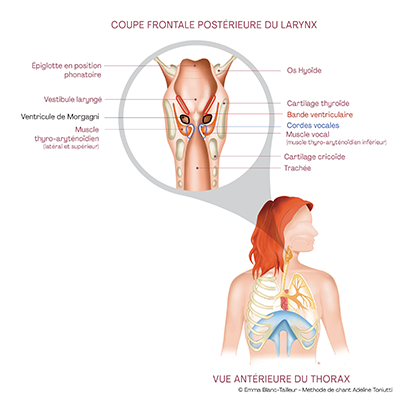
Illustration © Emma Blanc-Tailleur, Anatomie du Chant, Adeline Toniutti
The second part is that of behaviour. Two people who speak on exactly the same note are not heard in the same way. Pitch is only one parameter among several: the rhythm, the way of chanting, the way of leaning on certain vowels, the placement of the onsets, the shape of the melodic line of the spoken sentence. This is what Dr Mailly calls prosody, and it is the part that can be worked on.
KEY IDEA
The average pitch of a voice comes from the size of the larynx, set at puberty. The feminine or masculine character of a voice, at equal pitch, comes from prosody. The first level belongs to biology and, possibly, to the doctor. The second can be worked on.
THE RESONATORS
The resonators: what body size decides, and what it does not
The resonators are the cavities located above the vocal folds: the larynx itself, the pharynx, the oral cavity, the nasal cavities, the whole of the vocal tract. The vocal folds produce a sound; the resonators filter it, amplify some of its components and attenuate others. They are what gives the timbre its breadth, its richness, its colour.
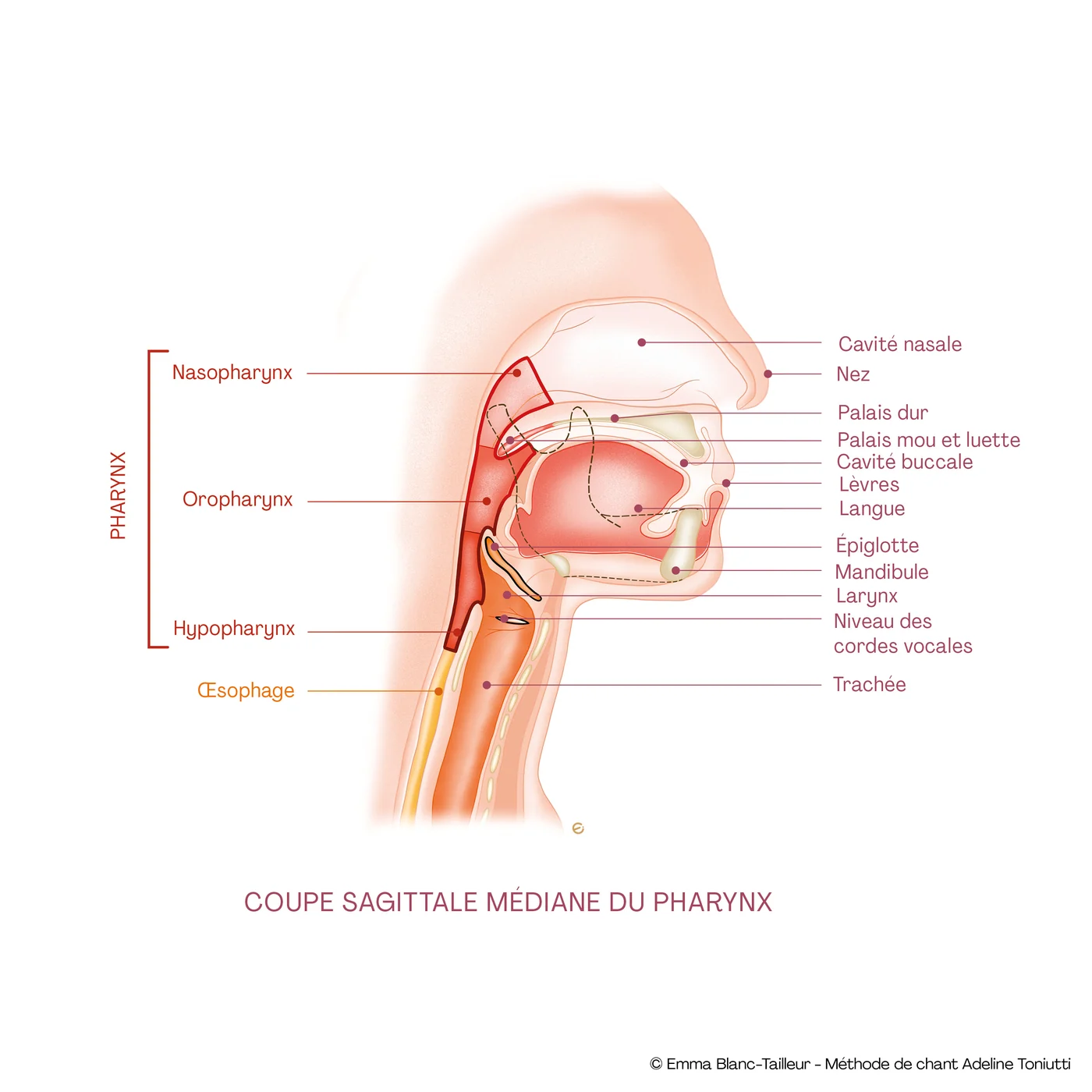
Illustration © Emma Blanc-Tailleur, Anatomie du Chant, Adeline Toniutti
Adeline Toniutti had her own opinion on the matter, and asked Dr Mailly for hers: is a man’s resonator ultimately different from a woman’s?
IN THE WORDS OF DR MARIE MAILLY
“In the end, male and female resonators look fairly alike. So I think the resonators have little influence on the masculine or feminine side of a voice.”
Dr Marie Mailly · ENT, voice and botulinum toxin specialist, Paris
It is a precious answer for anyone who wants to shift the gender of their voice, because it shows where not to look. The resonators decide the timbre, its breadth and its richness, and their volume remains that of the body: you do not get the crystal clarity of a child’s voice on an adult vocal tract, and you do not make the breadth of an adult voice with a child’s tract. But they are not what makes a voice heard as feminine or masculine. The lever is elsewhere: in the average pitch, to some extent, and above all in prosody.
KEY IDEA
The vocal folds allow the note. The resonators decide the timbre. Neither is enough to state the gender of a voice. Serious work begins by knowing which of the three levels you are trying to shift.
THE TWO MECHANISMS
M1 (chest voice), M2 (head voice): two mechanisms, available to everyone
The two terms come up constantly as soon as vocal gender is discussed, and they deserve to be set out.
Mechanism 1, or M1 (chest voice), is the so-called heavy mechanism. The vocal folds vibrate through their full thickness, with mass in play. It is the mechanism of everyday speech, in men as in women.
Mechanism 2, or M2 (head voice), is the light mechanism. The cricothyroid muscles tilt the thyroid cartilage, the vocal folds lengthen and tighten, and the vibration only engages a thinner portion of the folds. The sound is finer and carries higher.
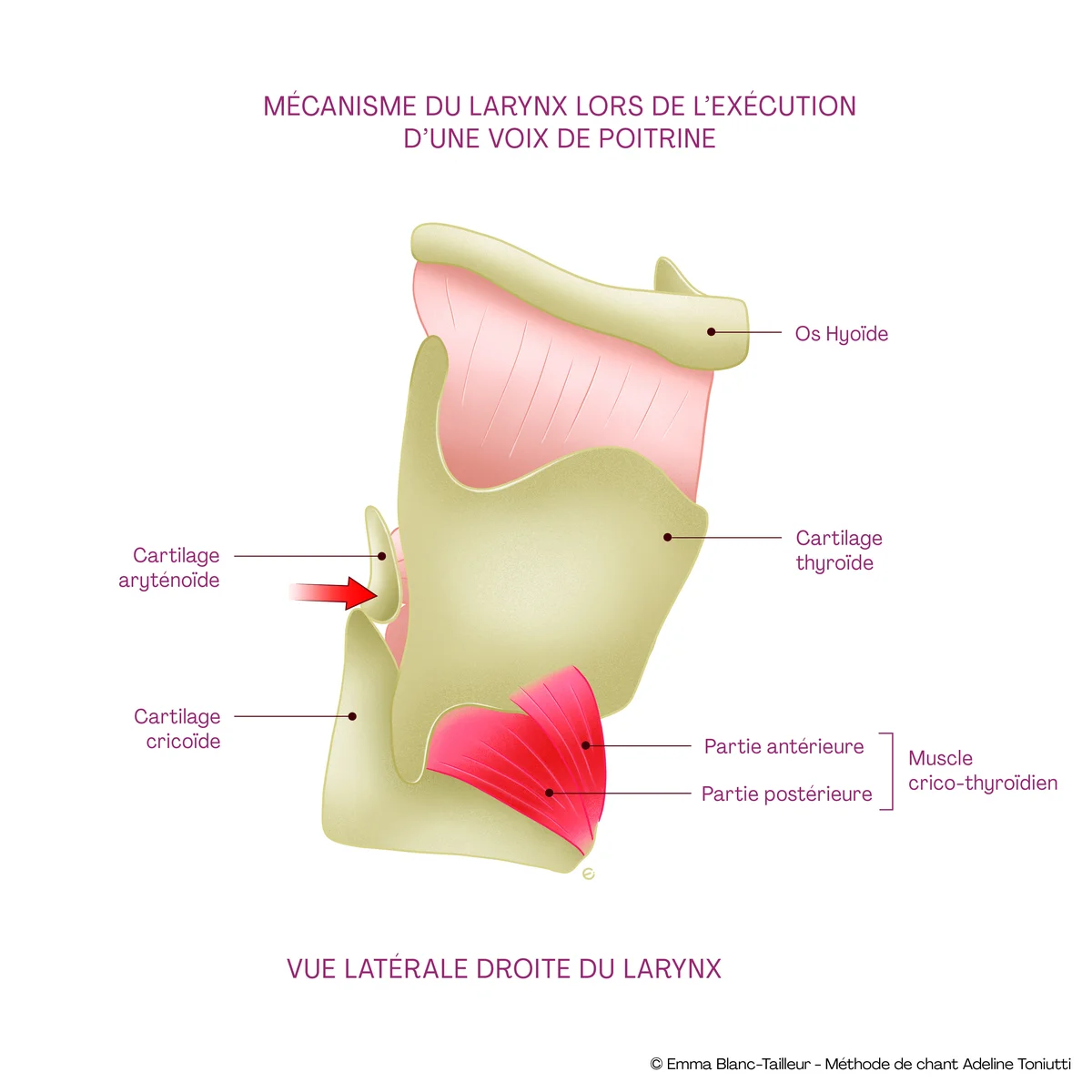
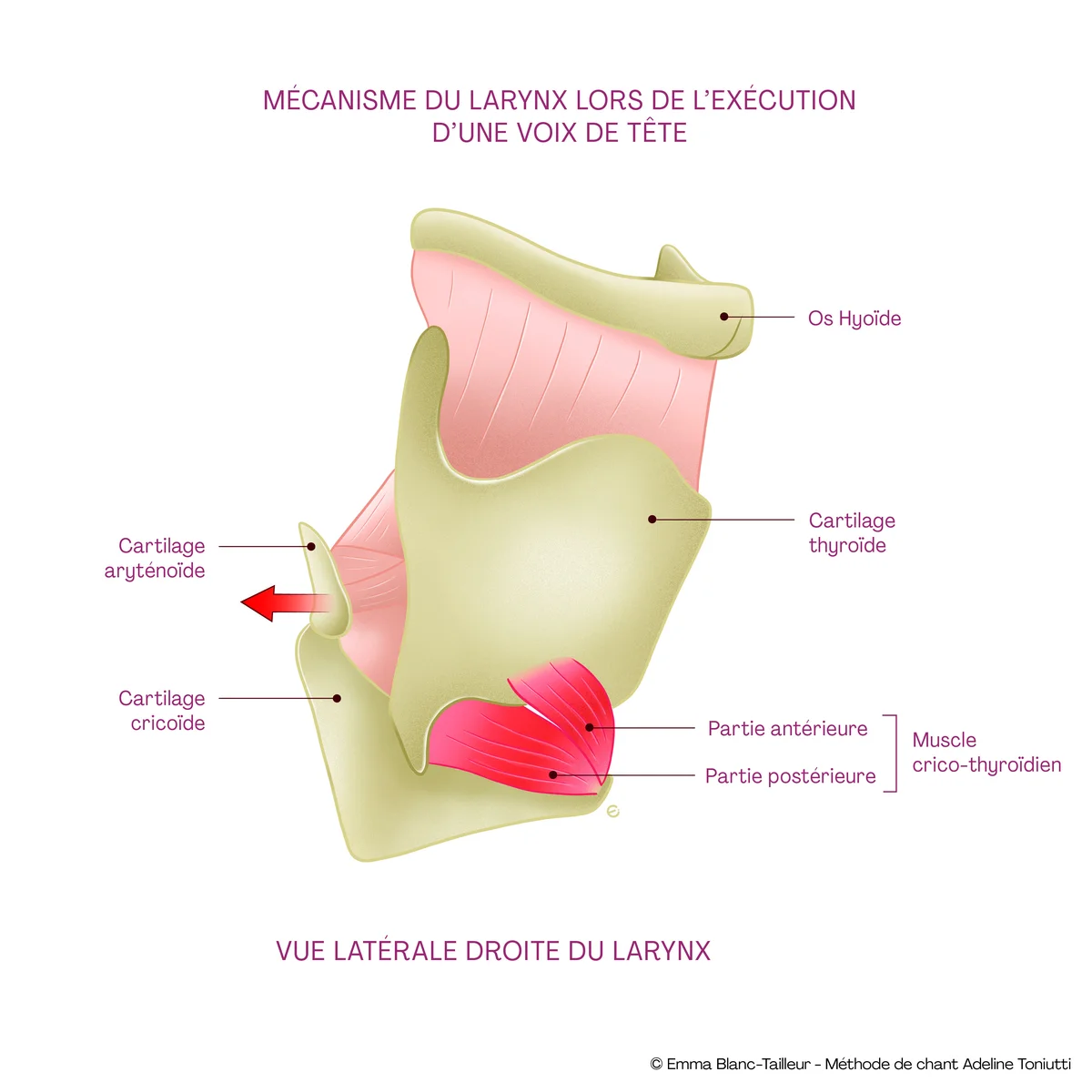
Illustrations © Emma Blanc-Tailleur, Anatomie du Chant, Adeline Toniutti
These two mechanisms are not distributed by sex. Everyone has both. What changes from one person to the next is the zone where each is comfortable, the quality of each, and the place where one passes to the other. The page Vocal registers describes them in detail.
A widespread idea holds that a man seeking a more feminine voice must speak in head voice. It is a false trail, and a tiring one: a speaking voice held in M2 (head voice) all day long wears out and sounds artificial. What works is a moderate rise in speaking pitch, which stays in M1 (chest voice), combined with a feminine prosody. In the other direction, a woman seeking a lower voice does not have to crush her larynx downwards: she lowers the pitch moderately, keeps M1 (chest voice) free, and adopts a masculine prosody.

Adeline Toniutti
Technically speaking, I can teach them to speak more in M1 (chest voice) or in M2 (head voice). But you don’t choose one mechanism against the other: you keep both in every session, and that way you keep a balanced larynx.
This rule applies to everyone, a teenager in the middle of voice change or an adult seeking to shift their voice. A mechanism that is abandoned deteriorates, and the larynx loses its balance.
KEY IDEA
M1 (chest voice) and M2 (head voice) exist in everyone. You do not choose between the two, you maintain both, in the same session. And you do not speak in head voice to seem more feminine.
PROSODY
Prosody: the part that can be worked on
This is the most practical point, and the most counter-intuitive for anyone who thinks everything rests on pitch. Dr Mailly says it in one sentence: at an equivalent frequency, there is a prosody, a musicality, that makes a voice sound more feminine than masculine. So the markers have to be identified, before they are produced.
Adeline Toniutti has been working on these markers for a long time, in a completely different context: pop.
Adeline Toniutti
When I tell people: be more of a guy in your prosody, or be more feminine, there are kinds of idioms that go with what we’d call feminine and what we’d call masculine. Anyone can play with them.
“There are idioms that belong to what is feminine and to what is masculine. Anyone can play with them.”
She adds that these idioms are not only gendered. They are also social and geographical. There is a more urban way of singing French, a Québécois way, a Franco-American way, a retro way, and each carries with it its rhythm, its accents and its vowels. She described them in The ways of singing French. A singer who knows how to move from one idiom to another has already learnt the gesture asked of someone who wants to shift the gender of their voice: identify markers, isolate them, install them.
One last parameter, a technical one this time: the amount of air. Adeline Toniutti points out that speaking with a lower voice requires putting in a little more air. It is a setting that can be worked on and that must be watched, because a voice that is pushed down by force tires quickly.
The fundamental question remains. Is the voice a marker of gender? In the great majority of cases, yes: we rarely hesitate when hearing someone sing. This classification rests both on material, the mass and length of the vocal folds, and on behaviour, the chosen pitch and the prosody. The first level belongs to biology. The second can be worked on.
KEY IDEA
The part of the voice that states gender and that can really be worked on is prosody: the rhythm, the accents, the vowels, the line of the sentence. It can be learnt, and it can be watched, like any vocal technique.
IN THE STUDIO
What this looks like in the studio
The work is built on four axes, which follow directly from what precedes.
Listening and identification. Before producing anything, you learn to hear what marks the feminine and the masculine in a given voice: average pitch, range of pitch variation within the sentence, rhythm, accents, treatment of vowels, onsets. You work on recordings, including the person’s own, until the markers become audible at will.
Speaking pitch. The average pitch of the speaking voice is shifted, moderately, and installed so that it holds all day long without fatigue. A voice lowered by pressing on the larynx or raised by squeezing does not hold beyond a few hours, and does damage.
The two mechanisms. M1 (chest voice) and M2 (head voice) are both maintained, in the same session. That is true for a teenager in the middle of voice change, and true for an adult seeking to shift their voice.
The resonators. You work on the settings of the vocal tract, the position of the larynx, the opening, the placement, knowing what they can give and where the limit of body size lies. That is where a realistic goal is set, and where you avoid chasing a timbre the body will not produce.

THE DOCTOR
What belongs to the doctor
This work is that of a vocal technique teacher. It works alongside medical follow-up and does not replace it. The division is simple.
- A voice that changes on its own, a voice that breaks, a dysphonia that lasts more than a month, breathing discomfort: these are reasons for a laryngeal examination by a phoniatrician or an ENT, without waiting.
- On the hormonal route, one point has long been known: androgens lower the pitch of the voice, predictably and durably. The reverse movement, durably raising a voice through hormones, has no reliable equivalent. This point is developed on the page Menopause, andropause, presbyphonia.
- Surgical procedures exist, in one direction as in the other. They are performed by identified ENT teams, experienced in these requests, and the science continues to evolve on this subject. The result is never guaranteed in advance, and it varies from one person to another.
- A plan to durably modify the voice, as part of a transition or not: assessment first with a specialised practitioner, who will say what the larynx allows, and technical work afterwards, with a teacher who knows what they are doing.
KEY IDEA
Before any plan to modify the voice, an assessment with a phoniatrician or an ENT experienced in these requests. It is the examination that says what the larynx allows, not the goal you have set yourself.
Dr Marie Mailly’s answers do not constitute personalised medical advice. For any question about your voice, consult a phoniatrician or an ENT.
CALYP
Shift your voice, without damaging it
Listening, speaking pitch, two mechanisms, resonators: at CALYP, work on the gender of a voice follows the same method as any vocal technique, in liaison with the doctor.
GO FURTHER
The Voice Clinic Interview series
Frequently asked questions
Where does the difference between a man’s voice and a woman’s voice come from?
First from a physiological fact: women’s larynx and vocal folds are smaller, and the smaller it is, the higher it sounds. Then, at equivalent pitch, from a prosody, a musicality of the sentence, that makes a voice heard as more feminine or more masculine.
Do the resonators make a voice feminine or masculine?
Little. According to Dr Marie Mailly, male and female resonators look very much alike and have little influence on the masculine or feminine side of a voice. They decide the timbre, not the perceived gender.
Do you have to speak in head voice to feminise your voice?
No. A speaking voice held in M2 (head voice) tires and sounds artificial. You raise the speaking pitch moderately while staying in M1 (chest voice), and you work on prosody: rhythm, accents, vowels, line of the sentence.
Can a voice be made lower with hormones?
Androgens lower the pitch of the voice predictably and durably. The reverse movement has no reliable equivalent. Any decision of this kind belongs to a doctor, after an assessment of the larynx.
Can surgery change the gender of a voice?
Procedures exist, performed by specialised ENT teams. The result is not guaranteed and varies from one person to another. The first step is always an assessment with a phoniatrician or an ENT experienced in these requests, who says what the larynx allows.