
Botulinum toxin, spasmodic dysphonia, dystonias
VOICE CLINIC
Everyone has heard of it. Who this treatment is really for, why, and how the injection is done.
INTERVIEW
The famous toxin
Everyone has heard of the famous botulinum toxin as a possible treatment for certain vocal disorders. Adeline Toniutti asked Dr Bruno Coulombeau, phoniatrician in Lyon, to clarify who this treatment is for, why, and how. Dr Marie Mailly, who performs these injections in Paris, explains the procedure itself: how it goes, how often it is repeated, and what curare is for during vocal fold surgery.
What is this molecule? What does it paralyse? In which situations is it indicated? What happens during the months after an injection, and what does vocal work add, or not add?
A useful clarification before we get into the subject. The toxin belongs to a specific chapter of vocal pathology, that of dystonias, and in particular spasmodic dysphonia. This chapter has almost nothing to do with augmentation injections, which are also performed in the vocal folds and are often confused with it.
AUGMENTATION OR TOXIN
“Botulinum toxin, is that it?”
The conversation begins with presbyphonia, the age-related evolution of the vocal folds, covered on the page Menopause, andropause, presbyphonia. Adeline Toniutti asks whether, in some cases, something is injected into the vocal folds.
Dr Bruno Coulombeau
Yes. In some cases, we even do injections into the vocal folds.

Adeline Toniutti
Botulinum toxin, is that it?
Dr Bruno Coulombeau
No, certainly not botulinum toxin. You have to inject a substance that will, in a way, give mass back to the vocal fold.
The principle of these augmentation injections is the exact opposite of that of the toxin. The aim is to fill the vocal fold in depth, to try to give it back the mass it has lost, with the most supple product possible: fat, hydroxyapatite or hyaluronic acid, whose uses are detailed on the presbyphonia page.
IN THE WORDS OF DR MARIE MAILLY
“Since this drug relaxes the vocal folds, it is rarely used for other indications, because most of the time we are looking for the opposite: to bulk them up, or to make a glottic gap disappear.”
Dr Marie Mailly · ENT, voice and botulinum toxin specialist, Paris
KEY IDEA
An injection into a vocal fold is not necessarily an injection of toxin. Augmentation and toxin answer opposite problems, and it is the phoniatrician’s examination that decides between one and the other.
THE MOLECULE
What the toxin does, and on what
Botulinum toxin is a poison secreted by a bacterium, Clostridium botulinum. It causes a disease called botulism: the bacterium grows and produces a toxin, which causes paralysis first of the cranial nerves, and can then “descend” to other muscle groups, in particular respiratory muscles, and this paralysis can lead to death. It is not a disease of the past: Dr Coulombeau points out that there are still around fifty cases a year in France, some of them fatal. Intensive care and specific serum therapies now make it possible to treat it.
The molecule is now synthesised industrially, and used to paralyse certain muscles that malfunction, in particular those that show signs of dystonia, that is, abnormalities of muscle tone.
IN THE WORDS OF DR MARIE MAILLY
“It is a drug that has been widely used since the 1980s. Originally, it is a powerful poison that kills by paralysing the muscles. But injected in small quantities directly into the muscles we want to relax, it is a great treatment for lots of diseases, in particular diseases where there are abnormal muscle contractions, the dystonias, or bruxism.”
“Forty years ago, it was noticed that, injected into glands, it dries them out, so it is used for example for drooling, and it is also a painkiller, extremely effective for post-operative pain and migraines. I use it for all these indications.”
Dr Marie Mailly · ENT, voice and botulinum toxin specialist, Paris
Adeline Toniutti
Does the toxin act on the muscle or on the nerve?
Dr Bruno Coulombeau
On the muscle. It acts mainly on the neuromuscular junction. It blocks conduction between the nerve and the muscle. This ends up paralysing the muscle, by blocking the transmission of the nerve impulse to the muscle.
This mechanism explains Dr Coulombeau’s clearest warning. Asked about the use of the toxin in the vocal folds, Dr Coulombeau cautions: “You must absolutely not put that into someone who has a dysphonia of any other origin than a dystonia. By paralysing their vocal muscle, you will get a disastrous effect, and they will not thank you.”
Faced with a hoarse, tired voice that no longer holds the ends of sentences, the toxin would paralyse a vocal muscle that is working. So the process begins with an examination.
“It acts mainly on the neuromuscular junction. It blocks conduction between the nerve and the muscle. This ends up paralysing the muscle.”
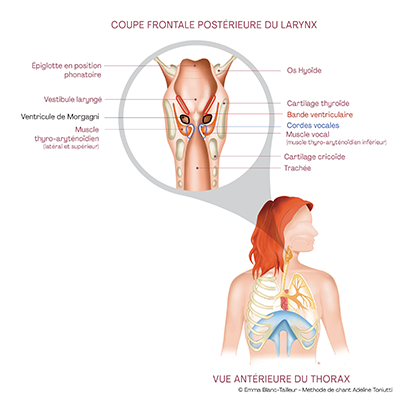
Illustration © Emma Blanc-Tailleur, Anatomie du Chant, Adeline Toniutti
KEY IDEA
Botulinum toxin paralyses the muscle into which it is injected. It is meant for dystonias, and a voice that is simply tired or hoarse does not fall under it.
THE DYSTONIAS
The dystonias, the family spasmodic dysphonia belongs to
Before getting to spasmodic dysphonia, a detour via the vocal instabilities seen with age, because they give a very telling picture of the mechanism.
Dr Coulombeau takes the example of the arm. You hold your arm out horizontally, normally it holds. From time to time, there is a drop in tone, the arm falls a little, you catch it very quickly, and that makes an oscillation, an instability. The same thing can happen in the diaphragm, the muscles of the abdominal wall or the larynx, and produce an instability of the voice. It is recognised in singers whose speaking voice is almost normal and who, as soon as they sing, can no longer maintain a stable tone. It is also recognised in the vibrato that has become very wide in some seventy-five-year-olds who sing in choirs.
The dystonias proper form a wider family. Some people have their head turned to one side because the muscles contract unilaterally, and they cannot straighten it. This can occur in any muscle of the body.
In musicians, we speak of task-specific dystonias. Dr Coulombeau has seen them in violinists, guitarists and pianists, which does not mean that other instruments are spared. A hand can work perfectly in everyday life, and become incapable, as soon as the person is at the piano, of playing passages they used to play without difficulty. He cites the case of a pianist of a good standard forced to stop between the ages of twenty-five and thirty, her fingers no longer responding, while her hands worked normally in every standard activity.
Adeline Toniutti
And does that get corrected with rest or not?
Dr Bruno Coulombeau
No, unfortunately, we do not know how to correct it. We have people do speech therapy when it is for the voice, physiotherapy work, to try to get them to relearn the movement from the ground up and find other command circuits.
Stuttering belongs to this family, in a slightly particular form. Rehabilitation helps, but every person who stutters says they are never cured, that they keep this unwanted muscle contraction ready to show up at any moment, even when others no longer hear it because they manage to control it.
On the origin, Dr Coulombeau is cautious. It is very probably neurological, and nobody knows which. A neurologist he worked with hypothesised that there are different circuits in the brain for the speaking voice and for the singing voice, and that some command circuits sometimes stop working in a consistent way. Functional MRI may provide explanations in the years to come.
This hypothesis of separate circuits sheds light on a case that struck him: a person whose speaking voice was very spastic, and whose singing voice was almost stable, without this contraction. This was not a professional singer, nobody was having them do high-level vocal exercises, and yet the disorder almost disappeared when singing.
KEY IDEA
The speaking voice and the singing voice do not always behave the same way in the same person. An assessment that explores both says more than one that explores only one.
THE INDICATION
Spasmodic dysphonia, and where the injection goes
Adeline Toniutti
And what is spasmodic dysphonia? You imitated a voice for me, it sounded like Grandpa Simpson, the quavering old man from the animated series, Homer’s father.
Dr Bruno Coulombeau
Yes. It is a vocal disorder that was long thought to be psychological, because it often appeared after various psychological traumas. When we doctors do not know, we tend to say: either it is psychological, or it is a virus’s fault. Spasmodic dysphonia was said to be of psychological origin, whereas we do not know its origin. And we realise that these people have difficulty maintaining a stable muscle contraction, in the vocal folds or around them.
IN THE WORDS OF DR MARIE MAILLY
“In the larynx, it is used in particular to treat one disease: spasmodic dysphonia, which is a rare disease in which there are abnormal contractions of the vocal fold muscles, which gives a very spasmodic, strangled voice, like that of Robert Kennedy Junior.”
“The indication is when there is spasmodic dysphonia. The other indications are extremely rare, or case by case.”
Dr Marie Mailly · ENT, voice and botulinum toxin specialist, Paris
Robert F. Kennedy Jr., the American politician, has himself made this diagnosis public, which has made the disease known far beyond phoniatricians’ consulting rooms.
The injection site depends on what is seen at the examination. The injection goes into the vocal folds, and it can also go into the ventricular folds, the “false vocal folds” located above the true ones, when they are seen to crush, enclose and smother the vocal folds as soon as the person tries to speak.
Adeline Toniutti sums up the situation out loud: the symptom is treated, without yet knowing the origin of these parasitic movements in the brain and the nervous system. Dr Coulombeau confirms without hesitation: “Exactly. And it is very problematic, because it is not a satisfactory treatment. But since we have nothing better for now, that is what we do.”
That is also why an injection is not something you ask for on a trial basis. It rests on an examination that shows a dystonia, and the expected result is temporary relief of a symptom whose cause is still unknown.
KEY IDEA
The indication for the toxin is established at the examination, with a phoniatrician or an ENT, on what is seen of the behaviour of the vocal folds and the ventricular folds. In practice, it is spasmodic dysphonia; the other laryngeal indications are extremely rare.
THE PROCEDURE
How the injection is done
Dr Mailly, who performs these injections, describes the procedure itself. Unlike an operation on the vocal folds, it requires no anaesthesia: it is done under electromyographic guidance.
IN THE WORDS OF DR MARIE MAILLY
“The injection takes place in the consulting room, with the patient lying down, without any vocal anaesthesia. I go through the neck, I insert my needle above the Adam’s apple and, thanks to an electromyograph connected to my needle, I know whether I am in the right place. The injection itself lasts thirty seconds.”
Dr Marie Mailly · ENT, voice and botulinum toxin specialist, Paris
The question of the cervical spine, which Adeline Toniutti had raised thinking that you needed to “see the vocal folds clearly” to inject, actually relates to another situation: surgery under general anaesthesia.
IN THE WORDS OF DR MARIE MAILLY
“When you talk about cervical spine problems, that is in general anaesthesia, for example to remove a polyp. To see the vocal folds clearly and examine them under the microscope, the head has to be in hyperextension, that is, with the chin raised very high. If the patient has, for example, had cervical spine surgery and has a plate on the vertebrae, we cannot put their head in that position, so the exposure, and therefore the operation, is impossible.”
Dr Marie Mailly · ENT, voice and botulinum toxin specialist, Paris
And curare, in vocal fold surgery?
Adeline Toniutti knew that curare is injected with propofol during general anaesthesia, and wanted to understand what curare is for. Dr Mailly’s answer is of interest to every singer who has to undergo an operation.
IN THE WORDS OF DR MARIE MAILLY
“Curare is used to relax all the patient’s muscles. It is always used in vocal fold surgery, because the patient absolutely must be completely relaxed so that we can put the laryngoscope in their mouth: the jaw must be relaxed, they must not clench their teeth on the instrument. And the same goes for seeing the vocal folds: if the patient is a little tense, which is possible even under general anaesthesia, they squeeze their vocal folds, and it is impossible to examine them and to operate in those conditions.”
Dr Marie Mailly · ENT, voice and botulinum toxin specialist, Paris
For augmentation injections, on the other hand, the product decides the setting: fat requires putting the person to sleep, hydroxyapatite is done in the consulting room. Mentioning that you are a singer before any anaesthesia is one of the useful reflexes, including for an operation that has nothing to do with the voice.
KEY IDEA
The toxin injection is done in the consulting room, without anaesthesia, with a needle guided by electromyography, in thirty seconds. Hyperextension of the neck and curare concern vocal fold surgery under general anaesthesia, not the injection.
THE AFTERMATH
The months following the injection
The timeline is worth knowing before saying yes.
The first days are difficult. People often have trouble speaking, with a sort of aphonia. Since the toxin also acts on the swallowing function of the vocal folds, they swallow slightly the wrong way. “We warn them,” Dr Coulombeau specifies. This phase lasts about a fortnight, sometimes three weeks.
Then comes the benefit, for about three months. Then it gradually decreases, and after six months there is in principle no more toxin and no more effect.
IN THE WORDS OF DR MARIE MAILLY
“Botulinum toxin, in spasmodic dysphonia, is a lifelong treatment. Since the toxin is effective for three to four months, I see patients again every four months to repeat the injections.”
Dr Marie Mailly · ENT, voice and botulinum toxin specialist, Paris
From there, everything is a matter of case by case. The problems can start very early: people in their thirties are injected just as much older people are. In a thirty-year-old in full professional activity, it is not unusual to inject more often, with lower doses, to limit side effects, at the cost of an effect that lasts less long. One side alone can then be injected, which limits the impact, and when the effect begins to wear off and the symptoms return, the other side can be injected three or four months later, in small doses as well.
This protocol exists for very concrete reasons, which Dr Coulombeau reports in his patients’ own words: “No, the initial aphonia, the fortnight when I talk like that, I don’t want it.”
KEY IDEA
After an injection into the vocal folds, count on about a fortnight of very diminished voice and swallowing going the wrong way, then about three months of benefit, and a new injection every three to four months, for life. This is organised around your professional diary ahead of the procedure.
VOCAL WORK
What vocal work adds to the injection
This is the part that most directly concerns a singing lesson, and it gives rise to an exchange of views.
Dr Coulombeau begins with an observation: when vocal rehabilitation, vocal work and toxin injection are combined, the vocal work seems to prolong the effect of the toxin. He immediately adds that he does not believe this explanation, since the toxin is a molecule whose action is chemical and limited in time.
Adeline Toniutti suggests a reading: the body, once it has felt the area soothed, would develop a replacement gesture that takes over.
Dr Coulombeau suggests another, from a domestic image. You want to thread a needle, you cannot manage it, you tense up, and as you tense up it works less and less well. This is exactly what happens in dystonias: your muscular system responds poorly, you tense up, and you increase the dystonia. Stress, anxiety and fatigue increase dystonic manifestations, that is well known.
Dr Bruno Coulombeau
By working on the technical side, you put in place systems that prevent the tonic contraction from settling back in too quickly. When you feel the contracture settling back in, you yourself avoid adding an element of contraction that will accentuate the disorder, like when you cannot get the thread through the eye of the needle. That makes it possible to prolong, not the effect of the toxin, but the benefit it has brought to the body.
He adds that the two readings can perfectly well combine.
For a student, the practical consequence is clear. The months following an injection are a window for work. The muscle is temporarily less reactive, the vocal gesture becomes accessible again, and this is the time to put in place the support, the suppleness and the reference points that will prevent tensing up again when the molecule wears off. Work carried out during those months, with a teacher who knows the diagnosis and who talks with the phoniatrician, does not replace the treatment and gives it its best chance.
KEY IDEA
The molecule wears off in a few months whatever you do. Vocal work, on the other hand, prolongs the benefit it has brought to the body, by preventing the tension from settling back in on top of it.
OTHER AREAS
The other areas where the toxin is used
Dr Marie Mailly, in Paris, is, according to Dr Coulombeau, one of those who perform these injections the most. She has indications that the Lyon team does not practise, not because they would be bad, but because they require a particular knack.
She thus injects toxin into certain muscles of the face, for particular kinds of headache, on the basis of a technique described as very effective, into the salivary glands for drooling, and into the jaw muscles for bruxism.
She also treats R-CPD, better known by its English nickname of no-burp syndrome: people who cannot burp and who, as a result, complain of very frequent abdominal pain. The injection is made into the muscle located at the upper part of the oesophagus, going through the neck. The procedure is difficult, the muscle has to be reached deep down, and Dr Coulombeau readily admits that his team does not perform it. Marie Mailly does it in the consulting room.
These indications give the measure of what the toxin is in practice: a tool that requires a precise diagnosis, a chosen anatomical site, and a hand trained in that particular procedure.

WHEN TO CONSULT
When to consult
Dr Coulombeau gives a simple rule that is easy to remember: a dysphonia lasting more than a month warrants an examination. Most of the time, this examination will find normal vocal folds or classic features. That is precisely what makes it a good examination.
For the disorders covered in this article, a few reference points emerge.
- A voice that becomes unstable, that breaks, that cuts out, that trembles on sustained notes while everyday speech remains more or less possible, deserves the opinion of a phoniatrician or an ENT, with an examination of the vocal folds and the ventricular folds.
- A diagnosed dystonia is not treated with rest. Dr Coulombeau is categorical on this point: we do not know how to correct it, and the approach combines speech therapy, physiotherapy and work on the gesture, with the idea of finding other command circuits.
- A toxin injection is decided with the doctor who did the examination, knowing the timeline of the months that follow and fitting it around your professional commitments.
- Vocal work has its full place in this story, before the injection to put in place a gesture that does not tense up further, and above all afterwards, during the months of benefit, so that the body keeps for as long as possible what the molecule has given back to it.
Dr Bruno Coulombeau
Since we have nothing better for now, that is what we do. And from time to time, we realise that when vocal rehabilitation, vocal work and toxin injection are combined, the vocal work apparently makes it possible to prolong the effect.
This article is intended for information and prevention. It does not replace a consultation: any voice that changes lastingly must be examined by a phoniatrician or an ENT.
CALYP
A voice that tightens, that cuts out, that trembles
CALYP works with the phoniatricians and ENTs who make the diagnosis. Vocal work fits around the treatment, never in its place.
GO FURTHER
The Voice Clinic Interview series
Frequently asked questions
Does botulinum toxin treat a tired or hoarse voice?
No. It paralyses the muscle into which it is injected. In someone whose dysphonia has an origin other than a dystonia, the effect would be disastrous. It is meant for spasmodic dysphonia; the other laryngeal indications are extremely rare.
What is spasmodic dysphonia?
A rare disease in which abnormal contractions of the vocal fold muscles give a very spasmodic, strangled, sometimes quavering voice. Its origin is very probably neurological and remains unknown. The symptom is treated, not the cause.
How is a toxin injection into the vocal folds done?
In the consulting room, with the patient lying down, without anaesthesia. The needle goes through the neck, above the Adam’s apple, guided by an electromyograph that indicates whether it is in the right place. The injection lasts thirty seconds.
How long does the effect last?
About a fortnight of very diminished voice and swallowing going the wrong way, then about three months of benefit. Effectiveness lasts three to four months, and the treatment is repeated about every four months, for life, in spasmodic dysphonia.
What is curare for during a vocal fold operation?
To relax all the patient’s muscles: the jaw, so that the laryngoscope can be placed without them clenching their teeth, and the vocal folds, which even a sleeping patient can squeeze, which would prevent examining and operating on them.
Does vocal work prolong the effect of the toxin?
Not the molecule, which wears off whatever you do. But the benefit it has brought to the body, yes: technical work prevents the tension from settling back in on top when the muscle becomes reactive again. The months following an injection are a window for work.