
How not to tire your voice
VOICE CLINIC
The throat does not have to pay. Abdominal tiredness is normal. Fold tiredness means the gesture was not healthy.
A HEALTHY GESTURE
The throat does not have to pay
Singing remains physical work. After a session the abdominals may be tired. That is normal.
The vocal folds, no.
Adeline Toniutti distinguishes two fatigues. The first, in the peripheral muscles (sling, ribs, back), appears when you correct a gesture. Discuss it with a professional. The second, in the folds, should not happen. If the throat is heavy, tight or sore after singing, the gesture was not healthy. In Anatomie du Chant, a healthy gesture (“singing the right way up”) has three conditions of equal weight:
- 1.The sound holds up in front of music professionals.
- 2.You can do it again as many times as asked.
- 3.Afterwards the sound is still supple. No fold fatigue. Only ordinary physical tiredness.
Physical comfort has a precise meaning here: at the end of the session, no discomfort and no pain in the throat.
THE GESTURE
What actually tires the voice
You can make a sound that “passes” with a bad gesture. The audience does not always hear the difference at once. Adeline calls that singing the wrong way up, or having the voice the wrong way up.
The bad gesture, repeated, with fatigue coming back, can lead to dysfunctional lesions. They appear later. The consequences for the folds are more serious.
Volume is not what wears the voice. Neither is “singing too much” as a count of hours. It is a larynx working instead of the sling, a tongue that blocks, too large a breath, a jaw slack as a yawn, a forgotten posture.
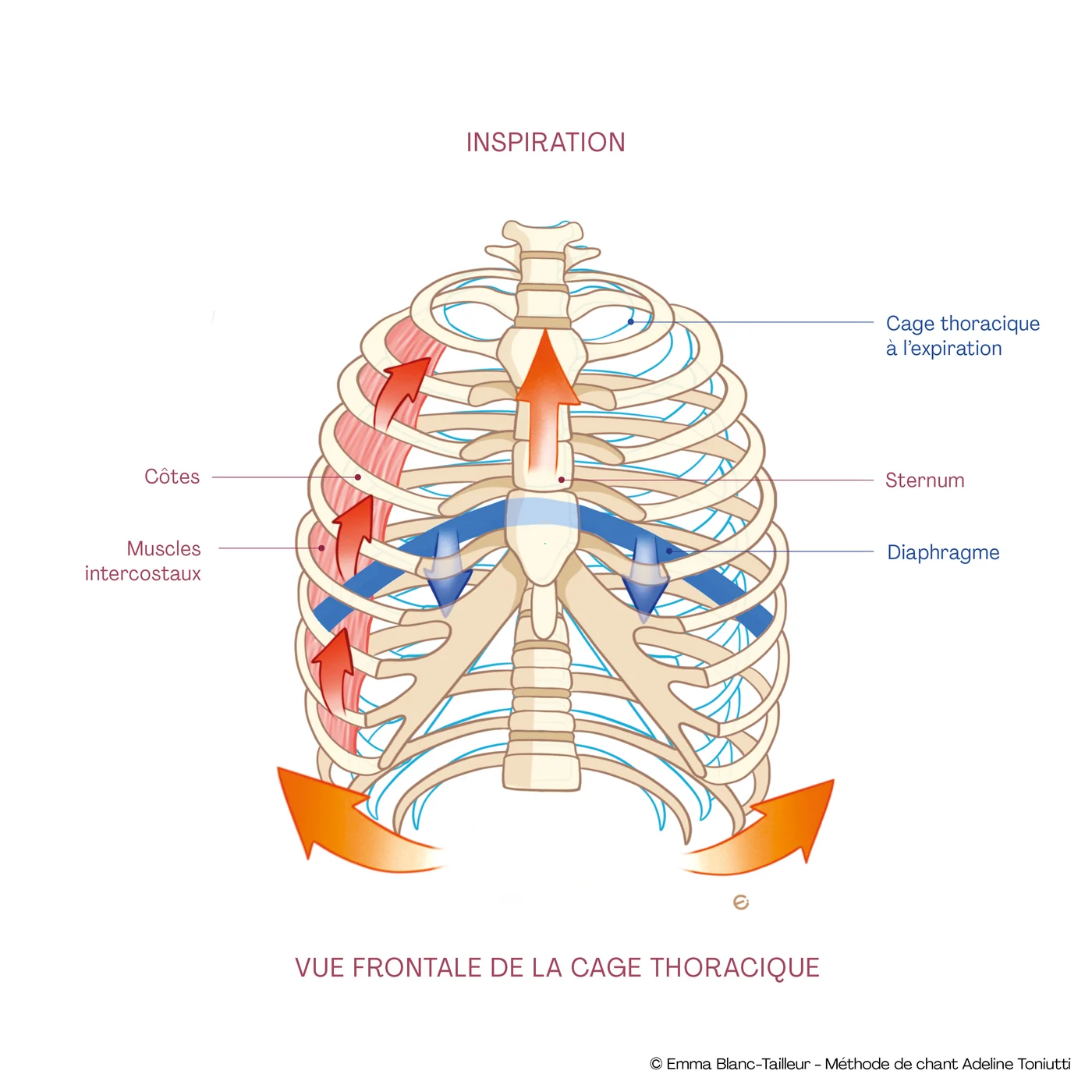
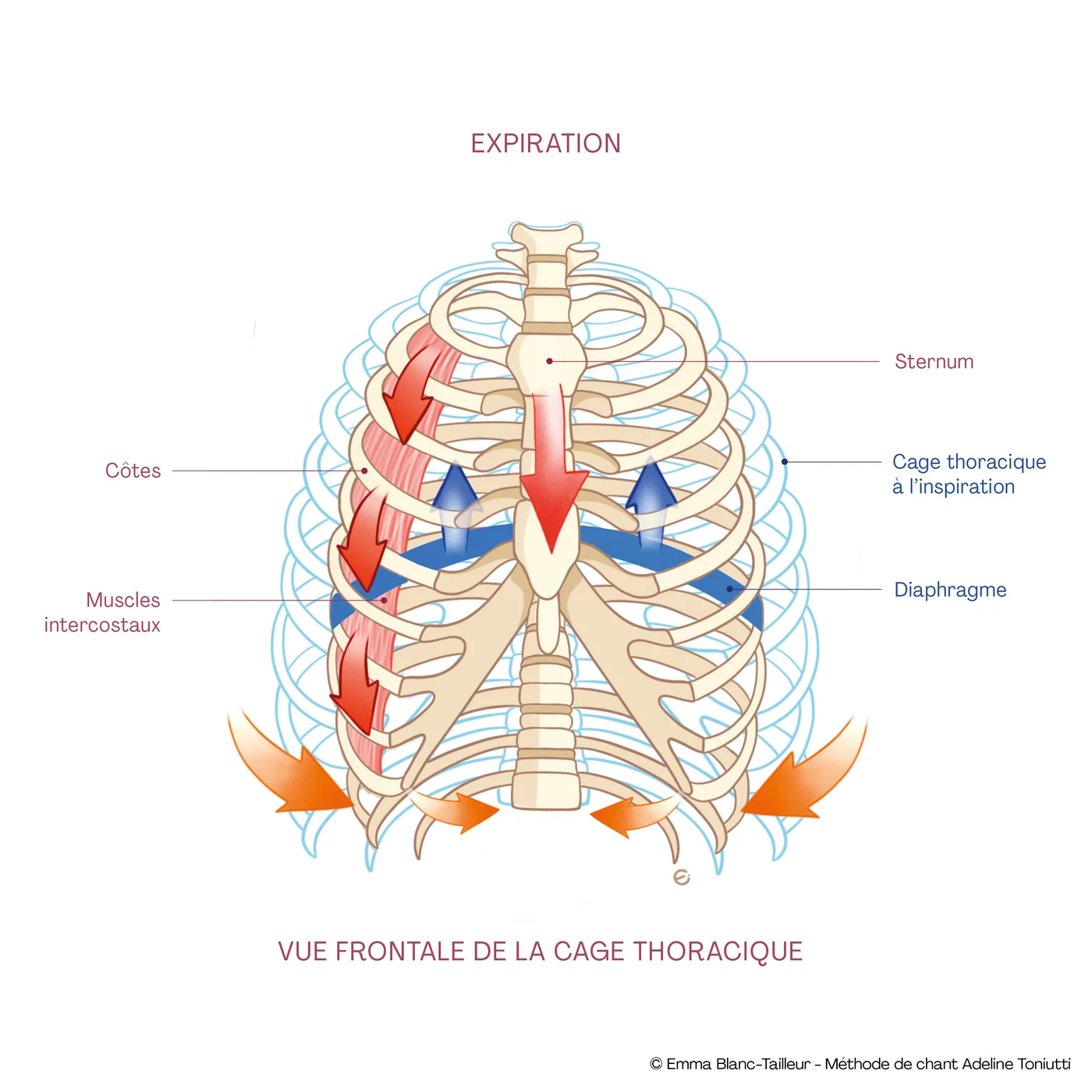
An inactive sling. The lungs have no motor muscle of their own. Without transversus, obliques and rectus, exhalation is no longer measured. The sound runs out of air, or is forced. The larynx compensates. It is the one that pays.
Illustrations © Emma Blanc-Tailleur, Anatomie du Chant, Adeline Toniutti
Ribs locked on the inhale. The diaphragm can no longer descend freely. Useful volume drops, the phrase stiffens, you push to finish.
The larynx held down. “Lower your larynx”, “open the throat as if yawning”: Adeline has heard those lines. Badly steered, a singer can lose a fifth at the top, darken the timbre by force, or injure the folds very fast. The larynx follows the exhaled air, upward, without locking at the top either. It remains a hammock, not a drawer you shove down.
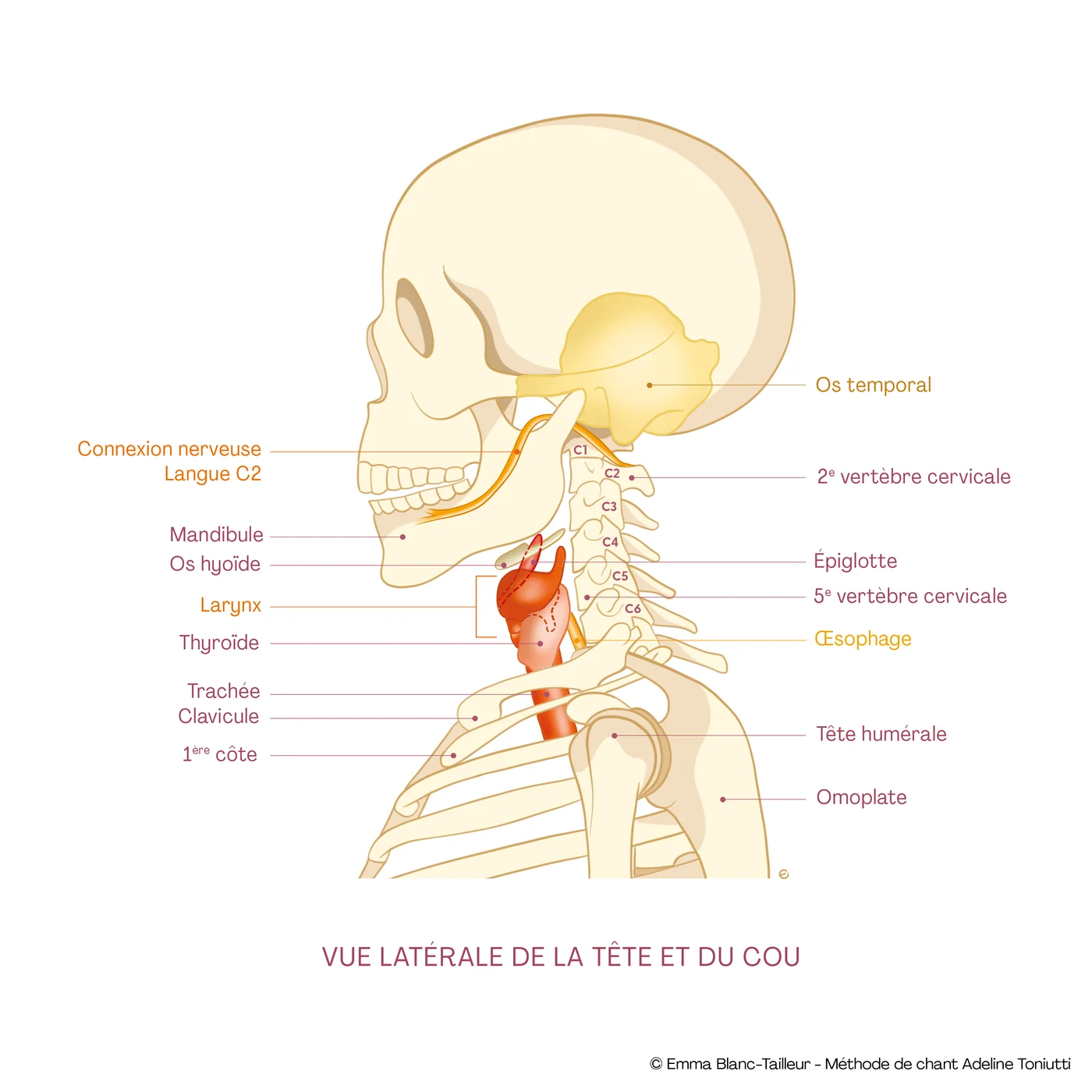
Illustration © Emma Blanc-Tailleur, Anatomie du Chant, Adeline Toniutti
The tongue falling onto the mandible. Thumbs behind the bone, in the space between larynx and jaw: if the tongue comes to meet the fingers and locks, the movement is wrong. If it moves away, toward the soft palate, without sticking to it, the gesture is the right one.
A mandible that is too slack. Opening is not yawning. A soft jaw releases the anterior chain, reduces the soft palate, disturbs laryngeal suspension, and articulation becomes a caricature that hurts the throat.
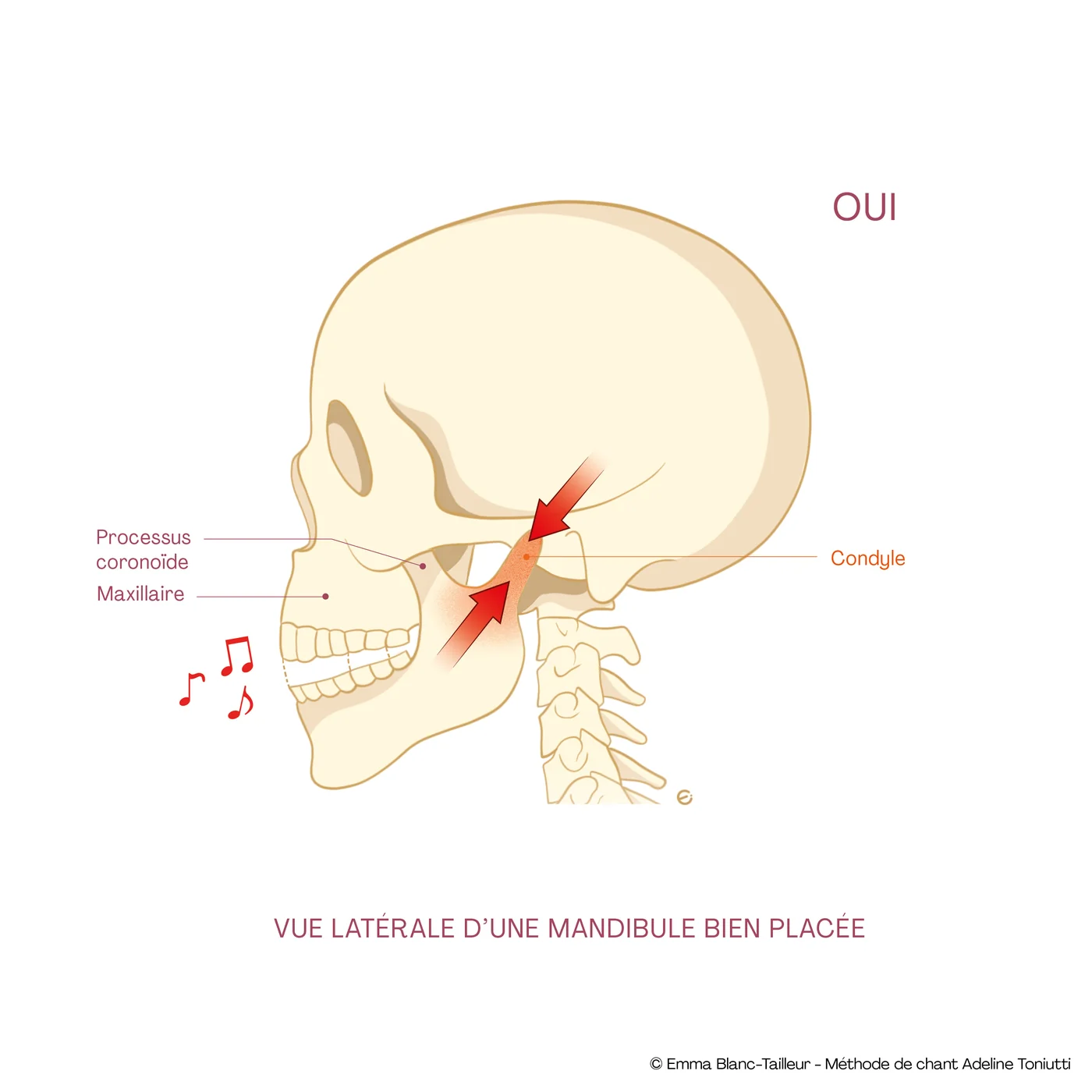
Illustration © Emma Blanc-Tailleur, Anatomie du Chant, Adeline Toniutti
Singing on the inhale. You can make a sound while inhaling. It is not aesthetic. It is exhausting.
The huge breath, the “vocal Everest”. Faced with a note that scares you, you inflate. You think a reserve of air will stop you falling. Adeline has seen the opposite: inhaling very small, twice, very fast, as if smelling a flower, finds the right movement sooner.
Releasing the ribs on the note. On a high note, most people let the floating ribs open again. The required pressure disappears. The larynx is left alone.
Forgotten posture. Neck, shoulders, pelvis: the first thing you drop, too busy with the notes or the stress. It is also the first thing that degrades the gesture. Osteopath Jean-Marie Legé: when the atlas slides sideways, the patient’s voice is veiled and fatiguable.
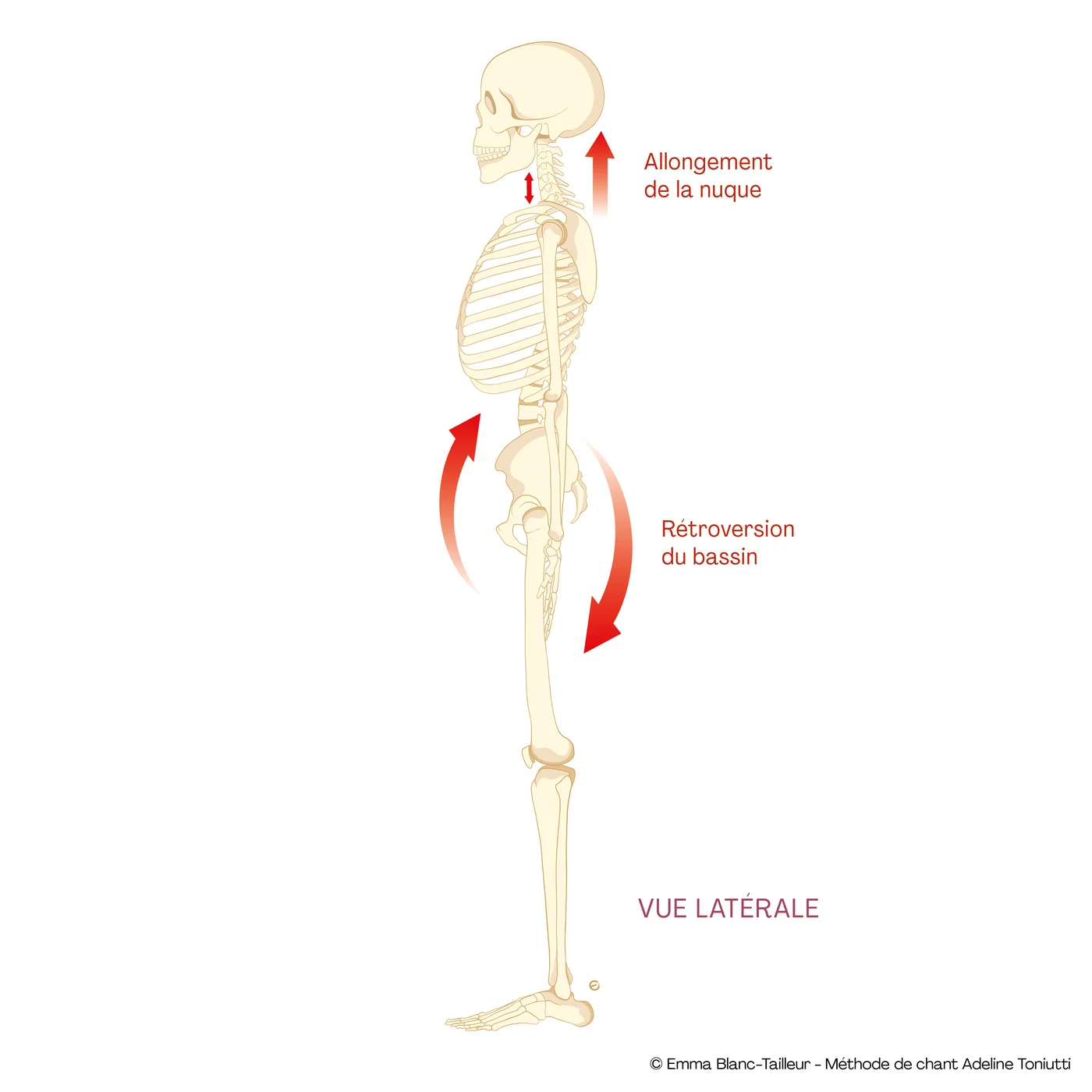
Illustration © Emma Blanc-Tailleur, Anatomie du Chant, Adeline Toniutti
IN THE LESSON
Stop as soon as the throat speaks
If the throat hurts, or a discomfort appears, say so at once. A parameter of the gesture must change. Do not continue an exercise that hurts.
It is the coach’s responsibility to check that the technique respects the instrument. It is the student’s duty to report. A lesson sung with a sore throat throughout can cause a lesion within 24 hours.
After the lesson: if the voice is still abnormal 24 hours later, something went wrong in the lesson. When there is a lesion, you need at least 48 to 72 hours of vocal rest for the instrument to recover on its own. If it does not improve, see an ENT. No self-medication. Repeated cortisone is a medical decision.
Signs to take seriously (this is then dysphonia): the voice carries less; the range shrinks; the timbre changes; speaking or singing becomes hard, the folds vibrate poorly.
Lifestyle, drinking ahead of effort, recovery after the stage: that already lives on the Voice Care page. This page is the gesture.
DOSE
A gesture you can repeat
The method does not give an hour quota. It gives a criterion: the gesture must be repeatable.
A high note is healthy when you can approach it every way: from below, staccato, legato, in every dynamic, in every register. If you can only do it by forcing once, it is not a high note yet. It is an accident.
The same for a forte. If the sound only holds because you pushed, you will not be able to ask for it again tomorrow. On stage, plan recovery. The stage is demanding.
Hydration is anticipated. Jean-Marie Legé: water takes six hours to be used. The detail is on Voice care.
“If I had been [Céline Dion's] vocal coach, I would have told her to do the same thing, it is an intelligent choice. […] With her illness, it is far more reasonable to lower the key so that she lasts the whole show, rather than giving everything on one song and being completely exhausted at the end.”
WHAT YOU FEEL
When it is right
You feel air leaving through the mouth, and a tiny mist through the nose, whatever the vowel. A finger under the nose checks it.
You do not try to hear yourself loud inside your own head. When the sound is intense, the stapedius reflex protects the inner ear. Your ears protect you. Forcing to “hear yourself” makes the larynx compensate for a filter the body has already lowered.
The larynx stays mobile. The sternal notch stays free. The base of the tongue goes toward the soft palate, without sticking to it (otherwise the sound becomes entirely nasal).
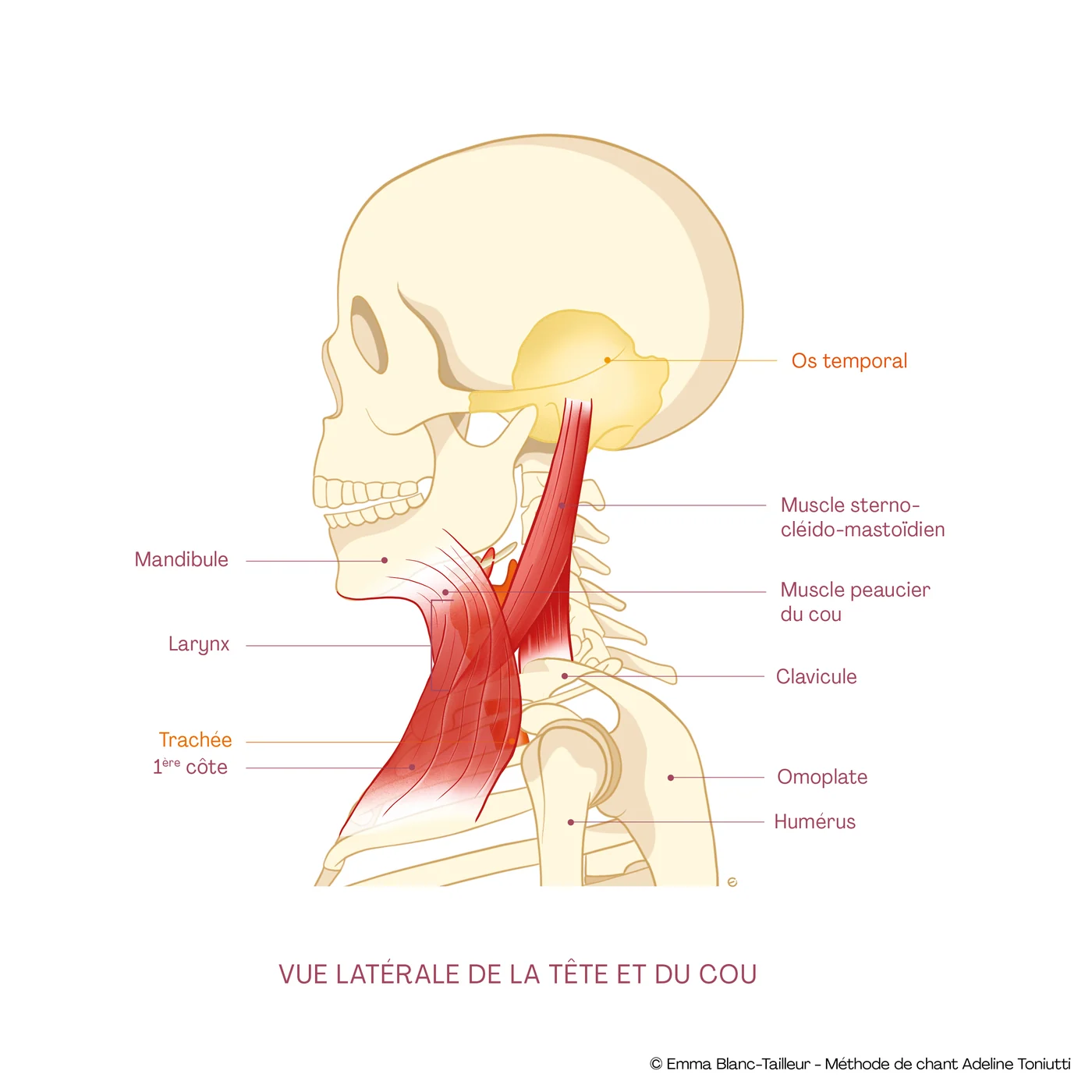
Illustration © Emma Blanc-Tailleur, Anatomie du Chant, Adeline Toniutti
IN PRACTICE
Three checks
1. Stop as soon as the throat speaks
Discomfort means you change a parameter. You do not push through.
2. Check who is working
Hands on the floating ribs, inhale as if smelling a flower. On the exhale the ribs draw together, the obliques hold. If only the neck hardens, that is not singing: it is compensation.
3. Thumbs under the mandible
The tongue moves away from the fingers. It does not rest on them. You should be able to sing like that without discomfort.
These three gestures are done while respecting the five pivot points. Pathology of the folds: see a specialist first.
CALYP
Work the gesture at CALYP
The method is in Anatomie du Chant (Marabout, 2024). To work it with the team: book an appointment.
Frequently asked questions
Is a sore throat after singing normal?
No. The abdominals may be tired. The folds should not. Discomfort or pain in the throat means a parameter of the gesture must change.
What does singing the wrong way up mean?
Making a sound that can seem correct with a bad gesture. Repeated, that gesture tires the folds and can lead to lesions later.
How long should I rest if the voice is abnormal after a lesson?
If the voice is still abnormal 24 hours after the lesson, something went wrong. If there is a lesion, at least 48 to 72 hours of vocal rest, then an ENT if it does not return.
Does volume tire the voice?
No. It is the larynx working instead of the sling, released ribs, a blocked tongue, too large a breath, or forgotten posture.