
Pregnancy and the singing voice: breath, pelvic floor, the return
VOICE CLINIC
A little being growing in the exact place of the support. What two voice doctors say about pregnancy, childbirth and coming back to singing.
INTERVIEW
The greatest change of their lives
Pregnancy is an important moment in a woman’s life. It brings an enormous number of changes, and it is our duty to support these singers through the greatest change of their lives. During pregnancy, the body changes a great deal: there are hormonal shifts, and there is a little being growing inside the singer’s belly, in the exact place of the support. Adeline Toniutti asked Dr Bruno Coulombeau, phoniatrician in Lyon, about the stages of change in a singer’s voice during pregnancy, and the right advice to follow. Dr Marie Mailly, ENT and voice specialist in Paris, gives her perspective on the same questions.
FIRST TRIMESTER
“I had the voice of the century”
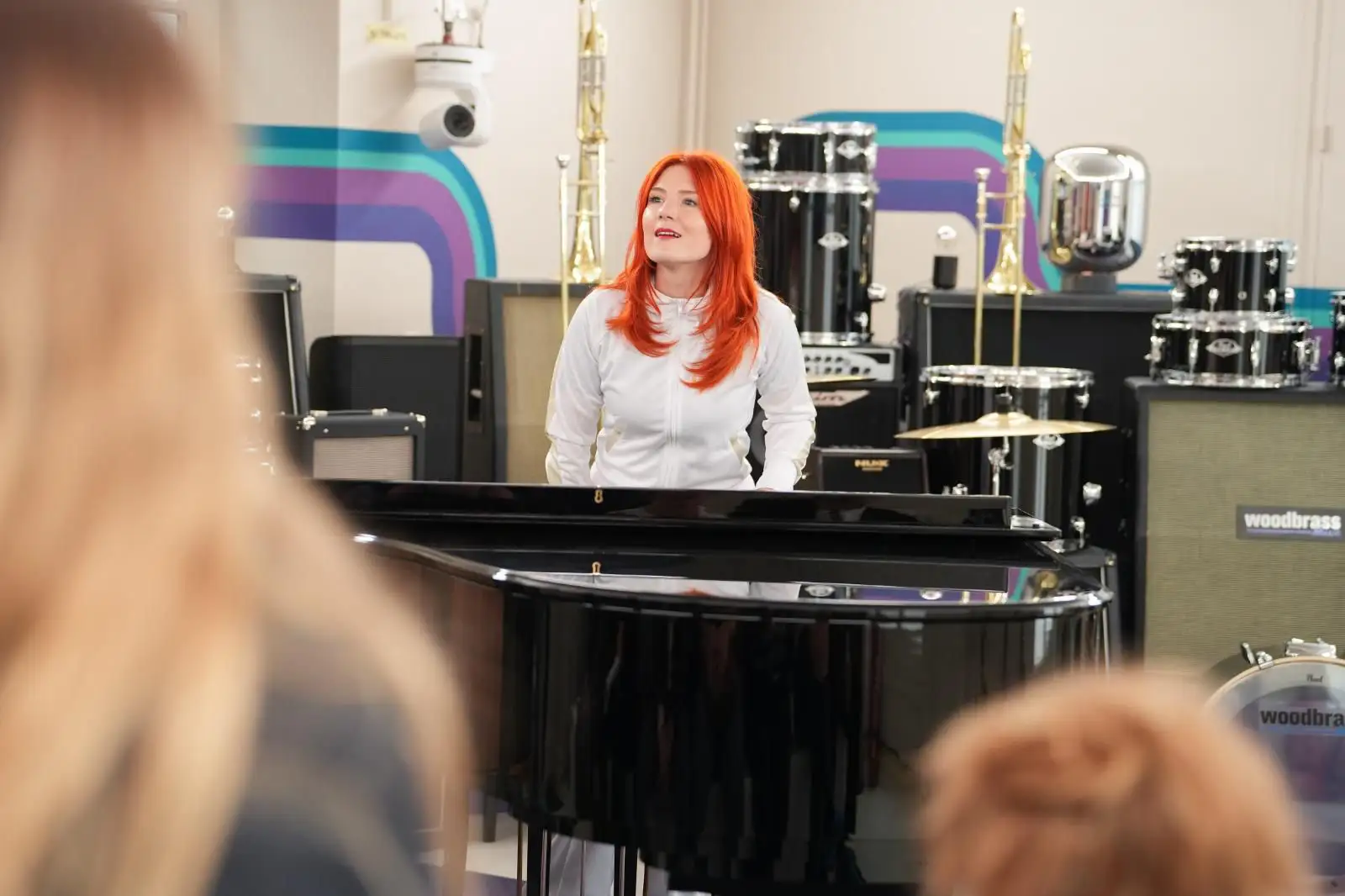
Adeline Toniutti
Pregnancy is a bit of a mystery. I have singers who come to me while they are pregnant: they sing very well, or they run out of air. They find it hard to take big breaths, because around the fifth, sixth, seventh month the baby weighs more, so they don’t have much room to breathe in. And often, when they give birth, there is a loss of voice. It takes several months to recover.

Dr Bruno Coulombeau
I have noticed, in some singers at least, that pregnancy gave them an almighty voice, as long as they weren’t too unwell in the first few months. At the stage where the baby is not yet too large and doesn’t interfere too much with the mechanics of the diaphragm. Several singers have told me: “I had the voice of the century at the start of my pregnancy.” I think it is the hormonal changes that cause a slight swelling of the vocal cords, but just enough for the closure to be perfect, without any loss of suppleness.
That reservation matters as much as the observation: the superb voice of the first trimester belongs to women who are not too unwell. The nausea, fatigue and vomiting of early pregnancy occupy the same ground and wipe out the benefit.
The mechanism the doctor describes is precise. A slight swelling of the vocal cords improves how they come together, and therefore the quality of the sound, as long as that swelling stays discreet enough not to cost any suppleness. Beyond that, the hormonal saturation can become a handicap. The singer who gains a few weeks of vocal comfort in the first trimester is enjoying a momentarily ideal setting of the voice she already has.
Adeline Toniutti put to Dr Mailly the double question heard in lessons: does the voice drop during pregnancy, and does the weight of the baby improve the support?
IN THE WORDS OF DR MARIE MAILLY
“Yes, there is a lowering of the voice due to the hormones: the cords swell. And indeed, when the baby is not too big, singers find that the support is better.”
Dr Marie Mailly · ENT, voice and botulinum toxin specialist, Paris
KEY IDEA
The very good voice of early pregnancy comes from a hormonal swelling of the cords, just enough to make the closure perfect without stiffening the mucosa. That window closes when the baby gains volume.
There remains the most widespread belief, the one students bring up in lessons: the baby supposedly presses on the diaphragm and so improves the support. The two doctors qualify it, each in their own way. For Dr Mailly, as long as the baby is not too big, singers do find the support better. For Dr Coulombeau, what singers feel as a help in the first trimester is mostly hormonal, and the weight of the baby then works the other way: it reduces the room available for the diaphragm to descend, and therefore the volume breathed in, and it resists the work of the abdominal wall on the out-breath. What they feel as a hindrance in the second and third trimesters is a matter of crowding.
HORMONES
What the hormones really affect
Dr Bruno Coulombeau
The vocal cords are a receptor for the sex hormones, for estrogens, progesterone and androgens alike, which bind to the cords.
This hormonal sensitivity can be observed outside pregnancy. The doctor points out that around menstruation it is not at all unusual to see a certain hypervascularisation of the vocal cords, a kind of saturation and swelling. The vocal consequences vary enormously from one woman to another: some describe a very beautiful voice at that moment, others say they are voiceless. Here Dr Coulombeau adds a nuance that is useful to teachers.
Dr Bruno Coulombeau
A singer who tells me “I have no voice” has sometimes lost a third at the top, and that is already a lot. She sings, but she sings with the impression, no doubt a correct one, that her voice is not responding at all as it normally would.
These differences between individuals, he repeats, are not always easy to understand or to approach. Some women go through their cycles and their pregnancy without any vocal change at all, others are strongly affected, and no rule makes it possible to predict which of the two categories a given singer belongs to before she has been observed. Dr Mailly, for her part, notes that “all the singers tell me that three days before their period, their voice is heavier”. The menstrual cycle has its own section on the page Menopause, andropause, presbyphonia.
Dr Mailly lists what pregnancy changes, trimester by trimester.
IN THE WORDS OF DR MARIE MAILLY
“Lowering of the fundamental frequency, especially in the second trimester. Edema of the vocal cords. Reduced maximum phonation time, especially in the third trimester. Worsening of laryngopharyngeal reflux, particularly marked in the third trimester. Reduced breath support in the third trimester, because lung expansion is limited.”
“Change in posture: ligament laxity, change in the shape of the chest, the back, the pelvis. Reduction of the vocal range at the top: women reach the high notes with more difficulty, sometimes with relative ease in the low notes.”
“Increased vascular fragility of the vocal cords: a risk of small blood vessels rupturing if the voice is forced, hence a greater risk of hemorrhage if the voice is pushed. Dryness and increased tissue viscosity: the mucus that coats the cords is scarcer and stickier.”
Dr Marie Mailly · ENT, voice and botulinum toxin specialist, Paris
One clarification is needed in passing, because the claim circulates in the vocal world: the mucosa of the vocal cords and the vaginal mucosa are not identical. Dr Coulombeau put the question to the pathologist he works with. In both cases these are stratified squamous epithelia, and these mucosae are indeed among those sensitive to the sex hormones, but the cells and the structures differ. The idea that a vaginal smear would show the same cells as a sample of vocal cord mucosa is inaccurate. The shared hormonal sensitivity is enough to explain what singers observe, without any need to claim that the tissues are the same. “It is false,” Dr Mailly says for her part: “the only thing they have in common is that they are hormone-dependent mucosae”.
KEY IDEA
During pregnancy, a vocal cord is more swollen, drier, more fragile in vascular terms. Forcing means taking the risk of a vocal cord hemorrhage. Reflux, which worsens in the third trimester, can be treated.
BREATH
From the fifth month, the breath gets shorter at both ends
This is the most concrete part, and the one that matches most closely what singers experience in lessons.
Adeline Toniutti
What I have noticed in pregnant women is that at some point, it is not that there is no more breath, it is that there is less length of breath. In my view, with the baby there, the diaphragm has less room to descend. There is no space left, so the lungs cannot fill completely.
Dr Bruno Coulombeau
Very probably, yes. And less length of breath. And then, when you call on your abdominal wall to push the air out, at some point the baby tells you too: “That’s enough, stop pressing on me.” So you lose on the in-breath, but you probably lose on the out-breath as well. At both ends.
Adeline Toniutti
The diaphragm struggles to descend any lower because the baby doesn’t agree, and at the same time, to come back up, the baby may be pushing back the other way and stopping it from rising efficiently. And the baby presses on the abdominals, presses on everything.
Dr Bruno Coulombeau
Exactly. It rests on the pelvic girdle, on the pelvic floor. It hinders the lower part of the abdominal wall from contracting. It can contract, but at some point, it stops.
The practical consequence is immediate in repertoire. The long phrases go first, the ends of phrases become short, and the singer compensates by tightening elsewhere. This is the moment when technical follow-up is justified, before the compensations settle in.
“Less length of breath. You lose on the in-breath, but you probably lose on the out-breath as well. At both ends.”
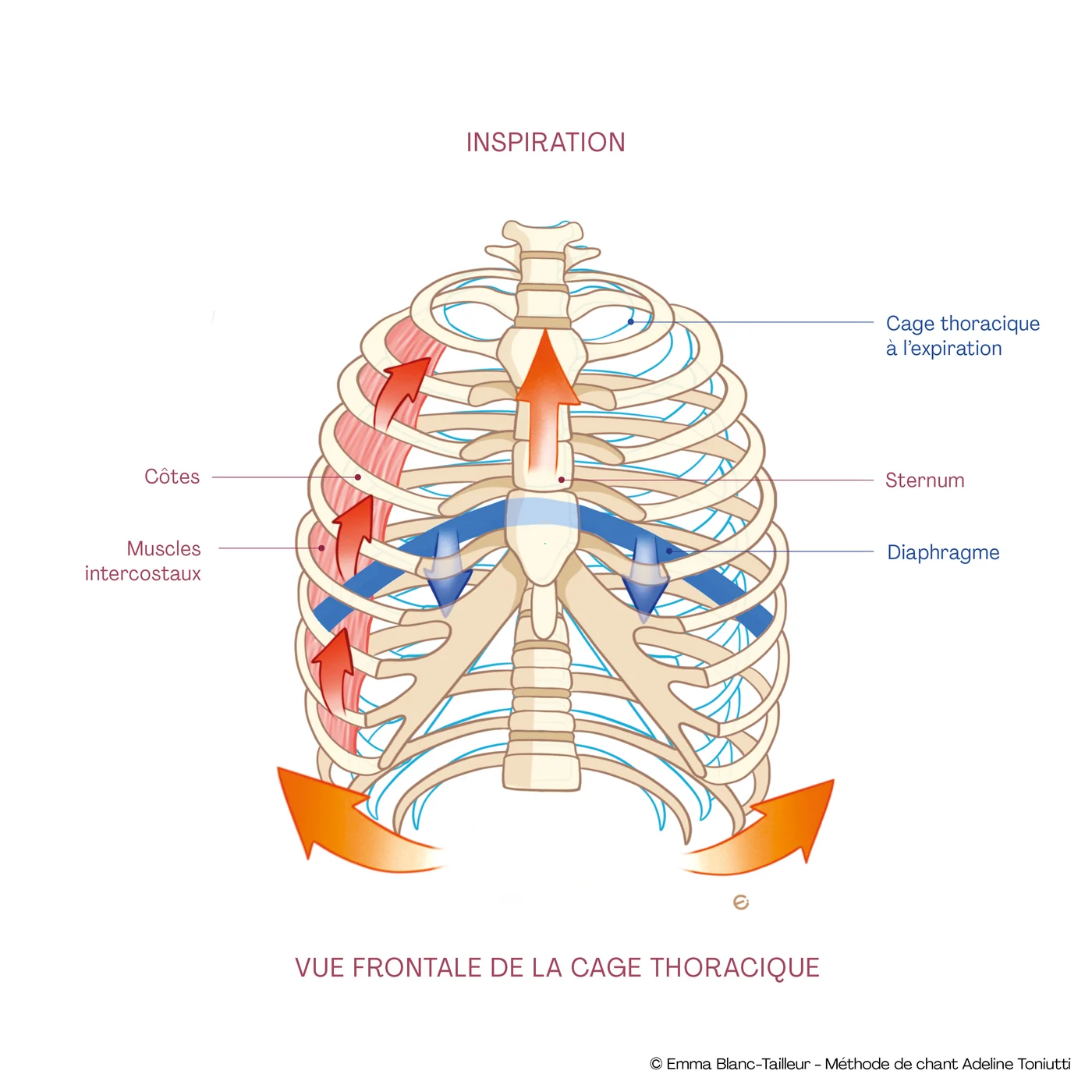
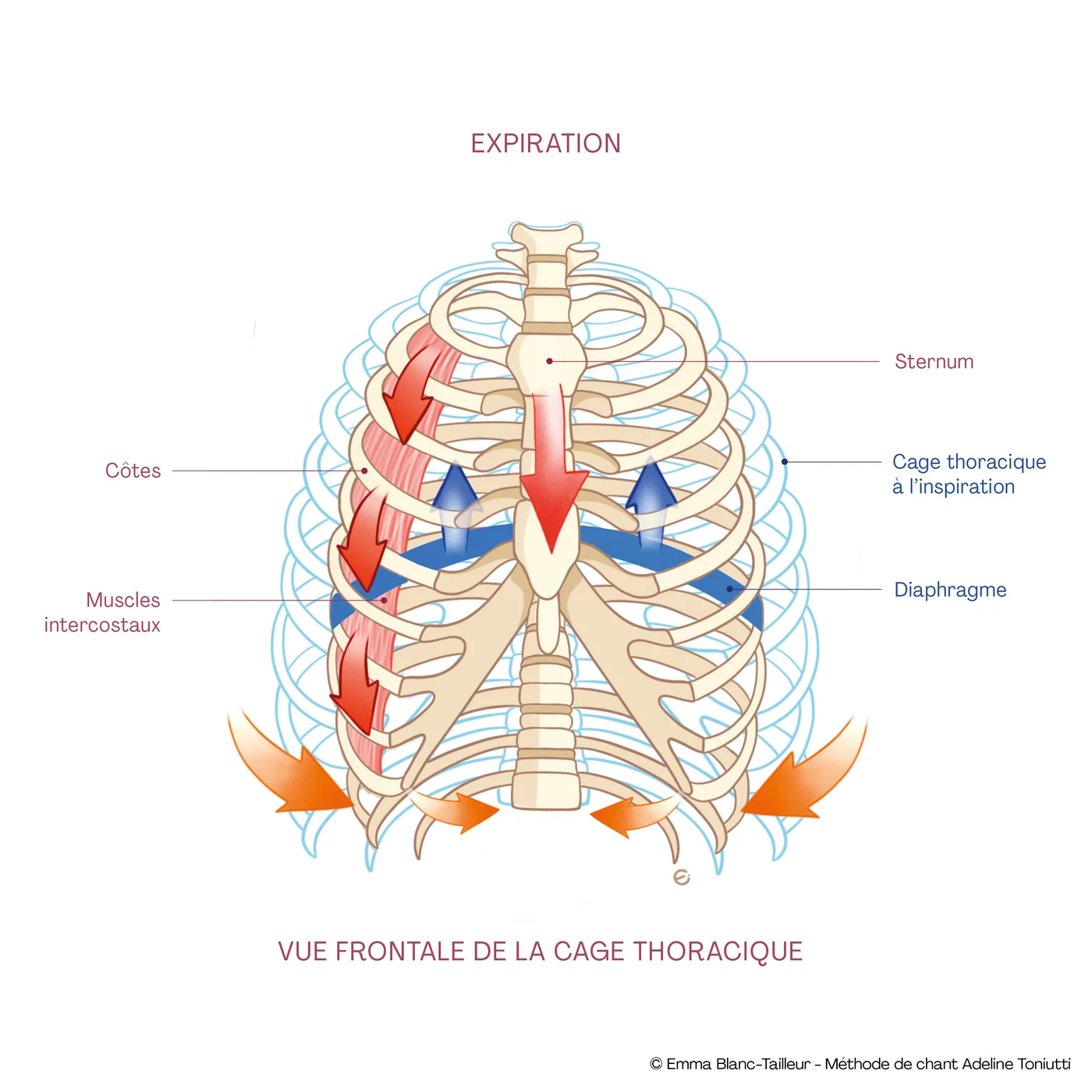
Illustrations © Emma Blanc-Tailleur, Anatomie du Chant, Adeline Toniutti
KEY IDEA
During the second half of pregnancy, you lose on the in-breath and on the out-breath. Long phrases get shorter, and the reflex of compensating with the throat settles in quickly if nobody is watching.
HOW LONG
How many months to keep singing, and above all what to sing
Adeline Toniutti
How long do you think they can keep singing? What do you say when someone comes to see you in consultation?
Dr Bruno Coulombeau
I would have said: sing until the birth, or until you no longer can. The problem is if she asks me how long she can accept engagements. As a matter of caution, I will say: not after the first trimester. But we know very well that there are women who, after the first trimester, could perfectly well have gone on singing professionally.
The doctor therefore separates two questions that singers often confuse. Singing, in the sense of practising, continues as long as the body keeps up. Committing by contract, with a date, a venue and a production counting on you, is a different calculation, and the cautious marker he gives for that is the first trimester. He adds straight away that this marker is theoretical and that many women go past it without difficulty.
IN THE WORDS OF DR MARIE MAILLY
“As for singing during pregnancy, it really is very individual, because there is no consensus at all. Some will sing right to the end, and others will stop at the seventh month. The big hindrance is the reduction in breathing capacity due to the size of the baby.”
Dr Marie Mailly · ENT, voice and botulinum toxin specialist, Paris
Adeline Toniutti places the practical limit she observes at the studio.
Adeline Toniutti
I see singers who can easily sing until the fifth, sixth month. But the stage director, in the case of opera, has to adapt, meaning they won’t be able to leap about everywhere. When you are a star, we will all remember Natalie Dessay, who was pregnant at La Scala in Milan and sang the Doll in The Tales of Hoffmann: the staging had been redone to take her pregnancy into account, the wide dress, and no staging where you climb all over the beams.
Natalie Dessay, the French coloratura soprano, held the most virtuosic roles in the repertoire for two decades, including this Olympia from Offenbach’s Tales of Hoffmann, a mechanical doll whose aria is a summit of difficulty. The example speaks because it does not involve an easy part: the production rewrote the staging around the physical constraint and the role was sung.
Adeline Toniutti
And in pop, the staging has to be redone too. You are not going to do a Lady Gaga style tour, jumping around everywhere with a baby in your belly.
Dr Bruno Coulombeau
If we are talking about oratorio, we tell ourselves that we can surely do it. But if the singer asks us: “Are you sure that at five months I will be able to do a concert, to record a concert of opera arias without staging, or an oratorio?”, we will answer: “No, I am not sure you will be able to at that point. Will you have the phrase lengths?”
A concert without staging therefore protects you from nothing if the work demands long phrases and sustained expiratory pressure. Before signing, the question concerns the content of the programme and its length as much as the stage of the pregnancy. The doctor adds a difficulty singers know well: the impossibility of guaranteeing a date.
Dr Bruno Coulombeau
It is always difficult to foresee, to predict that at such and such a moment you have to say stop to engagements. For a singer’s schedule, you know better than I do, it is a catastrophe. For the stars, there will always be an understudy planned, a double cast. But when it comes to ordinary people, in inverted commas, it becomes complicated to predict.
KEY IDEA
Before accepting an engagement in the second trimester, look at the score as much as the calendar: phrase length, sustained tessitura, staging. A production can adapt, an aria cannot.
This is where Adeline Toniutti raises the question of follow-up, and the doctor’s answer is clear.
Adeline Toniutti
Could we say that for any singer at all, there should still be some coaching over this period?
Dr Bruno Coulombeau
I think it can be useful, yes.
CHILDBIRTH
Vaginal delivery or caesarean: abdominal stretching and the pelvic floor
On the question of vaginal delivery or caesarean, Dr Coulombeau treats the second case as self-evident and insists on the first, because it is the one singers underestimate.
Dr Bruno Coulombeau
After the birth, we don’t even talk about the caesarean because it is even more obvious, but even with a vaginal delivery, there is all the abdominal and perineal stretching. I think we sometimes forget the pelvic floor. It has been stretched, it is slack. You no longer have the support, or you have much less of the support you need to sing at a high level. For someone who is not going to sing, the findings will no doubt be a little less complicated. This is where physiotherapy, and pelvic floor physiotherapy in particular, is really important. I think it isn’t talked about much, maybe a little more now. You really have to do rehabilitation work at that point to give you back your support.
Adeline Toniutti
There is no closure at the bottom any more. There is no support left to make the gesture.
Dr Bruno Coulombeau
There is the problem of closure, with whatever unpleasantness that may involve, but also, as you say very well, the problem of tone and therefore of support. And if you can no longer lean on it, in terms of the out-breath, you are going to be really very hindered.
Dr Mailly goes further on the comparison between the two kinds of delivery, and her finding is surprising.
IN THE WORDS OF DR MARIE MAILLY
“Contrary to the intuition one might have, the caesarean being perceived as more traumatic, it is in fact vaginal delivery that seems to have the more marked vocal impact, both objective and subjective, probably because of the effort of pushing with a closed glottis, a genuine acute mechanical phonotrauma. The caesarean, for its part, has more impact on the recovery of abdominal support, the muscle having been cut, without direct laryngeal trauma.”
“In both cases, there is the possibility of a diastasis, a failure of the abdominal muscles to close, which sometimes has to be operated on, because it does not necessarily recover on its own.”
Dr Marie Mailly · ENT, voice and botulinum toxin specialist, Paris
The pelvic floor matters to the singer for a mechanical reason, on top of the reasons of urinary comfort that postnatal rehabilitation usually targets. A toned pelvic floor gives the diaphragm and the abdominal wall a low anchor point to work against. Without that lower closure, the expiratory pressure leaks downwards and the support becomes impossible to hold, whatever the quality of the vocal cords. The pelvic floor rehabilitation prescribed after the birth therefore deserves, in a singer, to be followed through to the end.
KEY IDEA
Pelvic floor rehabilitation is a vocal act for the singer. Without closure at the bottom, there is no support for the out-breath, and the vocal gesture happens in the throat. After a vaginal delivery, the vocal cords themselves have been through the closed-glottis pushing; after a caesarean, it is the abdominal support that takes longest to come back.
THE RETURN
When to resume vocal work
Adeline Toniutti
How long do you normally have to wait before singing again?
Dr Bruno Coulombeau
I have no rule. When people ask me, I advise counting a month and a half, two months, a bit like vocal cord surgery, but not for the same reasons. It seems reasonable to me to plan for that. And after that, it is so different from one woman to another.
This delay of a month and a half to two months is a common-sense marker, and the doctor presents it as such. The comparison with the aftermath of vocal cord surgery concerns the duration alone. Dr Coulombeau says so himself as he makes it: the reasons differ, since after a birth it is the abdominal wall and the pelvic floor that have to recover their tone.
Dr Mailly adds a factor that singers do not always connect to their voice: breastfeeding.
IN THE WORDS OF DR MARIE MAILLY
“As for the return, it is breastfeeding that will determine it. During breastfeeding, estrogen secretion does not resume, so the singer is as if in a ‘mini-menopause’. Often, she only gets her voice back after breastfeeding, when the normal hormonal cycles resume.”
“If there is no breastfeeding, we know that hormonal disturbances are significant for at least twelve weeks after the birth. But some singers say they only get their ‘real voice’ back several months, or even several years, later.”
Dr Marie Mailly · ENT, voice and botulinum toxin specialist, Paris
The differences between singers are considerable. Adeline Toniutti told the doctor about the case of Léa, a Star Academy contestant, who sang Beyoncé one week after giving birth, incredibly well.
Dr Bruno Coulombeau
We can more or less agree that for 90% of the singers we know, it could have been a catastrophe. She was able to draw on reserves, or else, by luck, things were so well organised for her that she was capable of doing it.
Adeline Toniutti
What I can add is that Léa had excellent training before she got pregnant. There was a big muscular effort before the pregnancy, over a long time, real work. She is one of the most toned singers I see, she had taken seriously what I had told her. And we reduced the problem a great deal once she had given birth. It was completely striking.
“To sing, it is not enough to have vocal cords.”
This observation is the heart of the question of the return, and Adeline Toniutti generalises it from what she sees at the studio: the singers with the least muscle before pregnancy get back to singing more slowly after the birth. The doctor’s answer is direct.
Dr Bruno Coulombeau
It seems fairly logical. What’s more, if they are muscular beforehand, we can infer that it is because they have worked muscularly. It is the work. And so these are people who may have got going again fairly quickly afterwards to rebuild their muscles, and who, if they also had the good idea of adding pelvic floor rehabilitation, will indeed cope far better with the aftermath, which, in my view, most of the time is going to be really physical, because to sing, it is not enough to have vocal cords.
Adeline Toniutti
Singing well is a matter of the body as a whole.
Adeline Toniutti points to another factor that weighs on the return without being muscular: the postnatal period is sometimes crossed with the baby blues, and you find yourself facing artists who are not in good spirits at the very moment they have just given life. A voice that no longer responds is then added to an already fragile mental state, which pushes some of them to force the return.
KEY IDEA
The muscle built before pregnancy is the capital you lean on after the birth. A singer who is planning a pregnancy has every interest in preparing her body rather than hoping to recover quickly. And as long as breastfeeding lasts, the voice stays in a hormonal parenthesis.
HIGH NOTES
The high notes that don’t come back
The finding teachers report after a birth combines two things: stretched abdominals and a loss of the high notes, sometimes for several months. The two hold together through the mechanics described above.
Speaking of the muscular changes linked to age, Dr Coulombeau states the principle that applies here: to maintain the big high notes you need pressure, the muscles physically have to be there, and if the muscles start to be a little hard to engage, it becomes complicated. A stretched abdominal wall and a slack pelvic floor produce the same effect as a loss of muscle tone from a different cause: the subglottic pressure can no longer be established or held, and the top of the voice is the first area to feel it, since it is the one that demands the most.
A singer who loses her high notes after giving birth does not therefore necessarily have a vocal cord problem. That is also what explains why time alone is not always enough: without pelvic floor rehabilitation or getting the muscles going again, the support does not come back by itself, and the voice stays below what it was.
A caesarean, an ectopic pregnancy, an operated endometriosis can leave adhesions that change the support. That subject has its own page: Treat your adhesions to treat your voice.
CONTRACEPTION
Contraception and the voice
Adeline Toniutti has sometimes seen contraception act on her students’ voices. Dr Mailly answers from the literature.
IN THE WORDS OF DR MARIE MAILLY
“The reference literature shows that the oral contraceptive pill is associated with an improvement or a stabilisation of vocal quality in women, most probably by smoothing out the cyclical hormonal fluctuations responsible for premenstrual dysphonia.”
Dr Marie Mailly · ENT, voice and botulinum toxin specialist, Paris
In other words, a hormonal contraception that removes the variations of the cycle also removes, in many women, the three days of “heavier” voice that precede the period. The choice of a contraception remains a medical and personal decision, taken with the gynaecologist. A singer who notices a change of voice after a change of contraception has every interest in mentioning it, to her prescriber as well as to her teacher.
FATIGUE
Fatigue, diets and post-operative recovery
Coming back to singing after a pregnancy often goes with a wish to get your old body back quickly. The doctor issues a warning on this point, about diets and about recovery from surgery.
Dr Bruno Coulombeau
Balanced and not tired. We forget this in many situations: diets, post-operative recovery, and in particular recovery from major surgery. It creates fatigue, and that fatigue is thoroughly harmful to the sung vocal gesture.
The hypotheses he puts forward in the face of rapid weight loss are the loss of muscle mass and the drop in blood sugar, on top of the fatigue itself. Adeline Toniutti states the conclusion in terms of performance.
Adeline Toniutti
To have a fine vocal gesture and achieve certain performances, you need a body that is healthy overall, neither in calorie deficit nor in exercise deficit. You need a balanced body to maintain a fine vocal gesture.
She adds a remark that also applies to the aftermath of childbirth: her students sometimes turn up to a lesson, or to a recording studio, still strapped into a post-operative compression binder, without having mentioned the operation. The doctor, asked whether it is wise to sing in those conditions, replies that if it means hurting yourself while telling yourself “I can’t do it”, and hurting yourself psychologically, it is better to avoid it.
IN PRACTICE
What to remember
To organise a pregnancy and a return, without turning markers into rules.
- During the first trimester, the voice can be exceptionally easy in women who are not much troubled. Enjoy the window while keeping in mind that it closes.
- Keep singing as long as the body keeps up. There is no consensus on a date: some sing right to the end, others stop at the seventh month. For contractual engagements, the doctor’s cautious marker is the first trimester, with the clarification that it is indicative and that many singers go past it.
- Don’t force. The vocal cords are more fragile in vascular terms during pregnancy. A vocal cord hemorrhage comes at a high price.
- In the second and third trimesters, examine the repertoire before the date: phrase length, stamina required, staging. A production can adapt, as in the case of La Scala mentioned above. Have reflux treated if it appears.
- Technical coaching during this period is useful, to stop the compensations that set in when the breath gets shorter from staying on after the birth.
- After the birth, do the prescribed pelvic floor rehabilitation and see it through to the end, vaginal delivery and caesarean alike. It is the anchor point of the vocal gesture. Have a possible diastasis checked.
- Resume vocal work at around a month and a half to two months, knowing that this delay is a marker, that breastfeeding extends the hormonal parenthesis, and that the differences between women are considerable.
- A scar from a caesarean or another abdominal operation: see the page Treat your adhesions to treat your voice.
- Consult if the trouble lasts. The threshold Dr Coulombeau gives is simple: a dysphonia lasting more than a month justifies a laryngeal examination. Following the assessment, he readily prescribes vocal work.
The muscular work done before the pregnancy is what most visibly determines the speed of the return. It is also the only part of this subject over which a singer has complete control, well in advance. To prepare for it: Prepare your body to prepare for the stage.

The cases of students and patients mentioned are reported anonymously. This information is given as general guidance and does not replace a phoniatric or ENT consultation.
CALYP
Singing while pregnant, singing again afterwards
CALYP supports singers before, during and after pregnancy: muscular preparation, adapting the repertoire, a gradual return with the medical team.
GO FURTHER
The Voice Clinic Interview series
Frequently asked questions
Why is the voice often better in early pregnancy?
The hormones cause a slight swelling of the vocal cords, just enough for the closure to be perfect without losing suppleness. As long as the baby is not too big, many singers also find the support better. That window closes when the baby gains volume.
How many months can a singer keep singing?
There is no consensus: it is very individual. Some sing right to the end, others stop at the seventh month. The main hindrance is the reduction in breathing capacity due to the size of the baby. For contractual engagements, Dr Coulombeau’s cautious marker is the first trimester, an indicative marker that many go past.
Vaginal delivery or caesarean: what difference for the voice?
Contrary to intuition, vaginal delivery seems to have the more marked vocal impact, because of the effort of pushing with a closed glottis, a genuine phonotrauma. The caesarean mainly affects the recovery of abdominal support, the muscle having been cut. In both cases, a stretched pelvic floor and a possible diastasis of the abdominals.
When can you sing again after giving birth?
A month and a half to two months as a marker, with no rule. Breastfeeding extends the hormonal parenthesis: without the resumption of estrogen secretion, the singer is as if in a mini-menopause and often gets her voice back after breastfeeding. Without breastfeeding, the hormonal disturbances last at least twelve weeks.
Why don’t the high notes come back after the birth?
Because the top of the voice demands the most pressure, and that pressure rests on a toned abdominal wall and pelvic floor. Once stretched, they no longer produce the support. Pelvic floor rehabilitation and getting the muscles going again are the answer, not time alone.
Does the pill change the voice?
The literature shows that the oral contraceptive pill is associated with an improvement or a stabilisation of vocal quality, most probably because it smooths out the cyclical hormonal fluctuations responsible for premenstrual dysphonia.