
Breathing for Singers
ANATOMIE DU CHANT
Singing is, above all, mastery of breathing; it is the use of exhaled air to communicate for artistic purposes.
PRODUCING A SOUND
Singing is breathing
At the heart of the vocal method Adeline Toniutti developed and tested, and which she develops further in Anatomie du Chant, the anatomy of sound opens up its backstage. It all starts with air.
Singing is, above all, mastery of breathing; it is the use of exhaled air to communicate for artistic purposes. Over the course of evolution, humans have adapted the vital function of breathing into a means of communication. But communicating is also a survival function: human beings live in groups to be stronger and they need to express themselves to connect. Thus, singing is a form of aesthetic expression: one "tames" the communication function to make something artistic out of it.
From a physiological point of view, singing means filling the lungs on the inhale and releasing the air on the exhale, while pressing the vocal cords together to produce a sound.
One could compare singing to a cry, which expresses a strong emotion such as fear or pain. Indeed, in everyday life, we speak of a "cry of joy" or a "cry of pain." However, a cry has no aesthetic aim.
FOUR PHASES
Transforming air into sound
There are four phases in the production of a sung sound:
- We inhale: the phase during which air accumulates in the lungs.
- We exhale: the phase during which air is expelled from the lungs.
- We close the vocal cords to make them vibrate.
- The cavities resonate thanks to the sound produced by the vocal cords.
If all these parameters are well optimized, we obtain a sound that meets aesthetic criteria. We speak and sing using exhaled air. Sounds can be produced while inhaling, but the result is not aesthetic and is rather exhausting.
Exhaled air leaves the lungs, passes through the bronchi and rises up the trachea. The air is sent into the larynx where the vocal cords are located. Sound is the encounter of air with the vocal cords which, by pressing together and vibrating at a certain frequency, produce a sound wave that will take on color and form as it encounters and fills the membranes and cavities in its path.
Vocal technique allows us to become aware of all the elements of the inner choreography that promotes or hinders sound production.
DIAPHRAGM, ABDOMINALS, RIBS
Muscles to propel the air
The main actors in propelling air (and therefore sound) are: the diaphragm, the abdominal muscles, and the ribs. Once our lungs are filled during inhalation, they must be emptied to produce a sound.
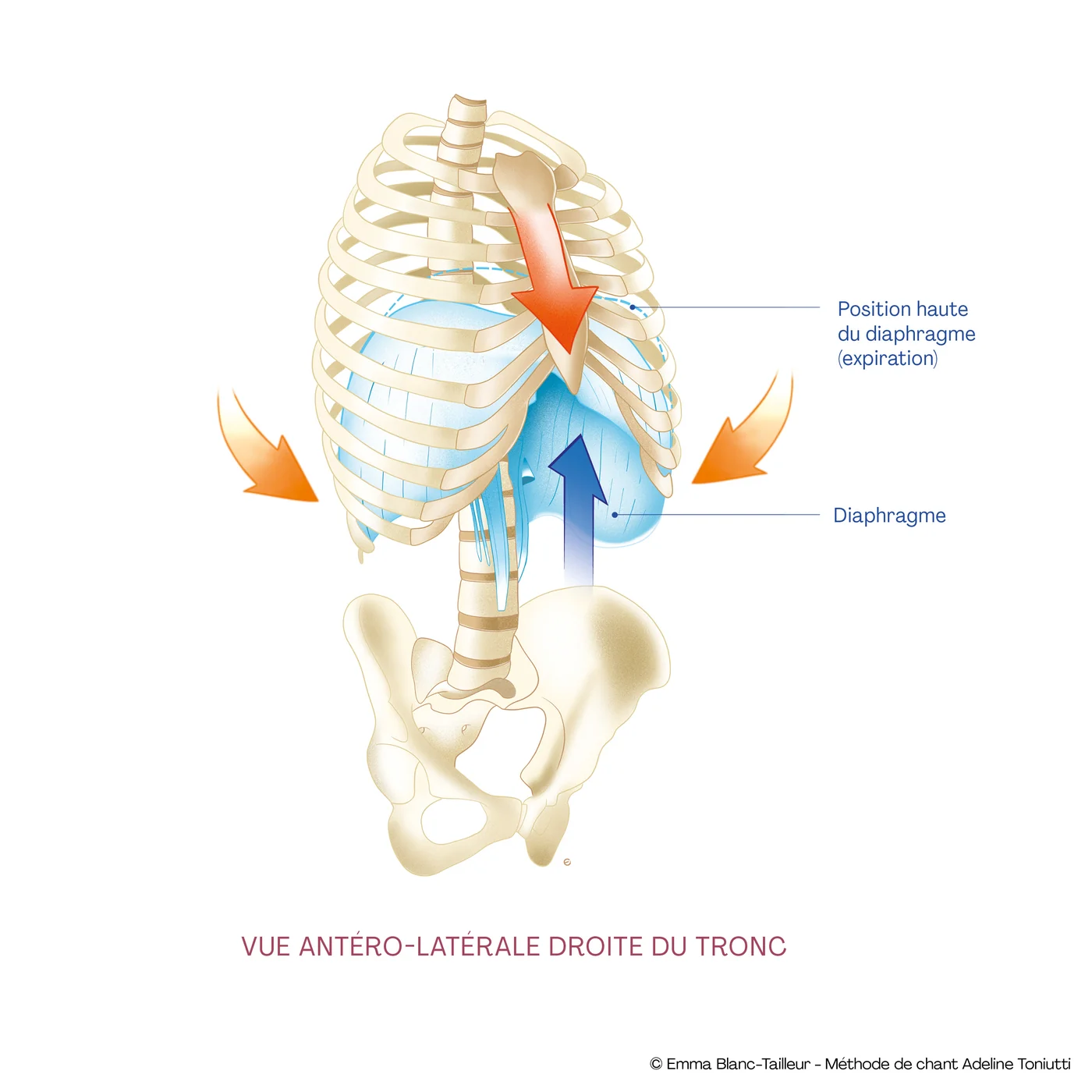
Producing a sound means exhaling the air contained in our lungs. To empty the lungs, the ribs must be drawn together and the diaphragm must be raised with the help of the abdominal muscles, which exert pressure to drive the air upward.
The abdominal muscles are the flat muscles that form the walls of the abdomen. They are a kind of sling or sash that wraps around and protects the viscera. They owe their names to their direction: transverse, rectus abdominis, and obliques.
- The transversus abdominis: the deepest of the abdominal muscles increases abdominal pressure and stabilizes the trunk. It does not work continuously; it is mainly engaged during active exhalation.
- The external and internal oblique muscles: they contribute to abdominal pressure during active exhalation and allow rotation and lateral mobility of the trunk.
- The rectus abdominis: the "six-pack" muscle manages the restrained bulge of the abdomen. It counterbalances inhalation and drives exhalation. It can be activated during exhalation to exert greater pressure on the diaphragm, which rises and compresses the lungs to expel and exhale the air that reaches the larynx.
THE ENGINE OF SINGING
Breathing as the engine
Running out of breath, being unable to finish a phrase, searching for the best way to breathe while singing: breath control, which determines the quality of singing, still holds many mysteries.
The air we use to speak or sing is first the air that oxygenates our body, our muscles, our tissues. Air enters the lungs, and inside the alveoli, oxygen enters the bloodstream, allowing us to stay alive.
To stop breathing is simply to stop being alive.
The act of inhaling and exhaling is the result of the combined action of the diaphragm and the intercostal muscles. Contraction of the intercostal muscles stiffens the rib cage, enables its opening (on inhalation) and closing (on exhalation) movements, and provides a fulcrum for the diaphragm.
The diaphragm is the muscle of life: through it we live, through it we die (Andrew Taylor Still, founder of osteopathy). It allows us to breathe, but also to digest. It is a membrano-muscular apparatus, shaped like a double translucent dome, that separates the thoracic cage from the abdominal cavity, the pulmonary from the digestive. Contraction of the diaphragm lowers its domes and creates inhalation. It accompanies inspiratory and expiratory movements by opening or closing the rib cage.
The lungs themselves have no motor muscle. It is their environment, particularly the rib cage, the intercostal muscles, and the diaphragm, that sets them in motion.
FROM THE NOSE TO THE ALVEOLI
The path of air through the body
The different stages of the journey, as set out by Adeline Toniutti's method:
- Air enters the respiratory system through the nose and mouth, then passes through the pharynx and the larynx, the organ of voice.
- The passage through the larynx is protected by the epiglottis, which distinguishes the digestive tract from the respiratory tract, and thus regulates the transition between breathing and eating.
- The air then passes through the trachea, which divides into two branches: the right and left main bronchi, each supplying a lung.
- Inside the lungs, the bronchi branch into progressively smaller airways called bronchioles, leading to thousands of small air sacs: the alveoli. It is at their innermost level that gas exchange takes place: oxygen from the air passes into the blood to feed the cells, and carbon dioxide passes through the alveoli to be expelled.
The air that carries carbon dioxide out of the body follows the same path as the oxygen-carrying air, but in reverse, traveling from the lungs back up to the nose and mouth.
DID YOU KNOW?
How much air does a singer breathe?
In normal breathing, we inhale and exhale about 0.5 litres per breathing cycle, or about 6 litres per minute. In active breathing, i.e. forced breathing, such as during physical training or singing, the ventilatory capacity is greater. For example, it will be about 6 litres for someone holding a sustained sung note.
Volumes vary depending on the individual, their morphology, sex, age, and physical condition. With good training, any singer or athlete can increase their vital capacity.
INHALATION AND EXHALATION
The movement of natural breathing
Breathing is triggered by the nervous centres; it is an automatic action that can nonetheless be controlled.
Natural inhalation
It occurs when the pressure inside the lung is lower than the pressure of the outside air. Oxygen-laden air enters through the nose or mouth and follows the path of air through the body to oxygenate the organism at the level of the alveoli.
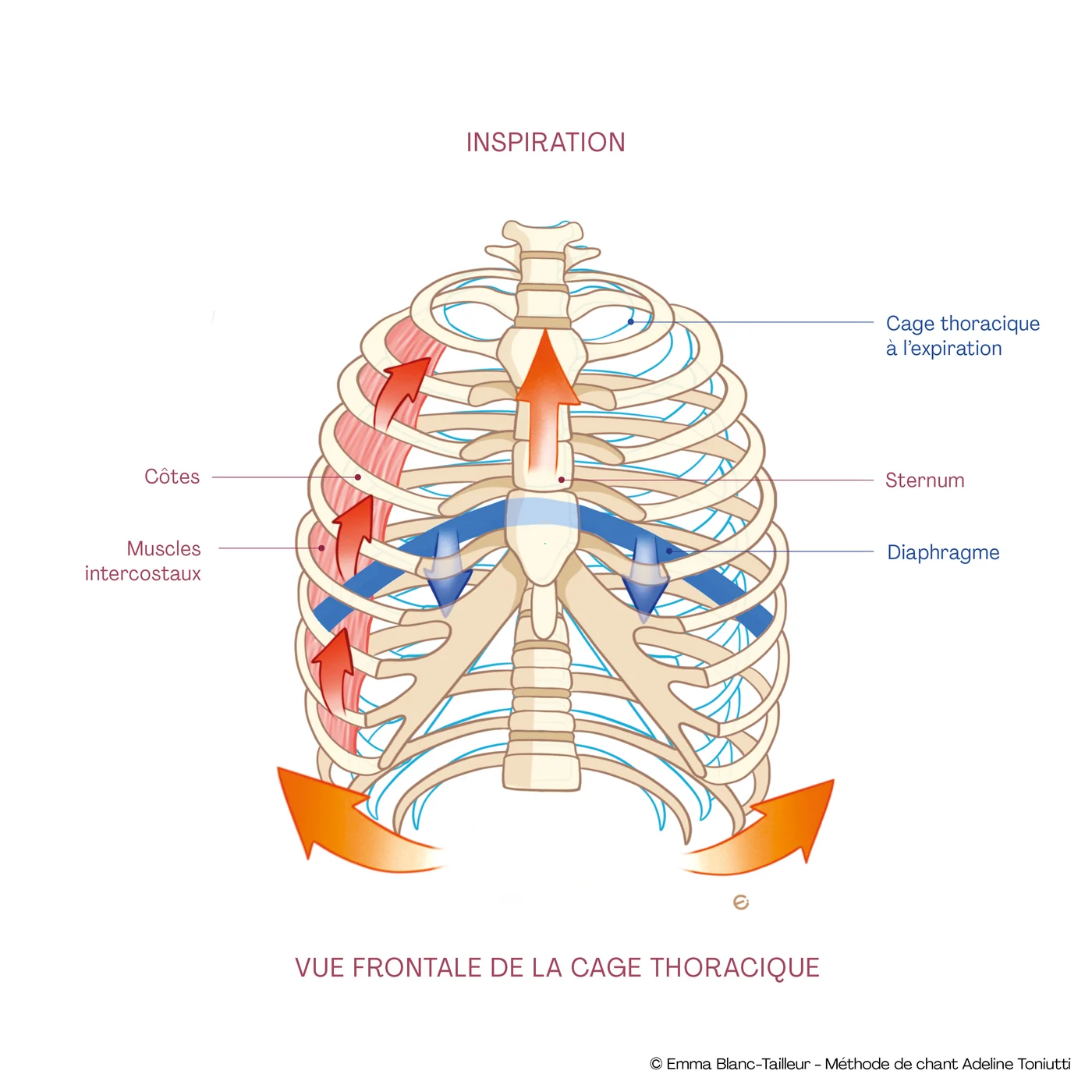
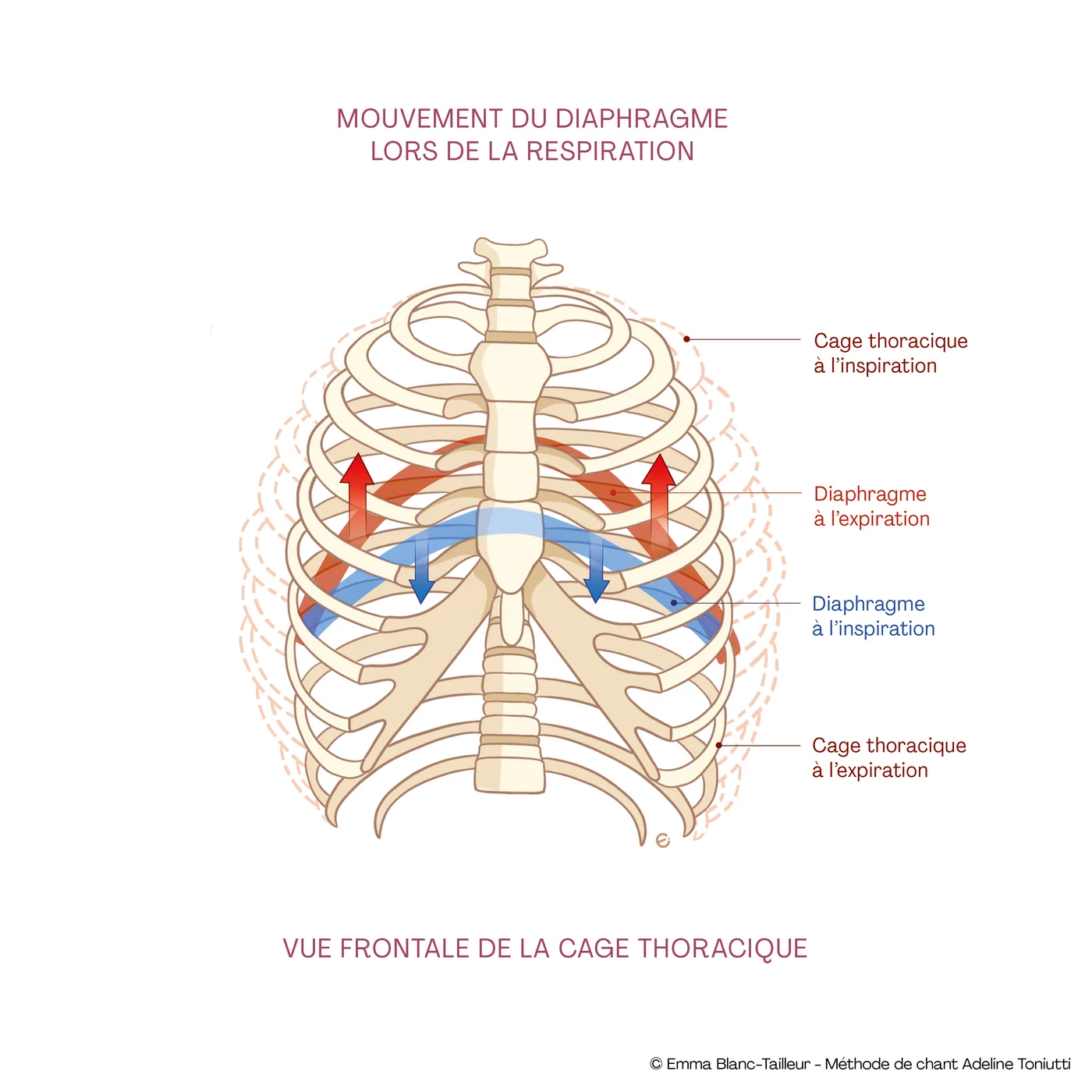
During the inspiratory movement, the rib cage expands and the diaphragm descends (the muscular cords of the diaphragm shorten, the dome of the diaphragm spreads like an umbrella), allowing the lungs to expand and fill with air.
Natural exhalation
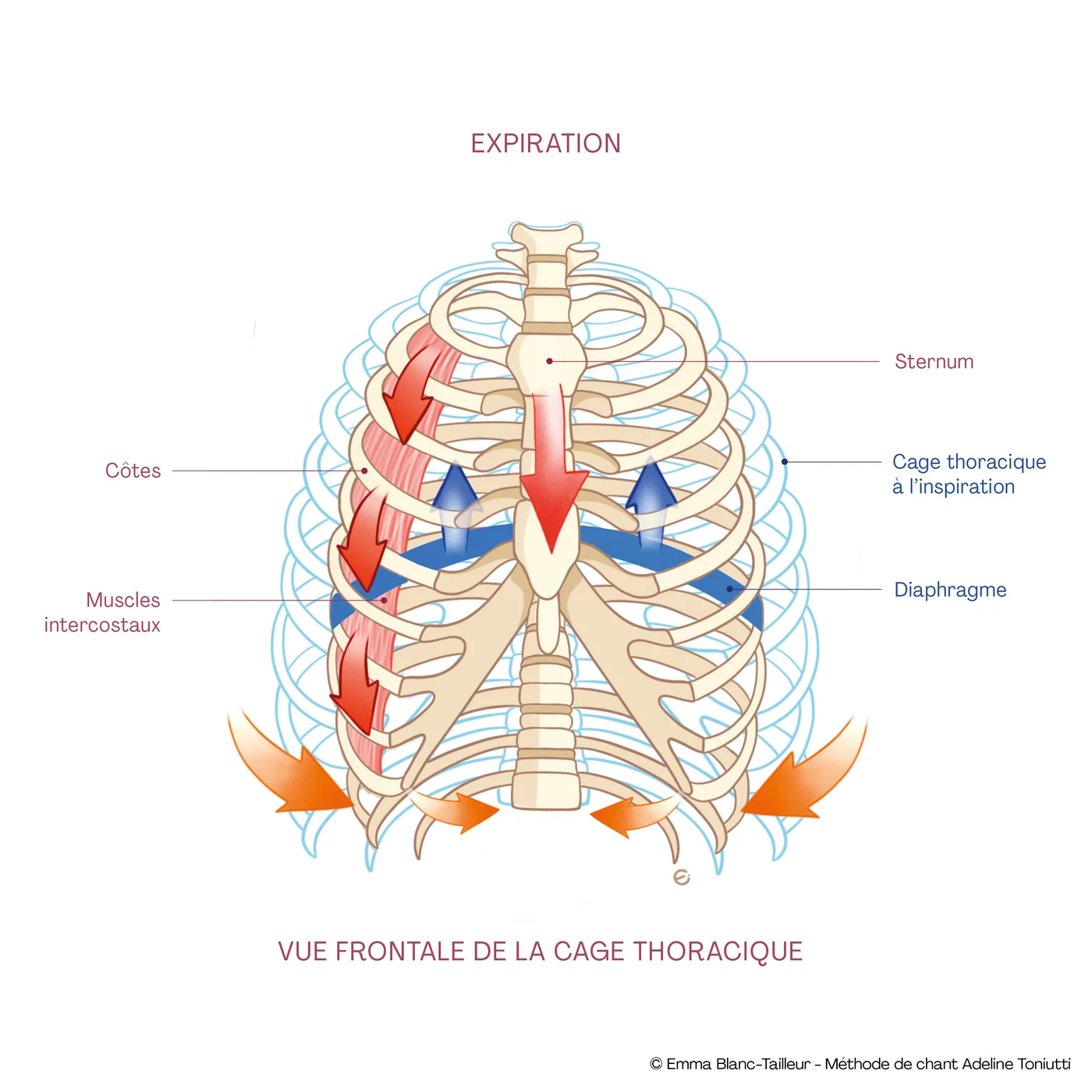
It occurs when the pressure inside the lung is greater than the pressure of the outside air. The expiratory movement begins when inhalation ceases; the mobilized muscles return to their resting position, which naturally and automatically causes the ribs to close and the diaphragm to rise (its cords relax, its pillars lengthen to let the dome rise). The volume of the rib cage decreases and air is expelled from the lungs.
Illustrations © Emma Blanc-Tailleur, Anatomie du Chant, Adeline Toniutti
The singer's challenge is to optimize inhalation and master exhalation, both for the purposes of musical aesthetics.
IN PRACTICE
Feeling the movement of the rib cage
On inhalation, the external intercostal muscles activate. The singer can observe the sternum rising and expanding. The ribs flare outward at the back and front; the floating ribs move slightly backward and horizontally; the diaphragm descends to allow the lungs to expand.
On exhalation, the internal intercostal muscles activate. One can feel the sternum descending. The ribs draw together and the diaphragm rises to expel air from the lungs.
Illustrations © Emma Blanc-Tailleur, Anatomie du Chant, Adeline Toniutti
As the osteopath Jean-Marie Legé, whose insight informs the method, explains: when one muscle layer contracts, it draws the ribs together; when the other contracts, it opens them. On inhalation, the ribs spread and become horizontal; on exhalation, they come together and become vertical.
EXERCISE
Smelling a flower
Goal: become aware of the movement of the rib cage.
- Inhale as if you wanted to smell the delicate fragrance of a flower, mouth closed.
- Cross your arms and place your hands on the floating ribs to feel the movement of the rib cage.
- You can do this exercise standing, sitting, or lying down.
EXERCISE
The breathing pause
Goal: breathe to reduce stress.
- Take a short breathing break during your day. It could be on the metro, in the supermarket queue, before a meeting. In all moments of your daily life, and especially when you feel stressed, this breathing awareness exercise will do you good.
- Inhale for two counts through the nose; then blow warm air out through the mouth for eight counts. Breathing should feel pleasant.
- A variation is possible: exhale first for four counts, then inhale for two counts.
GO FURTHER
Work on your breathing with CALYP
These principles are at the heart of the vocal method developed and tested by Adeline Toniutti, which she sets out in her book Anatomie du Chant (Marabout, 2024). To learn how to optimize your inhalation and master your exhalation with the CALYP team, contact the Voice Clinic.
Contact us