Die Stimme nicht ermüden
STIMMKLINIK
Der Hals muss nicht zahlen. Müde Bauchmuskeln: normal. Müde Stimmlippen: die Geste war nicht gesund.
A HEALTHY GESTURE
Der Hals muss nicht zahlen
Singing remains physical work. After a session the abdominals may be tired. That is normal.
Die Stimmlippen nicht.
Adeline Toniutti unterscheidet zwei Ermüdungen. Die der Randmuskeln kann beim Korrigieren einer Geste auftreten. Die der Stimmlippen darf nicht kommen. In Anatomie du Chant hat eine gesunde Geste drei gleich schwere Bedingungen:
- 1.Der Ton hält vor Musikprofis stand.
- 2.Man kann ihn so oft wiederholen, wie verlangt.
- 3.Danach ist der Ton noch geschmeidig. Keine Stimmlippenermüdung. Nur normale körperliche Müdigkeit.
Physical comfort has a precise meaning here: at the end of the session, no discomfort and no pain in the throat.
THE GESTURE
Was wirklich ermüdet
You can make a sound that “passes” with a bad gesture. The audience does not always hear the difference at once. Adeline calls that singing the wrong way up, or having the voice the wrong way up.
The bad gesture, repeated, with fatigue coming back, can lead to dysfunctional lesions. They appear later. The consequences for the folds are more serious.
Nicht die Lautstärke nutzt ab. Es ist ein Kehlkopf, der statt des Gürtels arbeitet, eine blockierende Zunge, eine zu große Einatmung, ein schlaffer Kiefer, eine vergessene Haltung.
Der inaktive Gürtel. The lungs have no motor muscle of their own. Without transversus, obliques and rectus, exhalation is no longer measured. The sound runs out of air, or is forced. The larynx compensates. It is the one that pays.
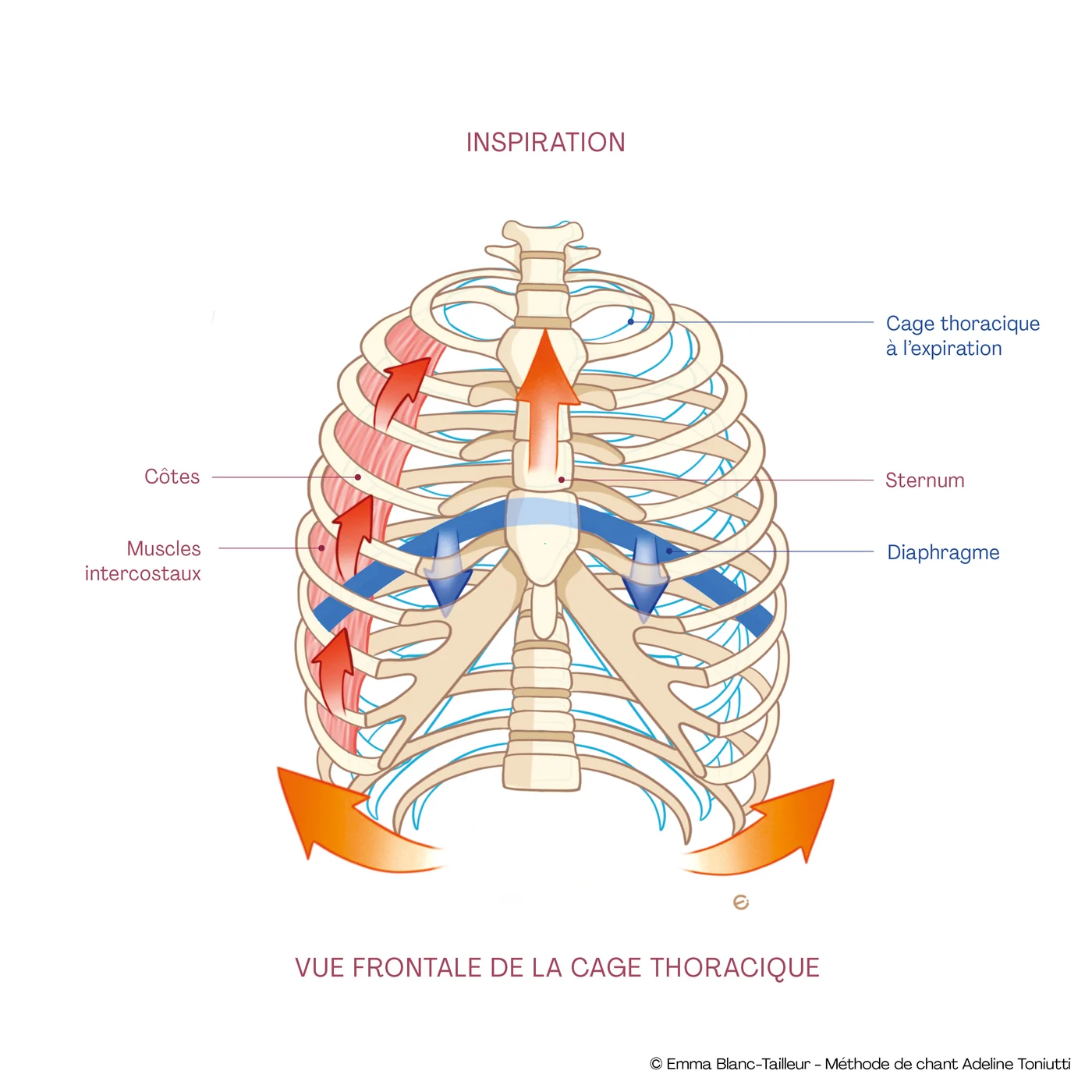
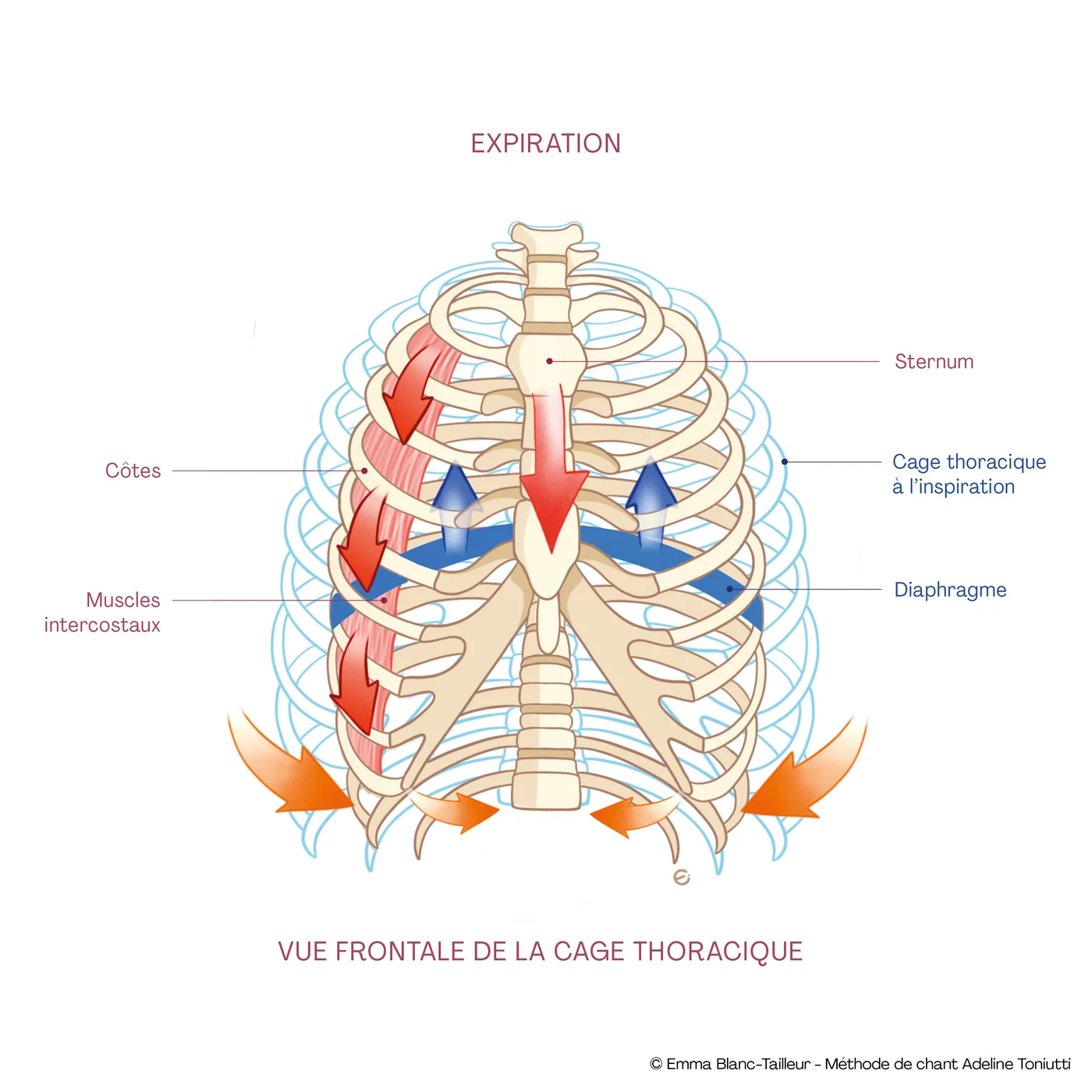
Illustrationen © Emma Blanc-Tailleur, Anatomie du Chant, Adeline Toniutti
Ribs locked on the inhale. The diaphragm can no longer descend freely. Useful volume drops, the phrase stiffens, you push to finish.
Der nach unten gedrückte Kehlkopf. Der Kehlkopf folgt der ausgeatmeten Luft nach oben, ohne oben zu blockieren. Er bleibt eine Hängematte, keine Schublade.
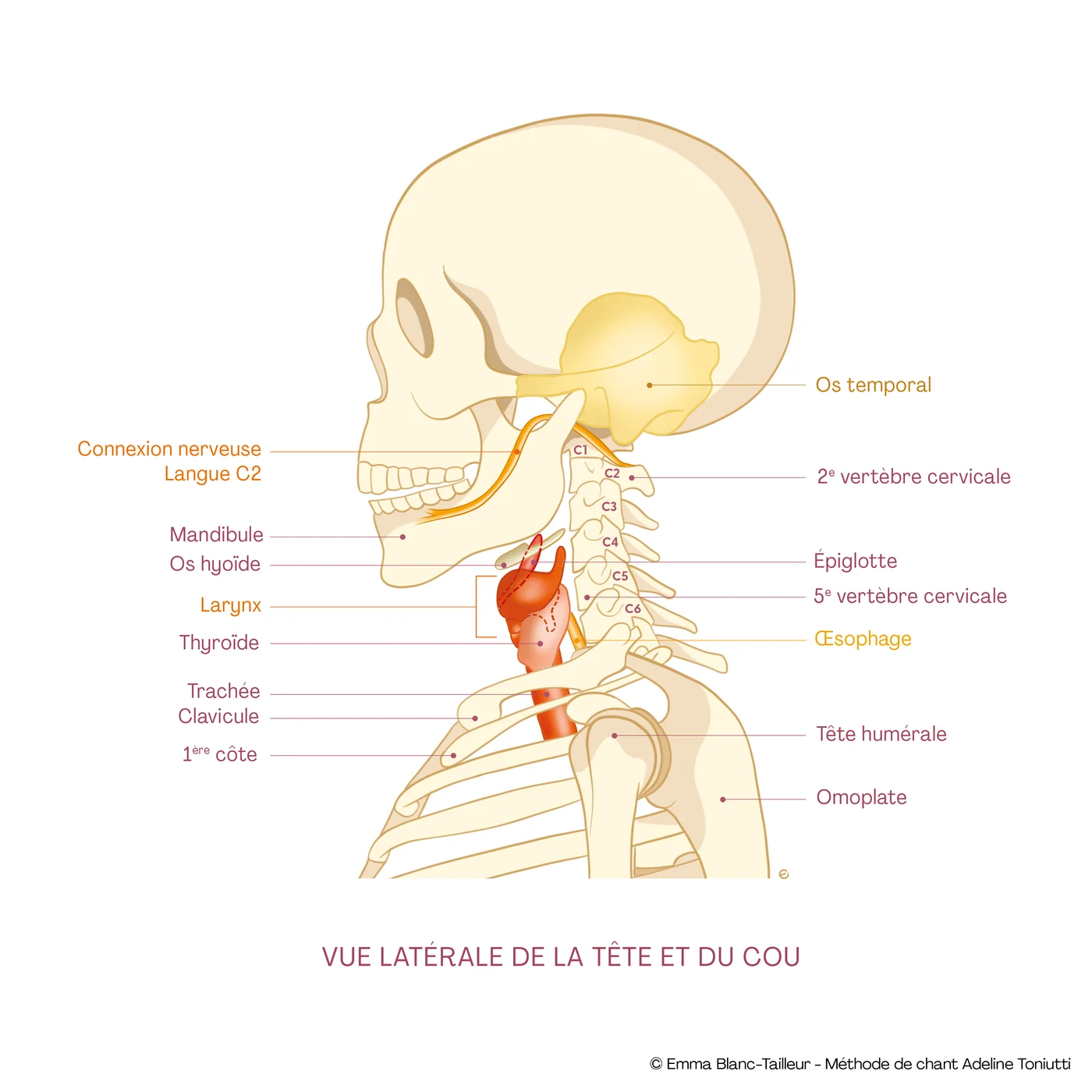
Illustration © Emma Blanc-Tailleur, Anatomie du Chant, Adeline Toniutti
The tongue falling onto the mandible. Thumbs behind the bone, in the space between larynx and jaw: if the tongue comes to meet the fingers and locks, the movement is wrong. If it moves away, toward the soft palate, without sticking to it, the gesture is the right one.
A mandible that is too slack. Opening is not yawning. A soft jaw releases the anterior chain, reduces the soft palate, disturbs laryngeal suspension, and articulation becomes a caricature that hurts the throat.
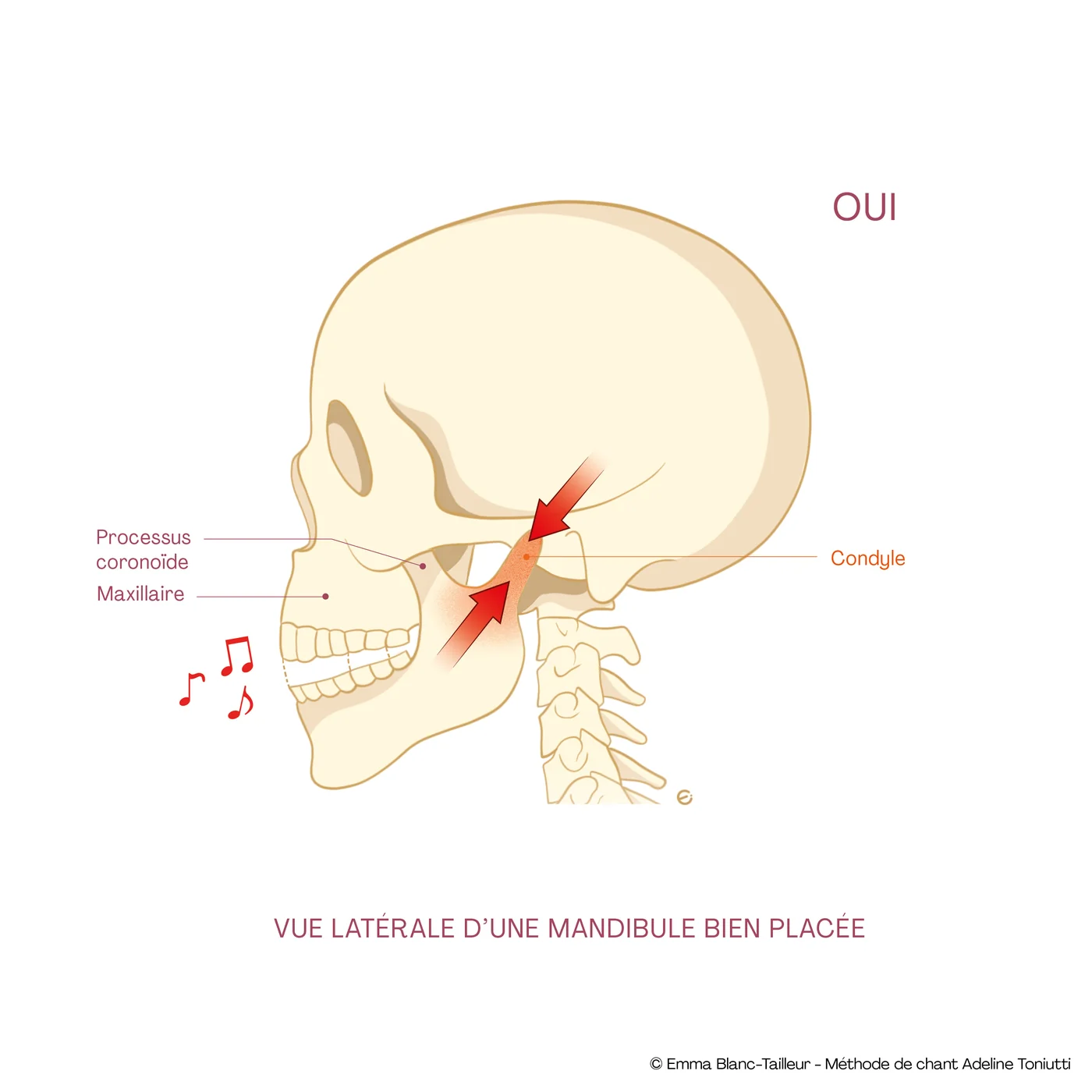
Illustration © Emma Blanc-Tailleur, Anatomie du Chant, Adeline Toniutti
Singing on the inhale. You can make a sound while inhaling. It is not aesthetic. It is exhausting.
Die große Luft, der «vokale Everest». Adeline hat das Gegenteil gesehen: sehr klein einatmen, zweimal, sehr schnell, als riechtest du eine Blume, findet die richtige Bewegung schneller.
Releasing the ribs on the note. On a high note, most people let the floating ribs open again. The required pressure disappears. The larynx is left alone.
Forgotten posture. Neck, shoulders, pelvis: the first thing you drop, too busy with the notes or the stress. It is also the first thing that degrades the gesture. Osteopath Jean-Marie Legé: when the atlas slides sideways, the patient’s voice is veiled and fatiguable.
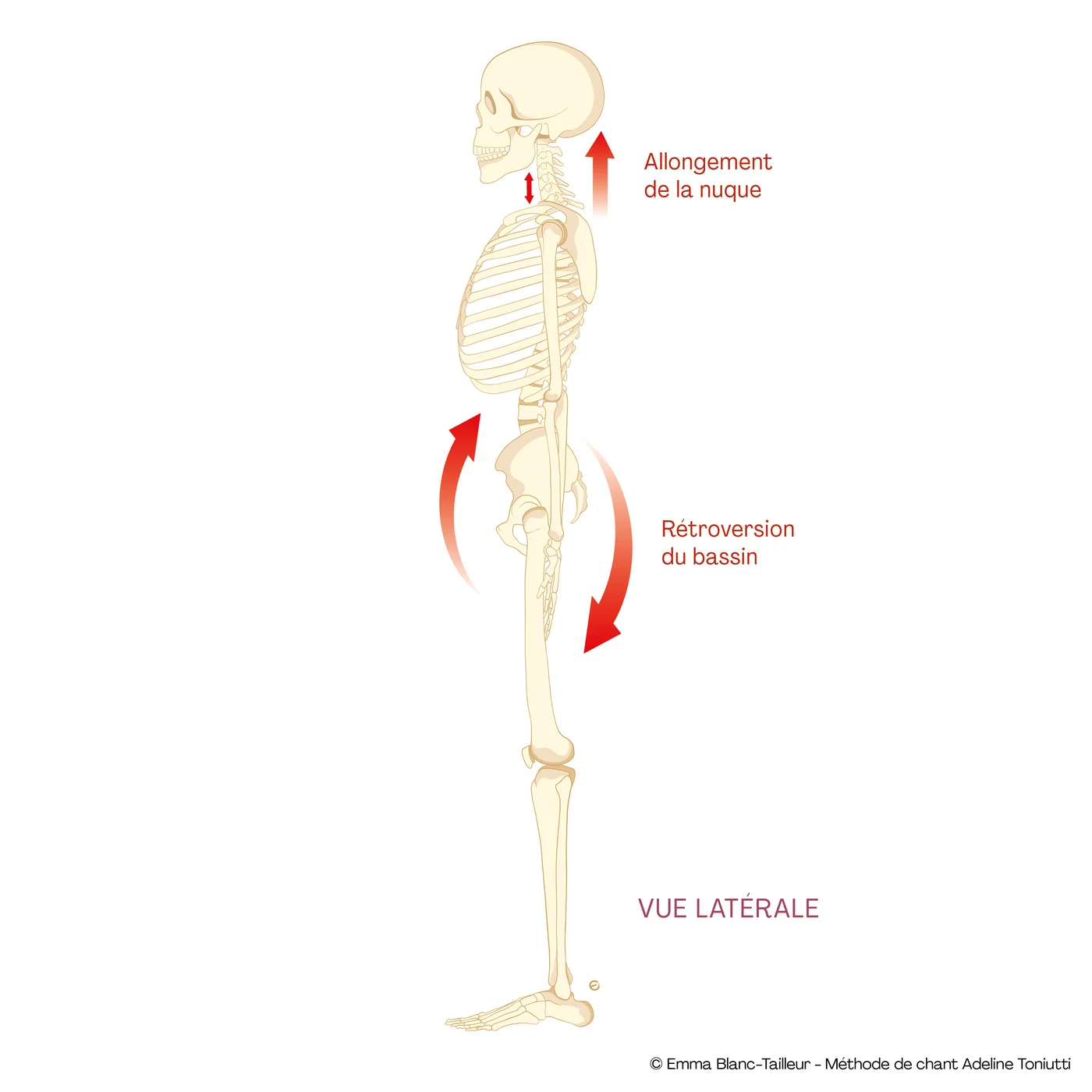
Illustration © Emma Blanc-Tailleur, Anatomie du Chant, Adeline Toniutti
IN THE LESSON
Stoppen, sobald der Hals spricht
Tut der Hals weh oder entsteht ein Unbehagen, sagt man es sofort. Eine Übung, die wehtut, wird nicht fortgesetzt.
It is the coach’s responsibility to check that the technique respects the instrument. It is the student’s duty to report. A lesson sung with a sore throat throughout can cause a lesion within 24 hours.
Ist die Stimme 24 Stunden nach der Stunde noch unnormal, gab es ein Problem. Bei einer Läsion mindestens 48 bis 72 Stunden Stimmschonung, dann HNO, wenn sie nicht zurückkehrt.
Signs to take seriously (this is then dysphonia): the voice carries less; the range shrinks; the timbre changes; speaking or singing becomes hard, the folds vibrate poorly.
Lifestyle, drinking ahead of effort, recovery after the stage: that already lives on the Voice Care page. This page is the gesture.
DOSE
Eine Geste, die man wiederholen kann
The method does not give an hour quota. It gives a criterion: the gesture must be repeatable.
A high note is healthy when you can approach it every way: from below, staccato, legato, in every dynamic, in every register. If you can only do it by forcing once, it is not a high note yet. It is an accident.
The same for a forte. If the sound only holds because you pushed, you will not be able to ask for it again tomorrow. On stage, plan recovery. The stage is demanding.
Hydration is anticipated. Jean-Marie Legé: water takes six hours to be used. The detail is on Stimmpflege.
„Wäre ich [Céline Dions] Vocal Coach gewesen, hätte ich ihr dasselbe geraten, es ist eine kluge Entscheidung. […] Mit ihrer Krankheit ist es weit vernünftiger, die Tonart abzusenken, damit sie die ganze Show durchhält, statt bei einem Lied alles zu geben und am Ende völlig erschöpft zu sein.“
WHAT YOU FEEL
Wenn es stimmt
You feel air leaving through the mouth, and a tiny mist through the nose, whatever the vowel. A finger under the nose checks it.
Man versucht nicht, sich im eigenen Kopf laut zu hören. Der Stapediusreflex schützt das Innenohr.
The larynx stays mobile. The sternal notch stays free. The base of the tongue goes toward the soft palate, without sticking to it (otherwise the sound becomes entirely nasal).
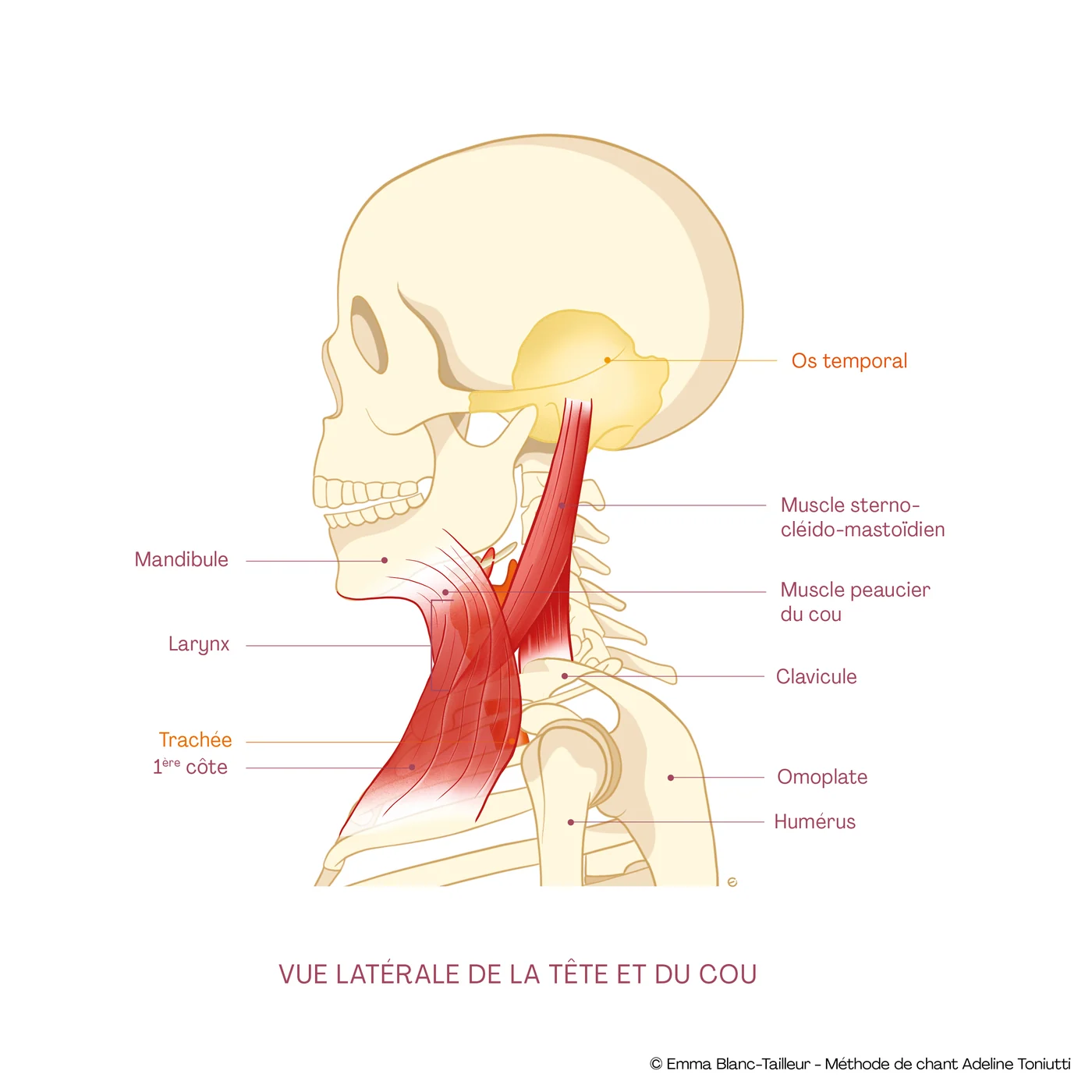
Illustration © Emma Blanc-Tailleur, Anatomie du Chant, Adeline Toniutti
IN PRACTICE
Drei Prüfungen
1. Stop as soon as the throat speaks
Discomfort means you change a parameter. You do not push through.
2. Check who is working
Hands on the floating ribs, inhale as if smelling a flower. On the exhale the ribs draw together, the obliques hold. If only the neck hardens, that is not singing: it is compensation.
3. Thumbs under the mandible
The tongue moves away from the fingers. It does not rest on them. You should be able to sing like that without discomfort.
Diese drei Gesten geschehen unter Beachtung der fünf Drehpunkte. Pathologie der Stimmlippen: zuerst die Fachperson.
CALYP
Die Geste beim CALYP erarbeiten
Die Methode steht in Anatomie du Chant (Marabout, 2024). Um sie mit dem Team zu erarbeiten: Termin vereinbaren.
Häufige Fragen
Ist Halsschmerz nach dem Singen normal?
Nein. Die Bauchmuskeln dürfen müde sein. Die Stimmlippen nicht. Unbehagen oder Schmerz im Hals heißt: ein Parameter der Geste muss sich ändern.
Was heißt verkehrt herum singen?
Einen Ton erzeugen, der mit einer schlechten Geste korrekt wirken kann. Wiederholt ermüdet das die Stimmlippen und kann später Läsionen nach sich ziehen.
Wie lange ruhen, wenn die Stimme nach der Stunde unnormal ist?
Ist sie 24 Stunden später noch unnormal, gab es ein Problem. Bei einer Läsion 48 bis 72 Stunden Stimmschonung, dann HNO, wenn sie nicht zurückkehrt.
Ermüdet die Lautstärke die Stimme?
Nein. Es ist der Kehlkopf, der statt des Gürtels arbeitet, gelöste Rippen, eine blockierte Zunge, eine zu große Einatmung oder eine vergessene Haltung.