Come non stancare la voce
CLINICA DELLA VOCE
La gola non deve pagare. Fatica degli addominali: normale. Fatica delle corde: il gesto non era sano.
A HEALTHY GESTURE
La gola non deve pagare
Cantare resta un esercizio fisico. Alla fine di una lezione gli addominali possono essere stanchi. È normale.
Le corde vocali, no.
Adeline Toniutti distingue due fatiche. La prima, dei muscoli periferici, appare quando si corregge un gesto. La seconda, delle corde, non deve arrivare. In Anatomie du Chant un gesto sano ha tre condizioni dello stesso peso:
- 1.Il suono regge davanti a professionisti della musica.
- 2.Lo si può rifare tutte le volte che viene chiesto.
- 3.Dopo, il suono è ancora flessibile. Nessuna fatica delle corde. Solo la fatica fisica normale.
Physical comfort has a precise meaning here: at the end of the session, no discomfort and no pain in the throat.
THE GESTURE
Ciò che stanca davvero
You can make a sound that “passes” with a bad gesture. The audience does not always hear the difference at once. Adeline calls that singing the wrong way up, or having the voice the wrong way up.
The bad gesture, repeated, with fatigue coming back, can lead to dysfunctional lesions. They appear later. The consequences for the folds are more serious.
Non è il volume a usurare. È una laringe che lavora al posto della fascia, una lingua che blocca, un’inspirazione troppo grande, una mandibola molle, una postura dimenticata.
La fascia inattiva. The lungs have no motor muscle of their own. Without transversus, obliques and rectus, exhalation is no longer measured. The sound runs out of air, or is forced. The larynx compensates. It is the one that pays.
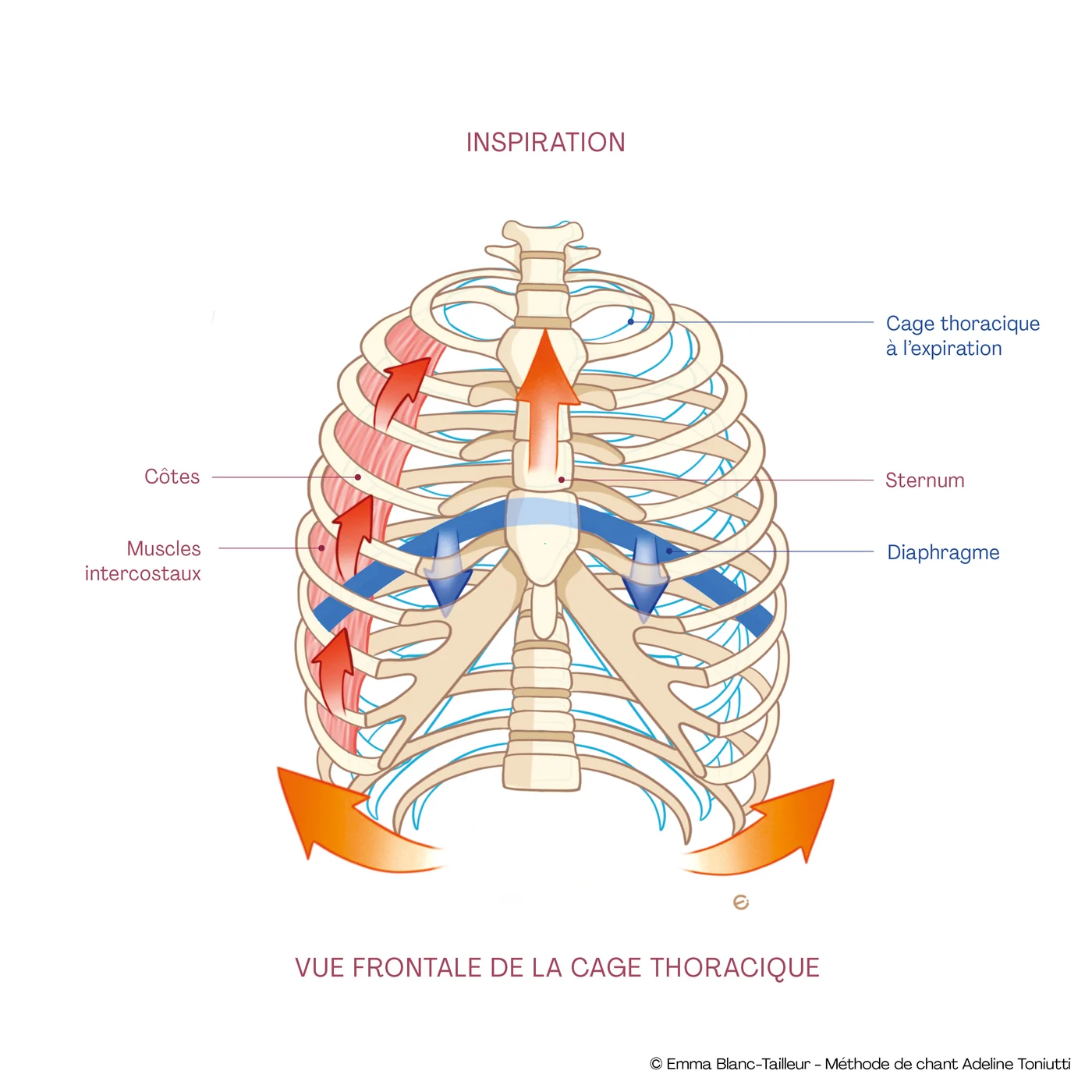
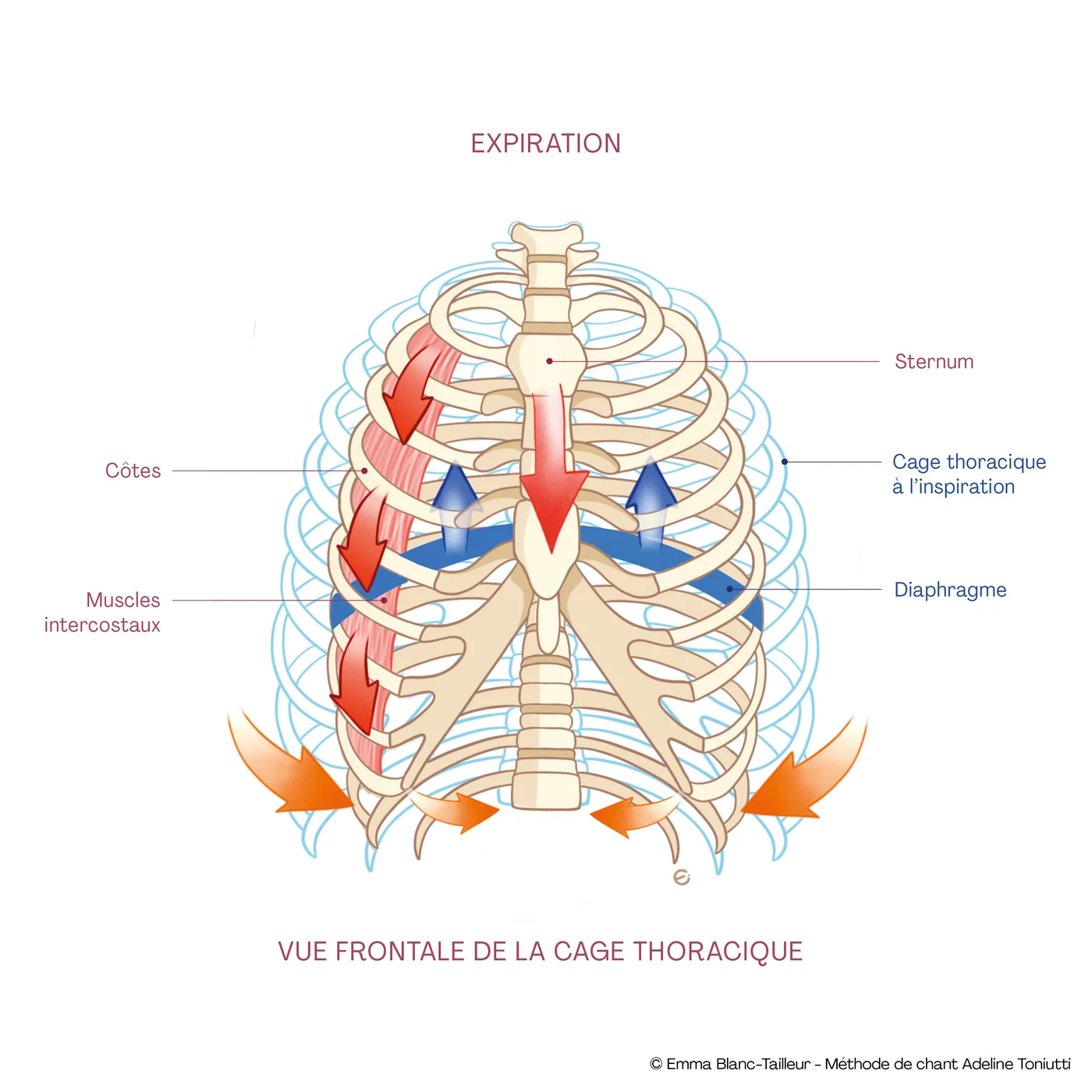
Illustrazioni © Emma Blanc-Tailleur, Anatomie du Chant, Adeline Toniutti
Ribs locked on the inhale. The diaphragm can no longer descend freely. Useful volume drops, the phrase stiffens, you push to finish.
La laringe spinta in basso. La laringe segue l’aria espirata, verso l’alto, senza bloccarsi in alto. È un’amaca, non un cassetto.
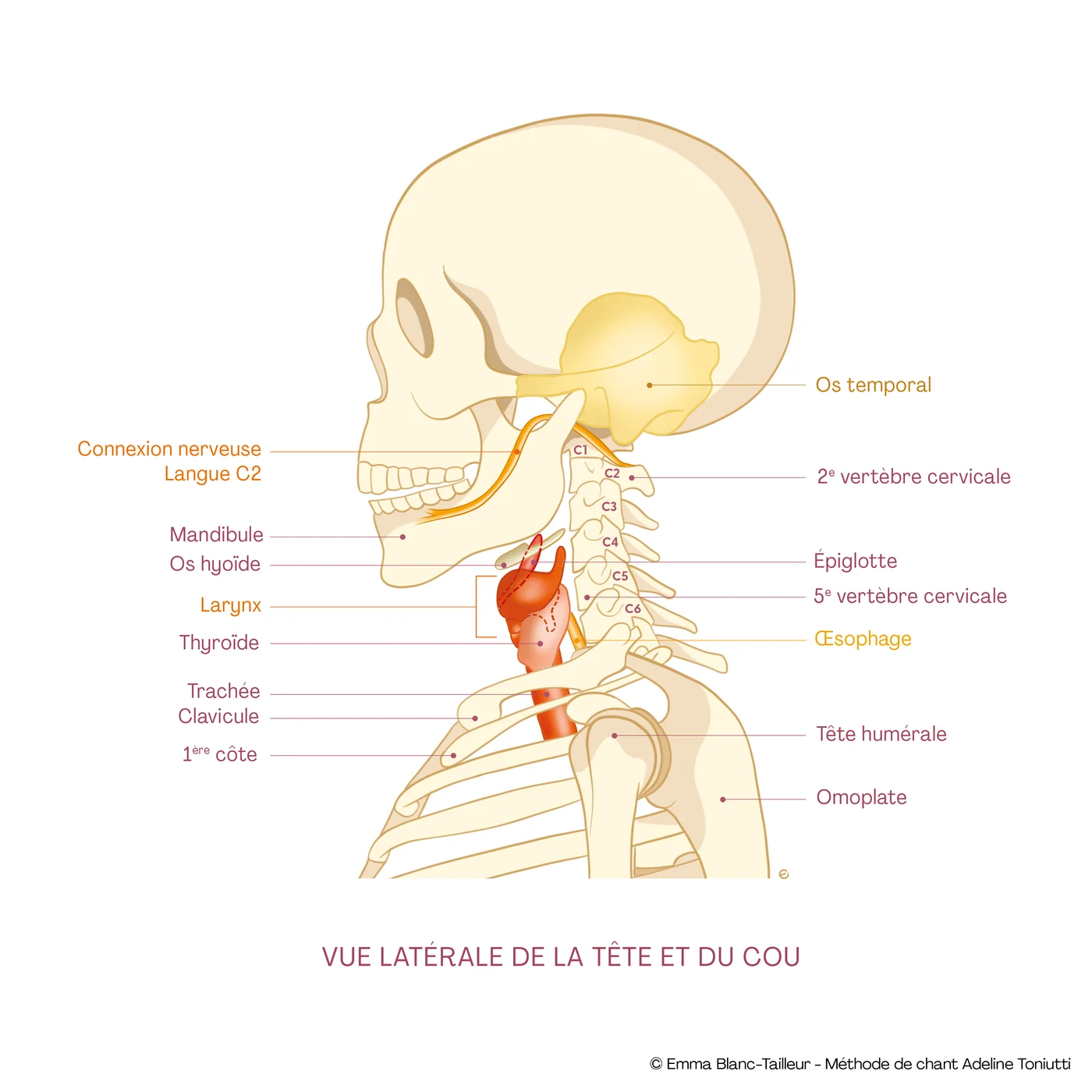
Illustrazione © Emma Blanc-Tailleur, Anatomie du Chant, Adeline Toniutti
The tongue falling onto the mandible. Thumbs behind the bone, in the space between larynx and jaw: if the tongue comes to meet the fingers and locks, the movement is wrong. If it moves away, toward the soft palate, without sticking to it, the gesture is the right one.
A mandible that is too slack. Opening is not yawning. A soft jaw releases the anterior chain, reduces the soft palate, disturbs laryngeal suspension, and articulation becomes a caricature that hurts the throat.
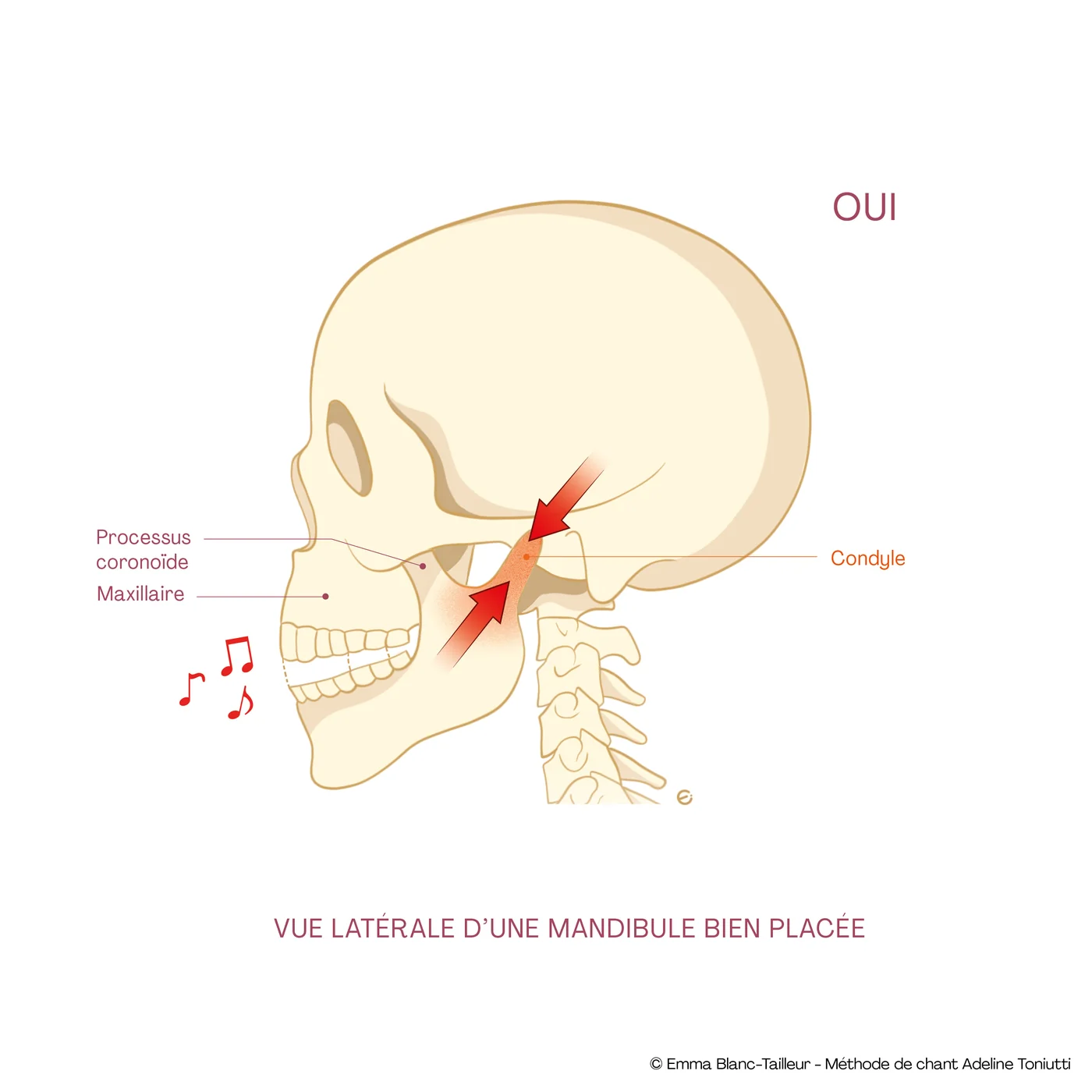
Illustrazione © Emma Blanc-Tailleur, Anatomie du Chant, Adeline Toniutti
Singing on the inhale. You can make a sound while inhaling. It is not aesthetic. It is exhausting.
La grande presa d’aria, l’«Everest vocale». Adeline ha constatato il contrario: inspirare molto piccolo, due volte, molto in fretta, come per annusare un fiore, trova prima il movimento giusto.
Releasing the ribs on the note. On a high note, most people let the floating ribs open again. The required pressure disappears. The larynx is left alone.
Forgotten posture. Neck, shoulders, pelvis: the first thing you drop, too busy with the notes or the stress. It is also the first thing that degrades the gesture. Osteopath Jean-Marie Legé: when the atlas slides sideways, the patient’s voice is veiled and fatiguable.
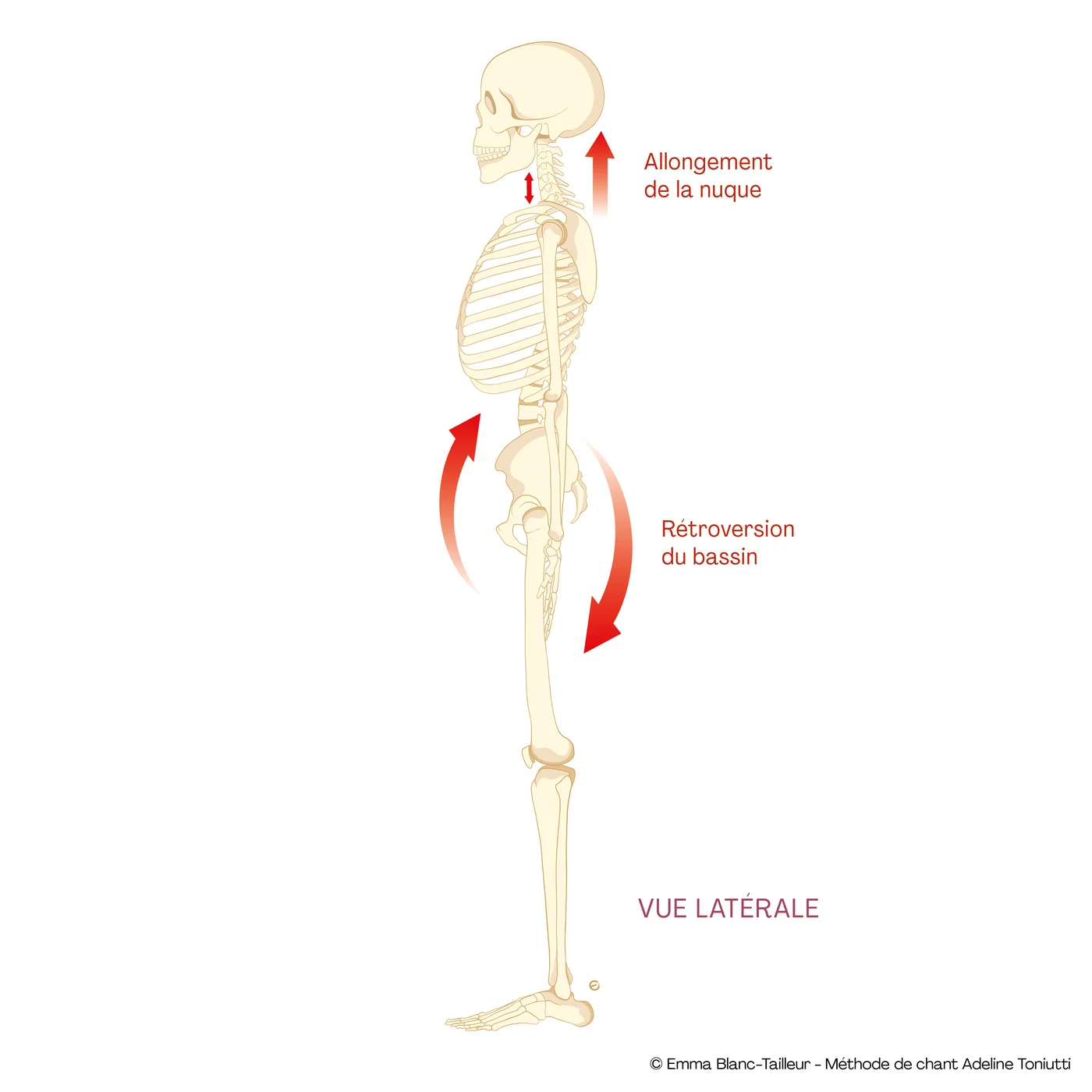
Illustrazione © Emma Blanc-Tailleur, Anatomie du Chant, Adeline Toniutti
IN THE LESSON
Fermarsi appena la gola parla
Se la gola fa male, o compare un disagio, lo si dice subito. Non si continua un esercizio che fa male.
It is the coach’s responsibility to check that the technique respects the instrument. It is the student’s duty to report. A lesson sung with a sore throat throughout can cause a lesion within 24 hours.
Se la voce resta anormale 24 ore dopo la lezione, c’è stato un problema. Con una lesione, 48-72 ore di riposo vocale minimo, poi un ORL se non torna.
Signs to take seriously (this is then dysphonia): the voice carries less; the range shrinks; the timbre changes; speaking or singing becomes hard, the folds vibrate poorly.
Lifestyle, drinking ahead of effort, recovery after the stage: that already lives on the Voice Care page. This page is the gesture.
DOSE
Un gesto che si può ripetere
Il metodo non dà un monte ore. Dà un criterio: il gesto deve potersi ripetere.
A high note is healthy when you can approach it every way: from below, staccato, legato, in every dynamic, in every register. If you can only do it by forcing once, it is not a high note yet. It is an accident.
The same for a forte. If the sound only holds because you pushed, you will not be able to ask for it again tomorrow. On stage, plan recovery. The stage is demanding.
Hydration is anticipated. Jean-Marie Legé: water takes six hours to be used. The detail is on Prendersi cura della voce.
«Se fossi stata la vocal coach [di Céline Dion], le avrei detto di fare la stessa cosa, è una scelta intelligente. […] Con la sua malattia, è molto più ragionevole abbassare la tonalità perché regga tutta la durata, piuttosto che dare tutto su una canzone e ritrovarsi completamente esausta alla fine.»
WHAT YOU FEEL
Quando è giusto
You feel air leaving through the mouth, and a tiny mist through the nose, whatever the vowel. A finger under the nose checks it.
Non si cerca di sentirsi forti nella propria testa. Il riflesso stapediale protegge l’orecchio interno.
The larynx stays mobile. The sternal notch stays free. The base of the tongue goes toward the soft palate, without sticking to it (otherwise the sound becomes entirely nasal).
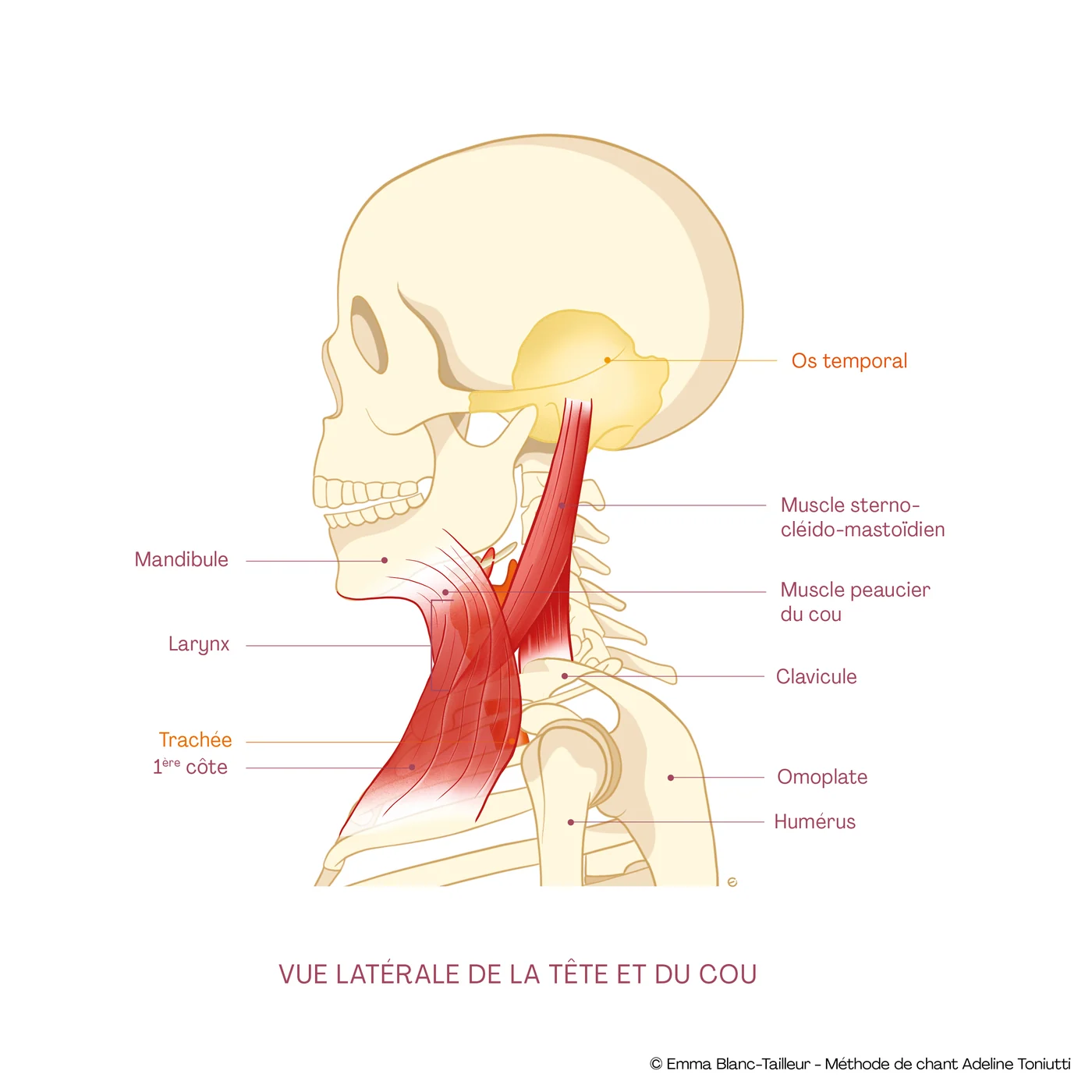
Illustrazione © Emma Blanc-Tailleur, Anatomie du Chant, Adeline Toniutti
IN PRACTICE
Tre verifiche
1. Stop as soon as the throat speaks
Discomfort means you change a parameter. You do not push through.
2. Check who is working
Hands on the floating ribs, inhale as if smelling a flower. On the exhale the ribs draw together, the obliques hold. If only the neck hardens, that is not singing: it is compensation.
3. Thumbs under the mandible
The tongue moves away from the fingers. It does not rest on them. You should be able to sing like that without discomfort.
Questi tre gesti si fanno rispettando i cinque punti cardine. Patologia alle corde: prima lo specialista.
CALYP
Lavorare il gesto al CALYP
Il metodo è in Anatomie du Chant (Marabout, 2024). Per lavorarlo con la squadra: prenota un appuntamento.
Domande frequenti
È normale avere mal di gola dopo aver cantato?
No. Gli addominali possono essere stanchi. Le corde no. Un disagio o un dolore in gola significa che un parametro del gesto deve cambiare.
Che cosa significa cantare al contrario?
Produrre un suono che può sembrare corretto con un gesto sbagliato. Ripetuto, stanca le corde e può provocare lesioni più tardi.
Quanto riposare se la voce è anormale dopo una lezione?
Se la voce resta anormale 24 ore dopo, c’è stato un problema. Con una lesione, 48-72 ore di riposo vocale, poi un ORL se non torna.
È il volume a stancare la voce?
No. È la laringe che lavora al posto della fascia, le coste rilasciate, la lingua bloccata, un’inspirazione troppo grande o una postura dimenticata.