
A clenched jaw: what are we talking about?
THE MANDIBLE
A singer’s jaw is held without being frozen. Neither slack nor locked: suspended by its joint, and free to make the micro-movements that pronunciation requires.
THE KEY IDEA
A jaw that is held is not a jaw that is locked
The key is the micro-movements. While you sing, the jaw is suspended by its joint and it keeps moving: the condyle stays lightly pinched, it holds the mandible instead of letting it drop, and the mandible still makes micro-movements during pronunciation and articulation, slightly forward and slightly back. They are what keeps the jaw from locking. You make sure not to let the jaw fall, and you still do not lock it in order to articulate.
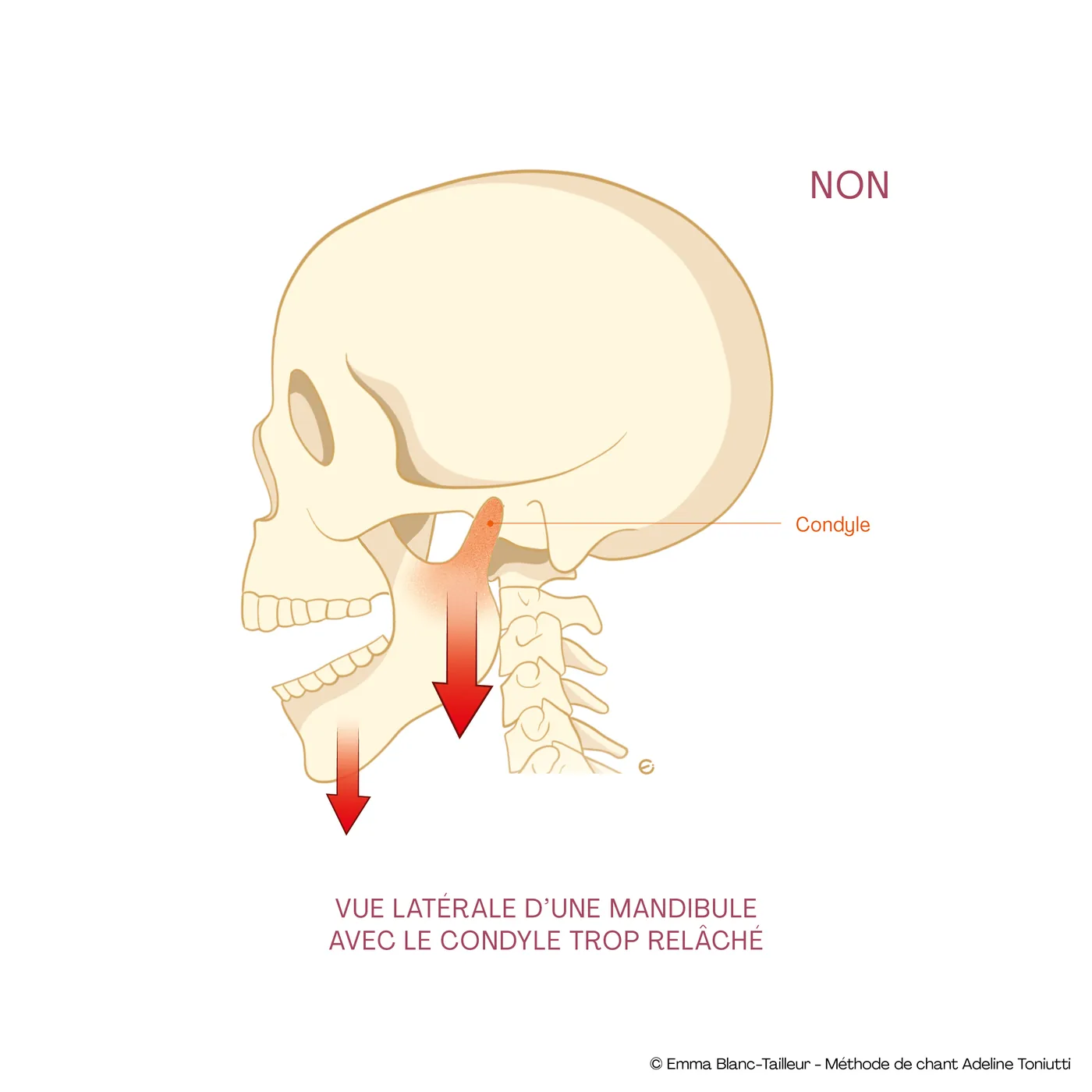
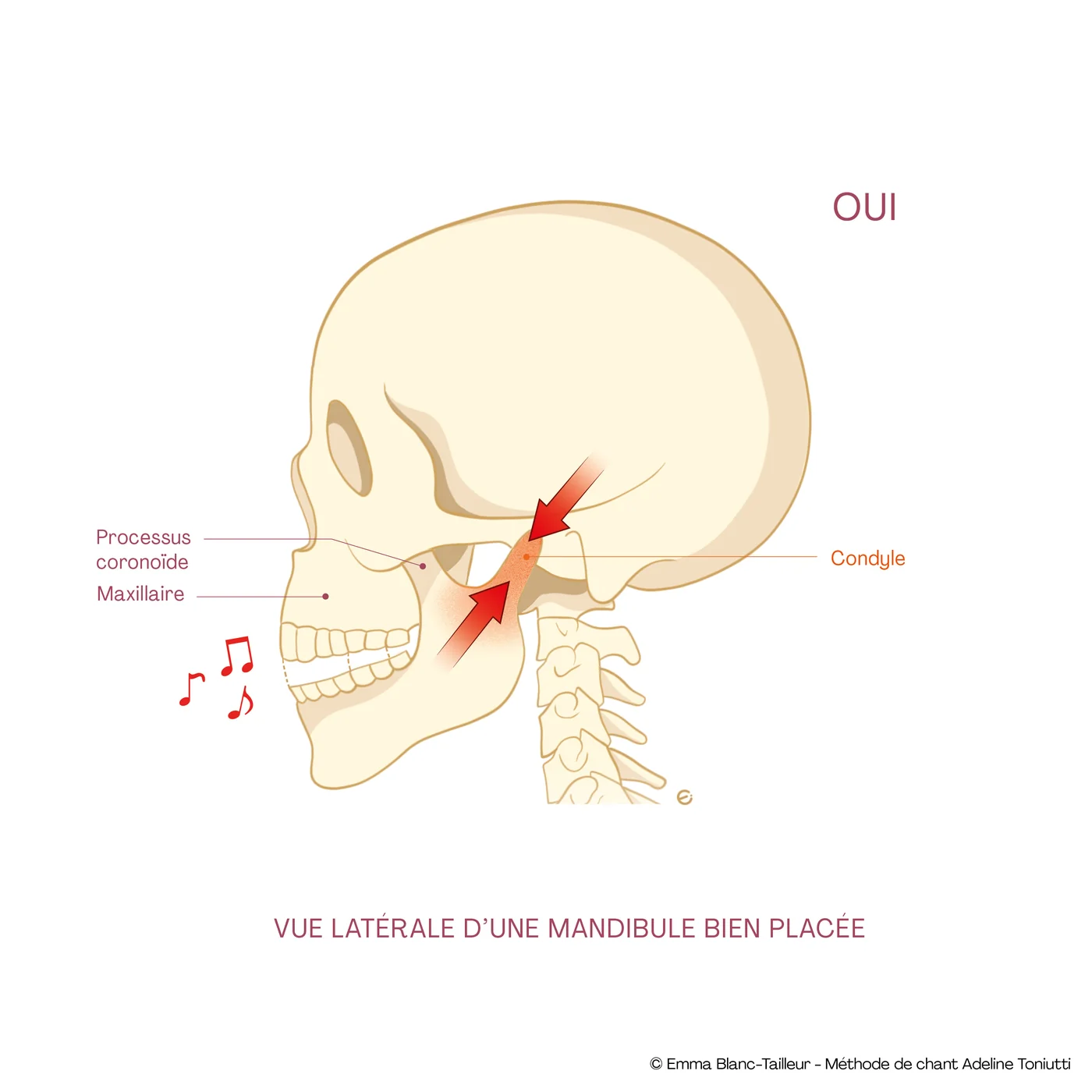
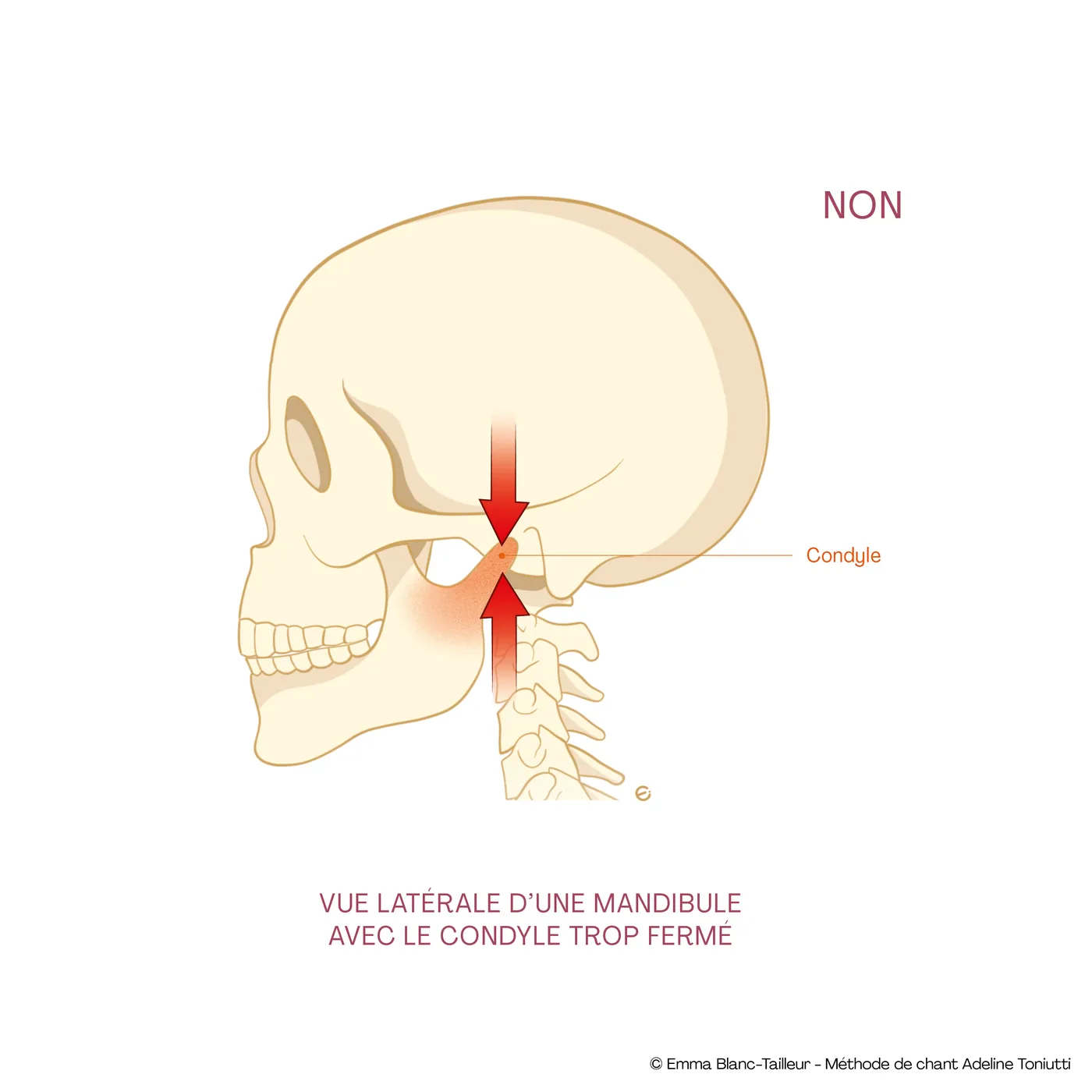
Illustrations © Emma Blanc-Tailleur, Anatomie du Chant, Adeline Toniutti
That sentence alone settles most of the misunderstandings about the jaw in singing. “Clenched” and “relaxed” are not the only two options available, and the right gesture is not found halfway between them. It belongs to a third category: a jaw that is held, toned and mobile.
The singer who clenches locks the joint upwards and can no longer pronounce. The singer who relaxes lets the joint drop, loses the hold, and ends up with exactly the same feeling of a stuck sound. The two gestures are opposite mistakes, and both are corrected by the same thing: giving the jaw back its active suspension.
The placement landmark fits in one sentence. The mandible comes down vertically, the upper and lower incisors tend to line up supplely, without freezing the position, and the condyle stays lightly pinched.
You have to look, like a watchmaker, for the balanced movement between not pulling the mandible too far back and not locking it forward past the upper incisors.
THE EXPRESSION
Why “your jaw is clenched” helps nobody
The phrase circulates in singing lessons, in studios and under competition videos. A teacher, a sound engineer or a fellow chorister uses it to describe a very real problem: the sound gets stuck, the high notes stop coming, the words blur, the voice loses its support.
So the expression describes a symptom, and it stops there. It says neither where the jaw is misbehaving nor in which direction the singer should correct the gesture. Two singers told the same sentence often make two opposite moves, and one of them makes things worse.
The advice that follows the phrase is almost always the same: open wider and relax. In Anatomie du Chant, Adeline Toniutti describes what that advice cost her when she was a student.
I tried everything, to the point where I had more appointments with my osteopath or my phoniatrician than with my singing teacher, because my jaw was locked or I could not find my voice again.
The rest of this page therefore takes the problem back to anatomy: what the jaw commands while you sing, then the four distinct ways of placing it badly.
ANATOMY
Where the jaw sits inside the instrument
The lower jaw is called the mandible. It is connected to the skull by the temporomandibular joint and it is part of the vocal tract, the tube that runs from the vocal folds to the lips. When it moves, the oral cavity changes shape, and the sound changes colour.
The cross-section below places the mandible among its immediate neighbours: the hard palate and the soft palate above, the tongue inside, the hyoid bone and the larynx just below. None of these parts moves without displacing the others.
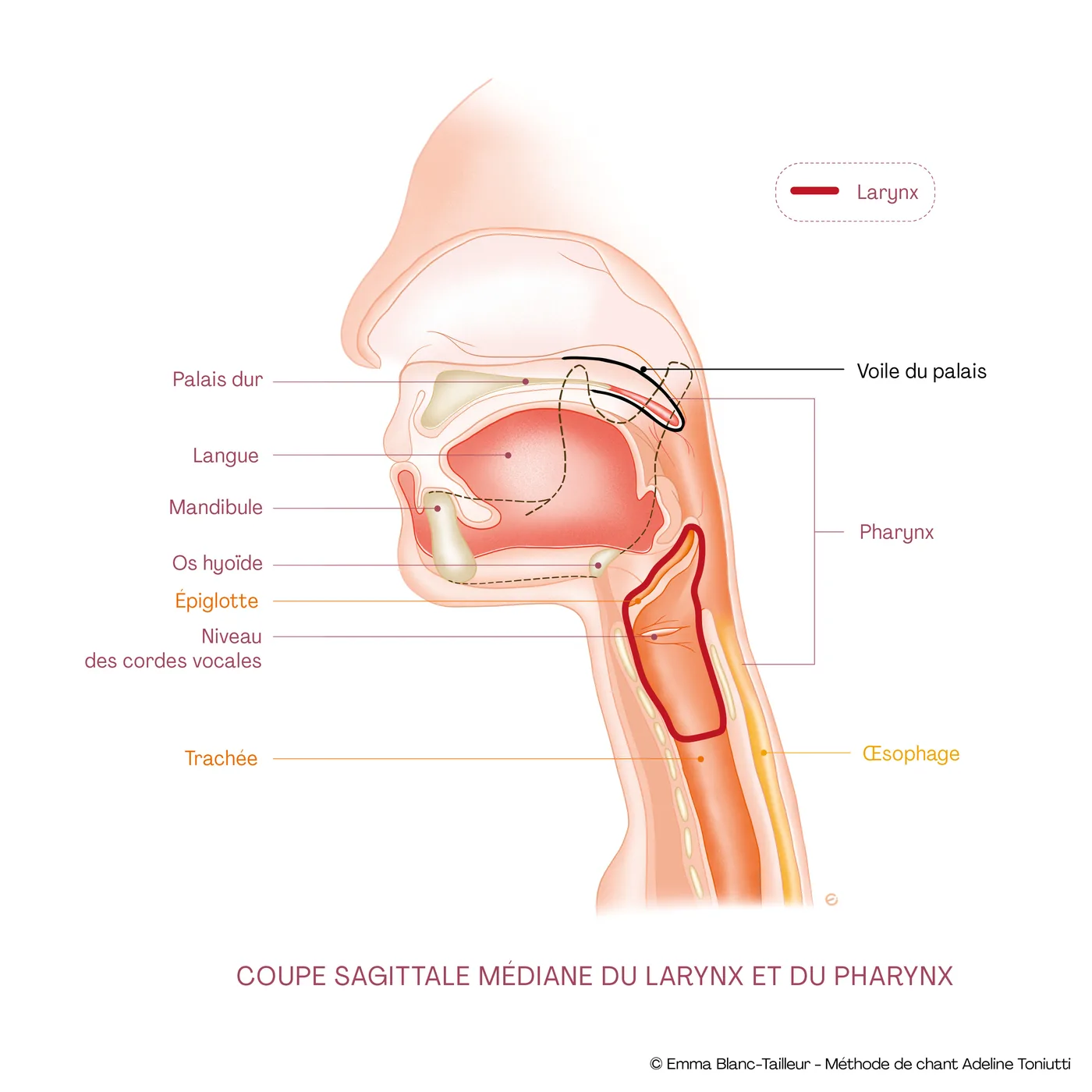
Illustration © Emma Blanc-Tailleur, Anatomie du Chant, Adeline Toniutti
The joint itself is steered by the condyle. The condyle is the rounded end of the mandible, on each side of the face, just in front of the external auditory canal. Place two fingers in front of your ear and open your mouth: the bump moving under your fingers is the condyle. It is the part you hold, and it is what gives the jaw its suspension.
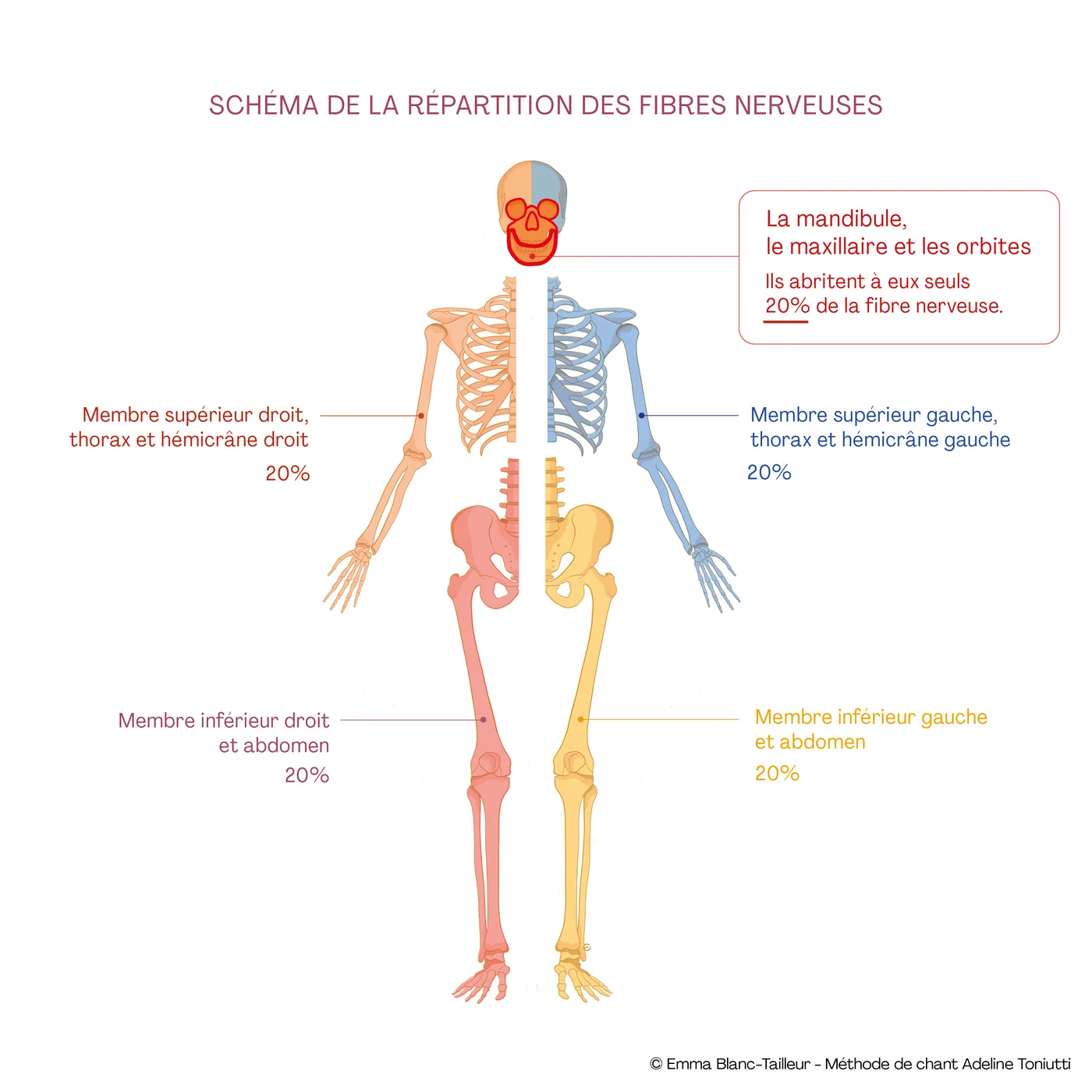
Illustration © Emma Blanc-Tailleur, Anatomie du Chant, Adeline Toniutti
DID YOU KNOW
A fifth of the nervous system sits in the face
According to osteopath Jean-Marie Legé, the jaw and the orbits alone hold 20 % of the body’s nerve fibre. The four limbs, the thorax and the abdomen share the remaining 80 %. That density explains why a small clench of the mandible produces such an invasive sensation.
THE THREE CHAINS
What the jaw commands while you sing
The mandible acts on three things at once, through nerve and muscle connections: the quality of the abdominal support, the mobility of the soft palate and the agility of word articulation. A badly held jaw therefore does not only disturb the mouth. It makes itself felt throughout the instrument, and that is why the hold of the condyle matters so much.
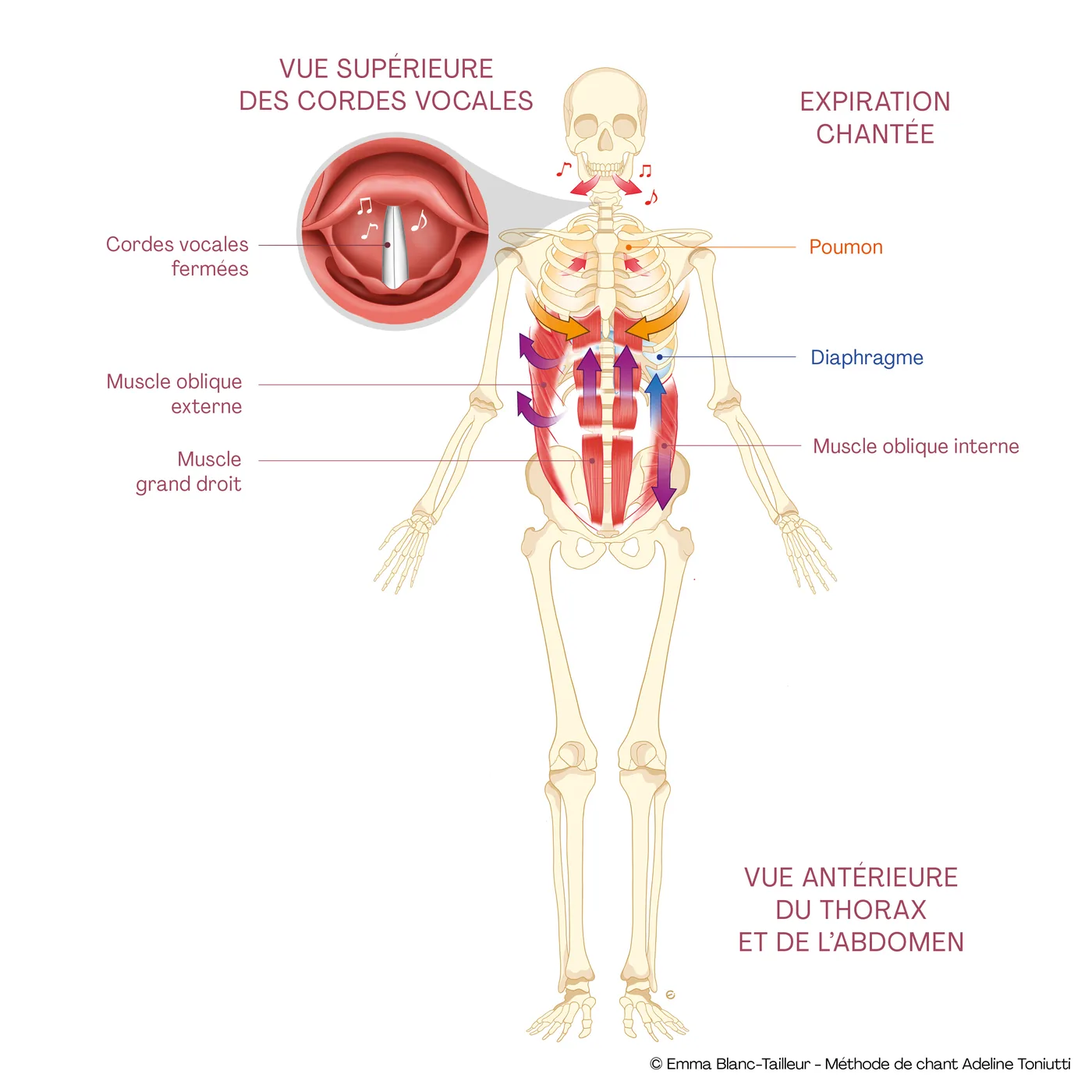
Downwards: the abdominals
When the singer keeps a certain tension in the jaw, they bring about the closing of the anterior muscle chain, and therefore of the abdominal muscles, and they tense all the muscles needed to control the diaphragm. Active exhalation then becomes steerable. You can check the link on yourself, without singing: the moment you swallow after chewing, the jaw relaxes and you feel the abdominals relax with it, instinctively.
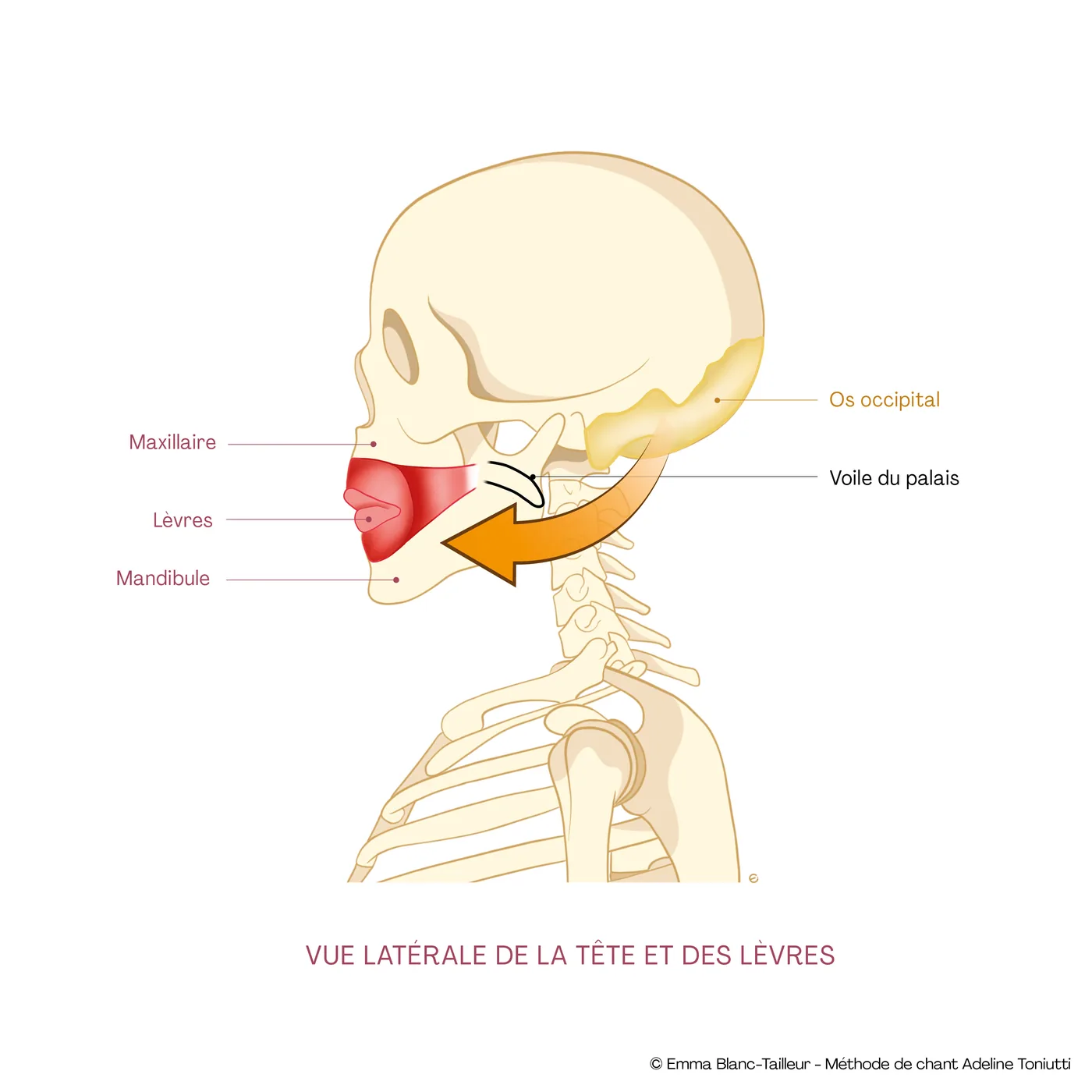
Upwards: the soft palate
The soft palate extends the hard palate backwards and regulates the passage between the mouth and the nasal cavities. Its movements depend on those of its neighbours, the tongue and the jaw. An over-relaxed mandible reduces the amplitude of those movements, and the singer loses the part of the sound that travels through the nose.
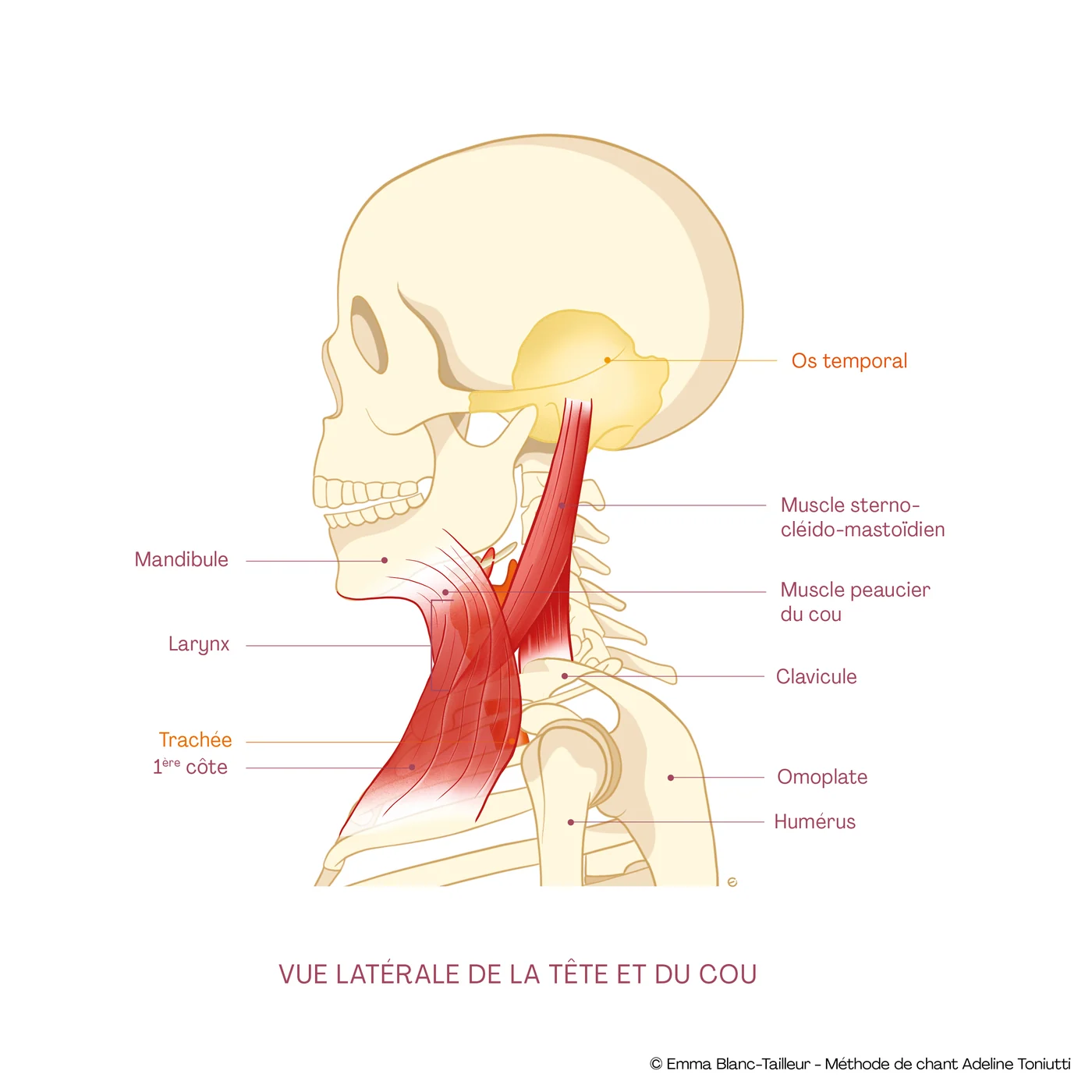
Backwards: the larynx and the shoulder blade
Tensing the condyle brings into play the muscles of the temporal bone, which has a descending membranous connection down to the shoulder blade and the hyoid bone. The jaw is therefore linked to the larynx by a continuous chain, and a badly held condyle hampers the laryngeal suspension as well as the movements of the soft palate. A mandible pulled too far back, for its part, directly disturbs the larynx sitting below it.
Illustrations © Emma Blanc-Tailleur, Anatomie du Chant, Adeline Toniutti
THE MISREADING
Why “relax your jaw” does not work
The advice rests on a simple idea: tension gets in the way, so relaxing frees you. Adeline Toniutti’s method takes the opposite view. The mandible is thought of as toned, not as very relaxed. Opening the mouth does not mean opening it all the way to slackness, as when you yawn.
When is the jaw completely relaxed? When you yawn and when you are dead.
An over-relaxed mandible produces four effects, and not one of the four looks like the freedom you were hoping for.
What an over-relaxed mandible causes:
- it slackens the anterior muscle chain, and therefore the abdominals;
- it reduces the amplitude of the soft palate’s movements;
- it alters the suppleness of the laryngeal suspension;
- it interferes with the articulation of words.
The instruction “open wide as if you were yawning” therefore manufactures precisely the problem it claims to solve. The singer loses the hold, still feels the sound stuck, and loses the abdominal support on top of it.
The right word for a singer’s jaw is neither “clenched” nor “relaxed”, it is “toned”. A toned jaw holds its position and keeps its mobility, like a hand holding a fragile object without crushing it or dropping it.
THE DIAGNOSIS
Four gestures that all go by the name “clenched jaw”
Two observations are enough to locate the problem: the axis of the mandible, meaning where it sits from front to back, and the hold of the condyle, meaning the way the joint is suspended. Each observation yields two possible errors.
1. The mandible too far forward
The singer pushes the jaw forward, often looking for room or for power, and the lower incisors go past the upper ones. The gesture stiffens the front of the neck and hardens the sound. The landmark is simple: the mandible must not come forward past the upper incisors.
2. The mandible too far back
The jaw travels backwards, often when the singer tucks in the chin to “place” the voice. A mandible pulled too far back disturbs the larynx, which sits just below. It is the gesture that most clearly gives the feeling of a sound stuck in the throat, even though the jaw itself is clenching nothing.
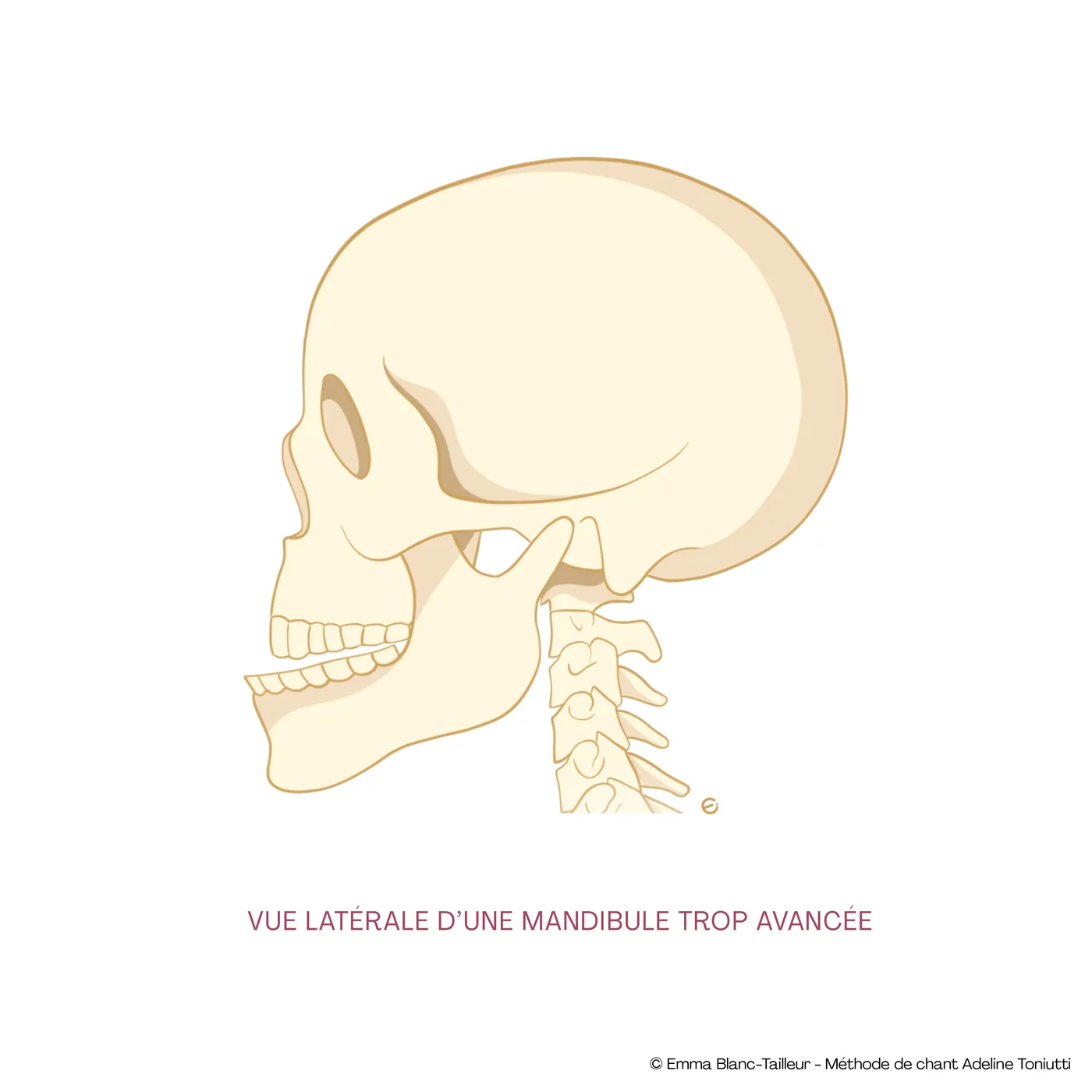
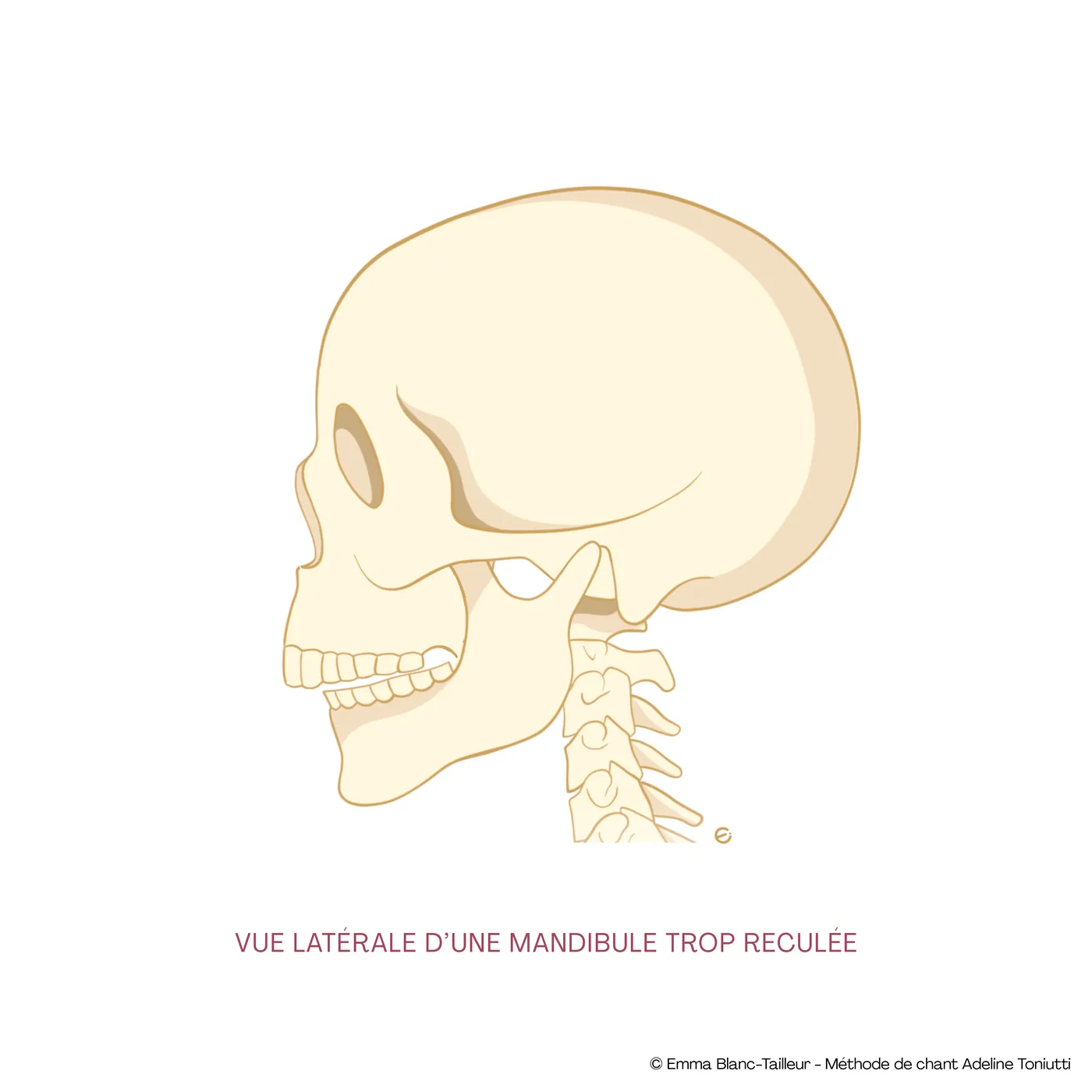
Illustrations © Emma Blanc-Tailleur, Anatomie du Chant, Adeline Toniutti
3. The condyle too closed
This is the only one of the four gestures that truly deserves the name of clenching. The joint is crushed upwards, the elevator muscles work permanently, and the mouth no longer opens enough to pronounce. A condyle that is too closed prevents the articulation of words and tires the area around the ear.
4. The condyle too loose
The jaw drops, without being held by the joint. The condyle then guides the mandible badly, hampers proper laryngeal suspension and hinders the movements of the soft palate. The singer feels a blockage and a sound that will not come out, exactly as in the previous case, even though the cause is the opposite. That is the gesture manufactured by the advice “relax and open wide”.
Illustrations © Emma Blanc-Tailleur, Anatomie du Chant, Adeline Toniutti
IN PRACTICE
How to check on yourself
Three simple gestures let you locate your own jaw, without a mirror and without equipment. The first checks the hold of the condyle, the second prepares the release when it is needed, the third gives the right opening through an image.
EXERCISE 1
Fingers placed on the condyle
While you sing, place your thumb and index finger around the jaw joint, in front of the ear. You will feel a space. That space must be neither loose nor too closed: in both cases you will no longer be able to pronounce. The condyle must be actively suspended. The fingers act as a landmark to feel the micro-movements and to steer the jaw better.
EXERCISE 2
Jaw massage
To be able to give your jaw the right tension, you also have to know how to release it. Practise a fingertip self-massage in front of the ears, breathing in and breathing out. This massage is very useful before a performance, to unwind a little before finding the working tone again.
EXERCISE 3
Show your claws
To find the right opening, picture a cat hissing because it is not happy. Its jaw and its tongue are placed exactly as they should be to produce a sound. Hiss in turn on “FFFihhhh!” with exhaled air. This exercise comes from La Bonne Voix, Adeline Toniutti’s book devoted to the speaking voice.
A correctly opened jaw supports the suspension of the larynx and stops the tongue from collapsing onto it, which directly benefits the articulation of vowels and consonants. Once the laryngeal movement is under control, it even becomes useful to work with the jaw closing, to get closer to the bocca chiusa effect: the lower jaw meets the upper jaw, the two rest on each other without being clenched, and the influence on the soft palate increases.
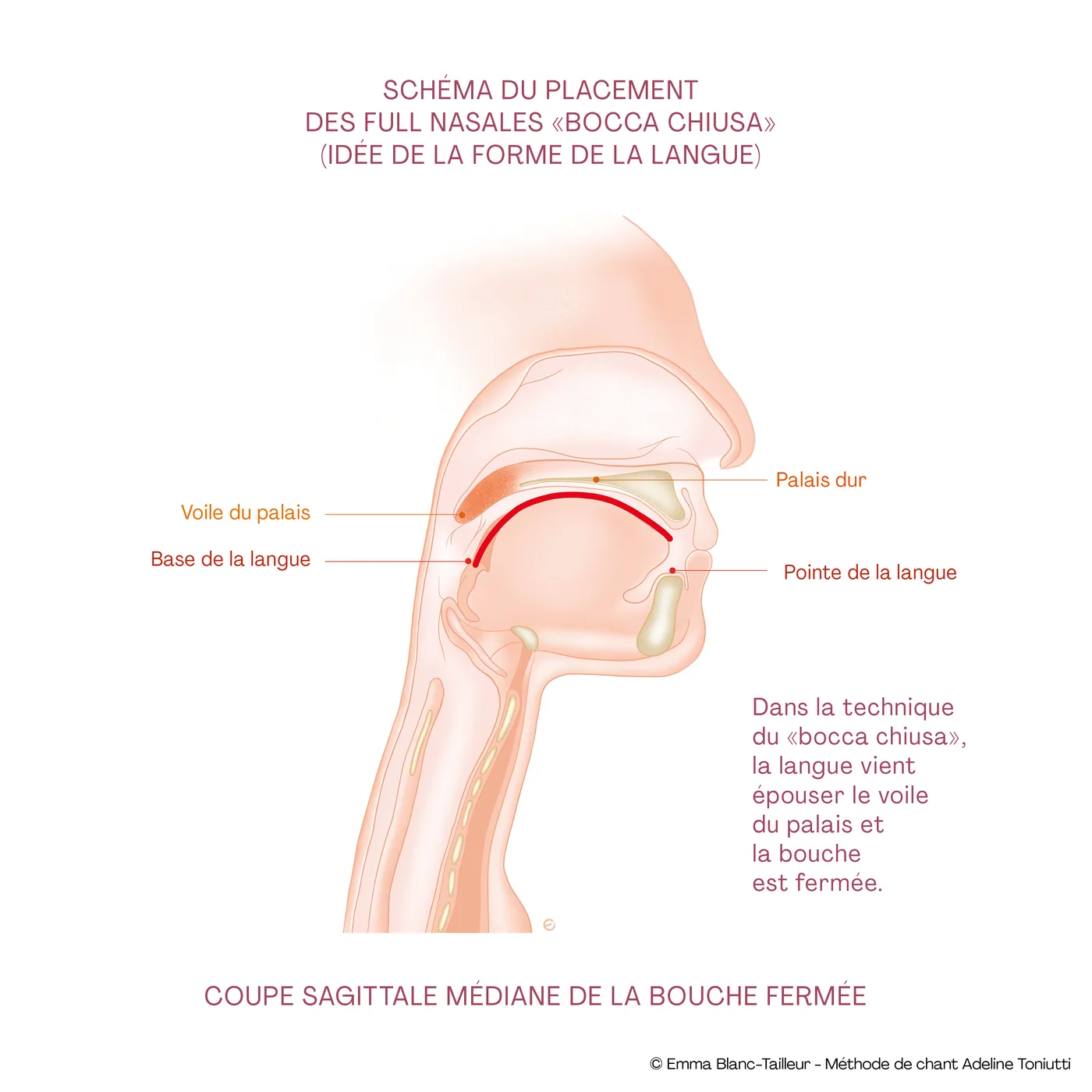
Illustration © Emma Blanc-Tailleur, Anatomie du Chant, Adeline Toniutti
WHEN TO SEEK HELP
When it is no longer a matter of technique
A jaw that stays locked, that clicks, that hurts or that opens crookedly is no longer a singing-lesson matter. Anatomie du Chant then points towards the osteopath, because the blockage is often linked to the cervical spine, and Jean-Marie Legé, osteopath and co-author of the book, works precisely on that chain from the skull to the shoulder blade.
If you have jaw lesions, the vocal gesture is readjusted according to you and to your own observation of the results. The placement described here remains a landmark, not a standard to be reached at any cost.
The CALYP Voice Clinic works with phoniatricians, ENT surgeons, osteopaths and speech therapists. Discomfort that persists despite a corrected vocal gesture deserves a medical opinion.
CALYP
Reposition your jaw with a teacher
At CALYP, the position of the mandible and the hold of the condyle are part of the fifth pivot point, worked on in lessons from the very first sessions.
GO FURTHER
Related pages from the Voice Clinic
Frequently asked questions
Should you lock or relax your jaw to sing?
Neither. A singer’s jaw is held by its joint without being frozen: the condyle stays lightly pinched, it suspends the mandible instead of letting it drop, and the mandible keeps its micro-movements during pronunciation and articulation, slightly forward and slightly back. You make sure not to let the jaw fall, and you still do not lock it in order to articulate. The right word is neither “clenched” nor “relaxed”, it is “toned”.
What is a clenched jaw when you sing?
The expression covers four different faults: the mandible too far forward, the mandible too far back, the condyle too closed and the condyle too loose. Only one of those four is a true clench, the condyle too closed. The other three give the same feeling of a stuck sound for opposite reasons, which is why the advice “relax” sometimes makes the problem worse.
Where is the condyle and how do you feel it?
The condyle is the rounded end of the mandible, on each side of the face, just in front of the external auditory canal. It forms the temporomandibular joint with the skull. Place your thumb and index finger around the joint while you sing: you feel a space, which must be neither loose nor too closed. The condyle must stay actively suspended, lightly pinched.
Why is “open wide as if you were yawning” bad advice?
Because yawning is precisely the moment when the jaw is completely relaxed. Opening that way, the singer lets the condyle drop, and it then guides the mandible badly, hampers the laryngeal suspension and hinders the movements of the soft palate. The feeling of blockage remains, and the abdominal support is lost on top of it.
Is the jaw connected to abdominal support?
Yes, directly. When the singer keeps a certain tension in the jaw, they bring about the closing of the anterior muscle chain, and therefore of the abdominals, which tenses the muscles needed to control the diaphragm. Conversely, a very relaxed jaw relaxes the abdominals: you can feel it the moment you swallow after chewing.
Does a mandible pulled too far back disturb the larynx?
Yes. Anatomie du Chant states it directly: a mandible pulled too far back disturbs the larynx, which sits just below. It is the gesture that most clearly gives the feeling of a sound stuck in the throat, even though the jaw itself is clenching nothing. It often happens when the singer tucks in the chin to place the voice.
When should you seek help for a locked jaw?
When the discomfort persists outside of singing, when the joint clicks, hurts or opens crookedly. Anatomie du Chant advises turning to an osteopath, because a locked jaw is often linked to the cervical spine. In the case of a confirmed lesion, the vocal gesture is readjusted case by case rather than aiming at the reference placement.