
Placing the tongue and the jaw
PIVOT POINT 5
The vowel carries the frequency of the notes out to the audience, and the consonant provides the intelligibility of the language.
MY METHOD IN 5 PIVOT POINTS
Pronounce the vowels and the consonants
"We can't understand a thing when you sing!" "What language are you singing in?" "Articulate! Articulate!" "Now that you're pronouncing, it's a caricature!" The singer has to sing intelligibly, but when they do, their throat sometimes hurts afterwards, or they are told that they are overdoing it, that the emotion is gone.
When we sing, we have to answer to the music and to the lyrics in every circumstance. There are anatomical points that offer good landmarks for combining the two.
TRANSFORMING SOUND
Transforming sound into sung language
All the work done with the previous pivot points aims to build the instrument that the voice is. From the moment we start making vowels and consonants, we transform a sound into aesthetic language, because the point is to sing. The performer's role is to convey a musicality and a meaning in the words.
In opera, an additional requirement is added: projecting the voice above the orchestra. All the vowels must be built in such a way as to meet the aesthetic criteria of homogeneity of the lyric voice. In musical theatre, the voice was projected naturally until 1964, the year the microphone appeared on stage on Broadway. In pop, emotion is king and the voice is systematically amplified: the vowel becomes the setting that gives the vocal signature.
Whether you sing pop or classical, the vowel carries the frequency of the notes out to the audience and the consonant provides the intelligibility of the language.
Thinking of the vowel in this way gives access to an infinity of nuances, colors and dynamics. What we are aiming for here is:
- Longevity: we do not hurt the voice.
- Performance: once a sound has been made, any other sound can be pronounced after it.
- Adaptability: we can produce every color and every emotion at any moment.
THINKING THE VOWELS
The tongue between the upper molars
Singing is a transformation of exhaled air. When we sing well, we feel air coming out through the mouth, but also a tiny amount of air, a slight mist due to the choreography of the soft palate, which passes through the nose, whatever the vowel. We can become aware of it by placing a finger under the nose while exhaling.
The word vowel, which comes from the Latin "vocalis" or "vox" meaning voice, is a sound of the voice produced by the pressing together of the vocal folds on a frequency that ends up being colored by a position of the tongue and of the soft palate. Anything blocked or frozen is harmful to singing.
The vowels "i" and "é" are said to be catching vowels: they are closed vowels, the mouth is barely open and the sound is concentrated. To pronounce the "i" correctly, the tongue must be high and placed in front of the soft palate. The "é" keeps the tongue at roughly the same position, but moves slightly back. At the point of contact, these two vowels take up more room laterally: they spread out between the molars. The tongue makes contact on either side of the upper molars.
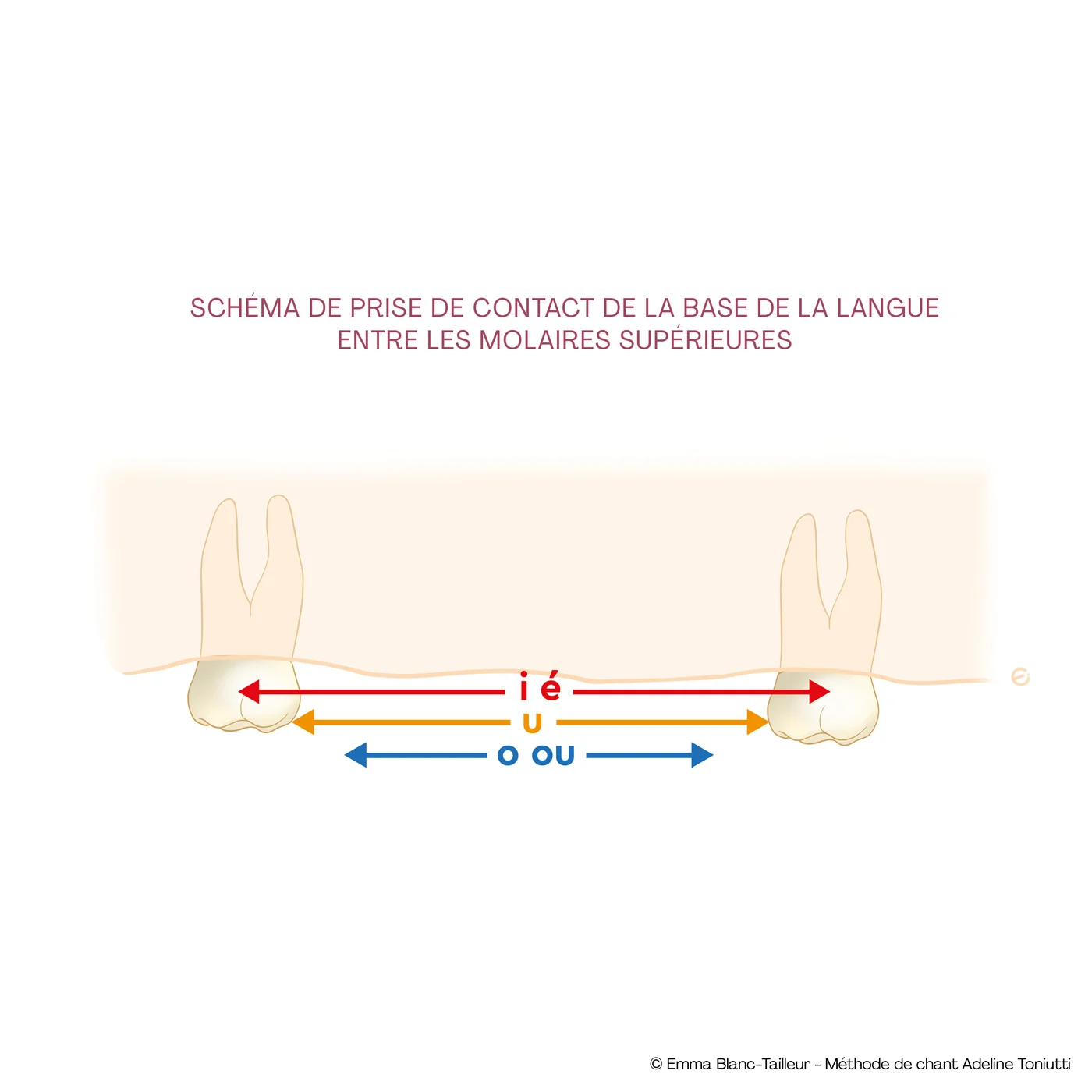
Illustration © Emma Blanc-Tailleur, Anatomie du Chant, Adeline Toniutti
The "i" is felt as the highest, the brightest, even the most acidic of the vowels. When we sing it, we feel that there is a peak, that it sits above the other vowels in the musical line. If you hear your "i" as round, it is badly placed. Some teachers nickname it the "nuclear power of the voice": very high, it channels the voice to climb into the high register while avoiding the pitfall of laryngeal collapse.
The case of the "u" is a particular one: its position is an intermediate between the catching vowels and the gathering vowels "o" and "ou". The tongue stays high, but spreads out less between the molars than for the "i" or the "é", while still keeping contact with them. The "o" and the "ou" come a little closer to the soft palate, and the tongue maintains contact between the two molars, in the center.
ADELINE'S ADVICE
When we sing, we hear the catching vowels as acidic and we will tend to darken them. But we must not: this sensation is normal, what matters is that the people around you hear a warm sound.
THE NASALS
The consonants that pass through the nose
The consonants M and N are nasals: in their execution, they stand at the crossroads between consonants and vowels. They have the role of a consonant but sound a little like vowels.
The nasal cavities are the place of resonance of nasal sounds: "m", "n", and the English "gn" of singing. It is impossible to pronounce these nasals while holding the nose shut. The tiny part of air must therefore be allowed to pass freely through the nose. We can check this by placing a finger under the nose while singing: we feel a slight warm mist.
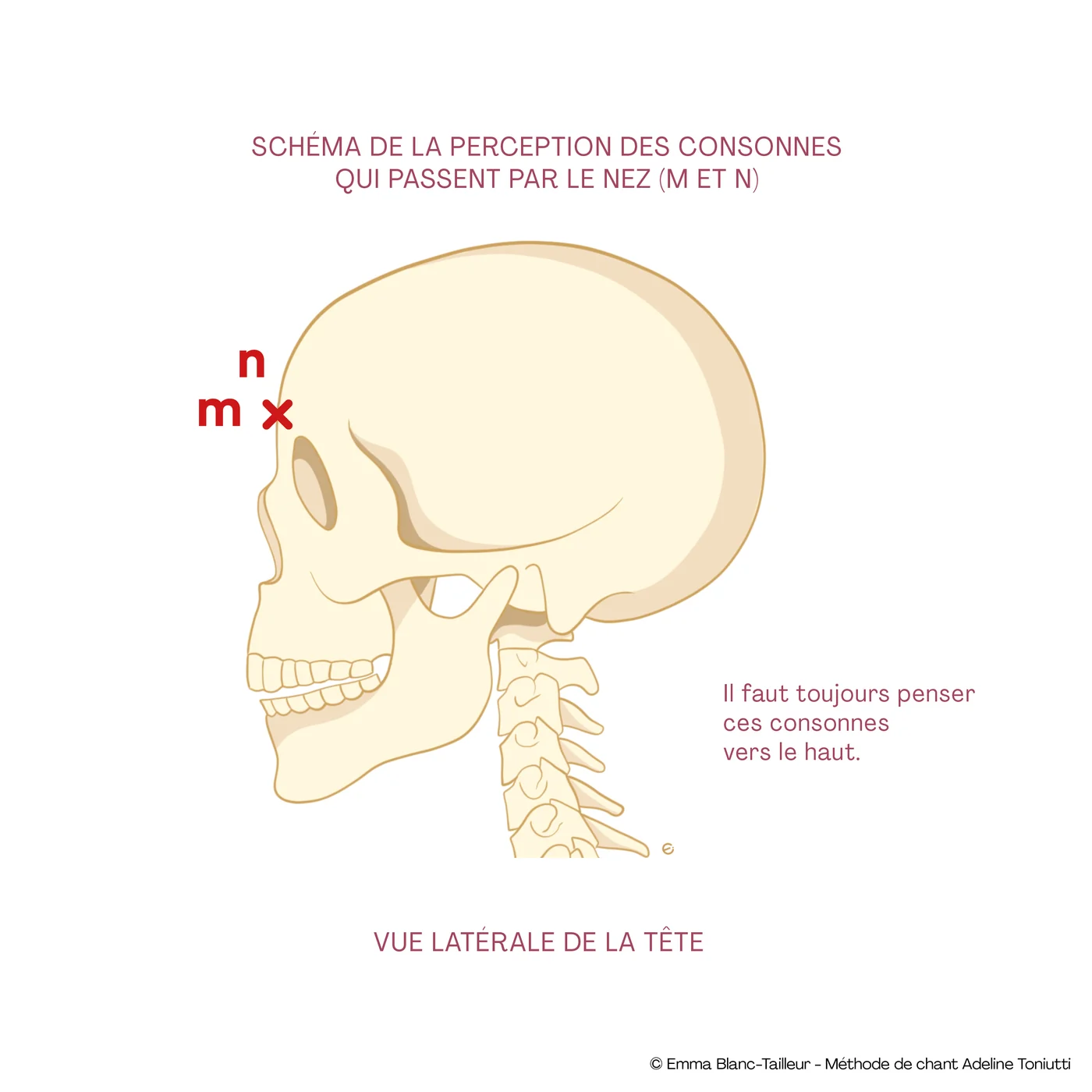
Illustration © Emma Blanc-Tailleur, Anatomie du Chant, Adeline Toniutti
To pronounce the consonant "m": take the position of the "p" with the lips and blow through the nose, with the vocal folds closed. To pronounce the consonant "n": take the position of the "l" with the lips and blow through the nose, with the vocal folds closed. We find these sounds in maman for the "m" and nounou for the "n".
These consonants must always be thought of upward.
THE MANDIBLE
The key role of the jaw
The jaw is a central piece in the action of singing. The movements and the inner tension at the level of the mandible can considerably modify the sound. It has the ability to act on three things simultaneously: the quality of the abdominal support, the mobility of the soft palate and the agility of articulation, through complex nervous and muscular connections.
To optimize the action of the mandible, we observe two things:
- Its axis: it drops vertically. We can imagine that the maxillary and mandibular incisors tend to align, with suppleness, without freezing into a position. A mandible that is pulled too far back disturbs the larynx.
- Its tension, its tonicity: we think of it as toned and not, as is often heard, very relaxed. Opening the mouth does not mean opening to the point of a release like when we yawn.
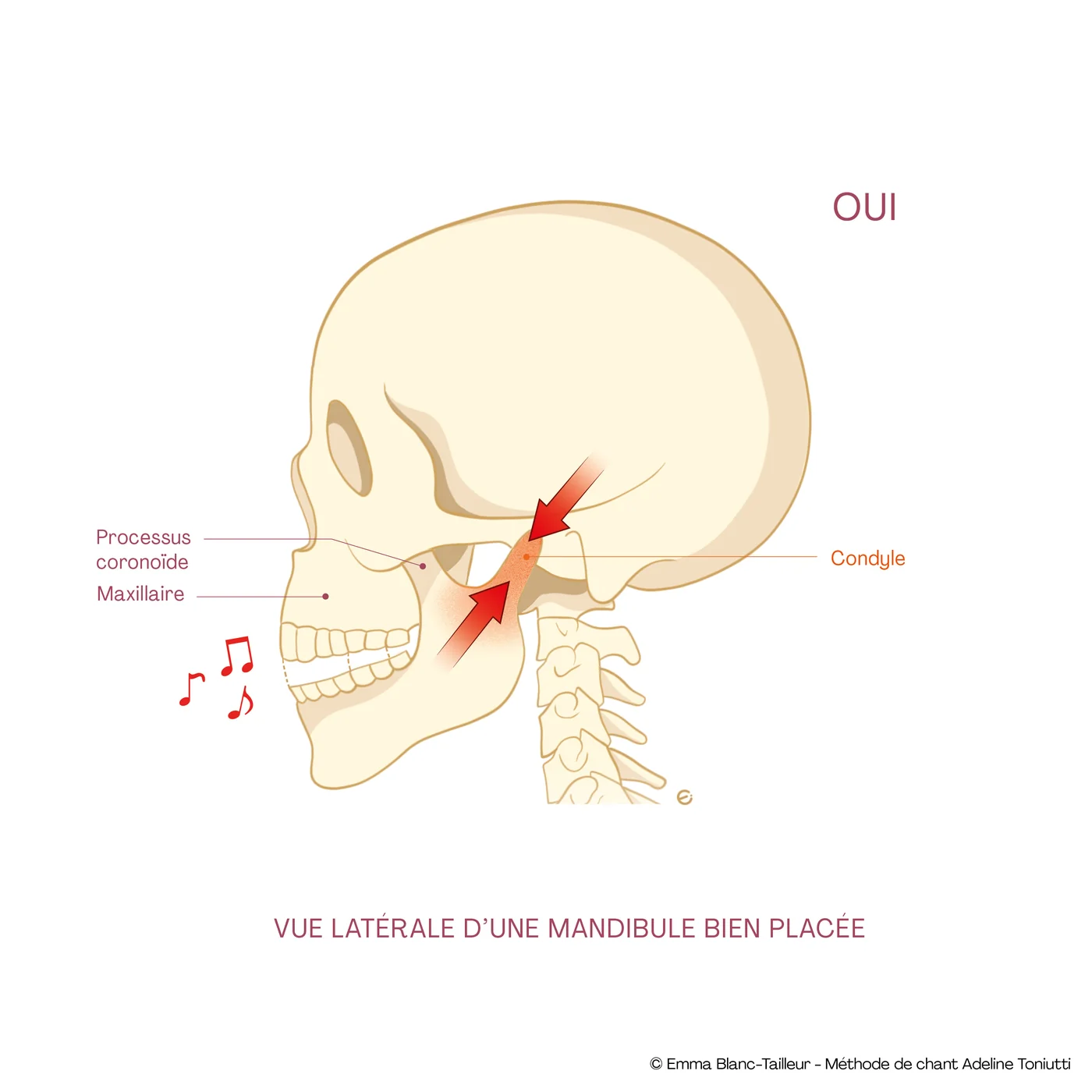
Illustration © Emma Blanc-Tailleur, Anatomie du Chant, Adeline Toniutti
If the mandible is too "relaxed", it can cause a release of the anterior muscular chain, reduce the range of movement of the soft palate, alter the suppleness of the laryngeal suspension and interfere with the articulation of the words.
When we keep a certain tension in the jaw, we bring about, on the contrary, the closing of the anterior muscular chain, and therefore of the abdominal muscles, which creates the tensioning of all the muscles we need in order to master the diaphragm. We can then take charge of the active exhalation more effectively.
Frequently asked questions
Where should you place your tongue to sing vowels?
For « i », the tongue must be high and placed in front of the soft palate; « é » keeps roughly the same position while moving back slightly. At the point of contact, these vowels spread laterally: the tongue makes contact on either side of the upper molars. Anything locked or frozen is harmful to singing.
Why does my « i » sound acidic when I sing?
That is normal. « i » is felt as the highest, the brightest, even the most acidic of the vowels. We tend to want to darken it, but we must not: this sensation is normal, what matters is that the people around you hear a warm sound. If you hear your « i » as round, it is badly placed.
How do you pronounce the consonants M and N while singing?
For « m », take the position of « p » with the lips and blow through the nose, with the vocal folds closed. For « n », take the position of « l » and blow through the nose, vocal folds closed. These are nasals: it is impossible to pronounce them while holding your nose. You must always think of these consonants upwards.
Should you relax your jaw to sing?
No. We think of the mandible as toned, not very relaxed: opening the mouth does not mean opening it to the point of slackness, as when yawning. An overly relaxed mandible can cause a slackening of the anterior muscle chain, reduce the amplitude of the soft palate's movements, alter the suppleness of the laryngeal suspension and interfere with the articulation of words.