
The singer's posture
PIVOT POINT 1
Posture is the first thing we forget. Yet if it is not right, it is the first thing that will degrade the quality of the vocal gesture.
MY METHOD IN 5 PIVOT POINTS
Take care of your posture
"Your head!" "Your pelvis!" "Don't lift your head to look at the sky!" These phrases echo through Adeline Toniutti's studio like almost divine commands. She explains good posture to every singer, and the singer answers: "easy, I've got it".
Easy as it is to understand, posture is the first thing we forget, too busy thinking about our notes or our stress. Yet if posture is not right, it is the first thing that will degrade the quality of the vocal gesture.
The body is our instrument.
FINDING THE RIGHT BALANCE
Finding the right balance
Posture influences laryngeal suspension, breathing, and how quickly the abdominal muscles can be "taken in hand", which are major assets of the sung gesture. Having good posture is both a way of orienting your bones and also a new way of stretching your fasciae, those membranes that wrap around and hold muscle groups and certain organs, in order to obtain a muscular response matching what you are about to ask of the body: to sing.
Cultivating good posture means making sure that the following are well understood:
- The positioning and orientation of the neck.
- The relationship between the shoulders and the movement of the rib cage.
- Pelvis retroversion in relation to the lengthening of the torso.
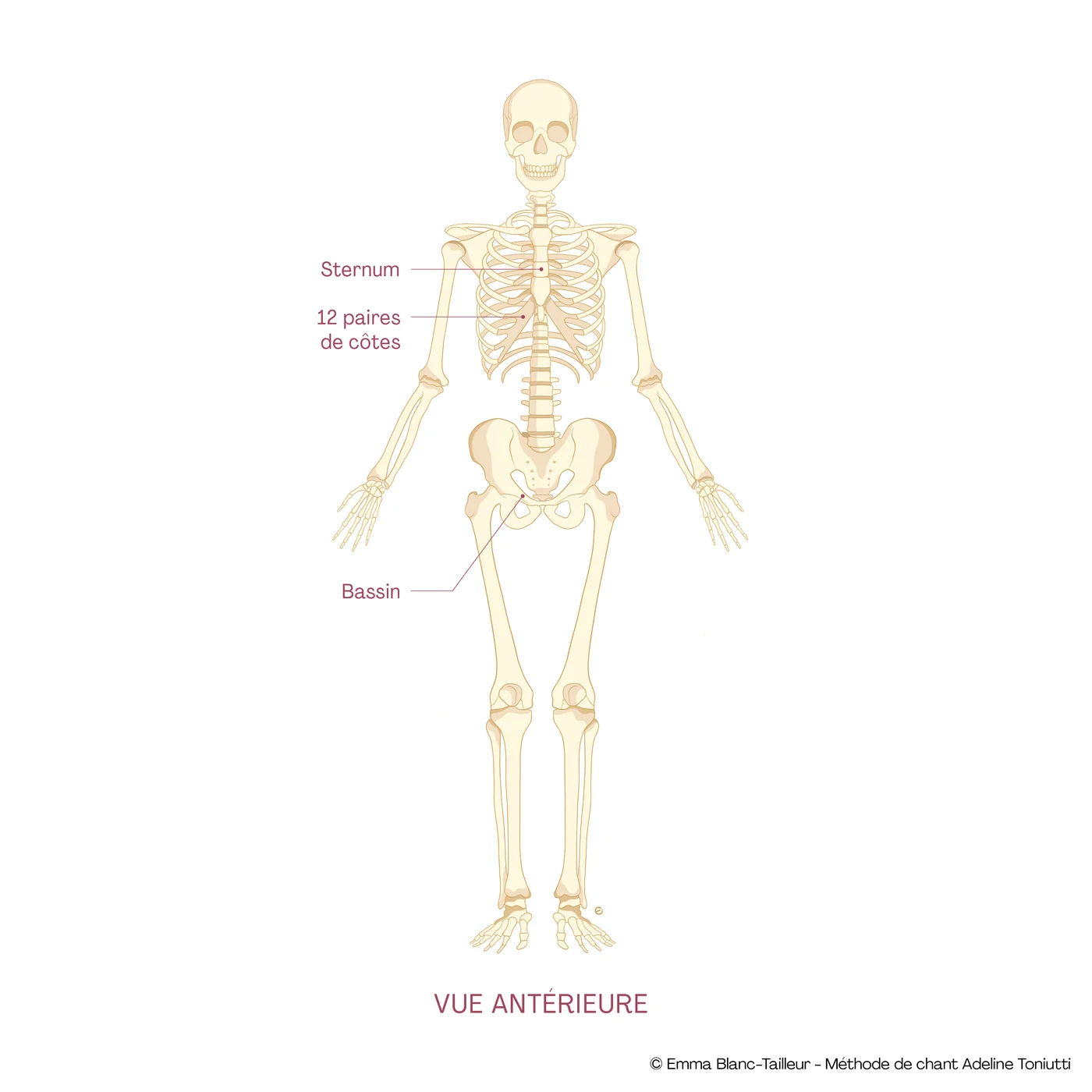
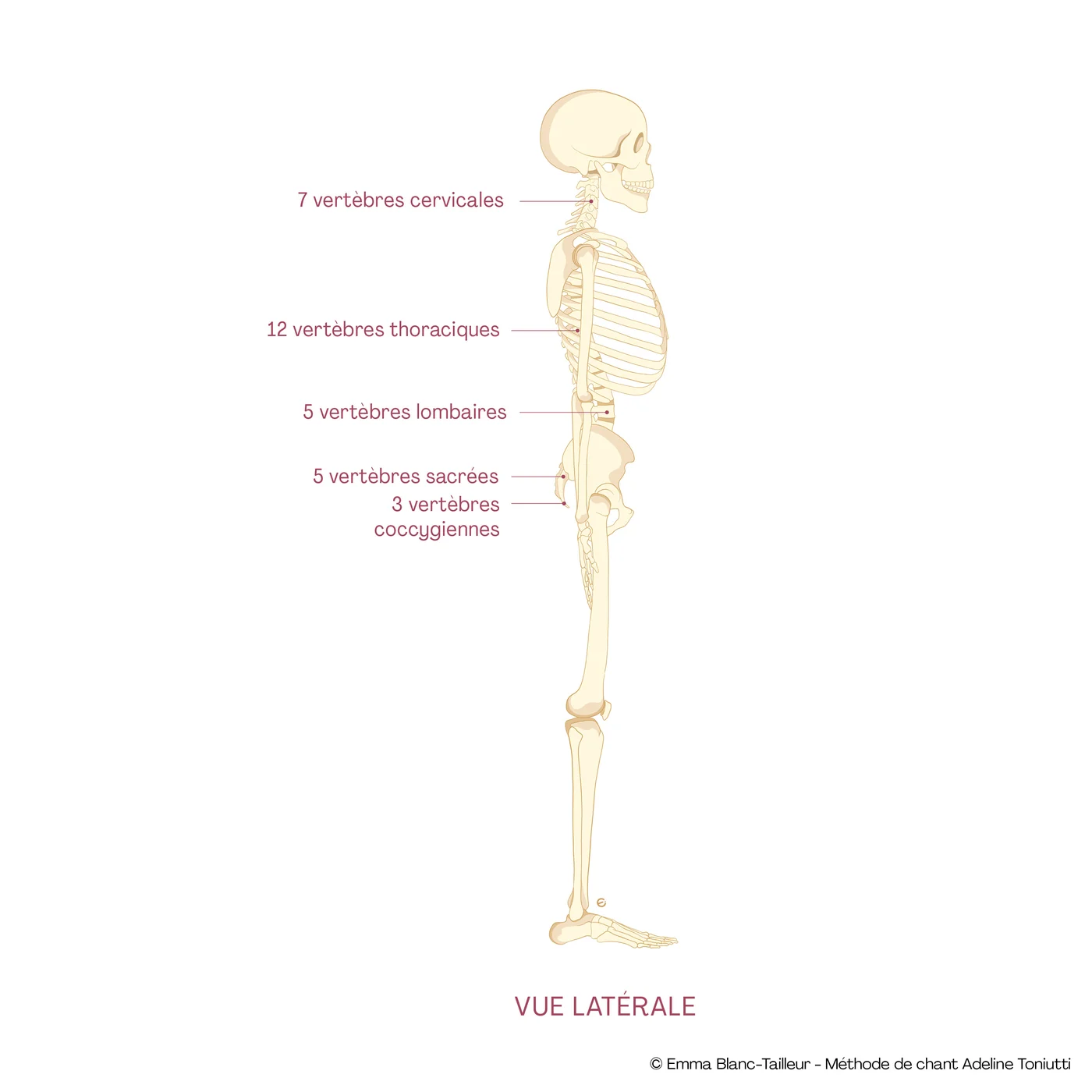
Illustrations © Emma Blanc-Tailleur, Anatomie du Chant, Adeline Toniutti
For singers with scoliosis or other problems related to the spine, the practice is adapted to each person's abilities, with the support of a specialist, in order to find their balance and encourage the vocal gesture.
As the osteopath Jean-Marie Legé, whose perspective informs the method, puts it: you have to "look for a dynamic balance within imbalance".
FIRST SUPPORT
Lengthen the neck
To position and orient the neck properly, we aim to "lengthen" it. This means stretching the back of the neck and tilting the chin slightly downwards, so as to encourage laryngeal suspension. You then feel that the posterior cervical chain is longer than the front of the neck. One of Adeline Toniutti's Australian teachers used to tell her to imagine clouds of oxygen between the cervical vertebrae in order to obtain a beautiful laryngeal suspension.
By lowering the chin slightly, swallowing becomes easier and more supple: swallowing your saliva becomes easier. The aim is to find a point of balance in the position of the head, neither too far forward nor too far back.
You sometimes hear the advice to put "the chin into the chest". That angle is not optimal, however: although it allows swallowing, it does not let the larynx carry out its full range of movement. Above all, the chin must never be locked, neither forwards nor backwards.
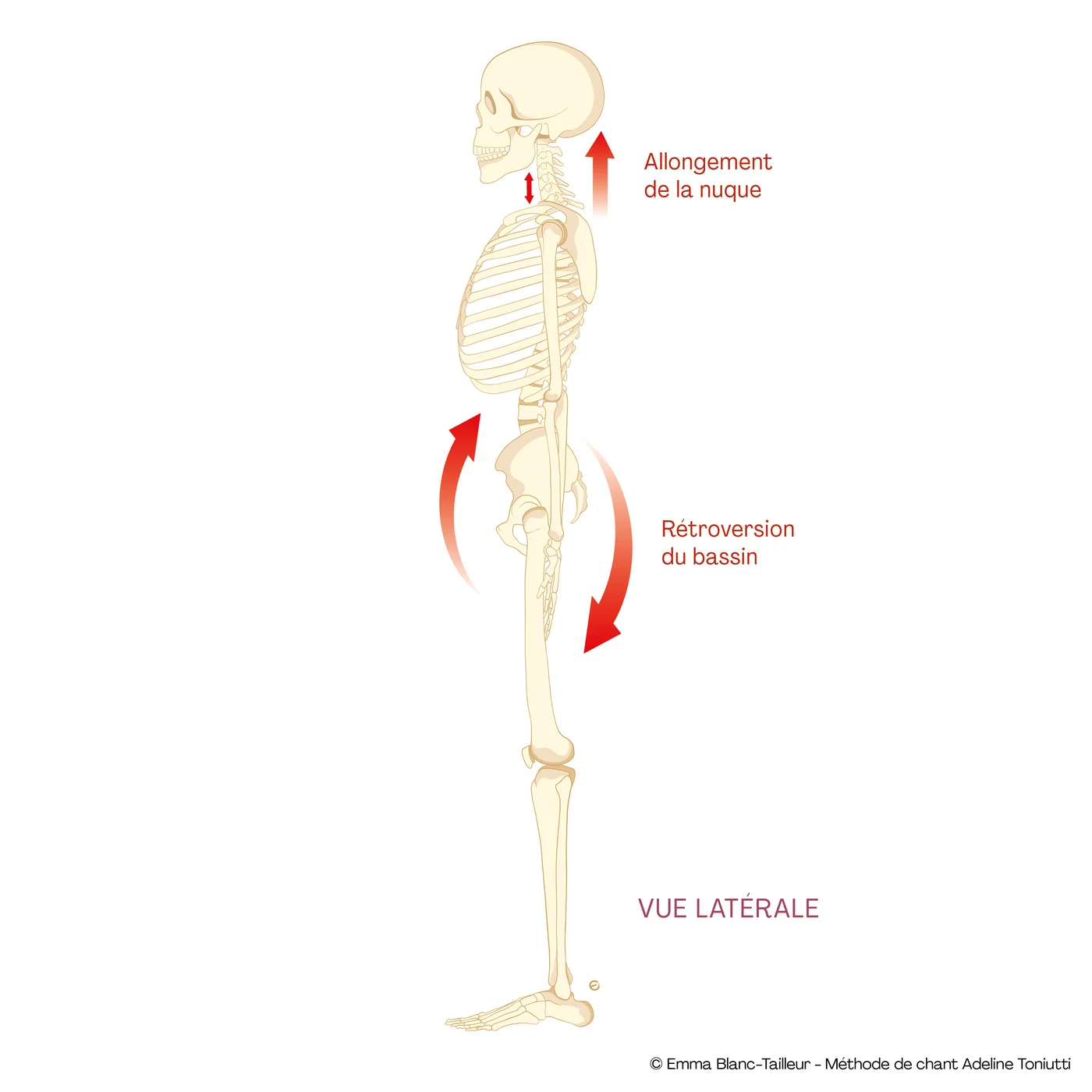
Illustration © Emma Blanc-Tailleur, Anatomie du Chant, Adeline Toniutti
Jean-Marie Legé, osteopath: "The second cervical vertebra, the axis, has a tendino-muscular action on the tongue. I have observed that when the first cervical vertebra, the atlas, is in lateral glide, the patient's voice is 'veiled' and tires easily."
If you position your head badly, if you suffer from a stiff neck or from muscle contractures, the repercussions on vocal performance can be bad. Conversely, good work on releasing the cervical spine and the movements of the head and neck gives favorable results for sound emission and for vocal technique. One tip: attacking the sound while moving the head from side to side, as if saying no, releases the upper cervical vertebrae and the laryngeal suspension, while being careful above all not to stiffen the neck.
EXERCISE
Hands clasped behind the head
Goal: to improve laryngeal suspension.
- Clasp your hands behind your head, at the base of the skull, at the level of the occiput.
- Create resistance between the action of your hands and your head.
- The pressure applied will let you engage the muscles of your neck and of your abdominal girdle. By keeping your head in line, you take your posture in hand to lengthen your neck and your torso, and thereby improve laryngeal suspension.
SECOND SUPPORT
Free the shoulders
By freeing the shoulder joints, you free the movements of the intercostal muscles, and so you set breathing in motion freely. The shoulders are intimately connected to the movements of breathing.
If you lock them downwards, or backwards, you prevent the intercostal muscles from initiating the in-breath. The result is both that the lungs cannot fill properly and that you create parasitic tensions on the laryngeal suspension.
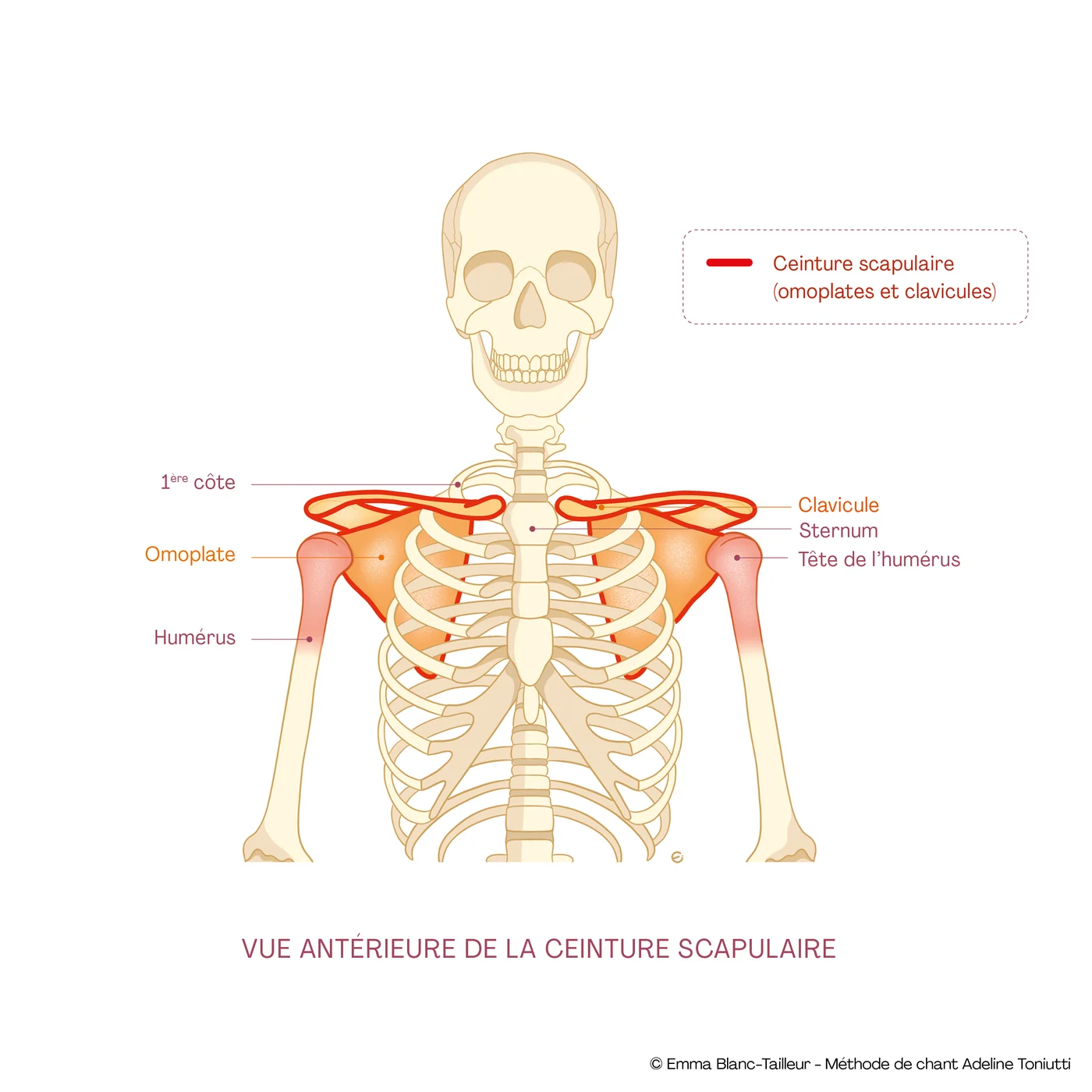
Illustration © Emma Blanc-Tailleur, Anatomie du Chant, Adeline Toniutti
EXERCISE
Singing while freeing the shoulders
Goal: to free the laryngeal suspension.
- Set up your upper body like a dancer in first position.
- Then raise your shoulders with your hands cupped like a nest to free the collarbone, taking care not to lock them backwards. And you sing.
- This exercise gives movement back to your shoulders in order to free them. Because singing with the shoulders locked down reduces the amplitude of the breathing movements.
This exercise must be performed while respecting the five pivot points. If you have a vocal cord condition, seek the advice of your specialist.
THIRD SUPPORT
Retrovert the pelvis
Pelvis retroversion and the lengthening of the torso work as two simultaneous actions to balance the posture. It is a favorable synergy: when you retrovert the pelvis, it is important to lengthen your torso in order to stretch the abdominal muscles and hold your column of air. Without the lengthening of the torso, there is a collapse in the anterior chain, and the abdominal muscles cannot activate to their full potential.
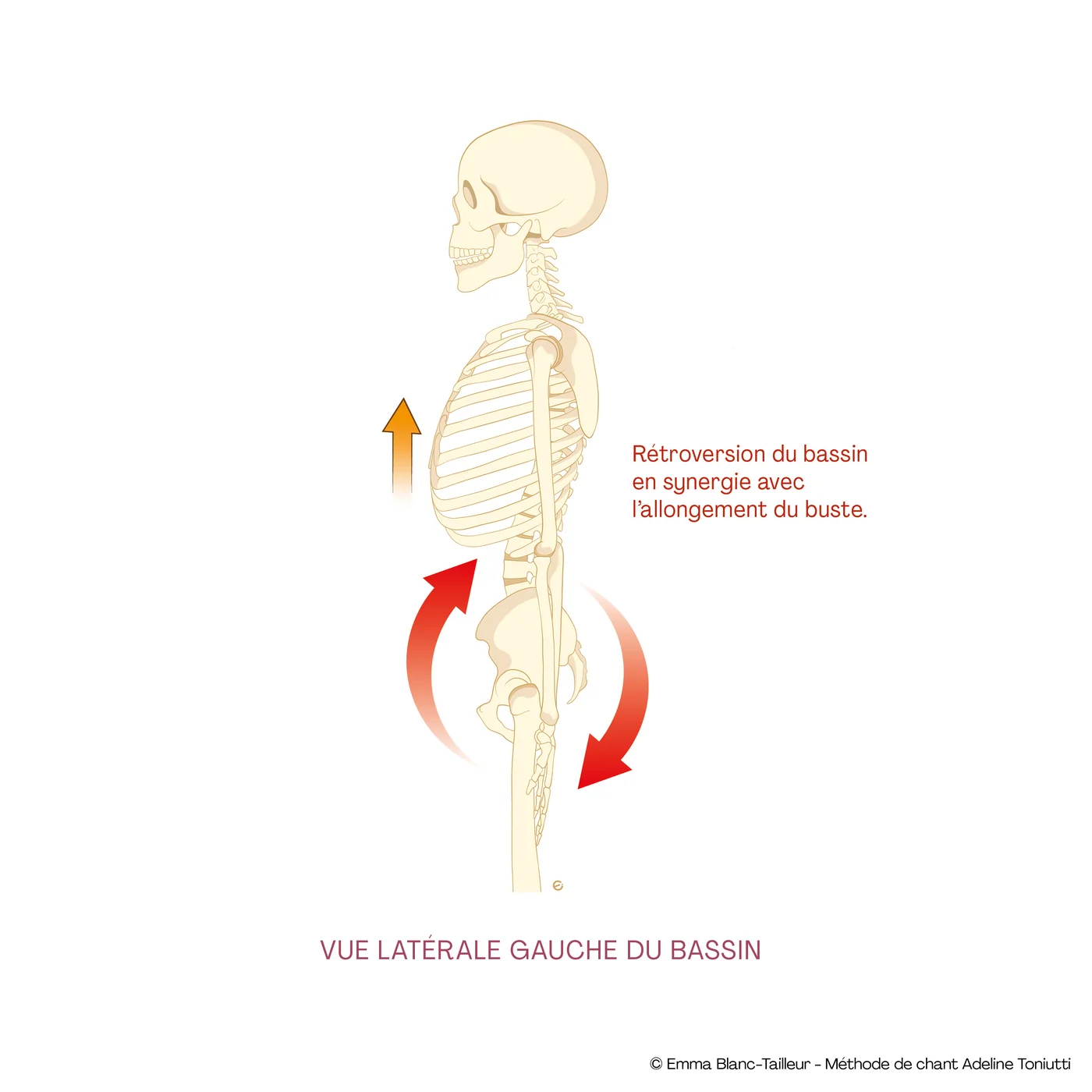
Illustration © Emma Blanc-Tailleur, Anatomie du Chant, Adeline Toniutti
Pelvis retroversion must be accompanied by a controlled engagement of the abdominal muscles. By lengthening the posterior chain, you stretch the paravertebral muscles, which will facilitate laryngeal suspension, you free the anterior chain, and you allow your abdominal muscles to activate.
At the level of the anterior chain, pelvis retroversion and the lengthening of the torso will give a better bodily point of support, and will offer more amplitude and responsiveness to the diaphragmatic movement.
The result: you optimize responsiveness and you have a better hold on the out-breath.
GOOD TO KNOW
We are made to move while singing
The body can perform almost every type of movement, as long as the abdominal muscles are engaged and you keep an eye on the orientation of your neck. Opera singers are even able to sing in the fetal position: this of course demands great mastery, but with experience and technique, the field of possibilities is vast.
Some movements are nevertheless not recommended, such as locking your head up or down, as well as singing while doing a headstand, because they hinder laryngeal suspension too greatly.
Frequently asked questions
Why is posture so important for singing?
Posture influences laryngeal suspension, breathing and how quickly the abdominal muscles are engaged. It is also the first thing we forget, too busy thinking about our notes or our stress. Yet if it is not right, it is the first thing that degrades the quality of the vocal gesture.
Should you tuck your chin into your chest to sing?
No. That angle is not optimal: although it allows swallowing, it does not let the larynx carry out its full movement. It is rather a matter of lengthening the nape, stretching the back of the neck and tilting the chin slightly downwards, without ever locking it either forwards or backwards.
What is pelvic retroversion in singing?
Pelvic retroversion and the lengthening of the torso work as two simultaneous actions. By lengthening the posterior chain, you stretch the paravertebral muscles that facilitate laryngeal suspension, and you allow your abdominal muscles to activate. The result is a better bodily point of support and more amplitude for the diaphragmatic movement.
Can you sing while moving?
Yes. The body can perform almost every type of movement, as long as the abdominal muscles are engaged and you keep an eye on the orientation of your nape. Some movements remain inadvisable, such as locking your head up or down, because they hinder laryngeal suspension too much.