더 크게 부르기
보이스 클리닉
소리치지 않는다. 후두 = 핸들, 갈비와 사근 = 가속.
NOT A CRY
외침에는 미적 목적이 없다
Physiologically, singing is filling the lungs, giving the air back on the exhale, bringing the folds together, making a sound. You could compare that to a cry. In life we say a cry of joy, a cry of pain. A cry has no aesthetic aim.
Singing louder, in Adeline Toniutti’s method, is not shouting louder. It is taking hold of the exhale, and letting the cavities do their work.
Adeline compares the larynx to a steering wheel, the ribs and obliques to accelerators. You do not press the wheel to go faster.
후두는 핸들이다. 갈비와 사근은 가속이다.
LITRES
리터의 문제가 아니다
At a colloquium with Prof. Thomas Sinowski, pulmonologist at the Pitié-Salpêtrière, a demonstration made the point. His theoretical vital capacity was clearly higher, around five litres. He did not hold a note as long as Adeline. Twice the available volume does not make up for an untrained gesture.
In ordinary breathing we inhale and exhale about 0.5 litres per cycle, six litres a minute. In active breathing, holding a note, one can move toward six litres. Training can raise vital capacity. That is not what makes the sound carry.
The “belly push” inhale is not, on its own, the singer’s technique. The gesture rests on a synergy: opening and managing the ribs, the diaphragm, a measured action of the obliques.
Faced with a note that scares you, you inflate. On television, internally, Adeline talks about the “vocal Everest” class. She has seen that asking people to inhale very small, twice, very fast, as if smelling a flower, finds the right movement sooner. More air is not more sound. More air badly held is more pressure on a larynx with no support.
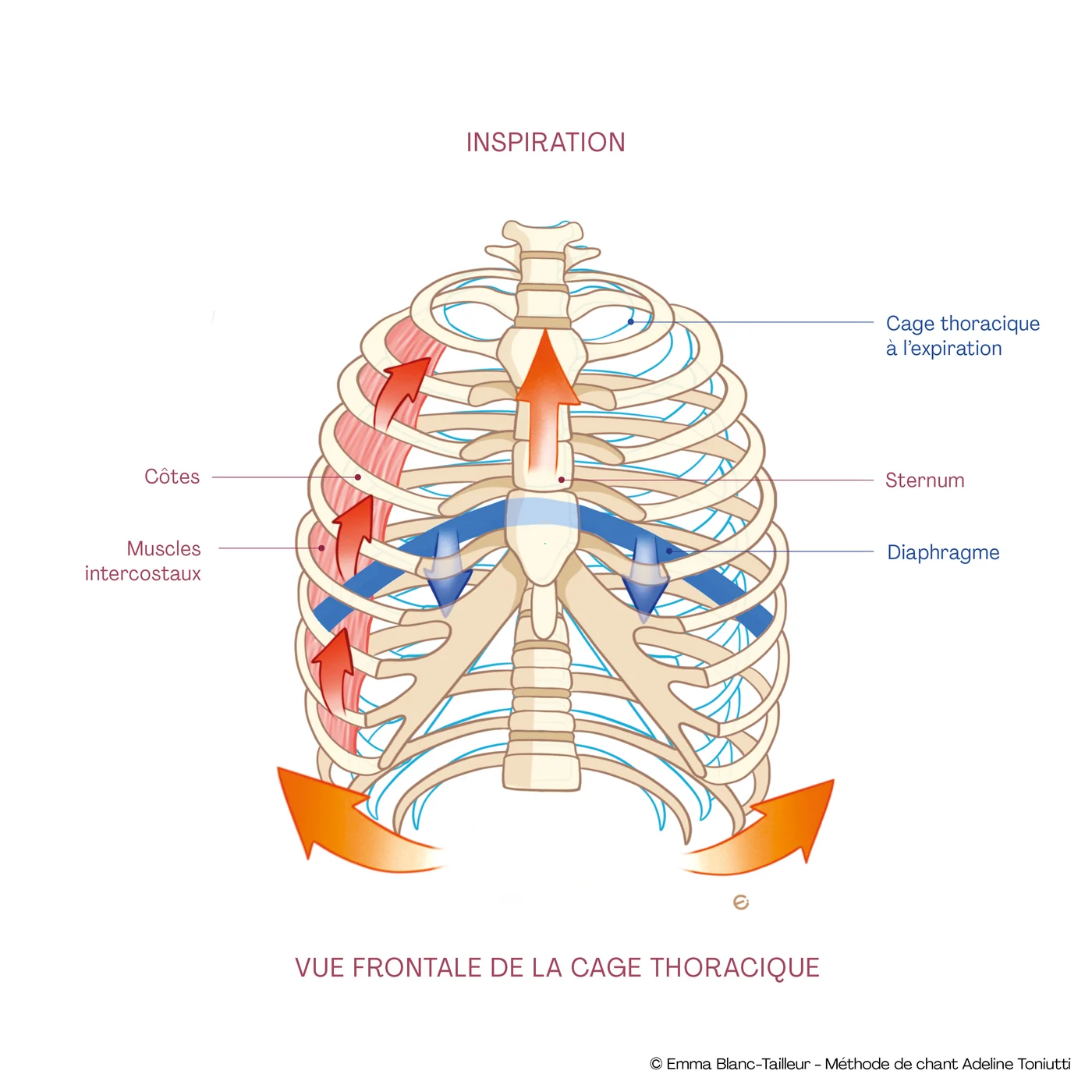
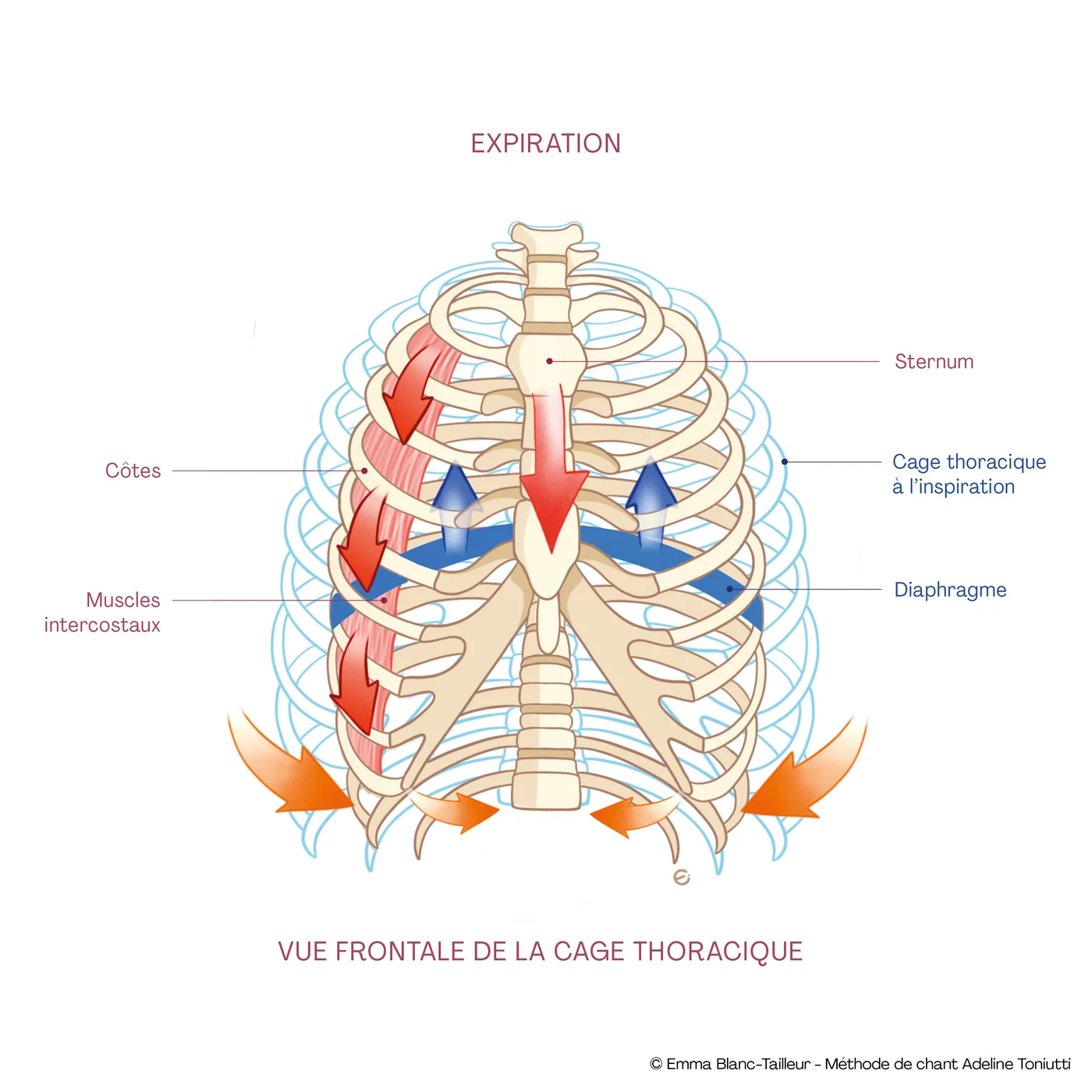
일러스트 © Emma Blanc-Tailleur, Anatomie du Chant, Adeline Toniutti
WHO DRIVES THE AIR
폐는 받는다. 근육이 명령한다.
The lungs have no motor muscle. Ventilation is the diaphragm, the intercostals, and for the active exhale of singing, the sling: transversus, obliques, rectus.
Making a sound is emptying the lungs. You draw the ribs together, raise the diaphragm, the abdominals press, the air goes up.
- The transversus, the deepest, raises pressure and stabilises the trunk. It is mainly used on the active exhale.
- The obliques add to that pressure and allow the trunk to rotate.
- The rectus, the “six-pack”, manages the held bulge of the abdomen. It is the engine of the exhale.
On the inhale the external intercostals fire, the sternum rises, the ribs flare, the diaphragm descends like an umbrella. On the exhale the ribs draw together. Jean-Marie Legé: when one plane contracts, it tightens the ribs; when the other contracts, it opens them.
The singer’s task: optimise the inhale, master the exhale. On a high note, or a forte, most people release costal pressure. The floating ribs open again. That pressure must be held, if the laryngeal movement is right.
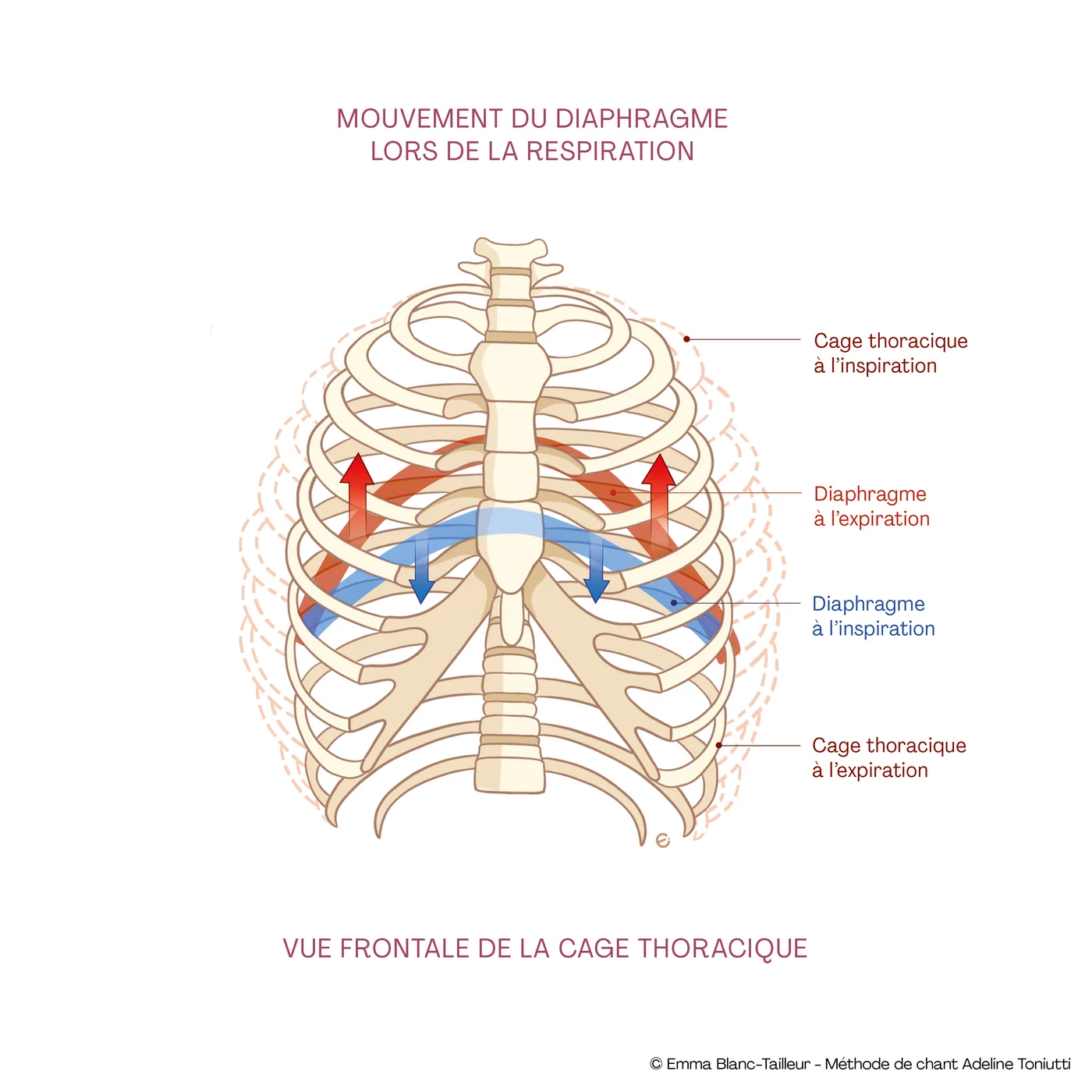
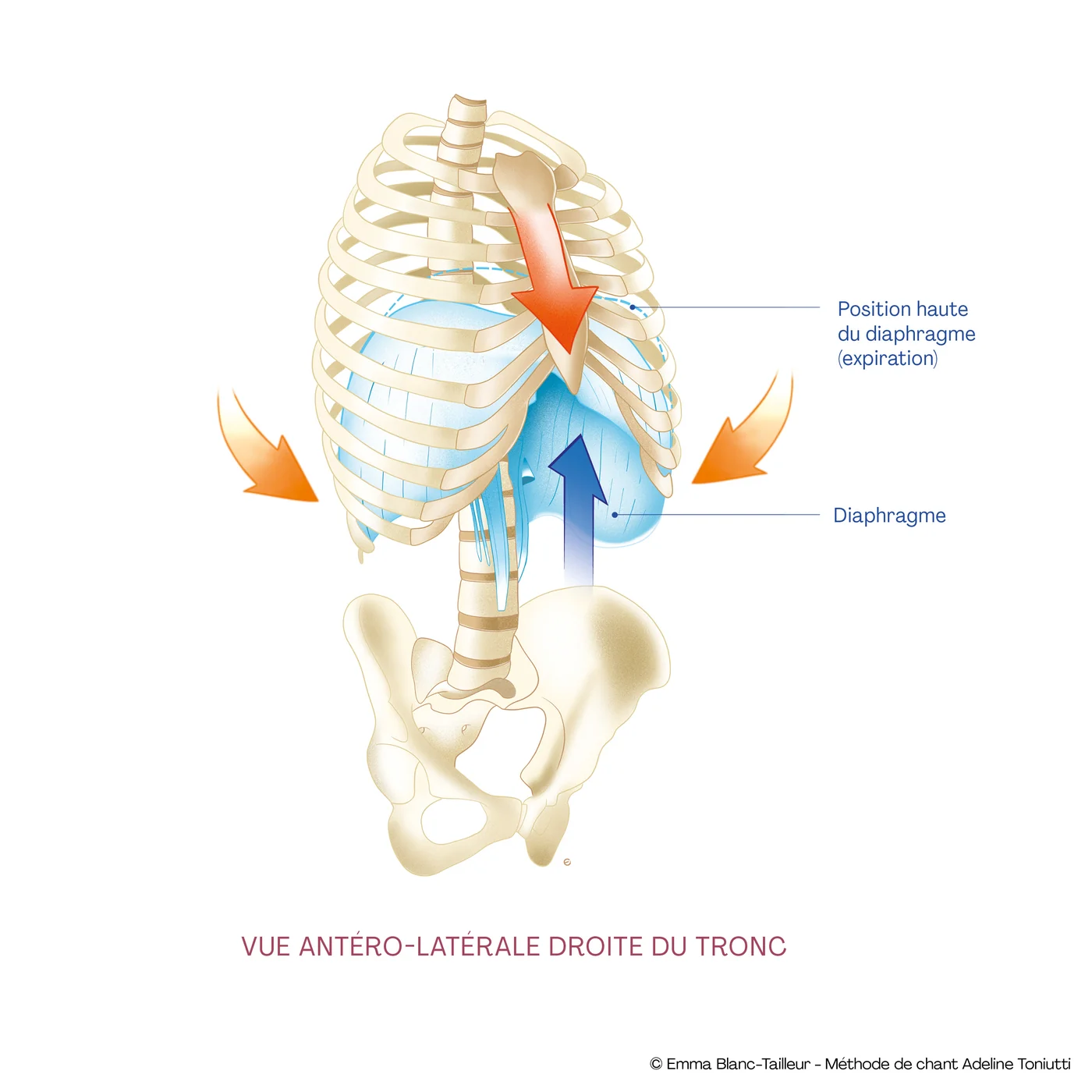
일러스트 © Emma Blanc-Tailleur, Anatomie du Chant, Adeline Toniutti
THE HAMMOCK
후두는 조향한다. 밀지 않는다.
“Lower your larynx” does not make a bigger sound. It unbalances the organ. There is improvement when the laryngeal movement goes with the exhaled air, upward. Without locking at the top. Soft movements, supported by the breath.
The larynx hangs in the throat like a hammock. Posture keeps that suspension.
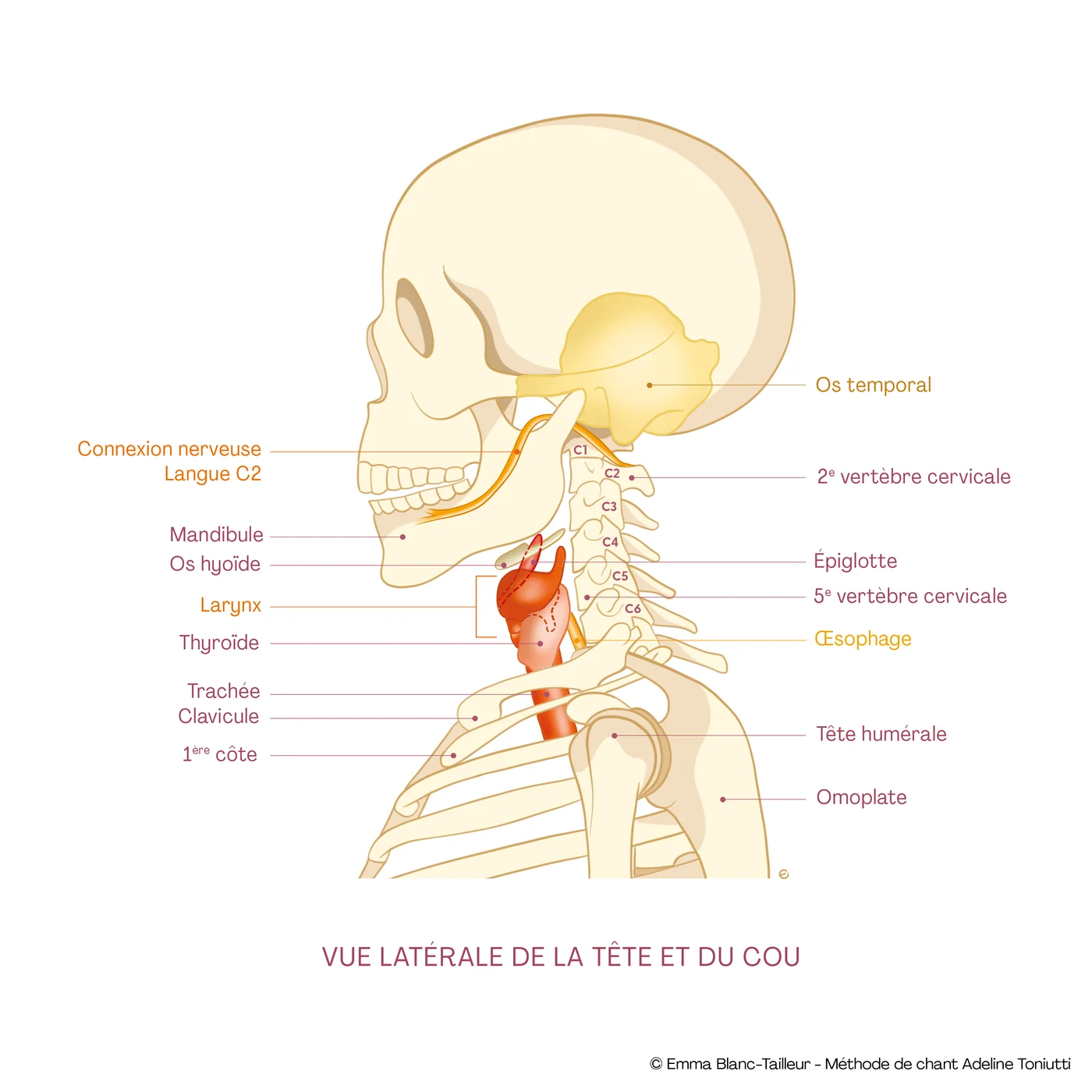
일러스트 © Emma Blanc-Tailleur, Anatomie du Chant, Adeline Toniutti
Neck lengthened, chin slightly down, not parked on the chest. Shoulders free: locking them down or back stops the intercostals launching the inhale. Pelvis retroverted and torso lengthened, or the anterior chain collapses and the abdominals cannot reach their potential.
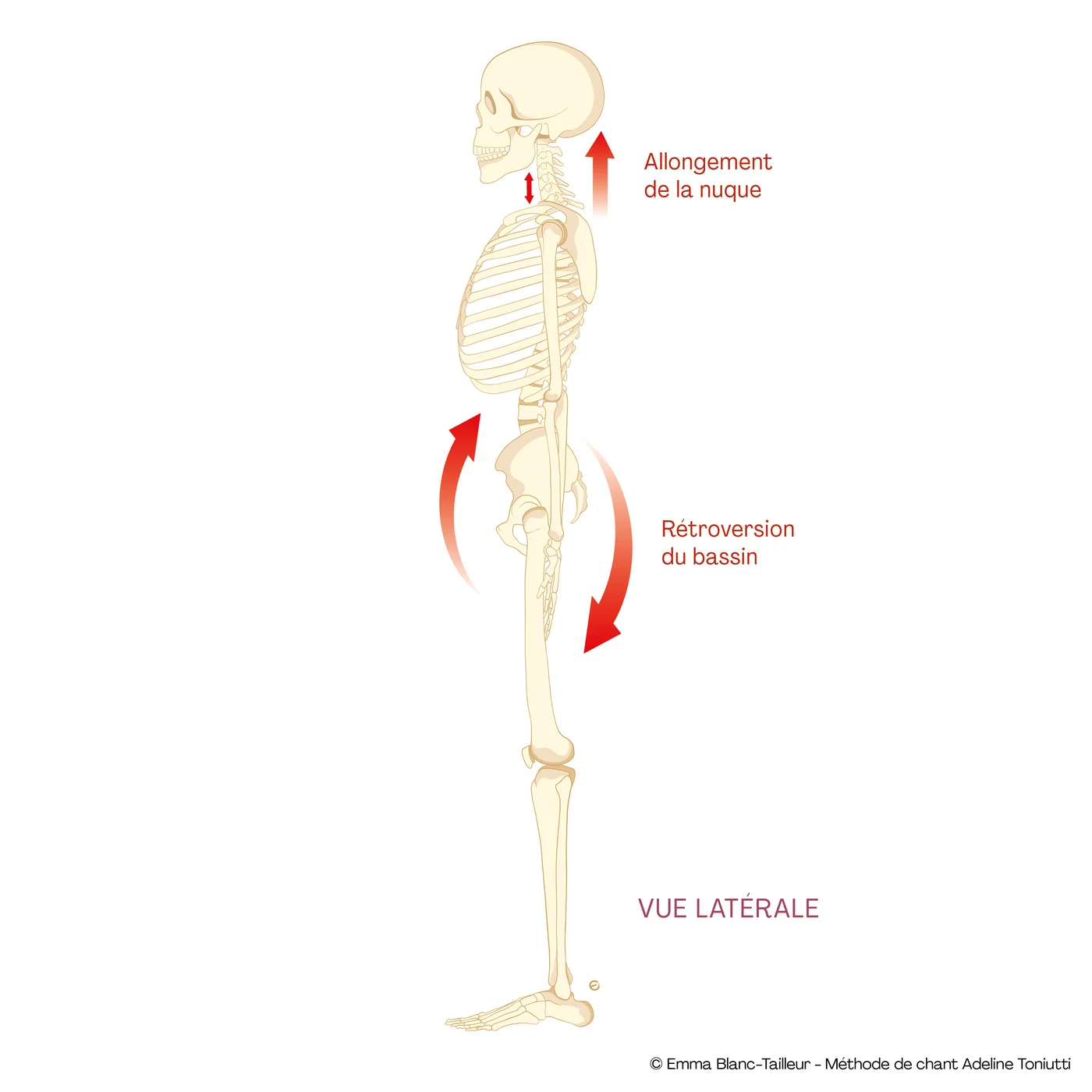
일러스트 © Emma Blanc-Tailleur, Anatomie du Chant, Adeline Toniutti
THE SPACES
공명강이지 목이 아니다
Sound is the meeting of air and folds. The wave then takes colour against the membranes and cavities. Making it resonate is the fourth pivot point: freeing those cavities for projection and timbre.
트왕은 Adeline이 수년째 다섯 피벗 포인트에서 가르치며, 안에서는 「미국식으로 부르기」라고 부른다. 호흡 부담 없이 느껴지는 힘을 올린다. 연구개가 올라간다.
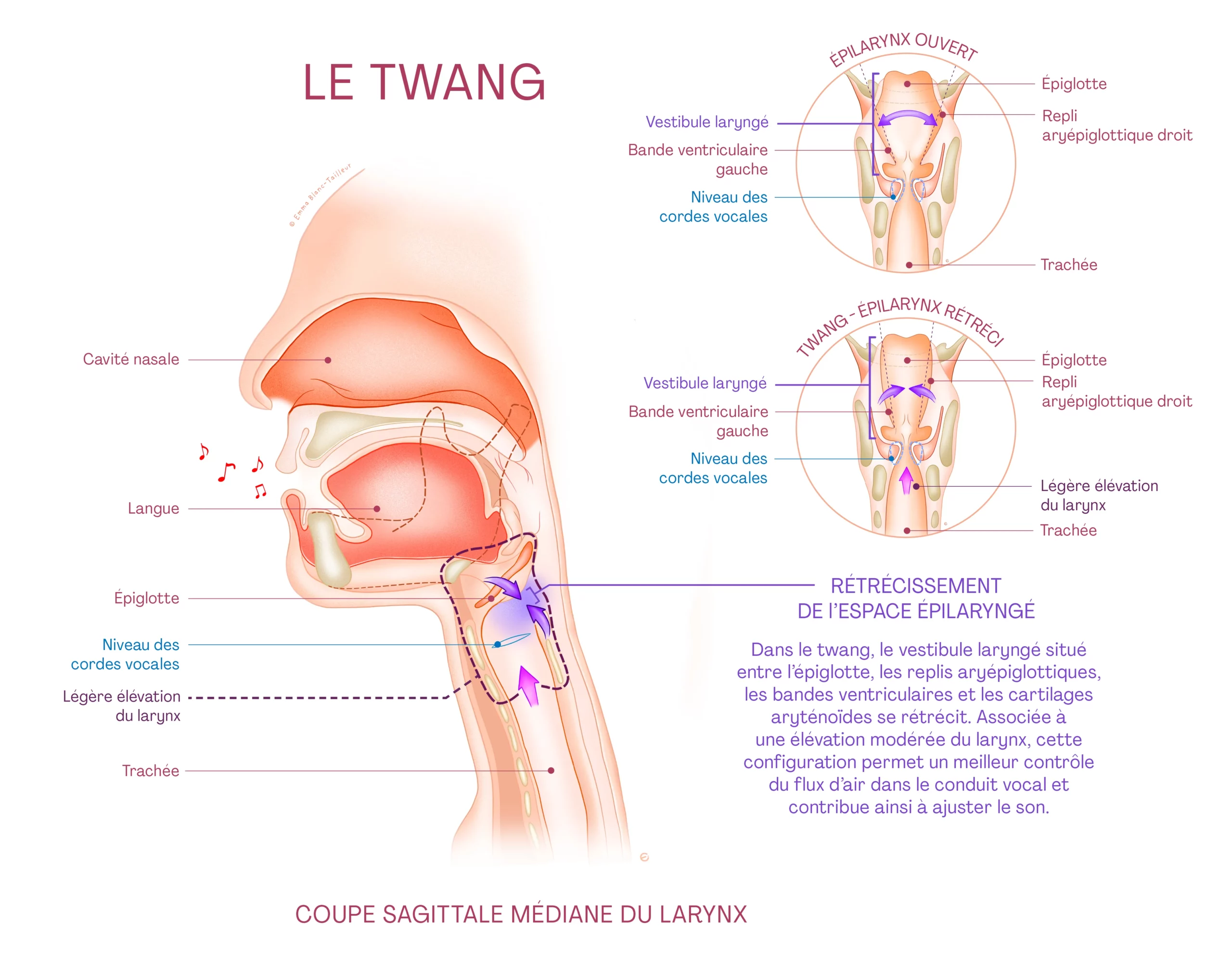
Anatomical representation of twang: aryepiglottic sphincter narrowing
Dr Marie Mailly: twang amplifies the high frequencies, the singer’s formant. The literature describes an inverted horn: narrow below, more open above.
현대 음악에서 트왕을 찾는 일은 오페라에서 마스크와 프로젝션을 찾는 일과 같다.
Belting, in the method, is not a shout. It is keeping mechanism 1 (chest voice) as high as possible. Subglottic air pressure raised by the sling, higher laryngeal resistance, moderate vestibular narrowing. Dr Bruno Coulombeau: in belting, moderate vestibular narrowing; in mixed or head voice, very little narrowing.
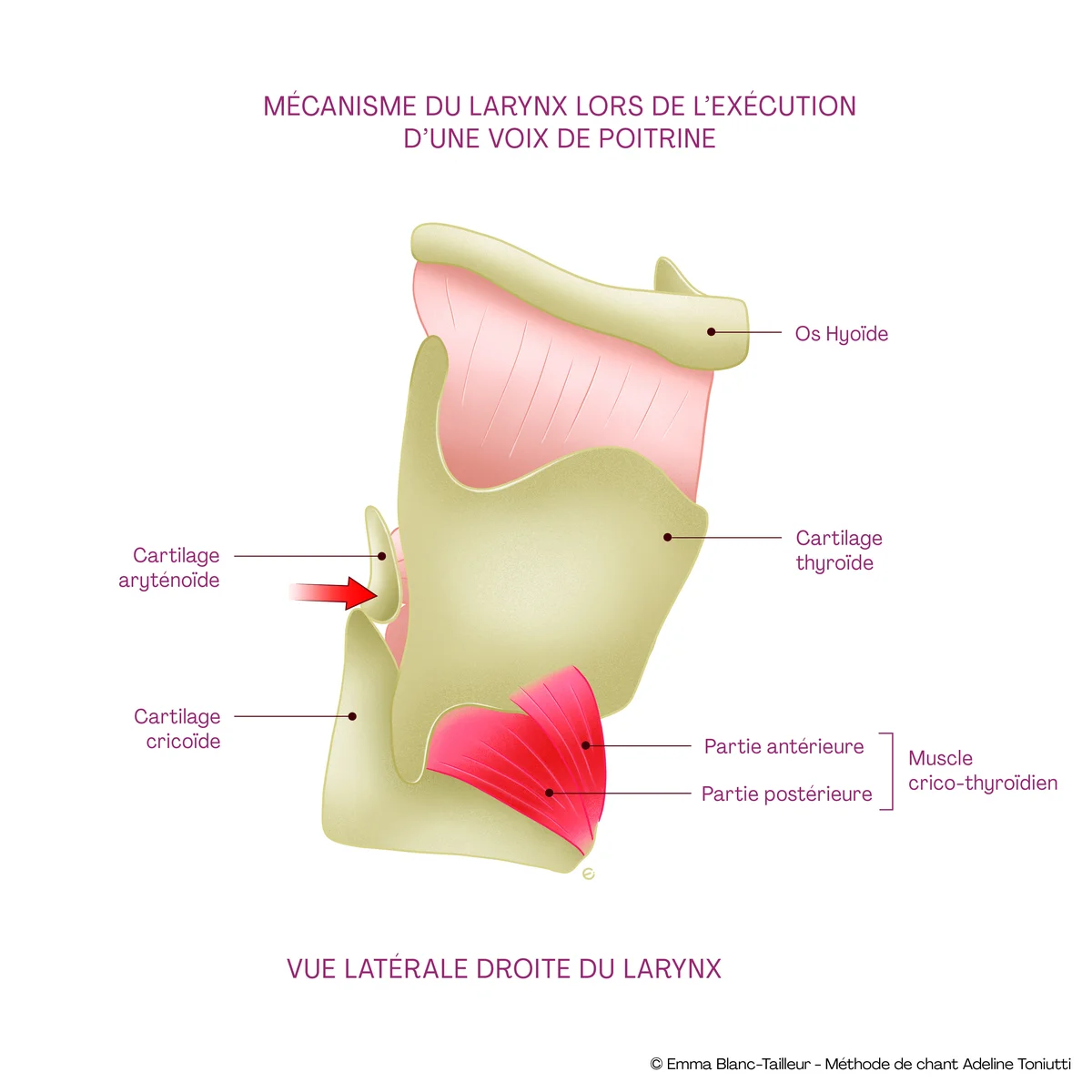
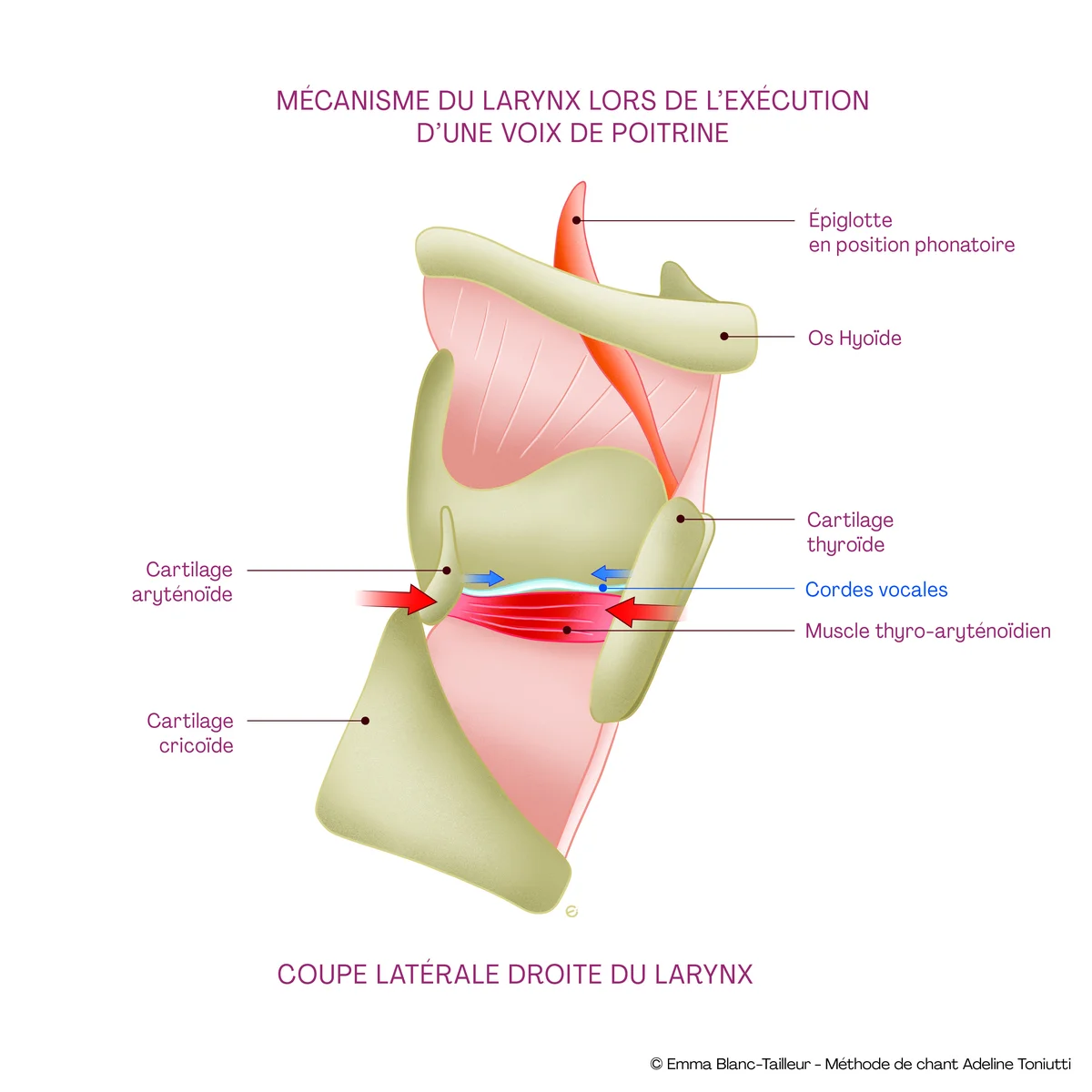
일러스트 © Emma Blanc-Tailleur, Anatomie du Chant, Adeline Toniutti
HEARING YOURSELF
자신을 들으려 하지 않는다
When you sing loud, the stapedius reflex protects the inner ear against very intense sounds, usually high ones. Your ears protect you.
Forcing to hear yourself is fighting that reflex. A sound that already seems huge to you may still lack carry outside, or the reverse: a sound that seems thin to you carries, if the cavities are working.
On a high note the method says: the sound always seems thin to you, unless you are heavily amplified. Three criteria for a healthy high note: others find it beautiful; it seems thin to you; no discomfort afterwards.
IN PRACTICE
네 가지 지지
1. Smell a flower
Mouth closed. Hands on the floating ribs. Feel the opening. Not the shoulders. Not an Everest.
2. Hold the ribs on the exhale
Sternum coming down, ribs drawing together, obliques working. If the neck hardens and the ribs open, you have dropped the accelerator and twisted the wheel.
3. Check the hammock
Hands around the larynx, or thumbs under the mandible. The tongue moves away from the fingers. The larynx is not jammed into the sternal notch.
4. Choose the space, not the push
Lyric: even vowels, projection over the orchestra. Contemporary: true twang (palate raised), taught from the five pivot points. Microphone: give the core of the sound, do not shout into the capsule.
이 연습은 다섯 피벗 포인트와 함께 한다.
CALYP
CALYP에서 전달을 다룬다
메소드는 Anatomie du Chant(Marabout, 2024)에 있다. 팀과 함께 하려면 예약하라.
常见问题
더 크게 부르는 것이 미는 것인가?
아니다. 후두는 조향한다(핸들). 갈비와 사근이 가속한다.
전달하려면 숨이 많이 필요한가?
아니다. 크게 들이마시고 못 잡으면 지지 없는 후두에 압력이 걸린다.
트왕은 비음인가?
아니다. 진짜 트왕은 다섯 피벗 포인트에서 가르치며 연구개가 올라간 채로 한다.
크게 부를 때 왜 내가 안 들리나?
등골근 반사가 내이를 지킨다. 가늘게 느껴지는 소리도 공명강이 일하면 밖으로 나간다.