唱得更响
嗓音诊所
不是喊。喉是方向盘,肋骨和斜肌是油门。
NOT A CRY
喊没有审美目的
Physiologically, singing is filling the lungs, giving the air back on the exhale, bringing the folds together, making a sound. You could compare that to a cry. In life we say a cry of joy, a cry of pain. A cry has no aesthetic aim.
Singing louder, in Adeline Toniutti’s method, is not shouting louder. It is taking hold of the exhale, and letting the cavities do their work.
Adeline compares the larynx to a steering wheel, the ribs and obliques to accelerators. You do not press the wheel to go faster.
喉是方向盘。肋骨和斜肌是油门。
LITRES
不是升的问题
At a colloquium with Prof. Thomas Sinowski, pulmonologist at the Pitié-Salpêtrière, a demonstration made the point. His theoretical vital capacity was clearly higher, around five litres. He did not hold a note as long as Adeline. Twice the available volume does not make up for an untrained gesture.
In ordinary breathing we inhale and exhale about 0.5 litres per cycle, six litres a minute. In active breathing, holding a note, one can move toward six litres. Training can raise vital capacity. That is not what makes the sound carry.
The “belly push” inhale is not, on its own, the singer’s technique. The gesture rests on a synergy: opening and managing the ribs, the diaphragm, a measured action of the obliques.
Faced with a note that scares you, you inflate. On television, internally, Adeline talks about the “vocal Everest” class. She has seen that asking people to inhale very small, twice, very fast, as if smelling a flower, finds the right movement sooner. More air is not more sound. More air badly held is more pressure on a larynx with no support.
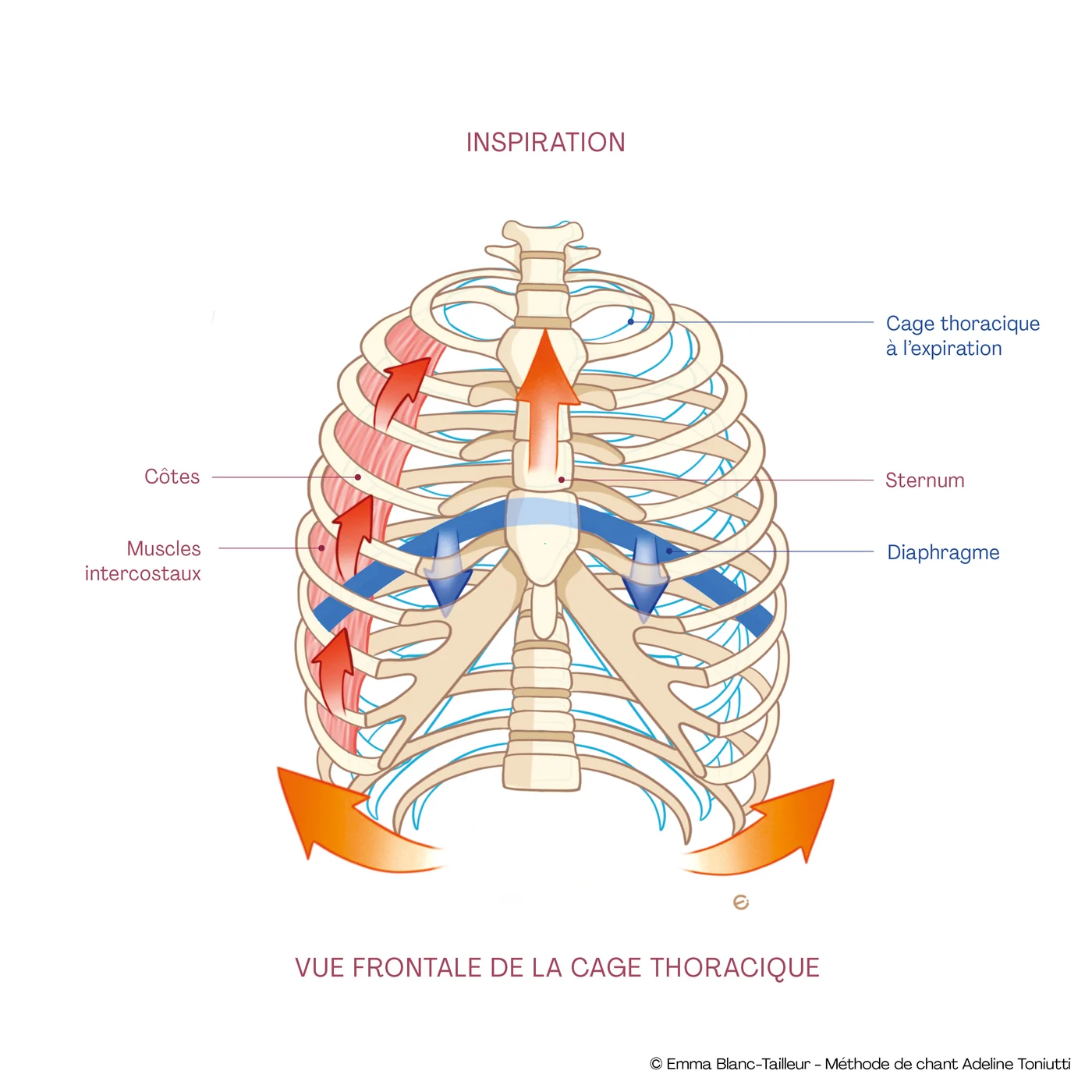
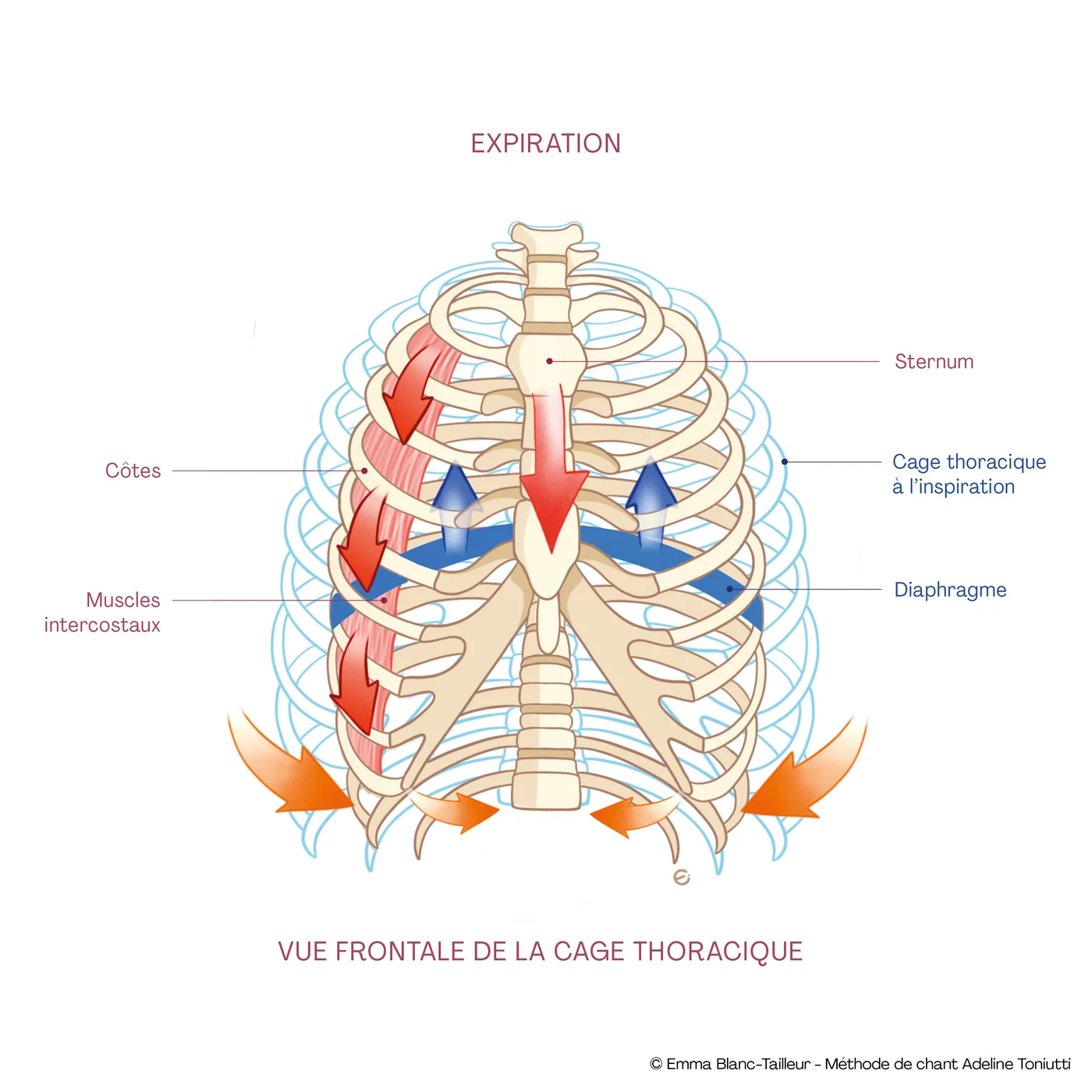
插图 © Emma Blanc-Tailleur,《Anatomie du Chant》,Adeline Toniutti
WHO DRIVES THE AIR
肺接收。肌肉发令。
The lungs have no motor muscle. Ventilation is the diaphragm, the intercostals, and for the active exhale of singing, the sling: transversus, obliques, rectus.
Making a sound is emptying the lungs. You draw the ribs together, raise the diaphragm, the abdominals press, the air goes up.
- The transversus, the deepest, raises pressure and stabilises the trunk. It is mainly used on the active exhale.
- The obliques add to that pressure and allow the trunk to rotate.
- The rectus, the “six-pack”, manages the held bulge of the abdomen. It is the engine of the exhale.
On the inhale the external intercostals fire, the sternum rises, the ribs flare, the diaphragm descends like an umbrella. On the exhale the ribs draw together. Jean-Marie Legé: when one plane contracts, it tightens the ribs; when the other contracts, it opens them.
The singer’s task: optimise the inhale, master the exhale. On a high note, or a forte, most people release costal pressure. The floating ribs open again. That pressure must be held, if the laryngeal movement is right.
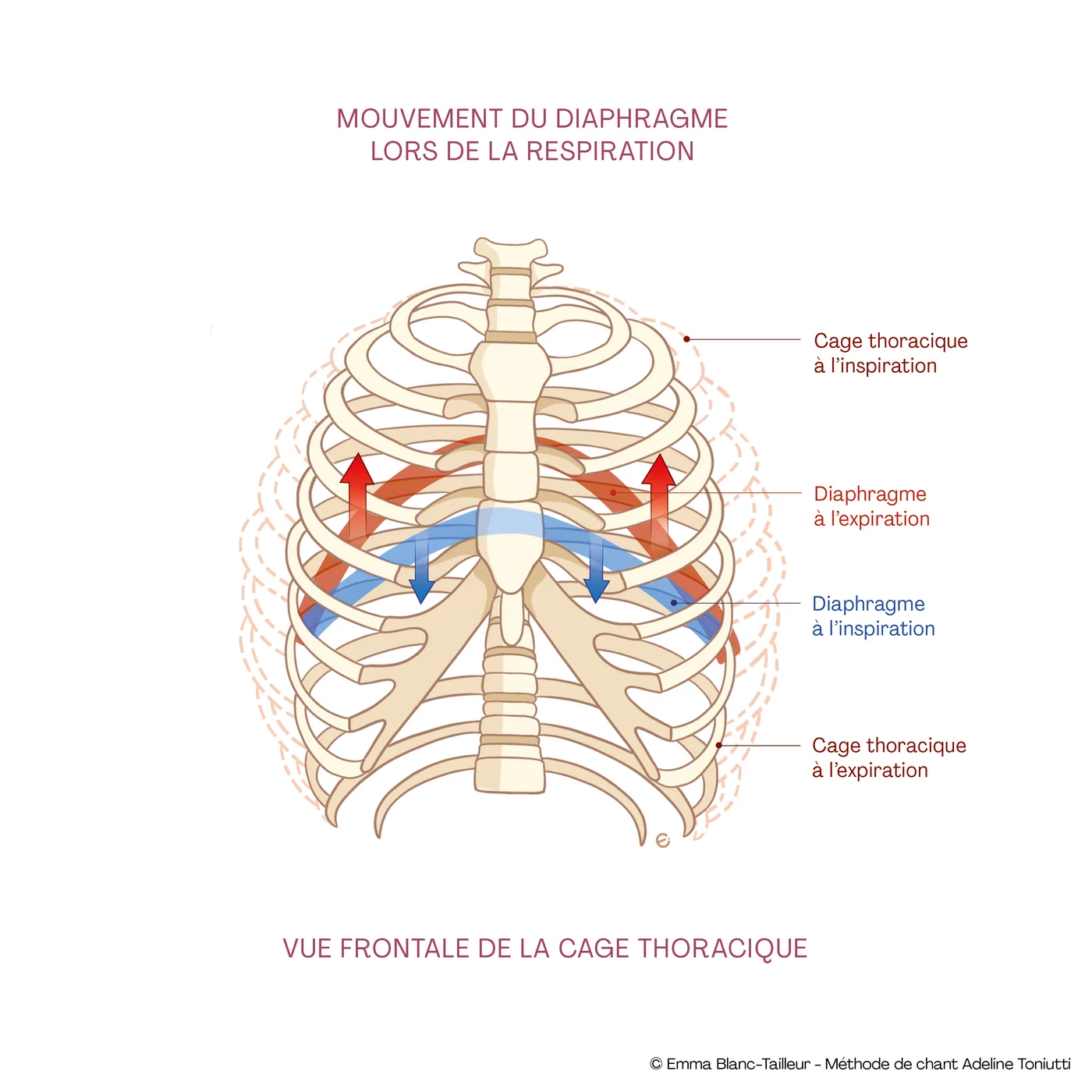
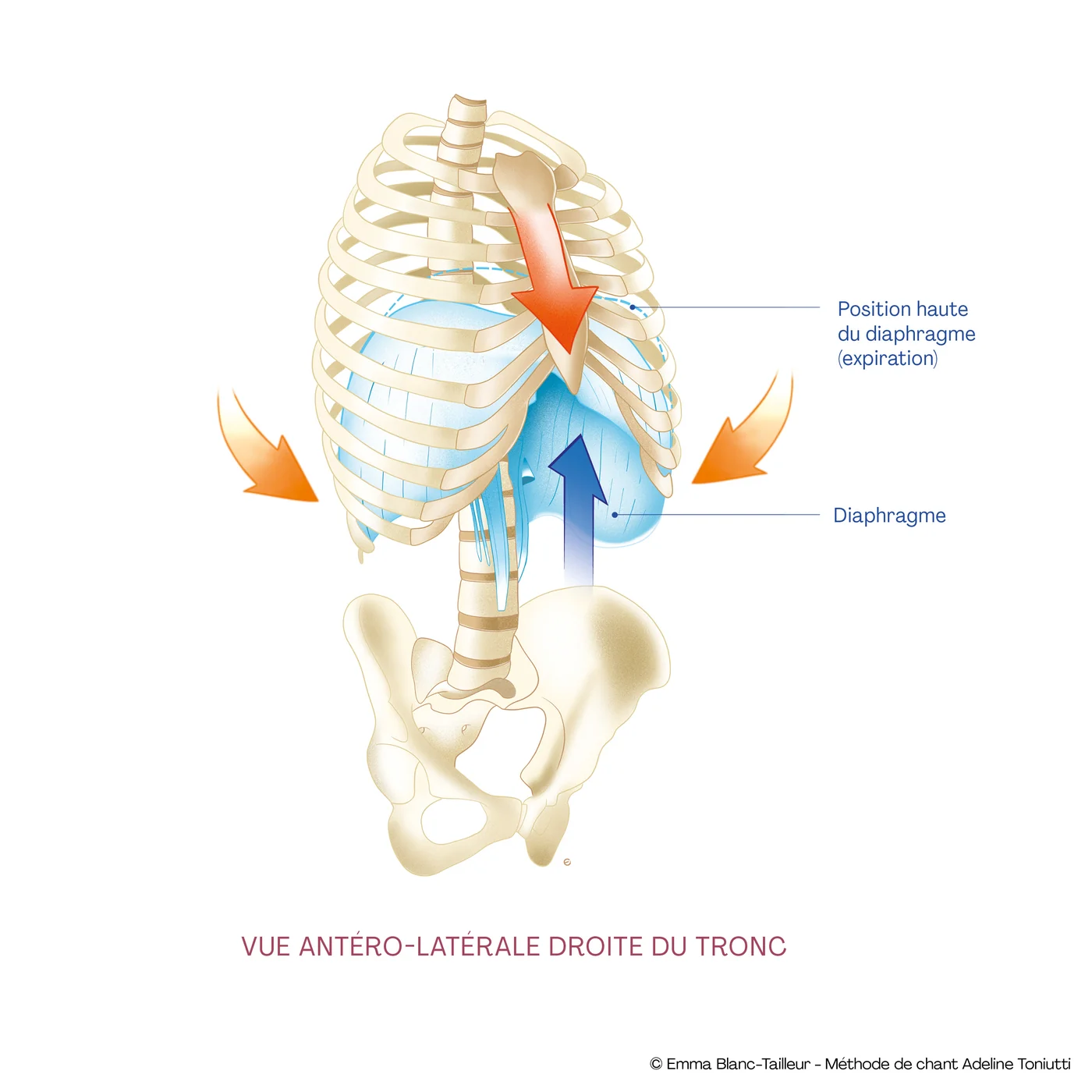
插图 © Emma Blanc-Tailleur,《Anatomie du Chant》,Adeline Toniutti
THE HAMMOCK
喉导向。不施压。
“Lower your larynx” does not make a bigger sound. It unbalances the organ. There is improvement when the laryngeal movement goes with the exhaled air, upward. Without locking at the top. Soft movements, supported by the breath.
The larynx hangs in the throat like a hammock. Posture keeps that suspension.
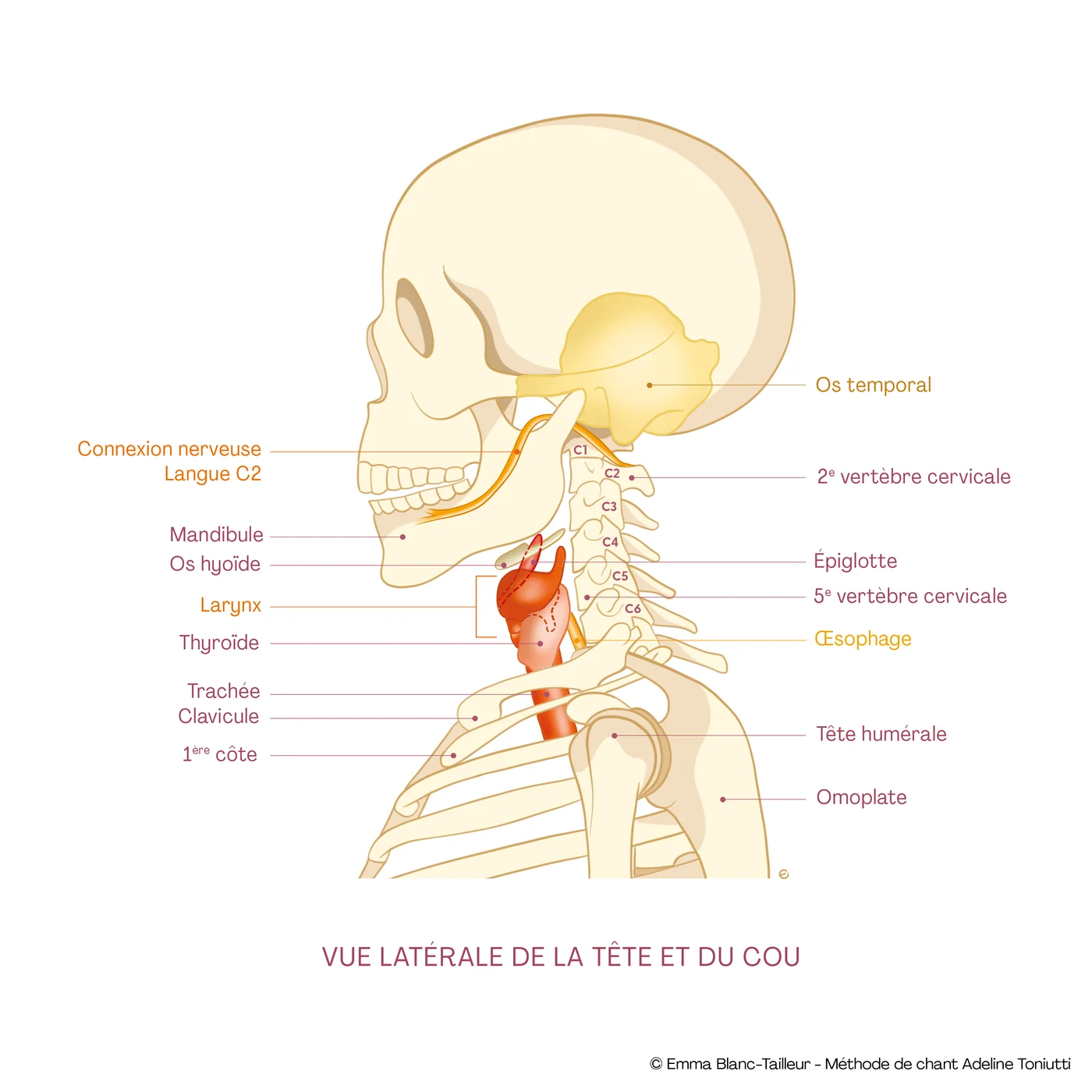
插图 © Emma Blanc-Tailleur,《Anatomie du Chant》,Adeline Toniutti
Neck lengthened, chin slightly down, not parked on the chest. Shoulders free: locking them down or back stops the intercostals launching the inhale. Pelvis retroverted and torso lengthened, or the anterior chain collapses and the abdominals cannot reach their potential.
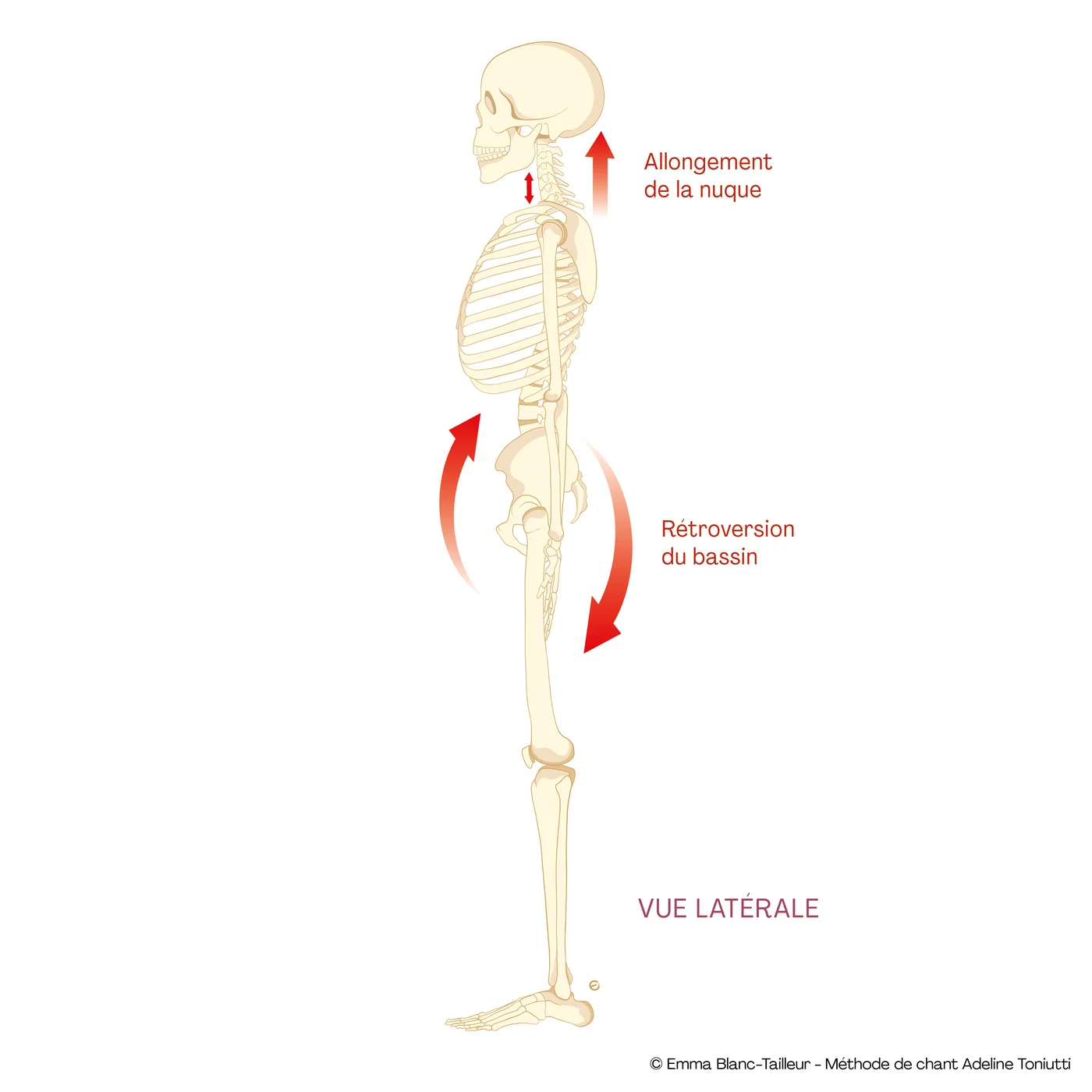
插图 © Emma Blanc-Tailleur,《Anatomie du Chant》,Adeline Toniutti
THE SPACES
腔体,不是脖子
Sound is the meeting of air and folds. The wave then takes colour against the membranes and cavities. Making it resonate is the fourth pivot point: freeing those cavities for projection and timbre.
Twang,Adeline 多年来从五个支点教,内部叫「按美国方式唱」,在不增加呼吸负担的情况下提高听感力度。软腭抬起。不是鼻音。
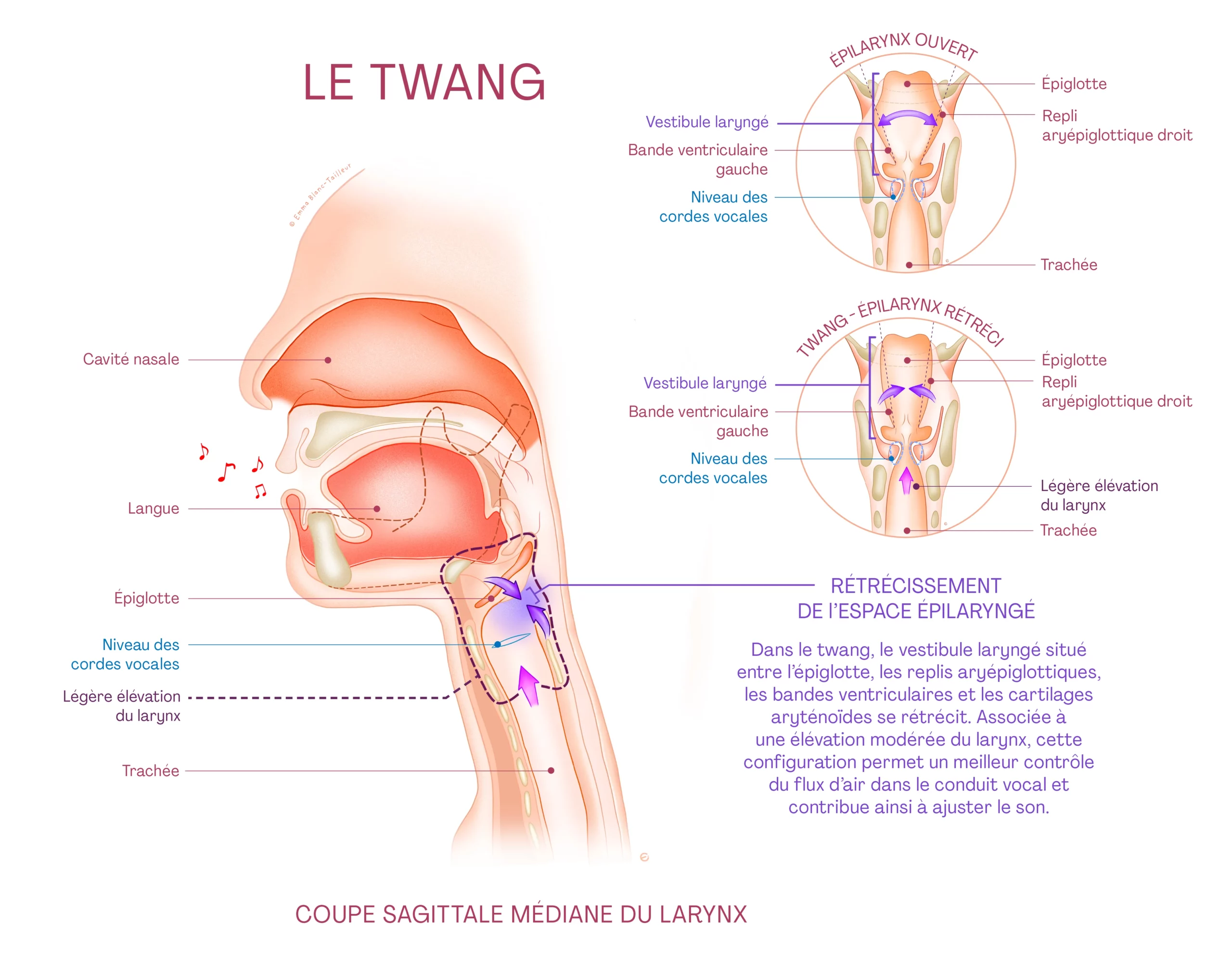
Anatomical representation of twang: aryepiglottic sphincter narrowing
Dr Marie Mailly: twang amplifies the high frequencies, the singer’s formant. The literature describes an inverted horn: narrow below, more open above.
当代音乐里找 twang,就像歌剧里找面罩和投射。要声音,少费力。
Belting, in the method, is not a shout. It is keeping mechanism 1 (chest voice) as high as possible. Subglottic air pressure raised by the sling, higher laryngeal resistance, moderate vestibular narrowing. Dr Bruno Coulombeau: in belting, moderate vestibular narrowing; in mixed or head voice, very little narrowing.
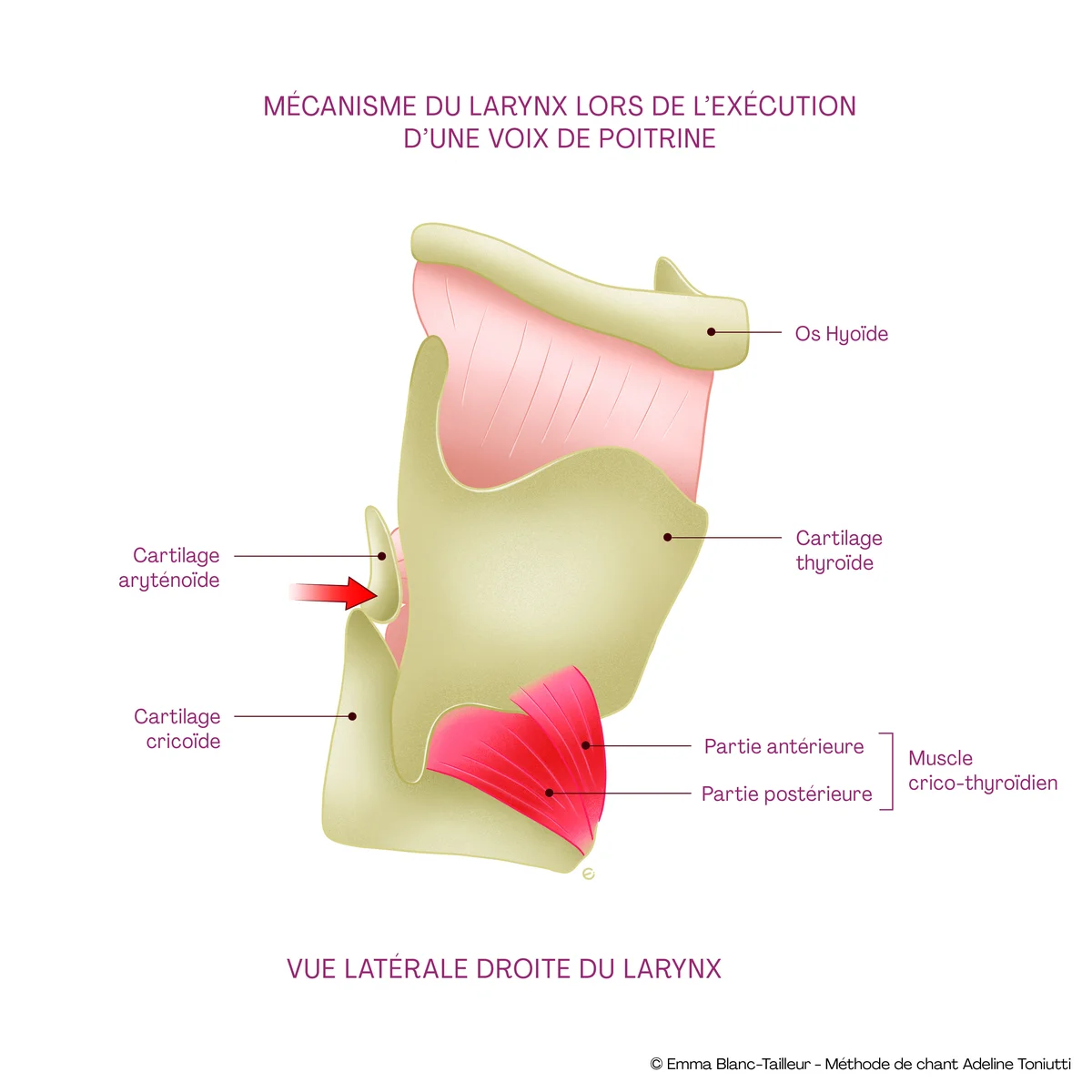
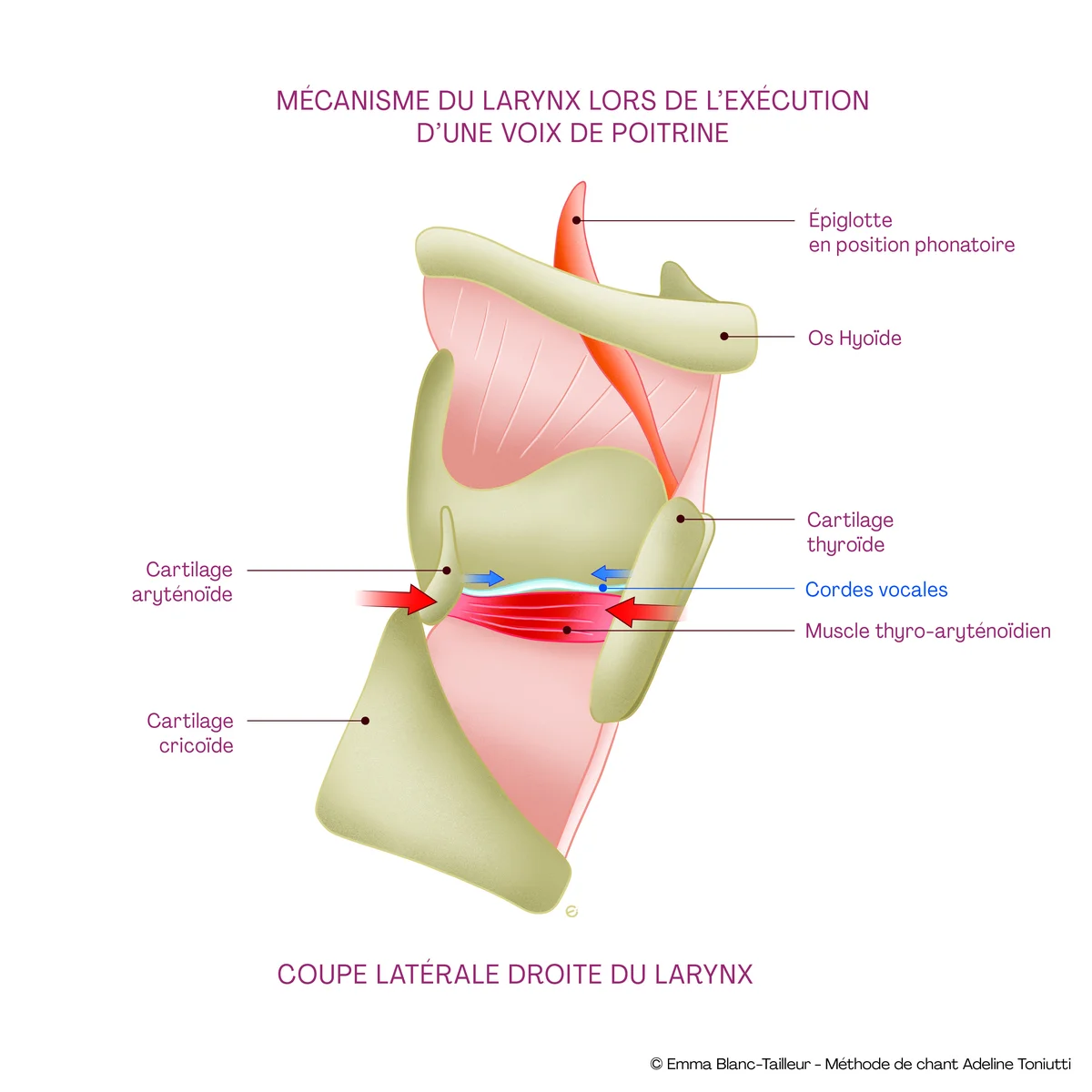
插图 © Emma Blanc-Tailleur,《Anatomie du Chant》,Adeline Toniutti
HEARING YOURSELF
不要去听自己
When you sing loud, the stapedius reflex protects the inner ear against very intense sounds, usually high ones. Your ears protect you.
Forcing to hear yourself is fighting that reflex. A sound that already seems huge to you may still lack carry outside, or the reverse: a sound that seems thin to you carries, if the cavities are working.
On a high note the method says: the sound always seems thin to you, unless you are heavily amplified. Three criteria for a healthy high note: others find it beautiful; it seems thin to you; no discomfort afterwards.
IN PRACTICE
四个支点
1. Smell a flower
Mouth closed. Hands on the floating ribs. Feel the opening. Not the shoulders. Not an Everest.
2. Hold the ribs on the exhale
Sternum coming down, ribs drawing together, obliques working. If the neck hardens and the ribs open, you have dropped the accelerator and twisted the wheel.
3. Check the hammock
Hands around the larynx, or thumbs under the mandible. The tongue moves away from the fingers. The larynx is not jammed into the sternal notch.
4. Choose the space, not the push
Lyric: even vowels, projection over the orchestra. Contemporary: true twang (palate raised), taught from the five pivot points. Microphone: give the core of the sound, do not shout into the capsule.
这些练习都带着五个支点做。
常见问题
唱得更响就是推吗?
不是。喉导向(方向盘)。肋骨和斜肌加速。用脖子推是拧方向盘。
要很多气才能传出去吗?
不要。大口吸气却握不住,会给没有支点的喉加压。Adeline 常要求吸得很小,两次,像闻一朵花。
Twang 是鼻音吗?
不是。真正的 twang 从五个支点教,软腭抬起。把声音鼻音化是赝品,会伤声带。
为什么唱响了反而听不见自己?
镫骨肌反射保护内耳。你觉得细的声音,腔体工作时在外面能传。