الغناء أقوى
عيادة الصوت
لا تصرخ. الحنجرة = المقود، الأضلاع والمائلون = الدواسة.
NOT A CRY
للصرخة لا غاية جمالية
Physiologically, singing is filling the lungs, giving the air back on the exhale, bringing the folds together, making a sound. You could compare that to a cry. In life we say a cry of joy, a cry of pain. A cry has no aesthetic aim.
Singing louder, in Adeline Toniutti’s method, is not shouting louder. It is taking hold of the exhale, and letting the cavities do their work.
Adeline compares the larynx to a steering wheel, the ribs and obliques to accelerators. You do not press the wheel to go faster.
الحنجرة هي المقود. الأضلاع والمائلون هم الدواسة.
LITRES
ليست مسألة لترات
At a colloquium with Prof. Thomas Sinowski, pulmonologist at the Pitié-Salpêtrière, a demonstration made the point. His theoretical vital capacity was clearly higher, around five litres. He did not hold a note as long as Adeline. Twice the available volume does not make up for an untrained gesture.
In ordinary breathing we inhale and exhale about 0.5 litres per cycle, six litres a minute. In active breathing, holding a note, one can move toward six litres. Training can raise vital capacity. That is not what makes the sound carry.
The “belly push” inhale is not, on its own, the singer’s technique. The gesture rests on a synergy: opening and managing the ribs, the diaphragm, a measured action of the obliques.
Faced with a note that scares you, you inflate. On television, internally, Adeline talks about the “vocal Everest” class. She has seen that asking people to inhale very small, twice, very fast, as if smelling a flower, finds the right movement sooner. More air is not more sound. More air badly held is more pressure on a larynx with no support.
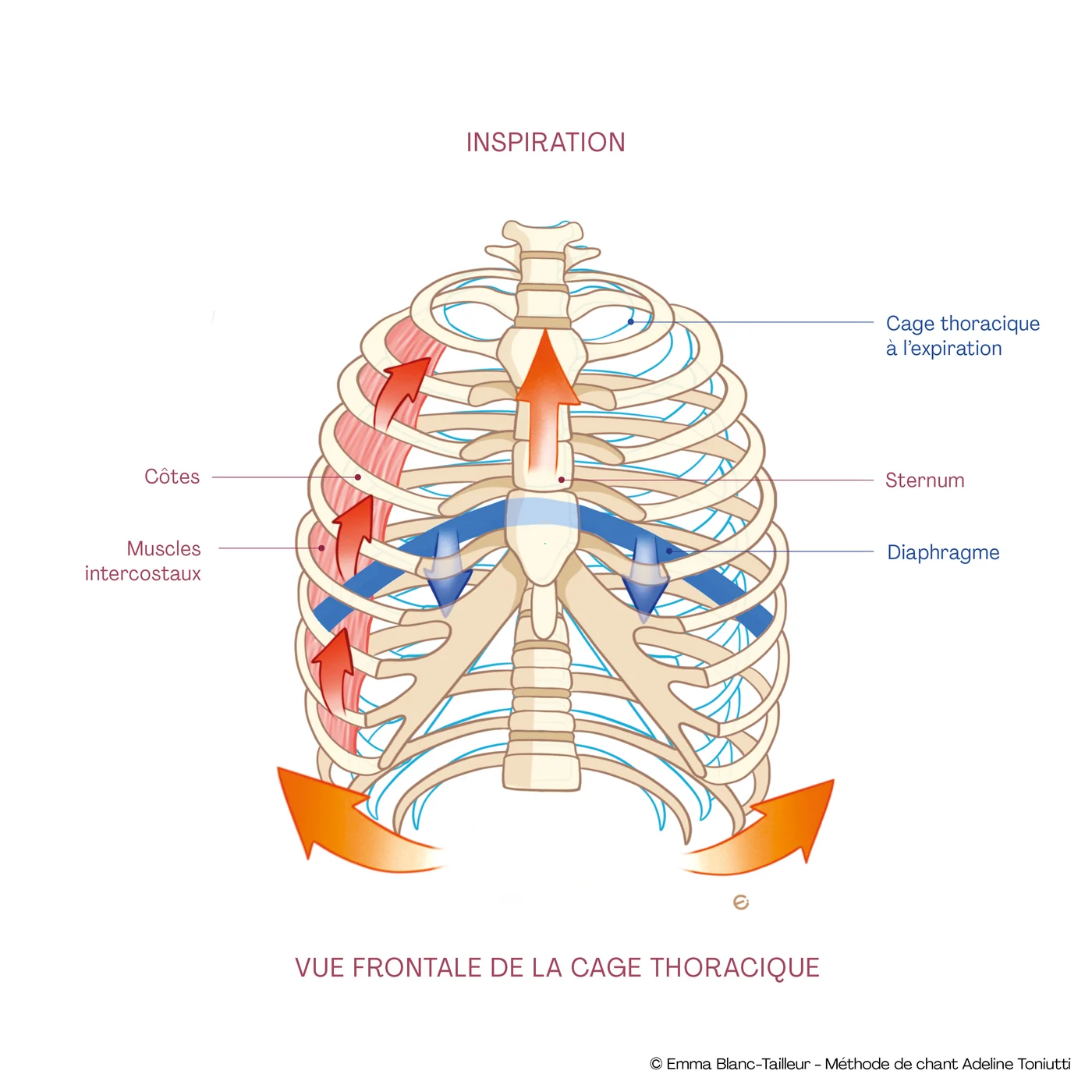
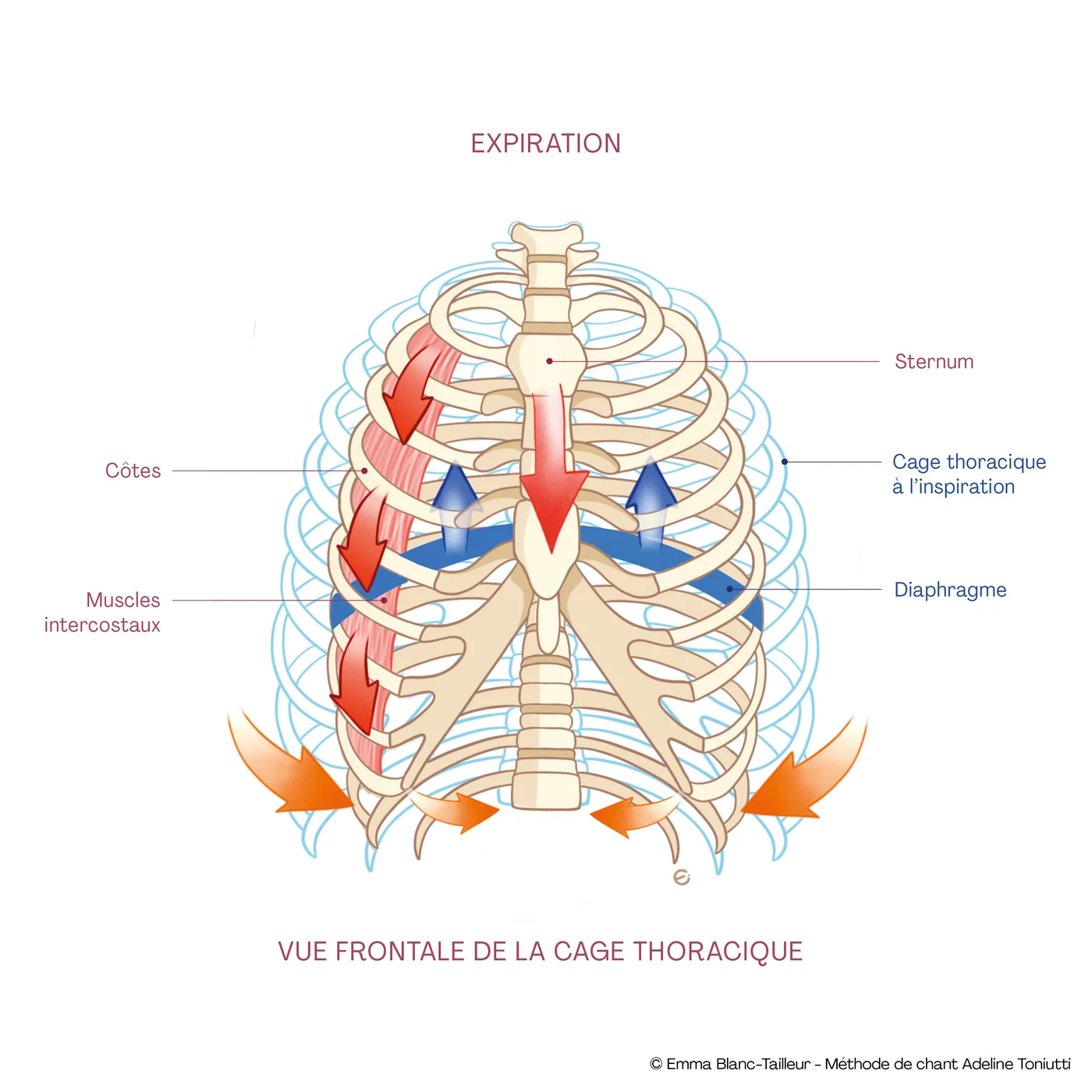
رسوم © Emma Blanc-Tailleur، Anatomie du Chant، Adeline Toniutti
WHO DRIVES THE AIR
الرئتان تتلقيان. العضلات تأمر.
The lungs have no motor muscle. Ventilation is the diaphragm, the intercostals, and for the active exhale of singing, the sling: transversus, obliques, rectus.
Making a sound is emptying the lungs. You draw the ribs together, raise the diaphragm, the abdominals press, the air goes up.
- The transversus, the deepest, raises pressure and stabilises the trunk. It is mainly used on the active exhale.
- The obliques add to that pressure and allow the trunk to rotate.
- The rectus, the “six-pack”, manages the held bulge of the abdomen. It is the engine of the exhale.
On the inhale the external intercostals fire, the sternum rises, the ribs flare, the diaphragm descends like an umbrella. On the exhale the ribs draw together. Jean-Marie Legé: when one plane contracts, it tightens the ribs; when the other contracts, it opens them.
The singer’s task: optimise the inhale, master the exhale. On a high note, or a forte, most people release costal pressure. The floating ribs open again. That pressure must be held, if the laryngeal movement is right.
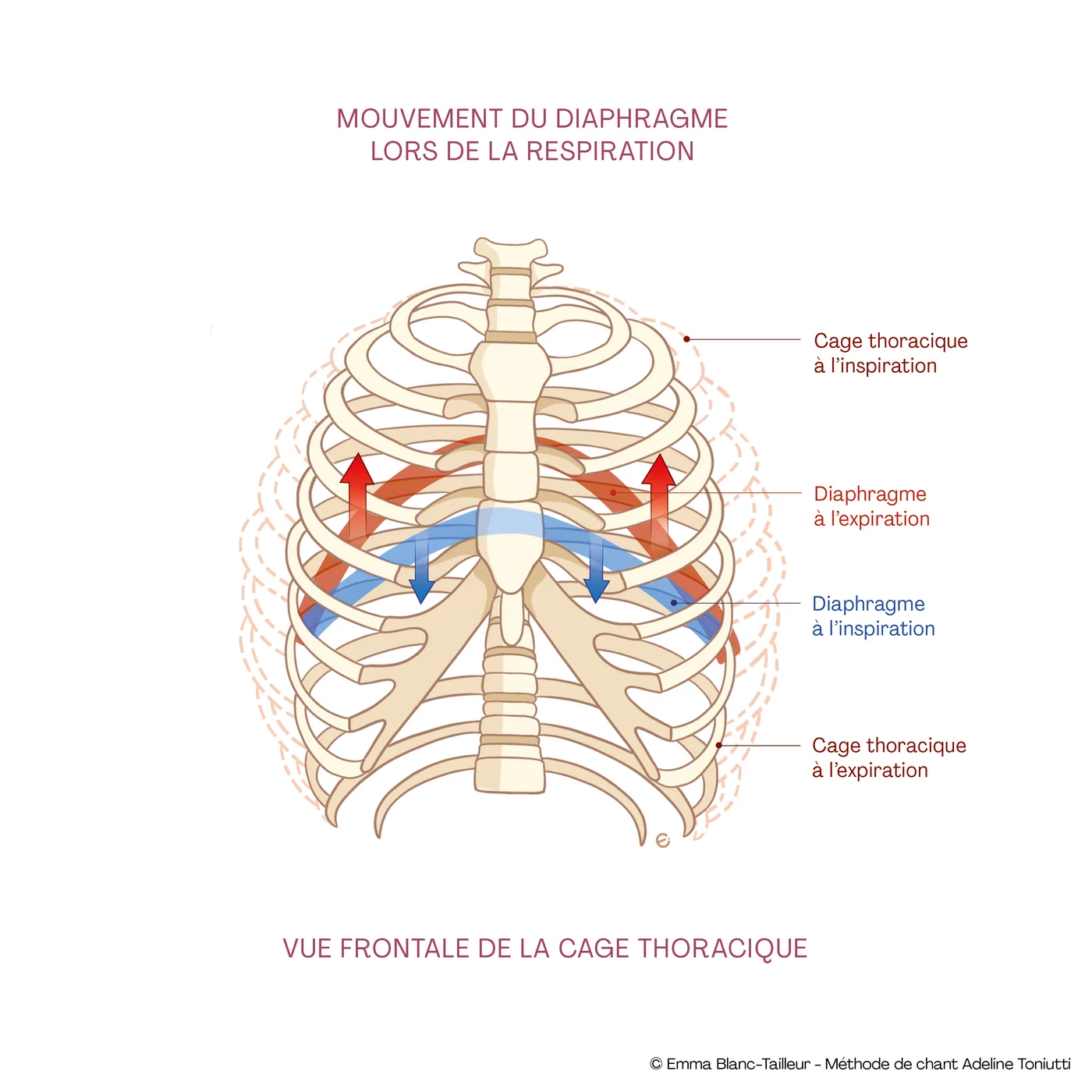
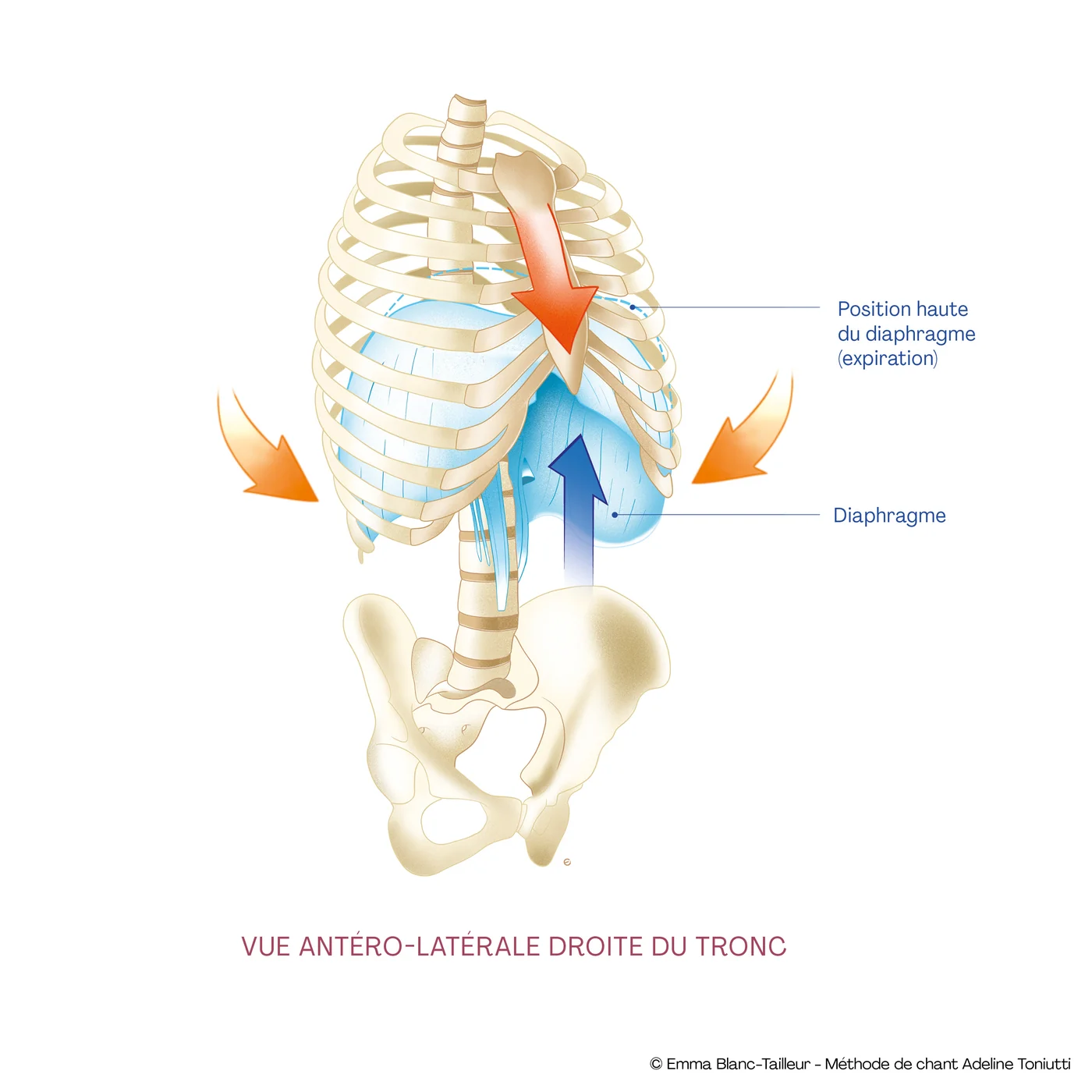
رسوم © Emma Blanc-Tailleur، Anatomie du Chant، Adeline Toniutti
THE HAMMOCK
الحنجرة توجّه. لا تضغط.
“Lower your larynx” does not make a bigger sound. It unbalances the organ. There is improvement when the laryngeal movement goes with the exhaled air, upward. Without locking at the top. Soft movements, supported by the breath.
The larynx hangs in the throat like a hammock. Posture keeps that suspension.
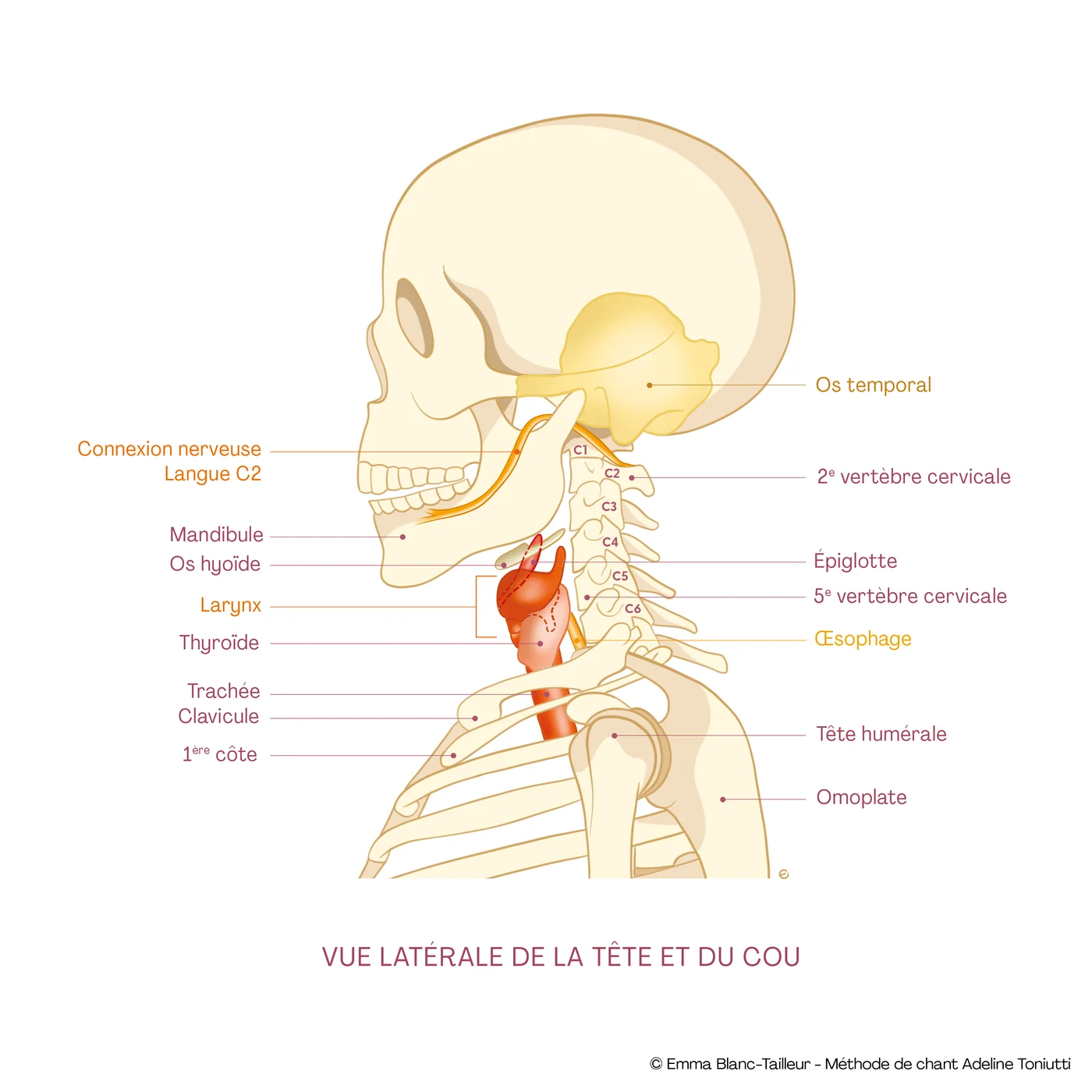
رسم © Emma Blanc-Tailleur، Anatomie du Chant، Adeline Toniutti
Neck lengthened, chin slightly down, not parked on the chest. Shoulders free: locking them down or back stops the intercostals launching the inhale. Pelvis retroverted and torso lengthened, or the anterior chain collapses and the abdominals cannot reach their potential.
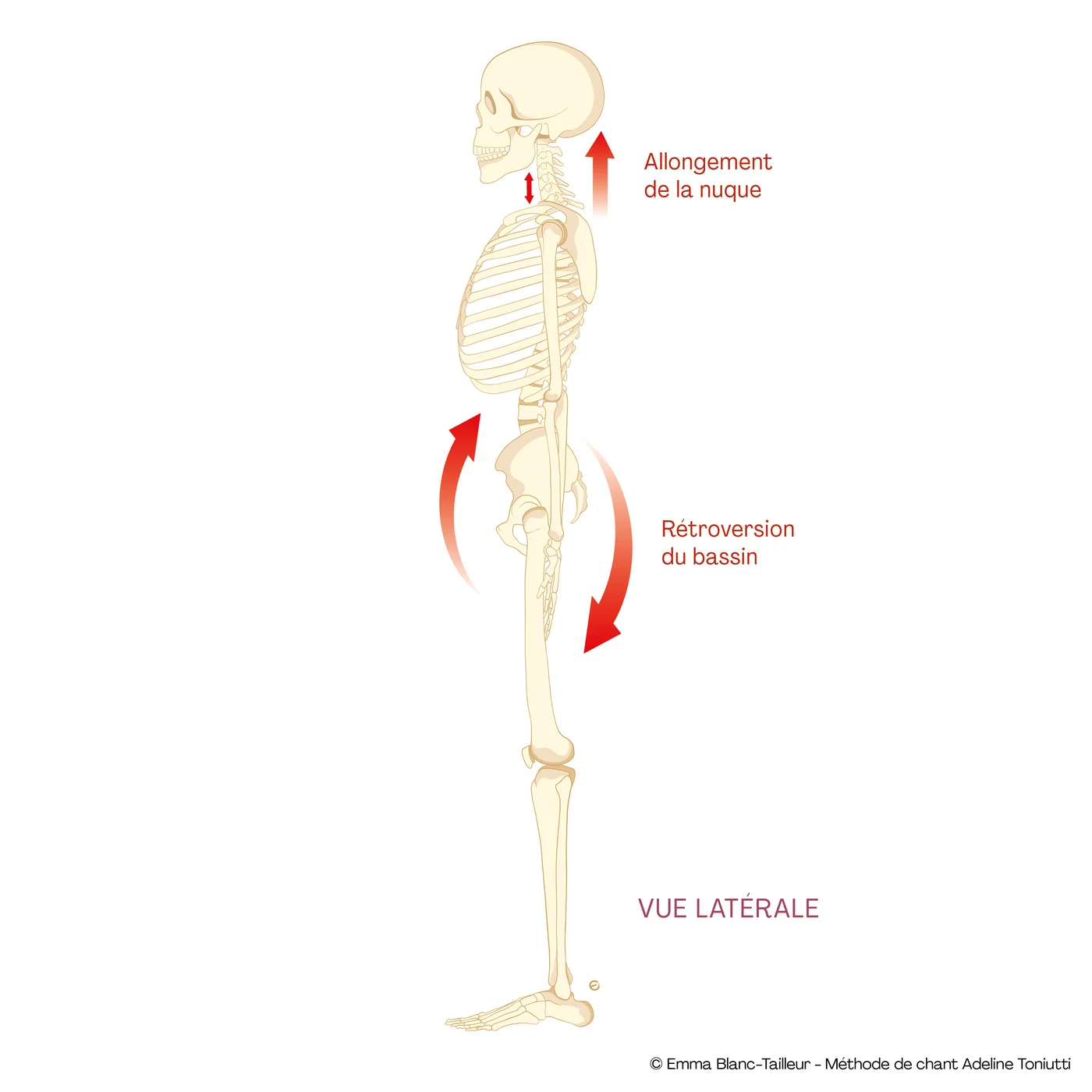
رسم © Emma Blanc-Tailleur، Anatomie du Chant، Adeline Toniutti
THE SPACES
التجاويف، لا العنق
Sound is the meeting of air and folds. The wave then takes colour against the membranes and cavities. Making it resonate is the fourth pivot point: freeing those cavities for projection and timbre.
التوانغ، الذي تعلّمه أدلين منذ سنوات انطلاقاً من النقاط المحورية الخمس، وتسمّيه داخلياً «الغناء على الطريقة الأمريكية»، يرفع القوة المدركة دون جهد تنفسي إضافي. الحنك مرتفع.
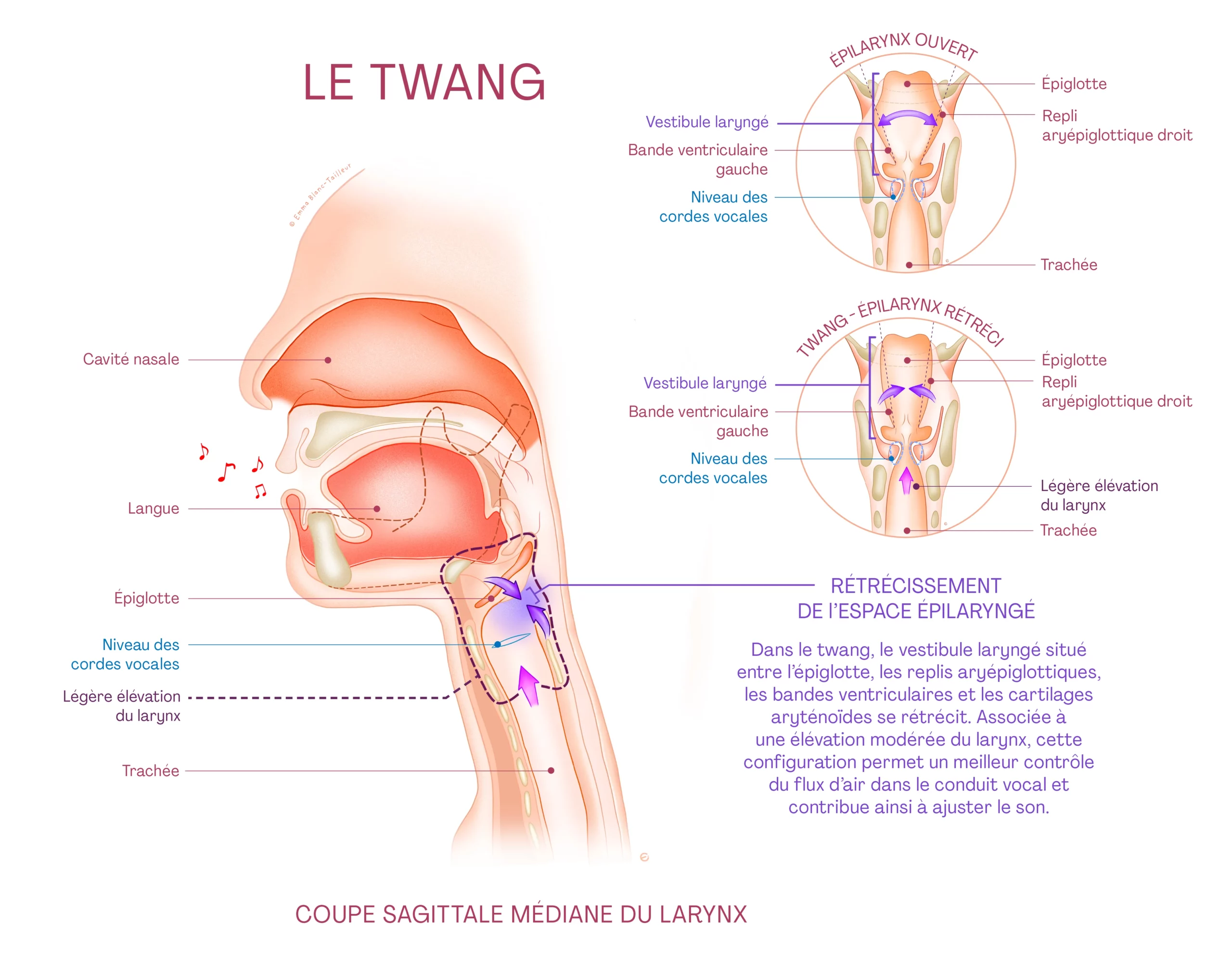
Anatomical representation of twang: aryepiglottic sphincter narrowing
Dr Marie Mailly: twang amplifies the high frequencies, the singer’s formant. The literature describes an inverted horn: narrow below, more open above.
البحث عن التوانغ في الموسيقى المعاصرة يشبه البحث عن القناع والإسقاط في الأوبرا.
Belting, in the method, is not a shout. It is keeping mechanism 1 (chest voice) as high as possible. Subglottic air pressure raised by the sling, higher laryngeal resistance, moderate vestibular narrowing. Dr Bruno Coulombeau: in belting, moderate vestibular narrowing; in mixed or head voice, very little narrowing.
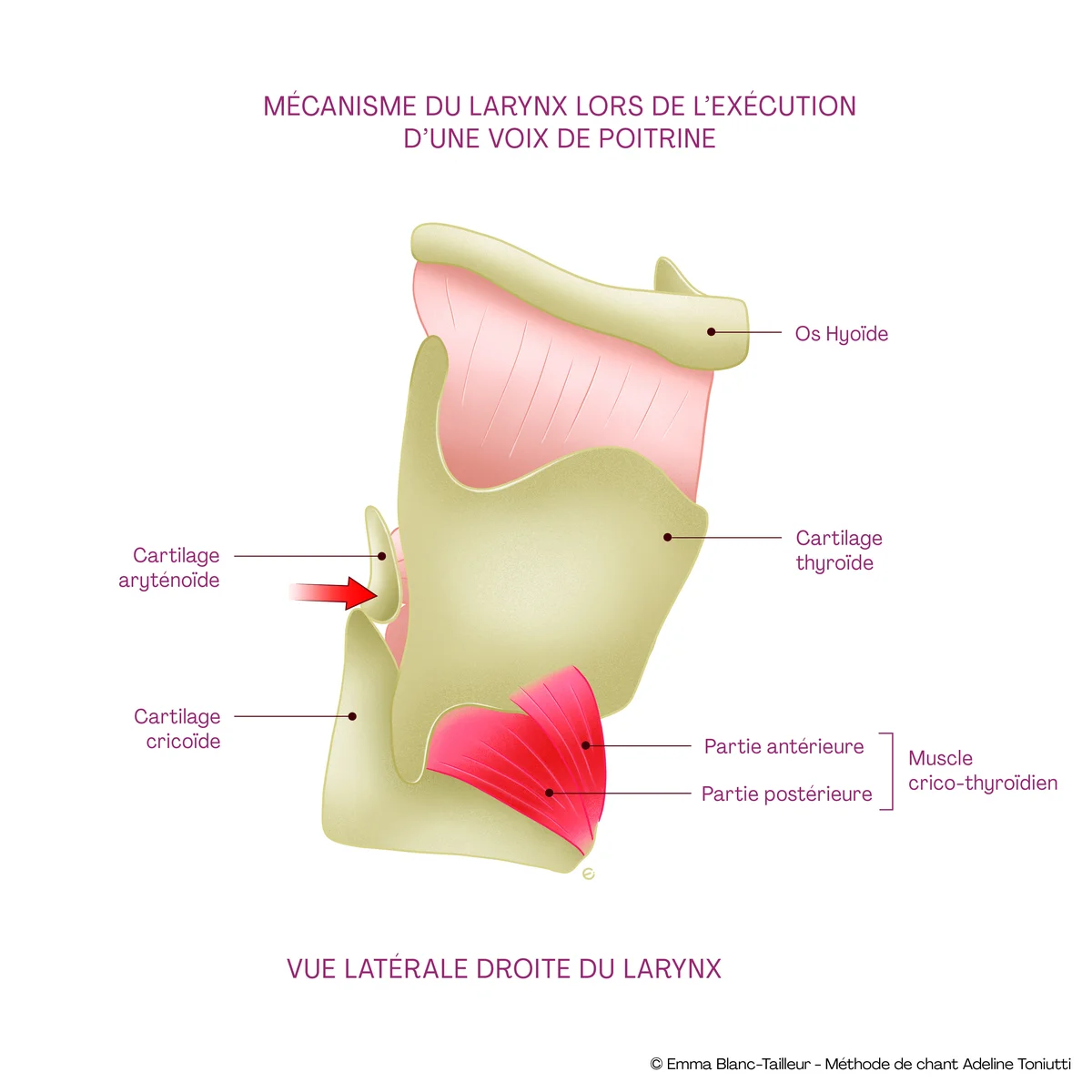
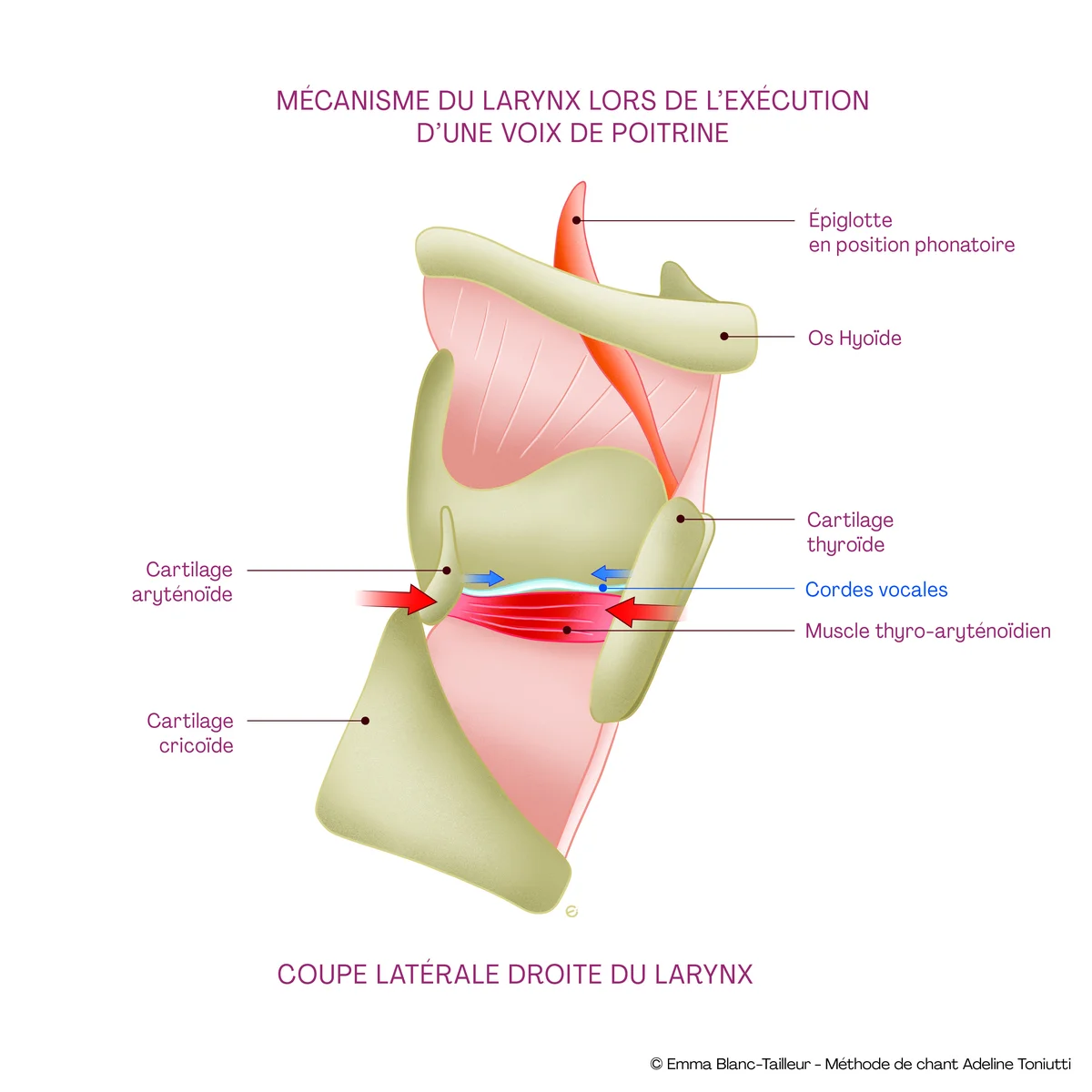
رسوم © Emma Blanc-Tailleur، Anatomie du Chant، Adeline Toniutti
HEARING YOURSELF
لا تسعَ إلى سماع نفسك
When you sing loud, the stapedius reflex protects the inner ear against very intense sounds, usually high ones. Your ears protect you.
Forcing to hear yourself is fighting that reflex. A sound that already seems huge to you may still lack carry outside, or the reverse: a sound that seems thin to you carries, if the cavities are working.
On a high note the method says: the sound always seems thin to you, unless you are heavily amplified. Three criteria for a healthy high note: others find it beautiful; it seems thin to you; no discomfort afterwards.
IN PRACTICE
أربعة دعامات
1. Smell a flower
Mouth closed. Hands on the floating ribs. Feel the opening. Not the shoulders. Not an Everest.
2. Hold the ribs on the exhale
Sternum coming down, ribs drawing together, obliques working. If the neck hardens and the ribs open, you have dropped the accelerator and twisted the wheel.
3. Check the hammock
Hands around the larynx, or thumbs under the mandible. The tongue moves away from the fingers. The larynx is not jammed into the sternal notch.
4. Choose the space, not the push
Lyric: even vowels, projection over the orchestra. Contemporary: true twang (palate raised), taught from the five pivot points. Microphone: give the core of the sound, do not shout into the capsule.
تُنفَّذ هذه التمارين مع النقاط المحورية الخمس.
CALYP
اعمل المدى في CALYP
المنهج في Anatomie du Chant (Marabout، 2024). للعمل عليه مع الفريق: احجز موعداً.
الأسئلة الشائعة
هل الغناء أقوى يعني الدفع؟
لا. الحنجرة توجّه (المقود). الأضلاع والمائلون يسرّعون.
هل أحتاج كثيراً من الهواء ليصل؟
لا. شهيق كبير غير ممسوك يضع ضغطاً على حنجرة بلا دعم.
هل التوانغ أنفي؟
لا. التوانغ الحقيقي، من النقاط المحورية الخمس، يُفعل والحنك مرتفع.
لماذا لا أسمع نفسي حين أغني بقوة؟
منعكس العضلة الركابية يحمي الأذن الداخلية. صوت يبدو لك رقيقاً قد يصل في الخارج إن عملت التجاويف.