Cantar más fuerte
CLÍNICA DE LA VOZ
No gritar. Laringe = volante, costillas y oblicuos = acelerador. El sonido lleva por el apoyo y los espacios.
NOT A CRY
El grito no tiene fin estético
Physiologically, singing is filling the lungs, giving the air back on the exhale, bringing the folds together, making a sound. You could compare that to a cry. In life we say a cry of joy, a cry of pain. A cry has no aesthetic aim.
Singing louder, in Adeline Toniutti’s method, is not shouting louder. It is taking hold of the exhale, and letting the cavities do their work.
Adeline compara la laringe con un volante, las costillas y los oblicuos con aceleradores. No se aprieta el volante para ir más rápido.
La laringe es el volante. Las costillas y los oblicuos son los aceleradores.
LITRES
No es una cuestión de litros
At a colloquium with Prof. Thomas Sinowski, pulmonologist at the Pitié-Salpêtrière, a demonstration made the point. His theoretical vital capacity was clearly higher, around five litres. He did not hold a note as long as Adeline. Twice the available volume does not make up for an untrained gesture.
In ordinary breathing we inhale and exhale about 0.5 litres per cycle, six litres a minute. In active breathing, holding a note, one can move toward six litres. Training can raise vital capacity. That is not what makes the sound carry.
The “belly push” inhale is not, on its own, the singer’s technique. The gesture rests on a synergy: opening and managing the ribs, the diaphragm, a measured action of the obliques.
Ante una nota que da miedo, se infla. Adeline pide a menudo inspirar muy pequeño, dos veces, muy rápido, como para oler una flor.
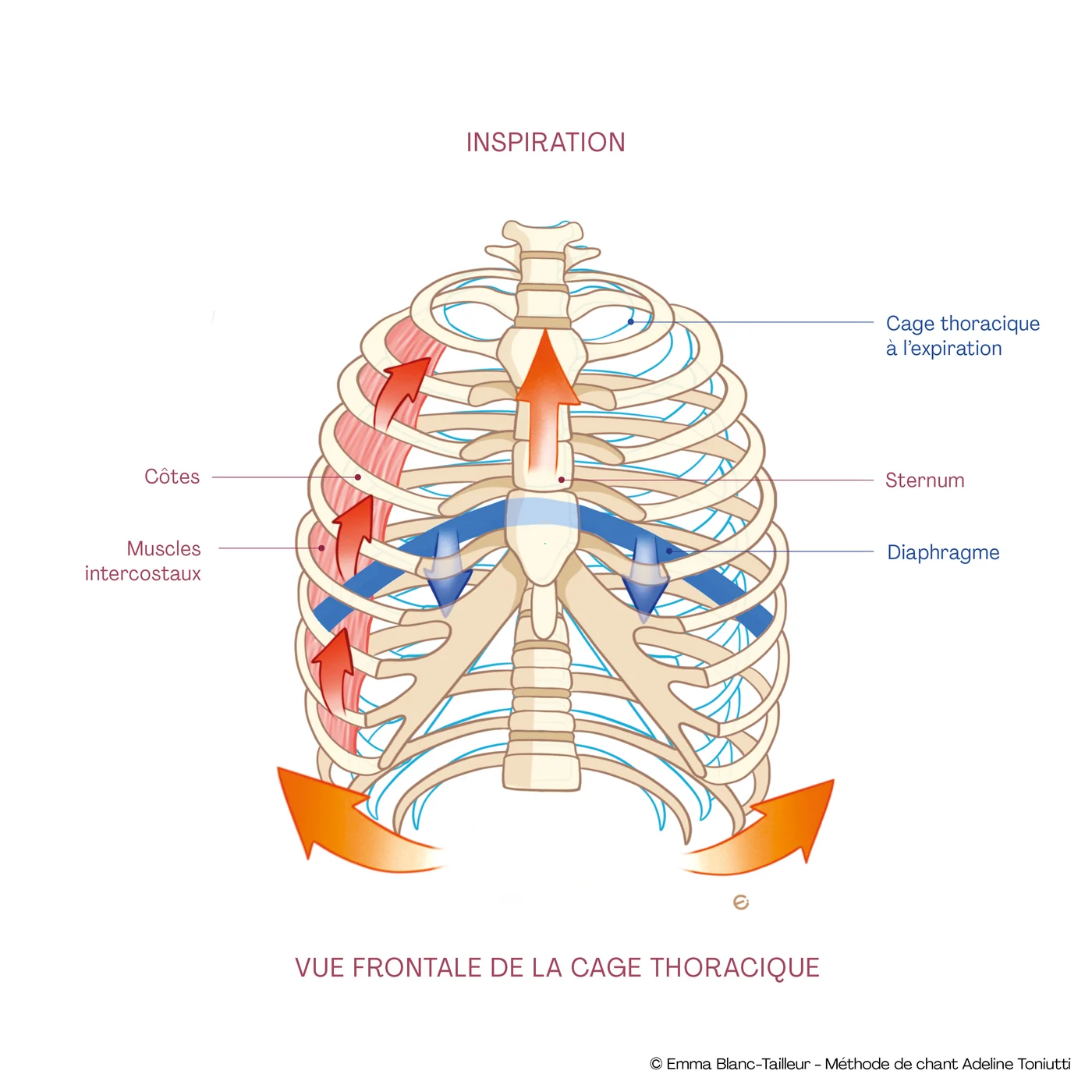
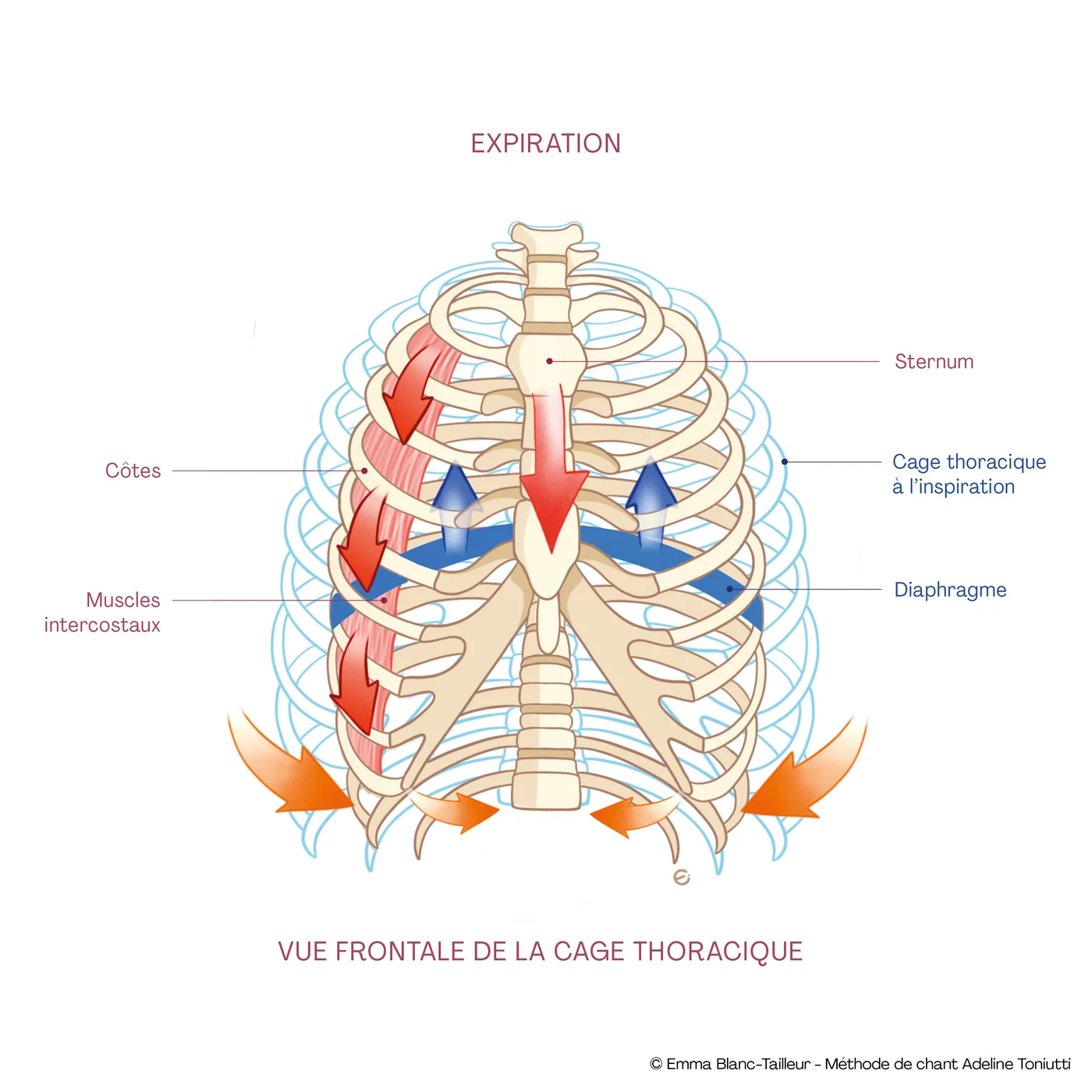
Ilustraciones © Emma Blanc-Tailleur, Anatomie du Chant, Adeline Toniutti
WHO DRIVES THE AIR
Los pulmones reciben. Los músculos mandan.
The lungs have no motor muscle. Ventilation is the diaphragm, the intercostals, and for the active exhale of singing, the sling: transversus, obliques, rectus.
Making a sound is emptying the lungs. You draw the ribs together, raise the diaphragm, the abdominals press, the air goes up.
- The transversus, the deepest, raises pressure and stabilises the trunk. It is mainly used on the active exhale.
- The obliques add to that pressure and allow the trunk to rotate.
- The rectus, the “six-pack”, manages the held bulge of the abdomen. It is the engine of the exhale.
On the inhale the external intercostals fire, the sternum rises, the ribs flare, the diaphragm descends like an umbrella. On the exhale the ribs draw together. Jean-Marie Legé: when one plane contracts, it tightens the ribs; when the other contracts, it opens them.
The singer’s task: optimise the inhale, master the exhale. On a high note, or a forte, most people release costal pressure. The floating ribs open again. That pressure must be held, if the laryngeal movement is right.
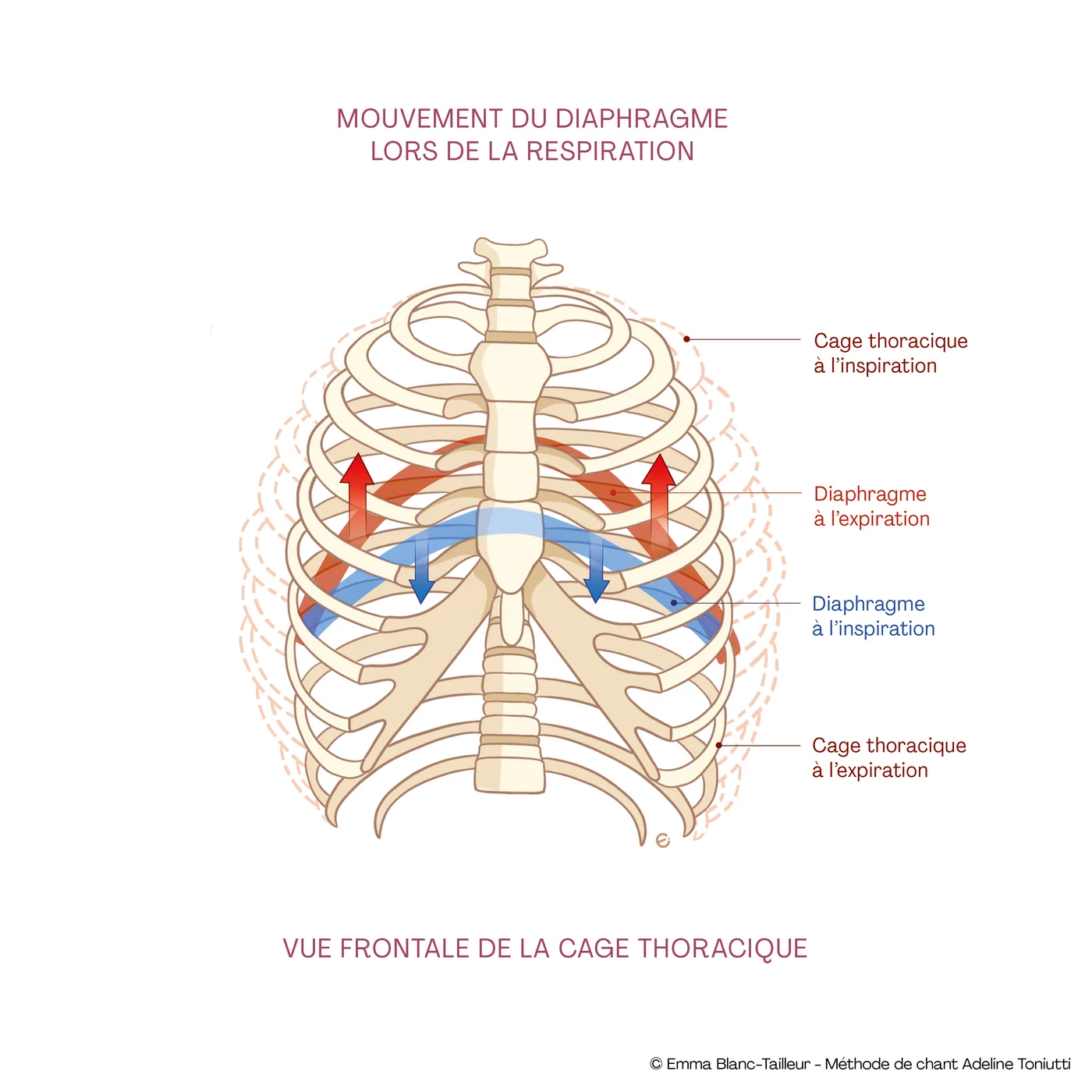
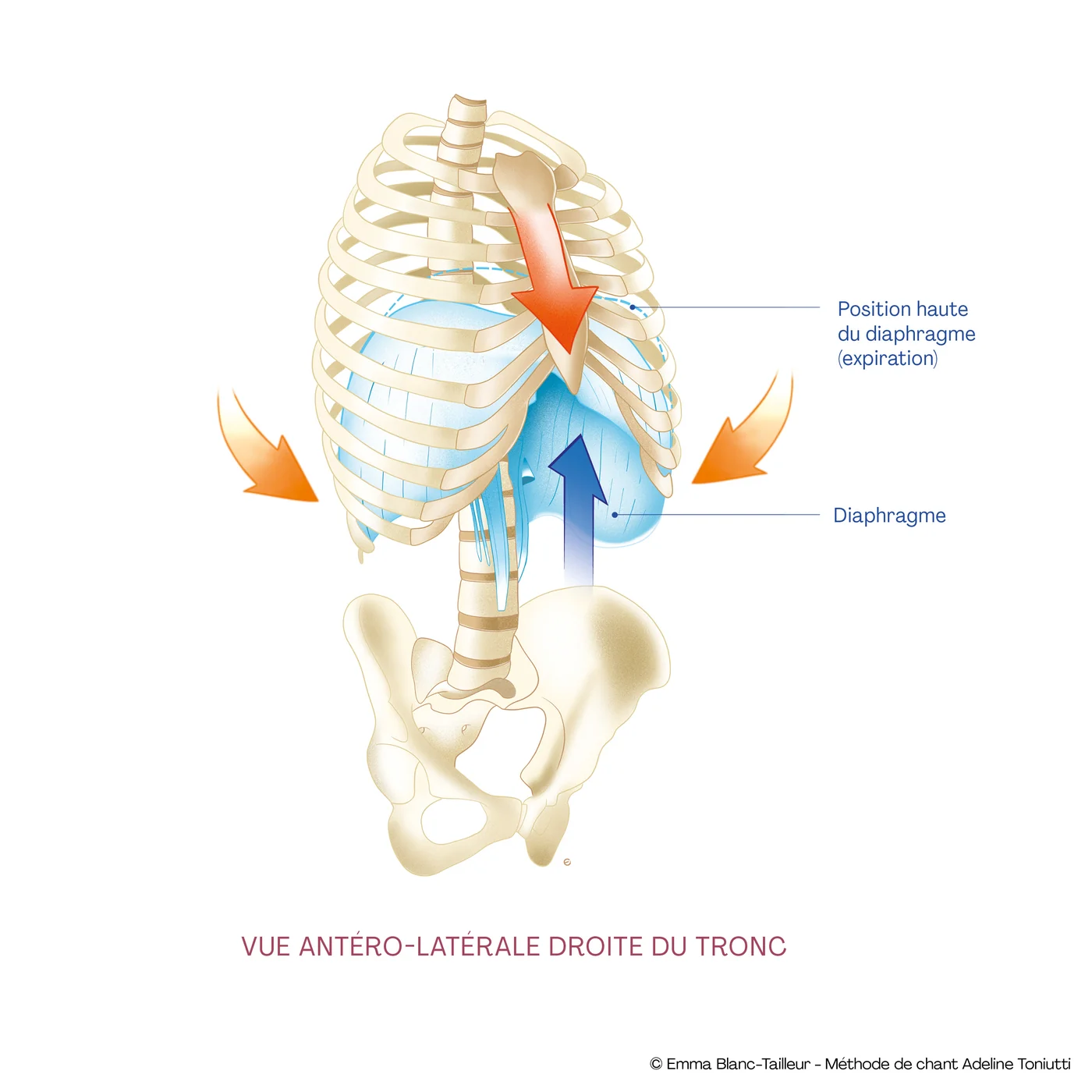
Ilustraciones © Emma Blanc-Tailleur, Anatomie du Chant, Adeline Toniutti
THE HAMMOCK
La laringe orienta. No fuerza.
«Baja la laringe» no hace un sonido más grande. La laringe sigue el aire espirado, hacia arriba.
The larynx hangs in the throat like a hammock. Posture keeps that suspension.
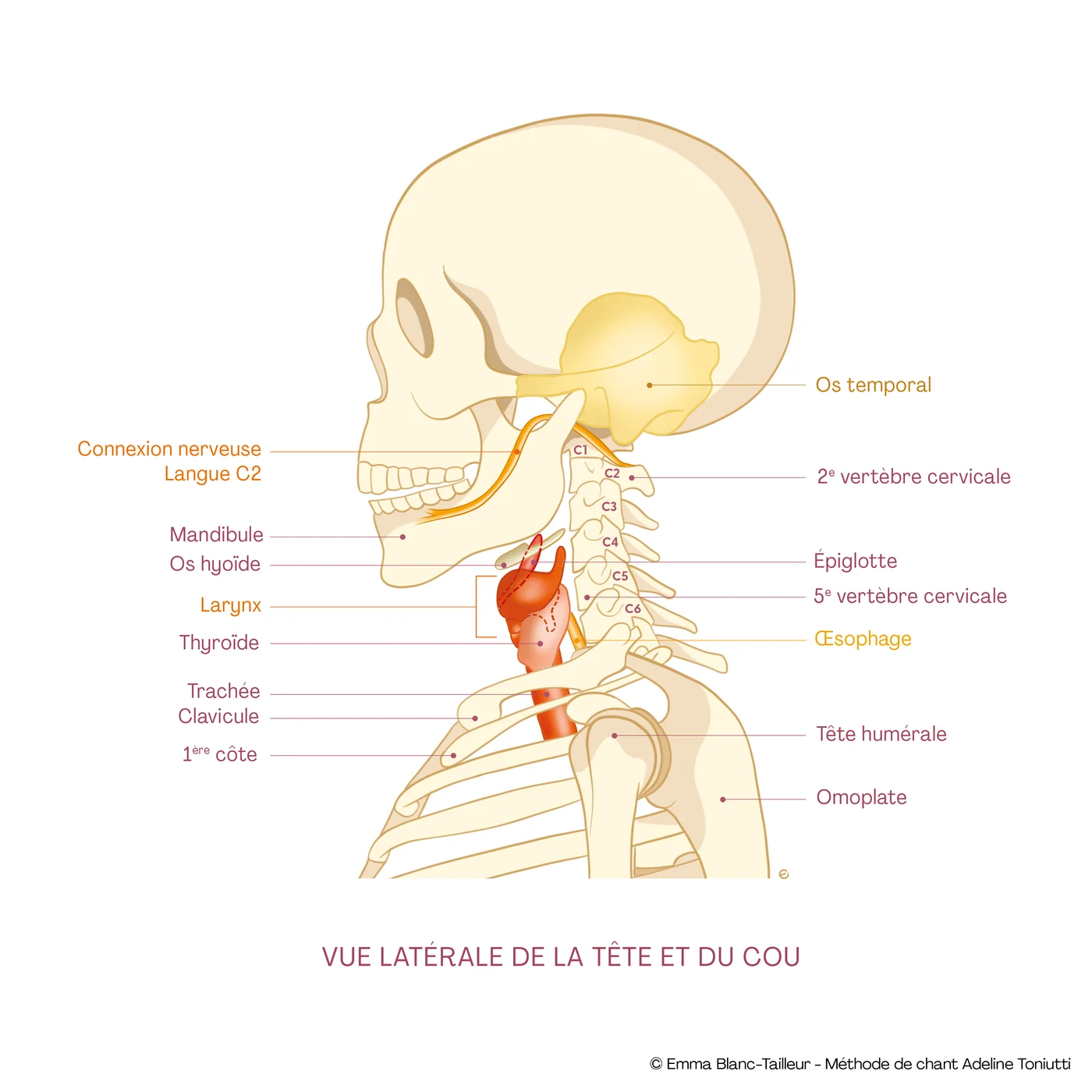
Ilustración © Emma Blanc-Tailleur, Anatomie du Chant, Adeline Toniutti
Neck lengthened, chin slightly down, not parked on the chest. Shoulders free: locking them down or back stops the intercostals launching the inhale. Pelvis retroverted and torso lengthened, or the anterior chain collapses and the abdominals cannot reach their potential.
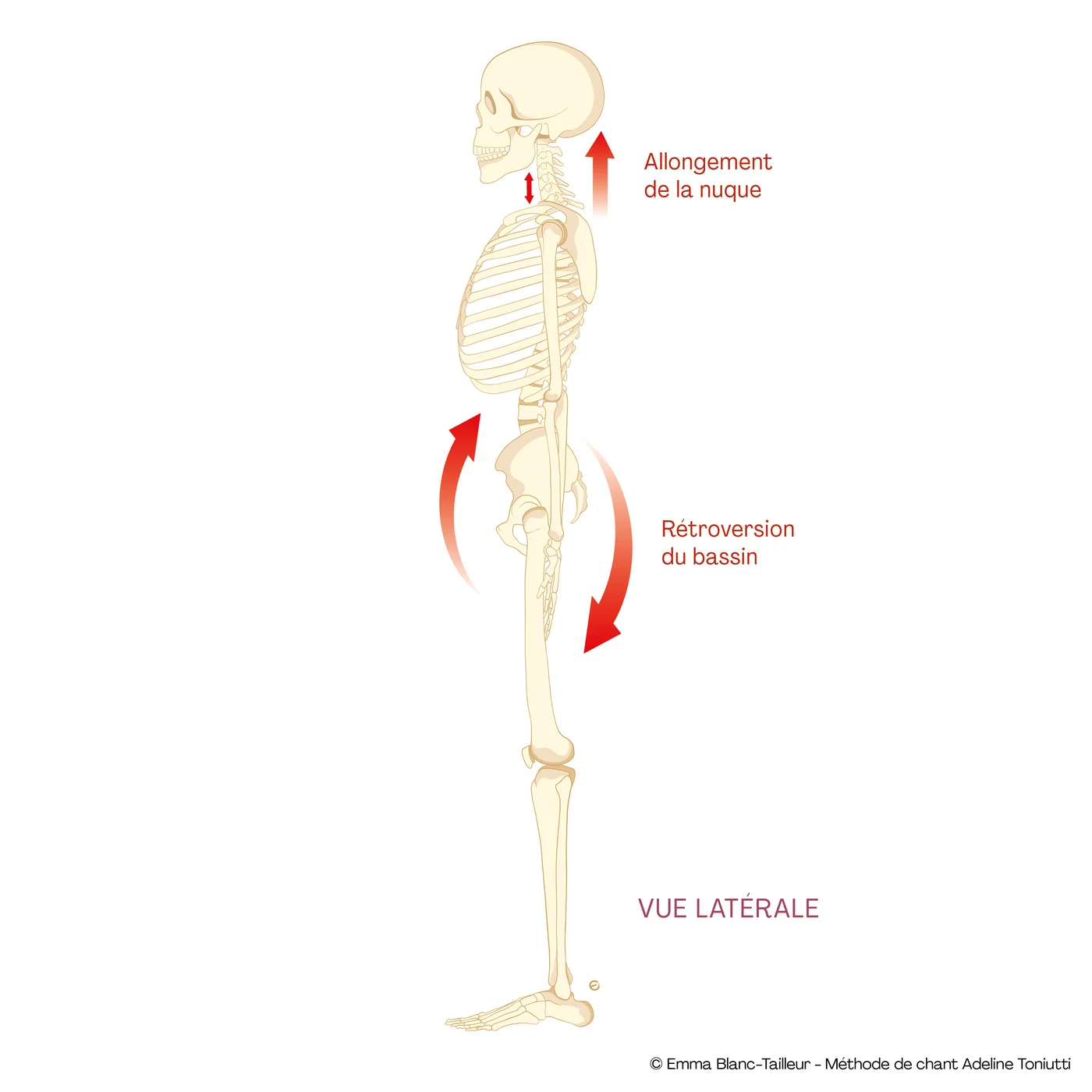
Ilustración © Emma Blanc-Tailleur, Anatomie du Chant, Adeline Toniutti
THE SPACES
Las cavidades, no el cuello
Sound is the meeting of air and folds. The wave then takes colour against the membranes and cavities. Making it resonate is the fourth pivot point: freeing those cavities for projection and timbre.
El twang, que Adeline enseña desde hace años a partir de los cinco puntos pivote, y que llama en interno «cantar a la americana», aumenta la potencia percibida sin esfuerzo respiratorio extra. El velo está levantado. No es un sonido nasal.
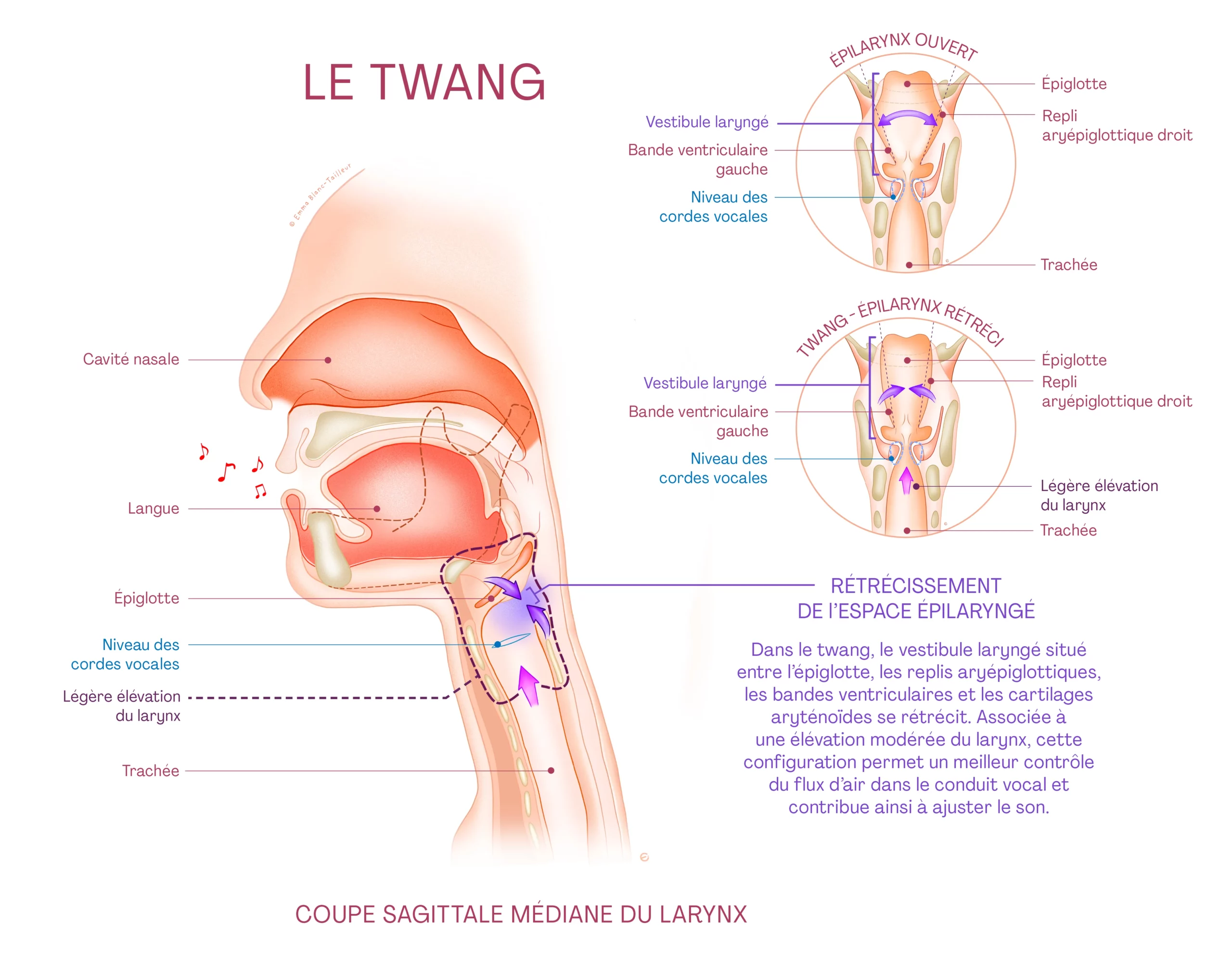
Anatomical representation of twang: aryepiglottic sphincter narrowing
Dr Marie Mailly: twang amplifies the high frequencies, the singer’s formant. The literature describes an inverted horn: narrow below, more open above.
La búsqueda del twang en la música contemporánea se parece a la del máscara y la proyección en la ópera. Se busca sonido, con menos esfuerzo.
Belting, in the method, is not a shout. It is keeping mechanism 1 (chest voice) as high as possible. Subglottic air pressure raised by the sling, higher laryngeal resistance, moderate vestibular narrowing. Dr Bruno Coulombeau: in belting, moderate vestibular narrowing; in mixed or head voice, very little narrowing.
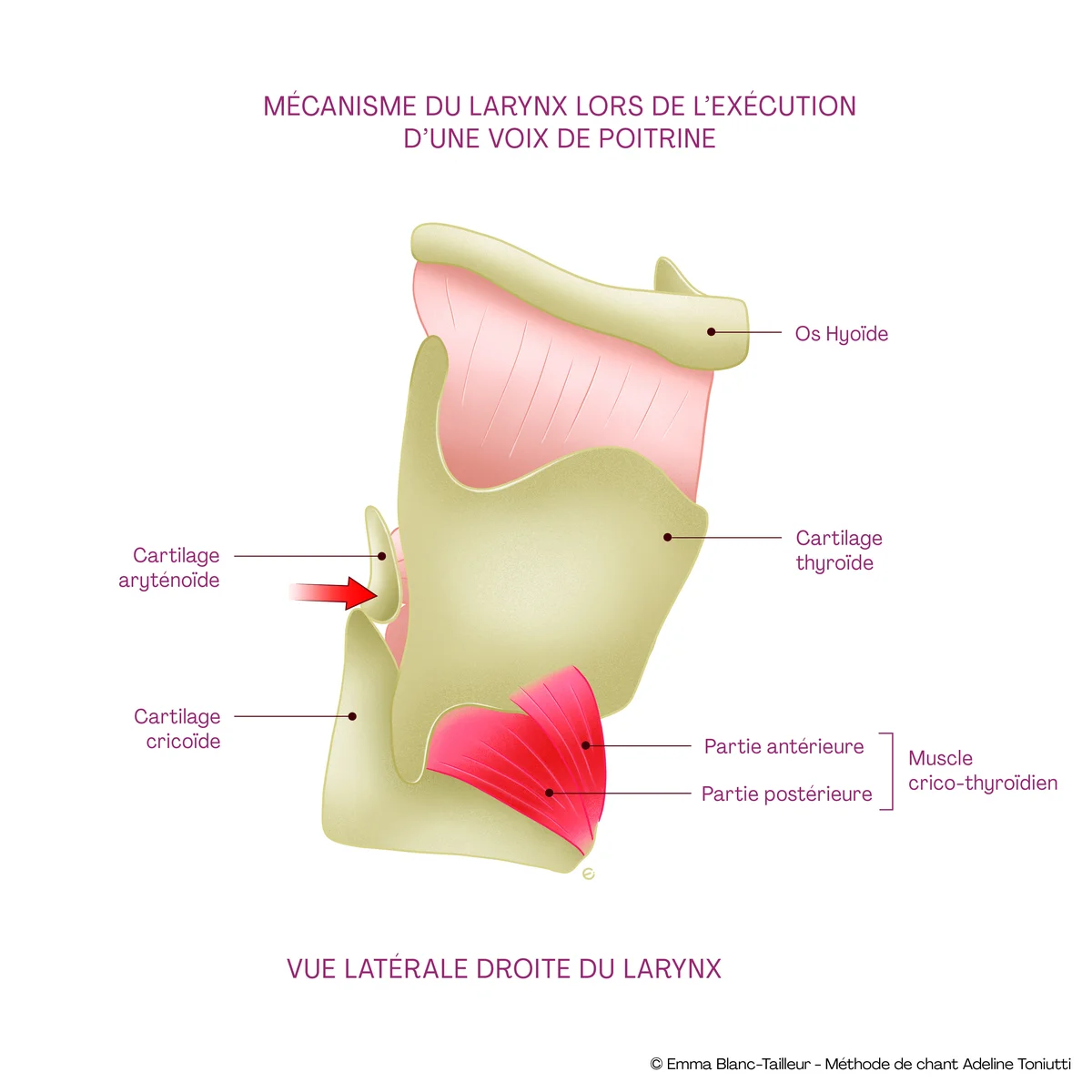
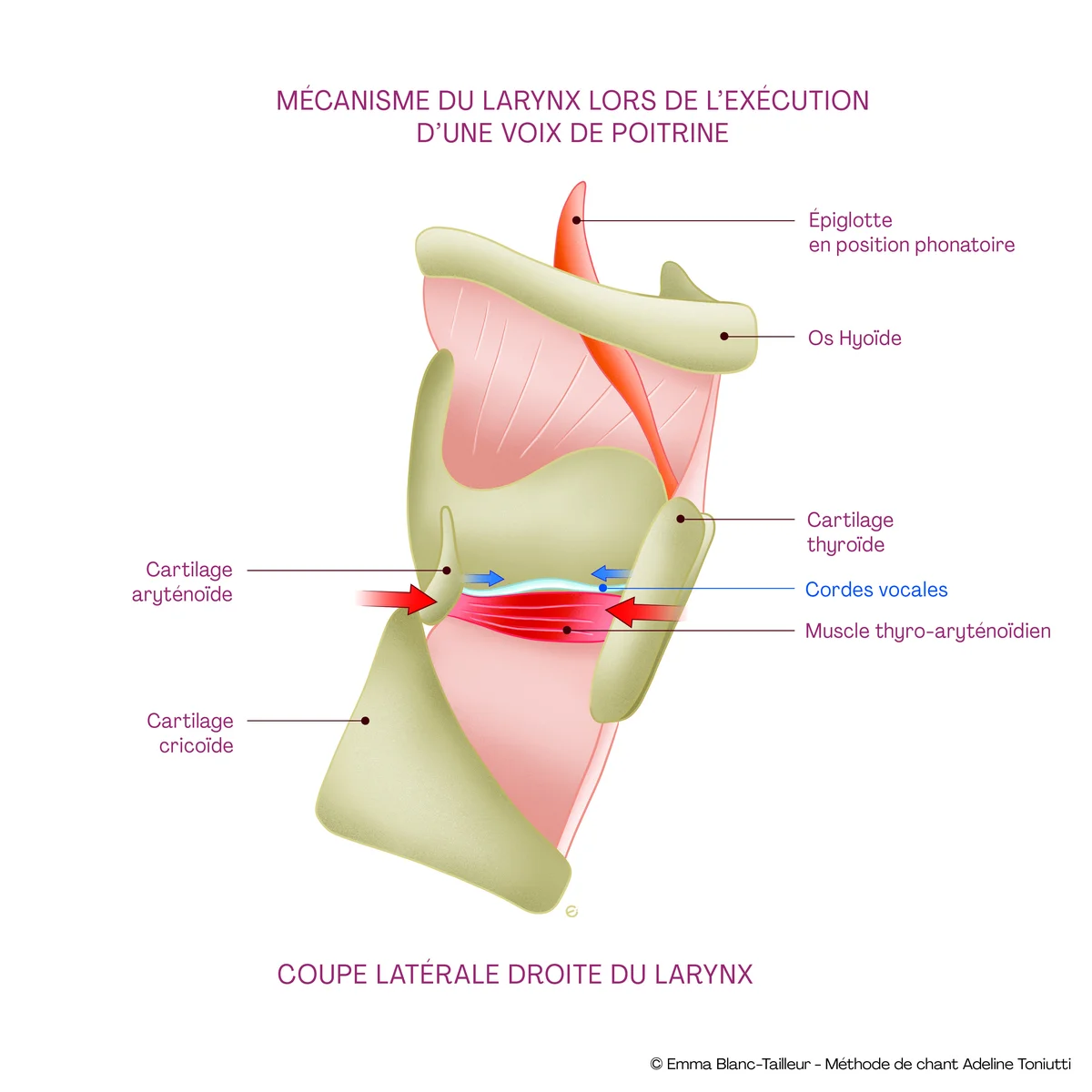
Ilustraciones © Emma Blanc-Tailleur, Anatomie du Chant, Adeline Toniutti
HEARING YOURSELF
No buscar oírse
Al cantar fuerte, el reflejo del estapedio protege el oído interno. Los oídos le protegen.
Forcing to hear yourself is fighting that reflex. A sound that already seems huge to you may still lack carry outside, or the reverse: a sound that seems thin to you carries, if the cavities are working.
On a high note the method says: the sound always seems thin to you, unless you are heavily amplified. Three criteria for a healthy high note: others find it beautiful; it seems thin to you; no discomfort afterwards.
IN PRACTICE
Cuatro apoyos
1. Smell a flower
Mouth closed. Hands on the floating ribs. Feel the opening. Not the shoulders. Not an Everest.
2. Hold the ribs on the exhale
Sternum coming down, ribs drawing together, obliques working. If the neck hardens and the ribs open, you have dropped the accelerator and twisted the wheel.
3. Check the hammock
Hands around the larynx, or thumbs under the mandible. The tongue moves away from the fingers. The larynx is not jammed into the sternal notch.
4. Choose the space, not the push
Lyric: even vowels, projection over the orchestra. Contemporary: true twang (palate raised), taught from the five pivot points. Microphone: give the core of the sound, do not shout into the capsule.
Estos ejercicios se hacen con los cinco puntos pivote. Patología de los pliegues: el especialista.
CALYP
Trabajar el alcance en el CALYP
El método está en Anatomie du Chant (Marabout, 2024). Para trabajarlo con el equipo: pida cita.
Preguntas frecuentes
¿Cantar más fuerte es empujar?
No. La laringe orienta (volante). Las costillas y los oblicuos aceleran. Empujar con el cuello es torcer el volante.
¿Hace falta mucho aire para que lleve?
No. Una gran toma de aire mal sostenida pone presión sobre una laringe sin apoyo. Adeline pide a menudo inspirar muy pequeño, dos veces, como para oler una flor.
¿El twang es nasal?
No. El twang verdadero, enseñado a partir de los cinco puntos pivote, se hace con el velo levantado. Nasalizar es la falsificación, y pone los pliegues en peligro.
¿Por qué no me oigo cuando canto fuerte?
El reflejo del estapedio protege el oído interno. Un sonido que le parece fino puede llevar fuera si las cavidades trabajan.