
Does emotion make the voice?
EMOTION AND VOICE
The saying circulates in every singing lesson. It describes a real experience, but it places emotion where emotion does not act. Between the emotion and the note, there is a nerve and a muscle.
THE SAYING
“Emotion makes the voice”
The phrase is said in singing lessons, in interviews and under competition videos. It describes an experience everyone has had at least once: a voice overwhelms us without our being able to name what moved us, and the most immediate explanation is to credit the singer’s emotion.
So the saying describes well what the listener feels. It describes badly what the singer manufactures. It places emotion at the point where sound is born, whereas sound is born in muscles, in air pressure and in cavities that change shape.
The gap is not a quarrel about words. A student who believes that emotion makes the voice works on their emotion and waits for the voice to follow. When it does not follow, they feel harder, they push, and they do not understand why complete sincerity gives them a constrained sound.
The useful question is not whether emotion makes the voice. It is what emotion does to the voice, gesture by gesture, in both directions.
WHAT THE SAYING GETS RIGHT
Singing does come from emotion
Before correcting the saying, we have to give it what it gets right. Anatomie du Chant has singing born from emotion, and says so from the very first pages. Breathing is a vital function. Human beings turned it into a means of communication, because living in a group requires entering into relationship. Then they turned that communication into art: they use it to express a felt emotion, with an aesthetic aim and according to cultural codes.
The book goes further and brings singing close to the scream, which expresses a strong emotion such as fear or pain. The scream and the song share the same mechanics, the same exhaled air, the same vocal folds. Only one thing separates them, the aesthetic aim. In other words, singing is a scream we have learned to shape.
Nobody therefore sings outside of emotion, and Dr Jean Charmoille, psychiatrist and psychoanalyst who contributed to the book, sums up that precedence in one sentence: life begins with the voice. On that point, the saying is not wrong. It is wrong about what comes next, and it is the brain that explains why.
THE BRAIN
What the brain does with music, with Dr Gilles Zah-Bi
What happens in the brain when we sing? Adeline Toniutti put the question to her friend, singer and neurosurgeon Dr Gilles Zah-Bi, and his teaching approach takes up a double page of Anatomie du Chant. It describes exactly the place where music, memory and emotion meet the muscle.

IN THE WORDS OF THE NEUROSURGEON
Hearing does not sleep, even while we sleep, and it is the last function still active before death. We do in fact use music therapy for people in a coma.
The eardrum receives a vibration which is converted into nerve impulses and sent back into the brain: the brain receives nothing but nerve impulses.
From the moment it is heard, music activates the areas of memory and emotion in the brain, whether we are aware of it or not.
Dr Gilles Zah-Bi · neurochirurgien, MD, MSc Neurosciences
Those three sentences read in one go. Hearing is the function that stays switched on when everything else goes out, which makes listening the oldest and most resistant channel of our equipment. The eardrum, for its part, does not transmit sound: it transmits a vibration converted into nerve impulses, and the brain never receives anything else. Finally, that impulse does not arrive in a neutral area. It arrives in memory and in emotion, without the listener having any say in it.
Dr Gilles Zah-Bi also points out that we are born with a capital of neurons, but that the connections between those neurons adapt throughout life, depending on stimulation and lifestyle. The brain is therefore not made of fixed zones: it is made of interconnected networks, with a mapping almost unique to each person, rather like a fingerprint. Three sets of functions light up together when an ear receives a sound: the hearing area, the area of memory, emotion and reward, and the cognitive functions. Music is able to stimulate the brain in its entirety, and even a tune heard for the first time points back to an emotion, by correlation and by sensitisation.
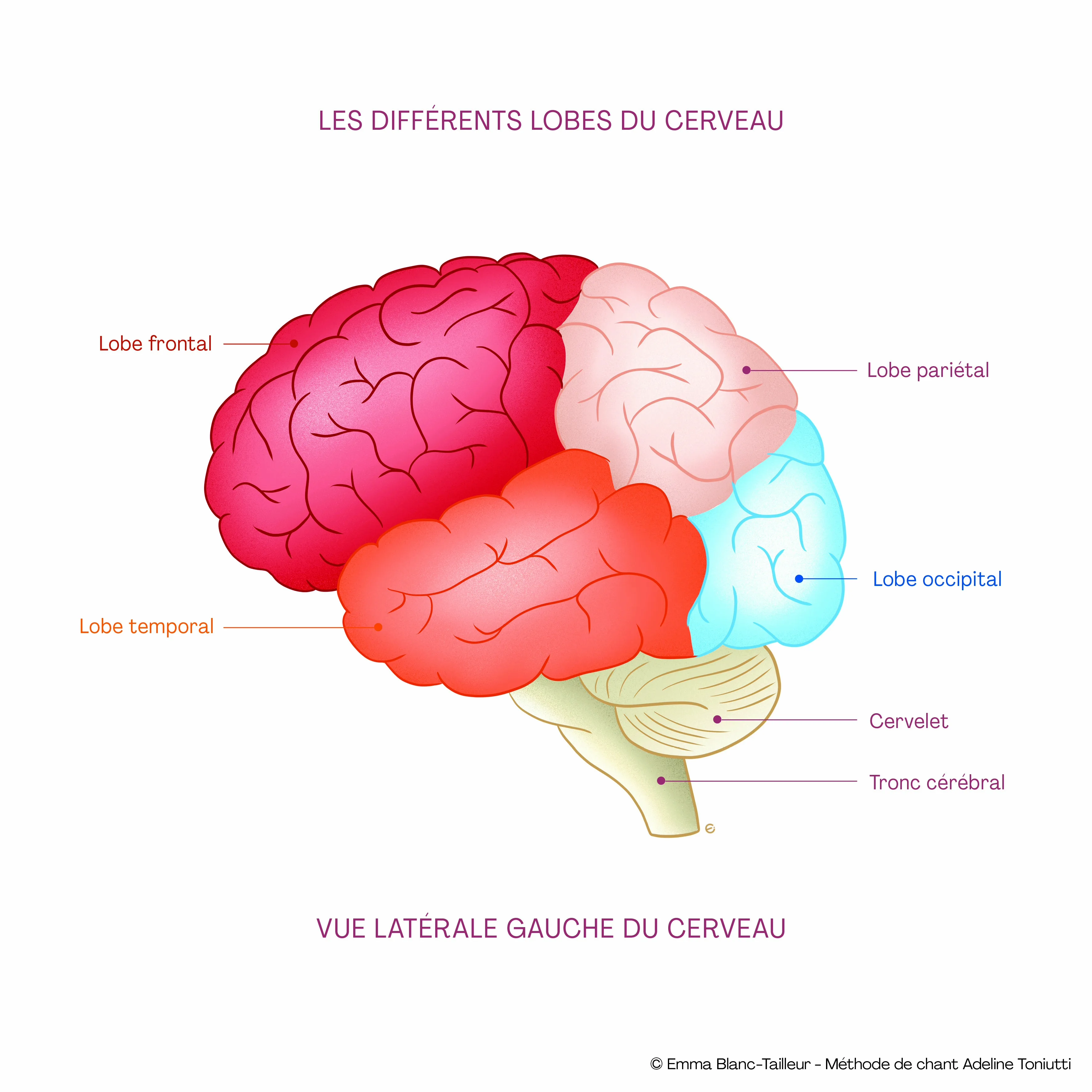
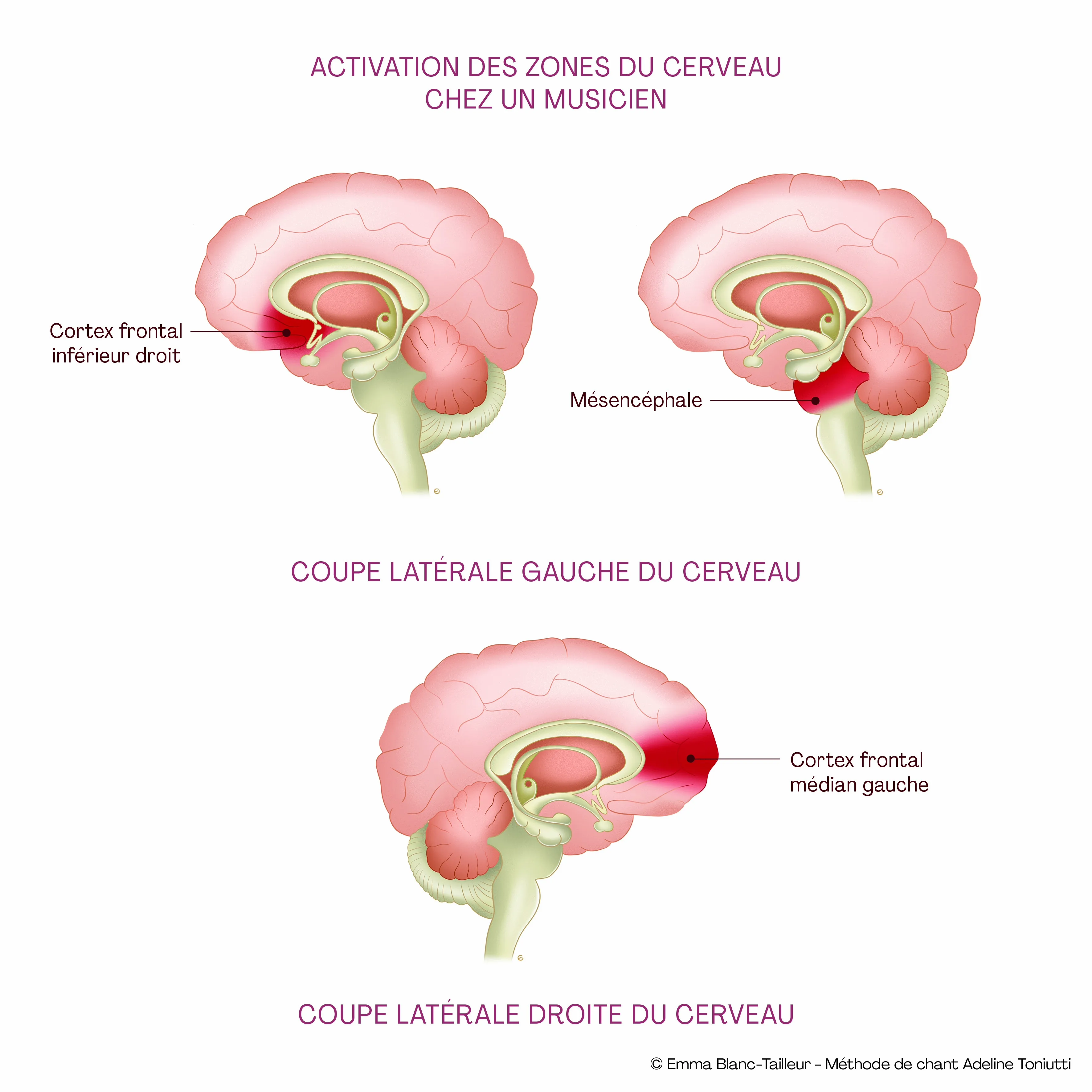
Illustrations © Emma Blanc-Tailleur, Anatomie du Chant, Adeline Toniutti
This is where the demonstration tips over to the side of the body. When we sing, the same networks activate fine motor function, that of the mouth and the face, and the motor function of the vocal folds, which can be unconscious or voluntary as soon as the singer seeks to optimise their vocal gesture. The areas mobilised by the singer are hearing, memory, movement motor function and cognitive biases, meaning reasoning, attention, memory and emotion. Singing, dancing and art in general call on the very same areas.
Music, memory, emotion and muscle are therefore not four separate circuits. They belong to the same network, and it is for that precise reason that a memory or a mental image changes a muscular gesture.
WHAT THE SAYING REVERSES
No emotion has ever closed a vocal fold
Anatomie du Chant defines the vocal gesture as a chain, and that definition is the heart of the disagreement with the saying.
The vocal gesture is the fruit of several factors: it is a thought that generates a nerve impulse, which brings about a muscular reaction, which makes it possible to produce the conditions for making a sound.
The sentence has four links, and they always follow one another in the same order.
The chain of the vocal gesture:
- a thought, or an emotion, appears;
- it generates a nerve impulse;
- the nerve impulse brings about a muscular reaction;
- the muscular reaction creates the conditions for sound.
Emotion occupies the first link. Sound is manufactured at the fourth. Between the two, a nerve transmits and a muscle executes, and neither of them can be skipped. It is the muscles of the larynx that bring the vocal folds together, it is the abdominals and the diaphragm that regulate air pressure, it is the walls of the resonators that give the sound its colour.
The diagram of the factors that influence singing confirms that position. The emotional state of the day appears there next to posture, breathing, hormonal state, general fatigue and the acoustics of the hall. Emotion is an input of the system, on the same footing as the others. It is never its output.
Emotion does not make the voice. It commands the body, and it is the body that makes the voice.
THE FOUR EFFECTS
What emotion really does to the voice
This correction does not diminish the role of emotion. It makes it precise, and it makes it usable. Since emotion acts on the body through the nerve, the singer can use it as a command, and the method formulates it the other way round from common intuition.
HOW THE METHOD PUTS IT
Provoking an emotion in order to obtain a particular sound
In the diagram of the factors that influence singing, emotion appears twice. It appears as a state undergone, that of the day itself, and it appears as a voluntary action of the singer, phrased as follows: provoking an emotion in order to obtain a particular sound. Emotion then becomes a technical lever, operated the way a posture is corrected. Here are the four effects that lever produces.
1. It opens a resonator, and the volume increases
The ventricle of Morgagni is the first resonator of the larynx, located between the ventricular folds and the vocal folds. That space opens under the effect of an emotion, and particularly under the urge to cry. A singer who summons the sensation of a sob is therefore not acting sadness: they are opening a cavity, and that cavity amplifies the sound.
I have multiplied the volume of opera singers’ voices tenfold by asking them to have the sensation of a sob.
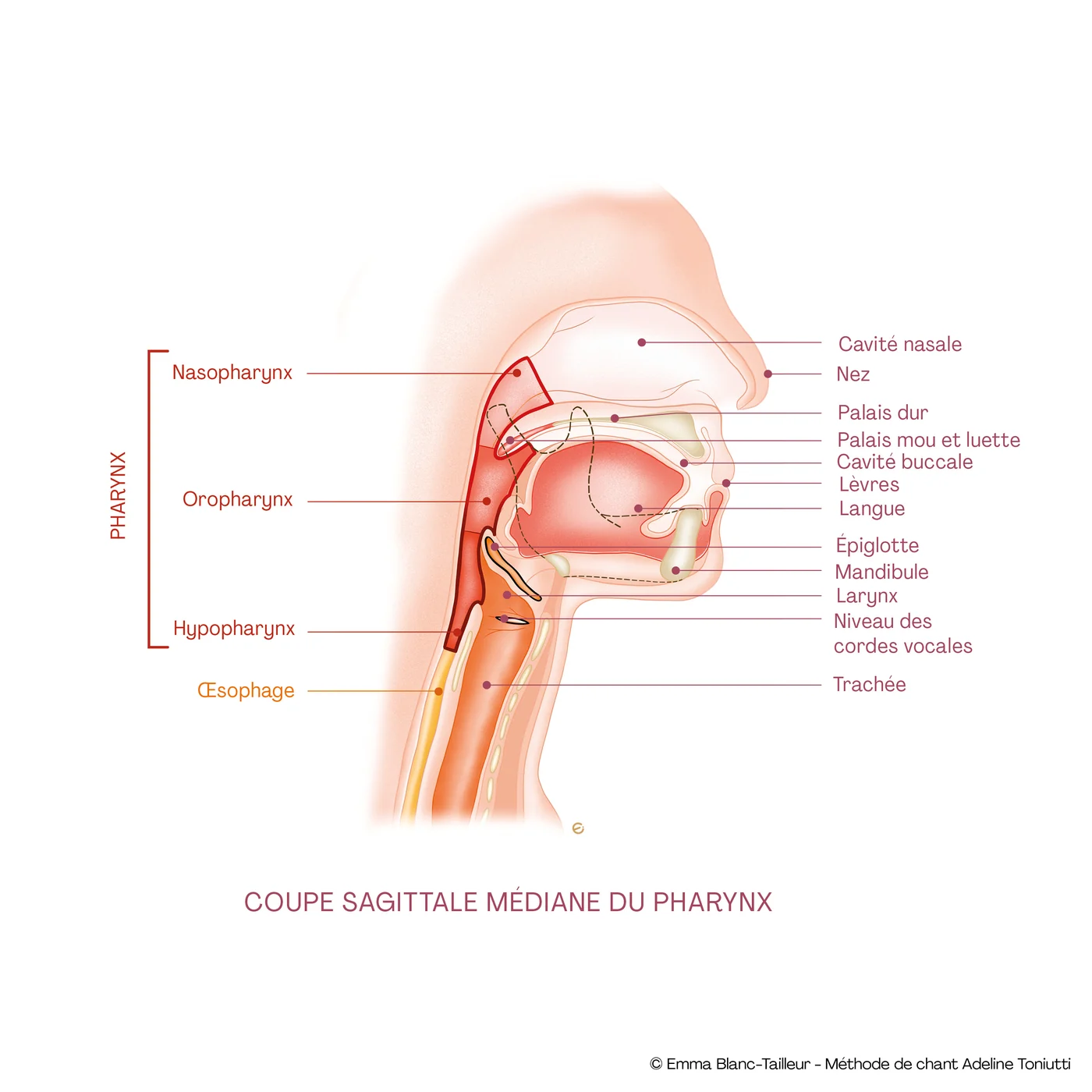
Illustration © Emma Blanc-Tailleur, Anatomie du Chant, Adeline Toniutti
2. It reconfigures the cavities, and the colour changes
Among the ways of acting on the resonators, Anatomie du Chant puts an order from the brain first, ahead of the mandible, the position of the head and the direction of the breath. Some resonators change automatically through a motor action of the brain: if the singer imagines a colour, the resonators change in order to produce it. The mental image does not replace the gesture, it triggers it.
3. It gives access to the registers
The book is explicit on this point: the vocal folds are commanded by thought, by imagination and therefore by the brain. The exercise that accompanies the chapter on registers asks the singer to rely on their imagination to reproduce a vocal colour they have heard. Fernando Henrique de Oliveira, concert pianist and vocal coach, says the same thing from the angle of style: a vocal colour is summoned through the imagination. A reservation always accompanies that freedom, and it is constant throughout the book: the search for registers must remain carried by a healthy technical gesture.
4. It is seen before it is heard
The gaze is part of the vocal gesture. A singer with half-closed eyes informs their own body of fatigue or boredom, and their voice follows that information. Simply becoming aware of the gaze produces an immediate gain in charisma and musicality, because opening your gaze amounts to opening yourself to the audience and to your interpretation. This dimension is developed on the page devoted to stage expression.
THE FLIP SIDE
The same lever damages the voice
A command that opens can also close. Anatomie du Chant devotes as much space to the opposite direction, and that is what makes the demonstration solid rather than decorative. Three effects come up regularly in lessons.
Stress throws the ear off
Stress is listed among the causes of faulty pitch, on the same level as a badly optimised vocal gesture or a hearing pathology. The ear is subject to emotional changes, and both concentration and performance degrade in a stressful situation. A singer who is in tune in the lesson and out of tune in concert has not lost their ear: they are singing with an ear under pressure.
Fear shows on the face and hampers the larynx
Raising the eyebrows hampers the movements of the larynx, and that movement often betrays fear, surprise or apprehension. Emotion does not stay inside: it takes the form of a gesture, and that gesture has a mechanical cost.
Acted emotion produces a technical fault
The artificial smile is the clearest example. Some singers spread the lips a great deal to compensate for a laryngeal suspension that is too low, what the Italians call laringe schiacciata, the collapsed larynx. A smile placed on the face to signify joy does not produce joy in the sound: it produces a compensation, and the audience hears it.
The decisive factor is therefore not the intensity of the emotion. Two singers can feel the same thing with the same sincerity and obtain two opposite results, depending on the state of the gesture that carries that emotion.
That is exactly what the saying “emotion makes the voice” prevents us from seeing. It suggests that feeling more is enough, whereas the work consists in preparing the body that will receive what emotion sends it.
THE RIGHT ORDER
Why the order matters in a lesson
The method never asks the singer to feel harder. It asks them to understand the text, then to build the image that will trigger the right gesture. In interpretation, meaning always precedes singing.
Adeline Toniutti describes her own working process without any mysticism. She starts from the musical line and its meaning, she imagines textures, she draws on her past to link a truth to her interpretation, and when she has not lived through the situation described by the text, she imagines it through empathy. A singer therefore does not need to have been bereaved in order to sing grief. They need a precise image and a body capable of carrying it.
The book also places emotional connection after technique, not before. The checklist of the five pivot points is the anatomical starting point of every speaking and singing being; emotional connection, musical interpretation and public speaking come afterwards.
Life begins with the voice and the voice begins with the body.
The saying faithful to the method would therefore fit in one line: emotion makes the voice, provided the body knows how to carry it.
CALYP
Working on emotion without losing the gesture
At CALYP, interpretation is worked on through the five pivot points, so that emotion finds a body capable of transmitting it without getting hurt.
GO FURTHER
Related pages from the Voice Clinic
Frequently asked questions
Does emotion make the voice?
No, not literally. Anatomie du Chant describes the vocal gesture as a chain of four links: a thought generates a nerve impulse, which brings about a muscular reaction, which creates the conditions for sound. Emotion occupies the first link and sound is manufactured at the fourth. Emotion commands the body, and it is the body that makes the voice. The exact saying would therefore be: emotion makes the voice provided the body knows how to carry it.
What does emotion do to the voice, concretely?
Four things. It opens the ventricle of Morgagni, the first resonator of the larynx, which increases the volume. It modifies the resonators through a motor action of the brain, which changes the colour of the sound. It gives access to the registers, since the vocal folds are commanded by thought and imagination. And it shows on the face, particularly in the gaze, before it is even heard.
What happens in the brain when we sing?
Dr Gilles Zah-Bi, neurosurgeon, describes in Anatomie du Chant a brain made of interconnected networks, with a mapping almost unique to each person, rather like a fingerprint. When a sound is heard, three sets light up together: the hearing area, the area of memory, emotion and reward, and the cognitive functions. When we sing, the same networks additionally activate the fine motor function of the face and that of the vocal folds. Memory, emotion and muscle belong to the same network.
Is hearing the last sense active before death?
That is what Anatomie du Chant reports in the double page devoted to the brain with Dr Gilles Zah-Bi: hearing does not sleep, even while we sleep, and it is the last function still active before death. That is in fact why music therapy is practised with people in a coma. The eardrum does not transmit sound to the brain, it transmits a vibration converted into nerve impulses.
Why does the sensation of a sob increase the volume?
Because the ventricle of Morgagni, located between the ventricular folds and the vocal folds, opens under the effect of an emotion, and particularly under the urge to cry. Adeline Toniutti recounts having multiplied the volume of opera singers’ voices tenfold simply by asking them to have the sensation of a sob. The singer is not acting sadness: they are opening a resonating cavity.
Does stress make you sing out of tune?
It contributes to it. Anatomie du Chant lists stress among the causes of faulty pitch, alongside a badly optimised vocal gesture and hearing pathologies: the ear is subject to emotional changes, and both concentration and performance degrade in a stressful situation. A singer who is in tune in the lesson and out of tune in concert has not lost their ear, they are singing with an ear under pressure.
Do you have to have lived an emotion in order to sing it?
No. Adeline Toniutti describes a three-step process: start from the meaning of the text and the musical line, imagine textures, then draw on your past to link a truth to your interpretation. When she has not lived through the situation described, she imagines it through empathy. What counts is not the real memory, but the precision of the image and the body’s capacity to carry it.
Should technique be worked on before emotion?
That is the order the book sets out. The checklist of the five pivot points is presented as the anatomical starting point of every speaking and singing being; emotional connection, musical interpretation and public speaking come afterwards. The book closes on this sentence: life begins with the voice and the voice begins with the body.