
Belting
VOICE CLINIC
Belting is the register that keeps the chest voice as high as possible in the tessitura. It is Tina Turner’s voice in River Deep, Mountain High.
What is belting?
Belting is a register that keeps mechanism 1, in other words the chest voice, as high as possible in the tessitura.
In the larynx, you stay in mechanism 1. But to stay there while the note rises, several things change. The air pressure beneath the vocal cords, known as subglottic pressure, increases thanks to abdominal pressure. The resistance of the larynx becomes higher. And the larynx compensates for this extra pressure by exerting more containment in the laryngeal vestibule, the storey just above the vocal cords.
Some specialists describe belting as a chest voice with a little covering (in opera, to “cover” a vowel is to add a touch of “oo” to it): putting a little “oo” into the sound would mean keeping the lips slightly forward and the base of the tongue high.
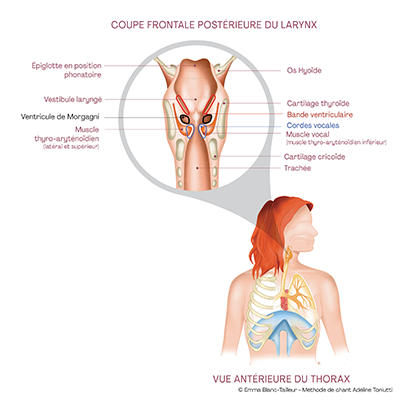
Illustration © Emma Blanc-Tailleur, Anatomie du Chant, Adeline Toniutti
Belting in a phoniatric examination
Adeline Toniutti sang in belting during a phoniatric examination carried out with Dr Bruno Coulombeau, phoniatrician, and Dr Romain Pérouse, ENT surgeon. The doctors observed a moderate tightening of the laryngeal vestibule. The same phrase sung in mixed voice or in head voice showed almost no tightening, whereas in saturated voice the tightening becomes intense and sets the ventricular bands vibrating.
The same examination measured the closure quotient, that is, the share of each vibratory cycle during which the vocal cords stay in contact. On one and the same note, sung first in head voice and then in belting, this quotient rose from 34.5% to almost 49%. To the ear, the transition sounded fairly smooth; on the trace, the change of mechanism was clear.
“During the examination carried out on Adeline Toniutti, we observed that in belting there is a moderate vestibular tightening with a slight retraction of the epiglottis.”
Belting and the passages
The second passage lies roughly a fourth above the first and calls for a marked technical adjustment. In a pop singer, it can come with a change of register: a passage into belting to keep the chest voice, or, on the contrary, a passage into head voice or saturated voice.
Men often struggle to find how to stay in chest voice for as long as possible. Some first find the sound in saturated voice before moving into belting: this is sometimes a step in the search for the high note.
On the chart of possible register zones in Anatomie du Chant, belting extends in women from the lower middle range up to the high range, and in men from the low range up to the high range. This chart is a performance goal: it is normal not to have every register at your disposal when you start out. In musical theatre, according to the casting notices collected by Rabah Aliouane, a soprano is expected to belt up to D5, a mezzo-soprano up to C5 and a contralto up to B4.
The effort asked of the body
The power of belting comes from abdominal pressure. At the moment of the high note, most singers release the rib pressure and let the floating ribs open out again; that pressure must instead be maintained, provided you are sure of a good laryngeal movement.
The higher the note, the greater the effort. Adeline Toniutti explained this on franceinfo, talking about Céline Dion:
“From a certain point, when you sing in belting, that is, in chest voice, for every semitone you go up, the effort the body has to produce grows exponentially.”
Working on belting
In Adeline Toniutti’s method, you start from head voice, mechanism 2, to set up a good laryngeal suspension, then place the belting inside it. To find a note, you can also sing it first in head voice to make sure of the right frequency, then let the abdominal muscles take more charge by spreading the external oblique.
For pop singers, the belting vocalise is part of the training programme, alongside a vibratory vocalise, an agility vocalise and a character vocalise. The “Zzz” vocalise, the first of the warm-up, is done in mixed voice or head voice, on the other hand, and not in belting.
She also uses the word in her comments as a coach. During one of the Star Academy live shows, she told Héléna Bailly: “you sang some very beautiful verses, very breathy in the lower middle range, and then you went up into belting.”
Songs to hear it
To find a register, it is very useful to listen to a singer who practises it, so that you form a mental image of it that the brain can then trigger. The examples given in Anatomie du Chant:
- River Deep, Mountain High, in the versions by Tina Turner and Céline Dion
- Allumer le feu, by Johnny Hallyday
Exercises
The special belting vocalise
Inspired by Lady Gaga and Freddie Mercury, this vocalise can be heard in the song “Hey Man” from Adeline Toniutti’s EP Rousse. It works on H onsets and glottal onsets within a single vocalise, and helps you master the consonants F and H. It is done in belting, but it can also be used to mix every register and every mood.
“Ça ira”
For the French part of the “Ça ira” vocalise, think of “Ça ira” as if Johnny Hallyday were singing it in belting, and do not let the “A” drop as you come down.
Changing register
Draw on your imagination to reproduce a vocal colour you have heard. When you move from one register to another, do not let go of pivot point 2: respect the laryngeal suspension, otherwise you risk hurting yourself.
These exercises must be done while respecting the five pivot points. If you have a vocal cord condition, ask your specialist for advice.
CALYP
Work on belting at CALYP
The registers are set out in detail in Anatomie du Chant (Marabout, 2024). To work on belting with Adeline Toniutti and her team, book an appointment.
Frequently asked questions
What is belting?
Belting is a register that keeps mechanism 1, the chest voice, as high as possible in the tessitura. Subglottic pressure increases thanks to abdominal pressure, the resistance of the larynx is higher, and the laryngeal vestibule tightens moderately.
What is the difference between belting and mixed voice?
Belting stays in mechanism 1, with a moderate tightening of the laryngeal vestibule. Mixed voice can use mechanism 1 as well as mechanism 2: its colour is shaped in the resonators, and under examination it shows very little vestibular tightening.
Is belting dangerous for the voice?
Like every register, belting is sought with a healthy technical gesture. When you move from one register to another, you must respect the laryngeal suspension, otherwise you risk hurting yourself.
How do you start working on belting?
In Adeline Toniutti’s method, you start from head voice to set up a good laryngeal suspension, then place the belting inside it. For pop singers, the belting vocalise is part of the training programme.