
Chest voice
VOICE CLINIC
Chest voice is mechanism 1: the vocal cords are thick, not very tense, and vibrate with a wide amplitude. It is Frank Sinatra’s voice in My Way.
Mechanism 1
Scientists count four vibratory mechanisms of the larynx, the ones that depend on the vocal cords coming together: vocal fry (mechanism 0), chest voice (mechanism 1), head voice (mechanism 2) and whistle voice (mechanism 3). Some people call mechanism 1 the “heavy mechanism”.
In mechanism 1, the cricothyroid muscles are not very active, whereas they play an essential role in mechanism 2. The vocal muscle, on the other hand, is active and contracted: it gives the vocal cord its mass. The vocal cords are therefore thick and, overall, not very tense, and they vibrate with a wide amplitude. Because they are massive and not very tense, their vibration produces lower sounds. They are also in contact over a larger surface than in mechanism 2.
“The recurrent nerve innervates the three muscles that move the joint of the vocal cord, as well as the thyroarytenoid muscle, which gives the vocal cord its mass. In mechanism 1, this action on the thyroarytenoid is particularly present, allowing the vocal cords to carry a large mass, and therefore a slower vibratory frequency.”
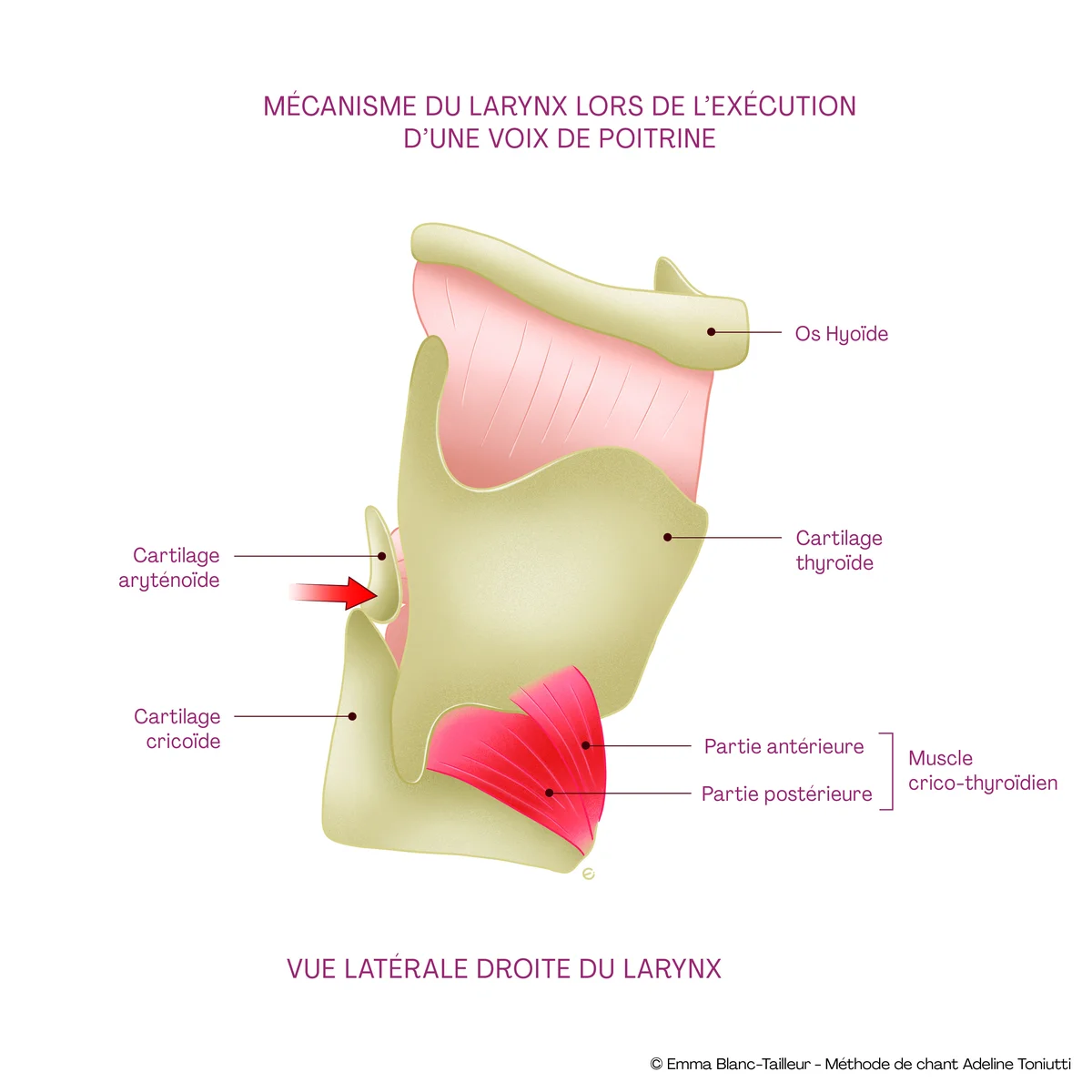
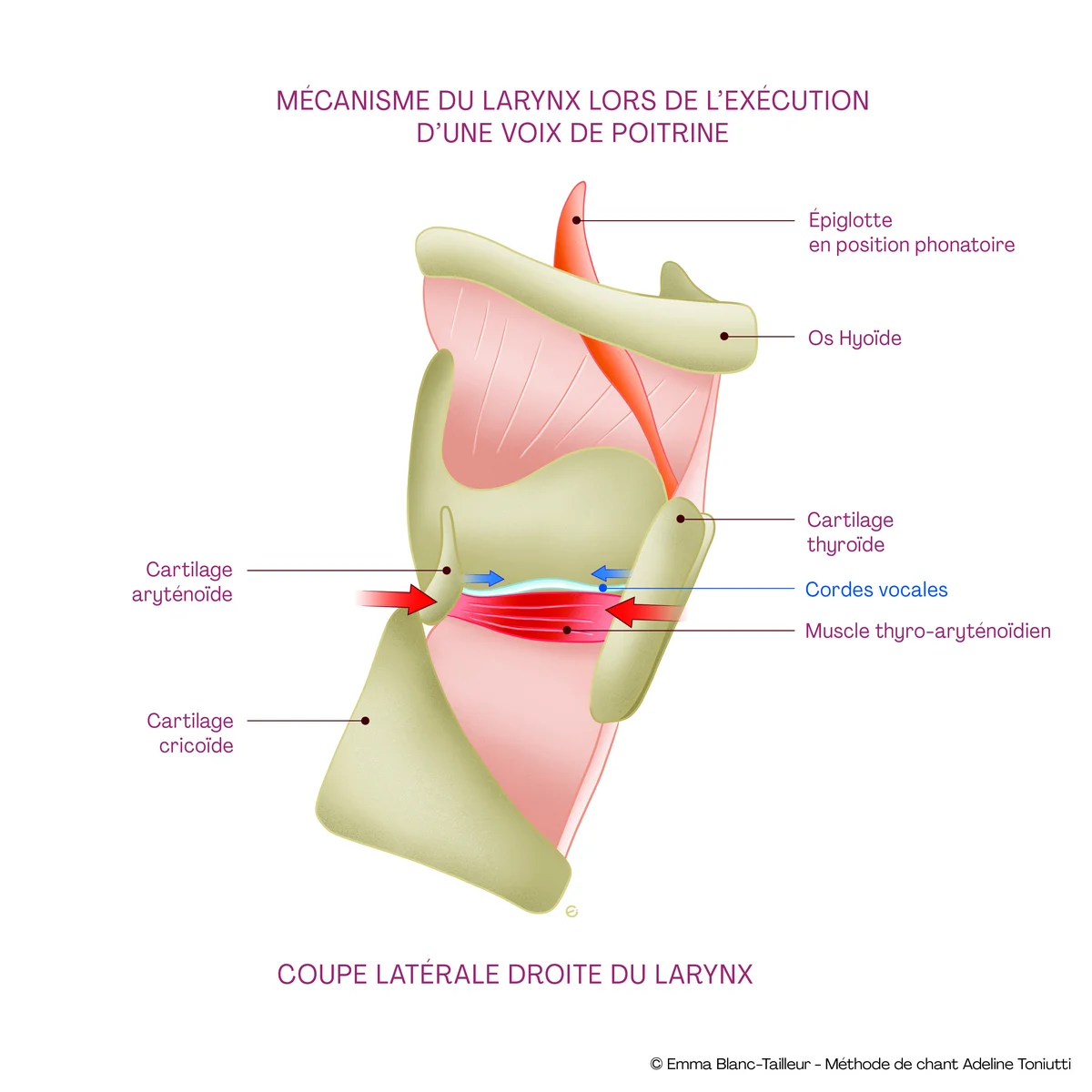
Illustrations © Emma Blanc-Tailleur, Anatomie du Chant, Adeline Toniutti
Contact between the vocal cords
Electroglottography measures the closure quotient: the time during which the vocal cords stay together over one complete vibratory cycle, expressed as a percentage. It is higher on average in mechanism 1 than in mechanism 2. Values are generally between 40% and 60% in chest voice, against 25% to 40% in head voice, with wide variation from one singer to another. During her phoniatric examination, Adeline Toniutti was above 40% in mechanism 1 and stayed below that value in mechanism 2.
Adeline Toniutti has observed that in female opera singers who had lesions, using the chest voice helped to improve the head voice, which can be linked to this greater contact between the vocal cords. In the long run, a benefit was seen, on the sole condition that the technical vocal gesture was perfectly executed.
Chest voice in speech and in singing
When we speak, we use mechanism 1 and mechanism 2, with mixed voice as the link between them. Men speak mostly in chest voice; they sing in chest voice like Johnny Hallyday, but they can also move into head voice to sing like Michael Jackson. Women show a wider spread: some speak mostly in head voice, others mostly in chest voice.
In opera, the female voice sings in head voice most of the time, except when the composer invites it to make a foray into the chest voice, for a powerful dramatic effect or to murmur and call up suffering. In contemporary commercial music, belting keeps the chest voice as high as possible in the tessitura, and men often struggle to find how to stay in it for as long as possible in the high range.
At the first passage, at the top of the octave that corresponds to the speaking voice, you may feel the vibrations in your chest weaken or stop. The singer is then tempted to lift the head; instead, they are asked for a substantial laryngeal movement and an increase in abdominal pressure.
Songs to hear it
To find a register, it is very useful to listen to a singer who practises it, so that you form a mental image of it that the brain can then trigger. The examples given in Anatomie du Chant:
- GoldenEye, by Tina Turner
- My Way, by Frank Sinatra
Exercises
The call to Chantal
To feel the chest voice mechanism, try imitating the actress Chantal Ladesou, whose voice helps to summon a very assertive chest voice, even in the most reluctant singer. Take a sentence with plenty of verve and a hint of anger, for example “Mais qu’est-ce qu’il m’emmerde celui-là” (“God, that man gets on my nerves”), and give it her tone. For male voices, imitate General de Gaulle solemnly declaring “Vive la France! Vive la République!”. If you do not manage it straight away, be patient: your neurons are looking for the gesture.
Changing register
Draw on your imagination to reproduce a vocal colour you have heard. When you move from one register to another, do not let go of pivot point 2: respect the laryngeal suspension, otherwise you risk hurting yourself.
These exercises must be done while respecting the five pivot points. If you have a vocal cord condition, ask your specialist for advice.
CALYP
Explore your registers at CALYP
The registers are set out in detail in Anatomie du Chant (Marabout, 2024). To explore them with Adeline Toniutti and her team, book an appointment.
Frequently asked questions
What is chest voice?
It is mechanism 1 of the larynx. The vocal cords are thick and not very tense, the vocal muscle gives them mass, and they vibrate with a wide amplitude while staying in contact over a large surface, which produces lower sounds.
Why is it called the heavy mechanism?
Some people call mechanism 1 by this name because the vocal cords are massive in it: the thyroarytenoid muscle, which is heavily engaged, gives them a large mass and therefore a slower vibratory frequency.
How do you find your chest voice?
In La Bonne Voix, Adeline Toniutti suggests imitating Chantal Ladesou on a sentence full of verve or, for men, General de Gaulle saying “Vive la France!”. By imitating, you make your own a mechanism you have already heard.