
Head voice
VOICE CLINIC
Head voice is mechanism 2: the vocal cords lengthen, become thinner and vibrate faster, which opens up access to the high notes.
Mechanism 2
In mechanism 2, which some people call the “light mechanism”, the cricothyroid muscles are much more active than in mechanism 1. As they contract, they tilt the thyroid cartilage onto the cricoid cartilage, which puts the vocal cords under tension. For this to happen, the thyroarytenoid muscle has to relax and move aside towards the edge of the vocal cord.
Mechanically, the vocal cords lengthen and become much thinner. Less thick, more tense and less massive, they vibrate faster, which makes it possible to reach higher frequencies. Their contact is also smaller: the closure quotient, the time during which the vocal cords stay together over a vibratory cycle, is generally between 25% and 40% in head voice, against 40% to 60% in chest voice.
“In mechanism 2, the contraction of the cricothyroid muscles causes a considerable lengthening of the vocal cords, which are also much thinner because the recurrent nerves stimulate the thyroarytenoids less. They therefore vibrate much faster.”
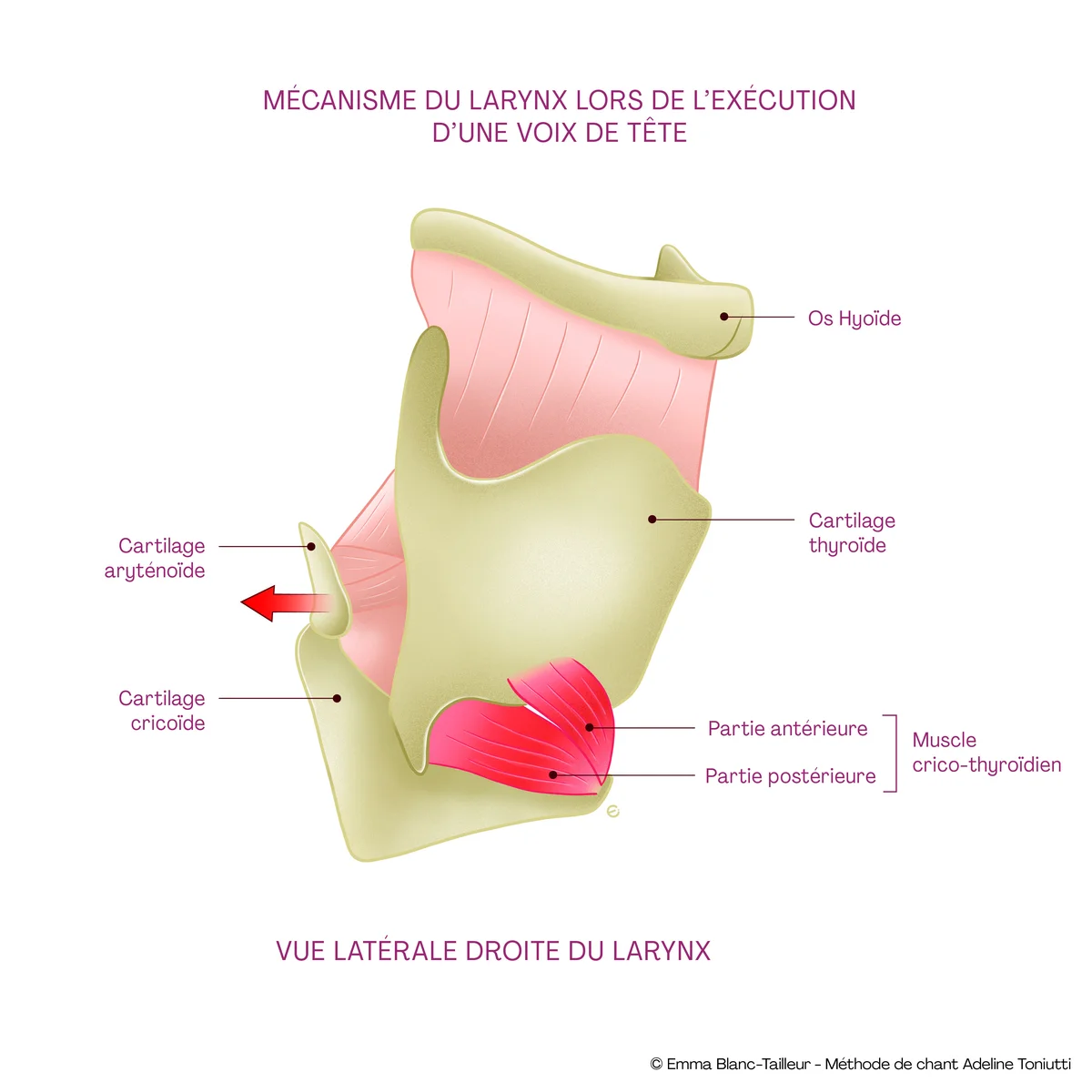

Illustrations © Emma Blanc-Tailleur, Anatomie du Chant, Adeline Toniutti
Head voice in women and in men
In opera, the female voice spends most of its time singing in head voice. In men, the same mechanism 2 is called falsetto voice, or falsetto; in contemporary singing, men also sing in mechanism 2, as Michael Jackson did. The extremely high notes of the coloratura soprano, above top C (C6), can be sung in head voice or in whistle voice.
In speech, too, some women speak mostly in head voice. In La Bonne Voix, Adeline Toniutti recalls telling a woman she was talking with, who spoke in this way: “You speak in head voice, that is mechanism 2, you would have quick access to your classical voice.”
A starting point in the method
In Adeline Toniutti’s method, head voice often serves as a starting point. You take mechanism 2 to set up a good laryngeal suspension, then place belting inside it. To find a high note, you can also sing the note in a head register to make sure of the right frequency, then let the abdominal muscles take more charge by spreading the external oblique.
Head voice is used more in singing than in speaking, but it needs to be worked on properly, for the sake of the muscles and, as Adeline Toniutti writes, as an anti-ageing treatment.
Songs to hear it
To find a register, it is very useful to listen to a singer who practises it, so that you form a mental image of it that the brain can then trigger. The examples given in Anatomie du Chant:
- Stayin’ Alive, by the Bee Gees
- Rêver, by Mylène Farmer
Exercises
The call to Castafiore
To find your head voice, take as your model Bianca Castafiore from Tintin, laughing to see herself so beautiful in the mirror, or the voice of the temperamental Cleopatra in the cartoon Asterix and Cleopatra. Ridicule never killed anyone: the most important thing is to try, and the nerve connections will form. This exercise works for everyone.
The fly behind the hand
Make an arc with your arm and rest your hand on the opposite cheek, so that your mouth sits inside the space this creates. Do the fly vocal exercise, with your lips shaped as if for a kiss, without forcing, at a piano or mezzo forte dynamic. As you climb into the high notes, the voice will want to move into head voice: let it. The “zzz” vibrates right up to the ear and wakes up your leading ear.
Changing register
Draw on your imagination to reproduce a vocal colour you have heard. When you move from one register to another, do not let go of pivot point 2: respect the laryngeal suspension, otherwise you risk hurting yourself.
These exercises must be done while respecting the five pivot points. If you have a vocal cord condition, ask your specialist for advice.
CALYP
Explore your registers at CALYP
The registers are set out in detail in Anatomie du Chant (Marabout, 2024). To explore them with Adeline Toniutti and her team, book an appointment.
GO FURTHER
Keep reading
Frequently asked questions
What is head voice?
It is mechanism 2 of the larynx. The cricothyroid muscles tilt the thyroid cartilage and put the vocal cords under tension: they lengthen, thin out and vibrate faster, which makes high frequencies possible.
What is the difference between head voice and falsetto?
They are the same laryngeal mechanism, mechanism 2. We speak of falsetto voice, or falsetto, when it is a man who uses it.
How do you find your head voice?
In La Bonne Voix, Adeline Toniutti suggests imitating Bianca Castafiore from Tintin, laughing to see herself so beautiful, or Cleopatra from the cartoon Asterix and Cleopatra, without being afraid of looking ridiculous. This exercise works for everyone.