
Saturated voice
VOICE CLINIC
Saturated voice is a register heard a great deal in rock and metal. The laryngeal vestibule narrows and the ventricular bands start to vibrate in addition to the vocal cords.
What is saturated voice?
Saturated voice (often called distortion) is one of the registers of contemporary singing, along with mixed voice and vocal fry. It is characterised by a narrowing of the laryngeal vestibule, the storey of the larynx just above the vocal cords, which accompanies the vocal cords coming into contact. This lateral compression often brings the ventricular bands into contact as well.
During Adeline Toniutti’s phoniatric examination, the doctors observed that in saturated voice the tightening of the vestibule becomes intense and sets the ventricular bands vibrating. This vibration is added to that of the vocal cords. In belting, the tightening stays moderate, and it is almost absent in mixed voice or head voice.
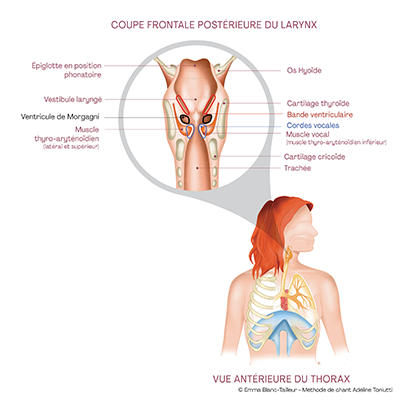
Illustration © Emma Blanc-Tailleur, Anatomie du Chant, Adeline Toniutti
The closure quotient in saturated voice
You might expect the vocal cords to be pressed together very firmly in saturated voice. Yet the closure quotient measured during the examination, that is, the contact time of the vocal cords over one vibratory cycle, was fairly low. Dr Bruno Coulombeau suggests a possible explanation: an opening and a closing coexisting at two levels, that of the vocal cords and that of the vestibule, which may have disturbed the measurement.
Dr Romain Pérouse has also observed that some tenors strongly contract the part of the larynx above the vocal cords to produce their high notes, to the point that their vocal cords are less visible during the examination.
Saturated voice and the high notes
At the second passage, about a fourth above the first, a pop singer can move into saturated voice, just as they can move into belting or head voice. In men, saturated voice is sometimes a step in the search for the high note: some first find the sound in saturated voice, before moving into belting or a classical chest voice. On the chart of possible register zones in Anatomie du Chant, it sits in the high range and the extremely high extension, in women as in men.
In her own rehabilitation, Adeline Toniutti first worked a great deal on belting, then added saturated voice. One of her doctors judged this work “so against the grain of classic speech therapy techniques, but so effective that it raises a question”. This path is her own; any rehabilitation is decided with your doctor.
Songs to hear it
To find a register, it is very useful to listen to a singer who practises it, so that you form a mental image of it that the brain can then trigger. The examples given in Anatomie du Chant:
- the end of Dream On, by Aerosmith
- the end of Stairway to Heaven, by Led Zeppelin
- Monstre, by Adeline Toniutti
Exercises
Spotting registers by ear
The same song often contains several registers. Rock and metal singers such as Robert Plant, Freddie Mercury or Matthew Bellamy vary their styles over the course of a set or a song. Adeline Toniutti asks her singers to try to spot these registers in order to develop their ear.
Changing register
Draw on your imagination to reproduce a vocal colour you have heard. When you move from one register to another, do not let go of pivot point 2: respect the laryngeal suspension, otherwise you risk hurting yourself.
These exercises must be done while respecting the five pivot points. If you have a vocal cord condition, ask your specialist for advice.
CALYP
Explore your registers at CALYP
The registers are set out in detail in Anatomie du Chant (Marabout, 2024). To explore them with Adeline Toniutti and her team, book an appointment.
Frequently asked questions
What is saturated voice?
It is a register of contemporary singing characterised by a narrowing of the laryngeal vestibule, above the vocal cords. This intense tightening often sets the ventricular bands vibrating in addition to the vocal cords.
What is the difference between saturated voice and belting?
Both tighten the laryngeal vestibule, but to different degrees: in belting the tightening is moderate, while in saturated voice it is intense and sets the ventricular bands vibrating.
Does saturated voice help you find the high notes?
For some men, yes: they sometimes find the sound in saturated voice before moving into belting or a classical chest voice. It is sometimes a step in the search for the high note.