
Vocal fry
VOICE CLINIC
Vocal fry is mechanism 0. Done well, it helps you feel your vocal cords, wake up the voice and prepare work on a new register.
Mechanism 0
Vocal fry is mechanism 0. You find it by producing a sound in mechanism 1, the chest voice, then considerably reducing the airflow. According to Dr Bruno Coulombeau and Dr Romain Pérouse, the air then generally arrives with too little flow to sustain a regular vibration, and therefore a given note: you are at the limit of the airflow needed to create a vibration.
Mechanism 0, as long as no excessive tension is put into it, cannot be bad for the vocal cords.
Two kinds of fry in a phoniatric examination
During her phoniatric examination, Adeline Toniutti produced two types of fry. In the “Adeline Toniutti-style” fry, there is a marked constriction of the laryngeal vestibule, the storey just above the vocal cords, close to saturated voice but with much less air pressure. The vibrations of the vocal cords are irregular, and the ventricular bands partly start to vibrate.
In “classic” fry, the tightening of the vestibule is slight. An unstable vibration sets in, without any squeezing, and the vibratory cycles lose their regularity until they seem random.
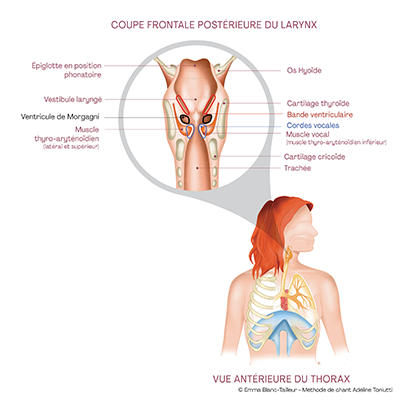
Illustration © Emma Blanc-Tailleur, Anatomie du Chant, Adeline Toniutti
What is fry for?
Done well, fry has many benefits: it helps you locate the vocal cords and develop your sense of them. Performed while respecting the laryngeal suspension, it wakes up the voice effectively and prepares work on a new register. Classical singers can often be heard doing fry just before going on stage, and Adeline Toniutti sometimes uses the vibration of mechanism 0 to help support the onset of the middle range.
In speech, mechanism 0 is also a feature of certain voices, such as that of Jean Lassalle, and some people use it to be able to speak after the removal of a vocal cord.
Songs to hear it
To find a register, it is very useful to listen to a singer who practises it, so that you form a mental image of it that the brain can then trigger. The examples given in Anatomie du Chant:
- Size Doesn’t Matter, by Nina Hagen
- Demolisher, by Slaughter to Prevail
Exercises
Finding fry
Produce a comfortable sound in chest voice, then considerably reduce the airflow until you hear the irregular vibration of fry. Put no excessive tension into it and keep the laryngeal suspension. You can use it to wake up the voice at the start of your warm-up.
Changing register
Draw on your imagination to reproduce a vocal colour you have heard. When you move from one register to another, do not let go of pivot point 2: respect the laryngeal suspension, otherwise you risk hurting yourself.
These exercises must be done while respecting the five pivot points. If you have a vocal cord condition, ask your specialist for advice.
CALYP
Explore your registers at CALYP
The registers are set out in detail in Anatomie du Chant (Marabout, 2024). To explore them with Adeline Toniutti and her team, book an appointment.
Frequently asked questions
What is vocal fry?
It is mechanism 0 of the larynx. You find it by producing a sound in chest voice and considerably reducing the airflow, to the point where the vibration of the vocal cords becomes irregular.
Does vocal fry damage the vocal cords?
According to Anatomie du Chant, mechanism 0, as long as no excessive tension is put into it, cannot be bad for the vocal cords. It must be done while respecting the laryngeal suspension.
What is fry useful for in a singer?
It helps you locate the vocal cords and develop your sense of them, wakes up the voice effectively and prepares work on a new register. Classical singers do it just before going on stage.