Whistle voice
VOICE CLINIC
Whistle voice is mechanism 3, the mechanism of extremely high sounds. The vocal cords are so tense that only a small portion of them keeps vibrating.
Mechanism 3
In mechanism 3, the vocal cords are put under extremely strong tension. This tension blocks part of the vibrating portion of the vocal cords, so the vibration takes place over a much shorter portion, which makes it possible to produce extremely high sounds.
During Adeline Toniutti’s phoniatric examination, Dr Bruno Coulombeau and Dr Romain Pérouse observed that only a very small part of the length of the vocal cords was vibrating. In her case, in this mechanism, the front of the vocal cords appears to be “held” by the ventricular bands, with a double action of lateral compression and high tension of the cords.
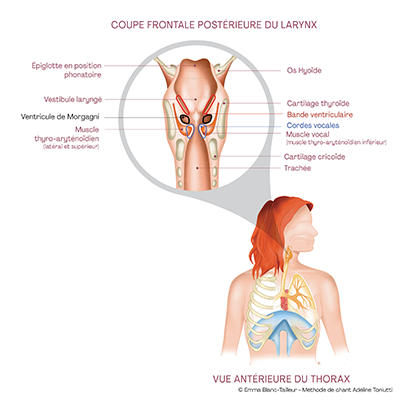
Illustration © Emma Blanc-Tailleur, Anatomie du Chant, Adeline Toniutti
Who sings in whistle voice?
The extremely high notes of the coloratura soprano, above top C (C6), can be sung in whistle voice or in head voice. In contemporary singing, Mariah Carey is known for her feats in this register. Men also produce mechanism 3, though not always for aesthetic purposes. Antoine Delie, for his part, uses it in the bridge of Don’t Speed Up, a song by Adeline Toniutti.
On the chart of possible register zones in Anatomie du Chant, whistle voice occupies the extremely high extension, in women as in men. This chart is a performance goal: it is normal not to have every register at your disposal when you start out.
During a filmed examination, the doctor asked Adeline Toniutti to try whistle voice while thinking of the vowel “i” (as in “see”).
Whistle voice and whistling
Whistle voice has nothing to do with whistling. When Adeline Toniutti whistled during her examination, the doctors observed that her vocal cords no longer worked as a vibrator but regulated the airflow; it is the position of the lips that acts on the frequency of the whistle. This is why, after vocal cord surgery, patients are often asked not to whistle during the period of silence.
Songs to hear it
To find a register, it is very useful to listen to a singer who practises it, so that you form a mental image of it that the brain can then trigger. The examples given in Anatomie du Chant:
- Emotions, by Mariah Carey
- Antoine Delie’s whistle voice in the bridge of Don’t Speed Up, by Adeline Toniutti
Exercises
Looking for your registers
To find a register and master it in a healthy way, first learn its physiological characteristics, then listen to a singer who practises it. The vocal cords are commanded by thought and imagination: a clear mental image helps the brain trigger the gesture. Some pitches are more favourable than others for a register to emerge, and whistle voice is to be looked for in the extremely high extension.
Changing register
Draw on your imagination to reproduce a vocal colour you have heard. When you move from one register to another, do not let go of pivot point 2: respect the laryngeal suspension, otherwise you risk hurting yourself.
These exercises must be done while respecting the five pivot points. If you have a vocal cord condition, ask your specialist for advice.
CALYP
Explore your registers at CALYP
The registers are set out in detail in Anatomie du Chant (Marabout, 2024). To explore them with Adeline Toniutti and her team, book an appointment.
Frequently asked questions
What is whistle voice?
It is mechanism 3 of the larynx. An extremely strong tension blocks part of the vocal cords, which then vibrate over only a very short portion: this is what makes it possible to produce extremely high sounds.
Can men sing in whistle voice?
Yes, men also produce mechanism 3, though not always for aesthetic purposes. Antoine Delie uses it in the bridge of Don’t Speed Up, a song by Adeline Toniutti.
Is whistle voice the same as whistling?
No. When you whistle, the vocal cords no longer vibrate: they regulate the airflow, and it is the lips that set the frequency. In whistle voice, it really is the vocal cords that vibrate, over a very small portion.