Falsetto voice
VOICE CLINIC
Falsetto, also called the falsetto voice, is the male head voice. It is the highest voice in the male singing register.
What is falsetto?
Falsetto is the register that corresponds to a man’s use of mechanism 2: it is the same laryngeal mechanism that a woman uses in head voice. It is the highest voice in the male singing register.
In mechanism 2, the cricothyroid muscles tilt the thyroid cartilage onto the cricoid cartilage and put the vocal cords under tension. The cords lengthen, thin out and vibrate faster, which makes it possible to reach high frequencies. Their contact is smaller than in chest voice. Men can also produce mechanism 3, whistle voice, though not necessarily for aesthetic purposes.
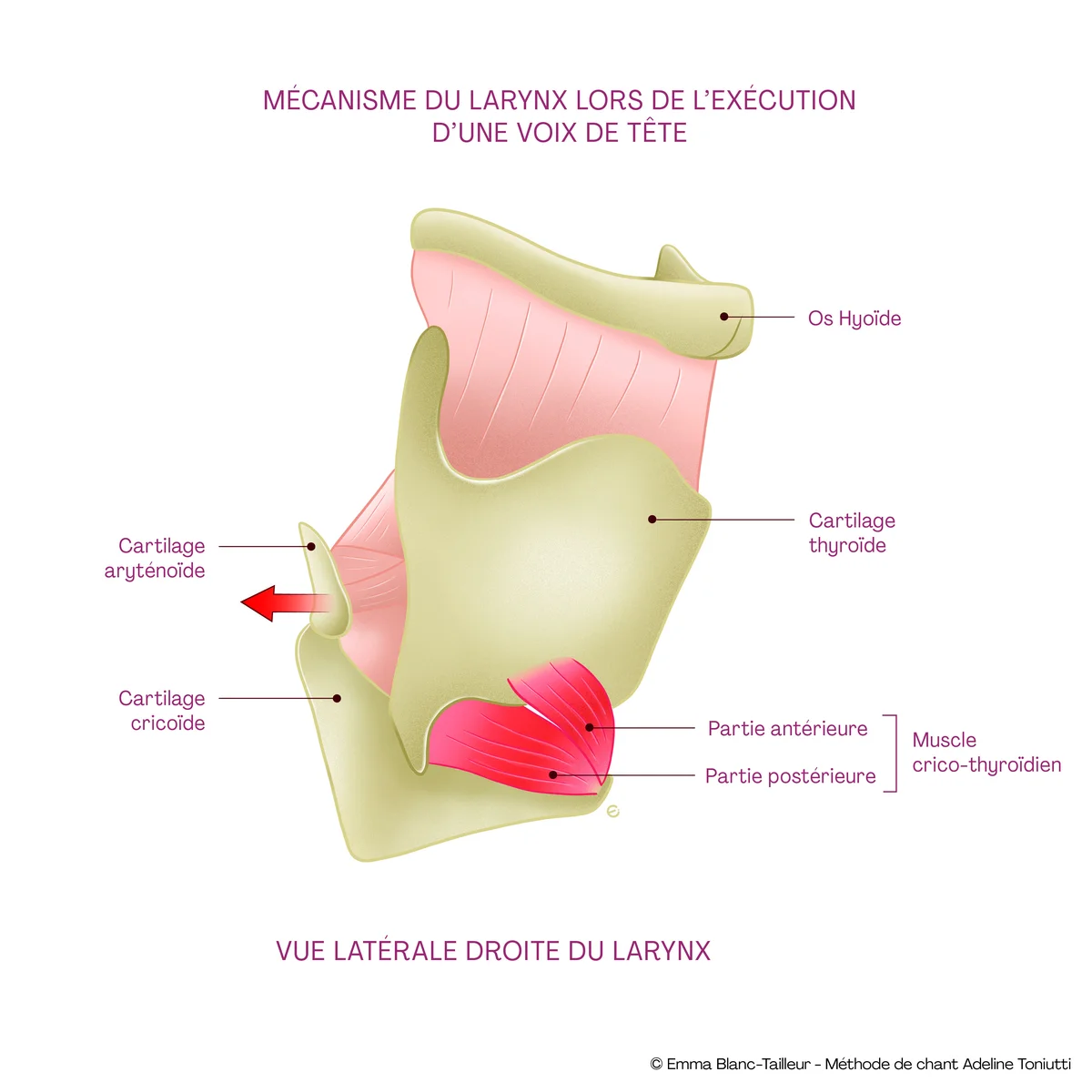

Illustrations © Emma Blanc-Tailleur, Anatomie du Chant, Adeline Toniutti
Falsetto in contemporary and classical singing
In contemporary singing, some men use falsetto according to their artistic identity and their musical style, as Michel Polnareff and Klaus Nomi do. A man can sing in chest voice like Johnny Hallyday, but also in mechanism 2, like Michael Jackson.
In classical singing, countertenors use their falsetto in the Baroque repertoire to sing the alto register, and sopranists use it to sing the soprano register.
Falsetto and the speaking voice
In speech, men mainly use chest voice. In the collective unconscious, Adeline Toniutti explains in La Bonne Voix, a man is seen as someone who ought to speak in chest voice: he can sing in whatever mechanism he likes, but the speaking voice remains codified.
Artists to hear it
To find a register, it is very useful to listen to a singer who practises it, so that you form a mental image of it that the brain can then trigger. The examples given in Anatomie du Chant and La Bonne Voix:
- Michel Polnareff
- Klaus Nomi
- Stayin’ Alive, by the Bee Gees, cited for mechanism 2
- Michael Jackson, cited for head voice in men
Exercises
The call to Castafiore
To find mechanism 2, take as your model Bianca Castafiore from Tintin, laughing to see herself so beautiful in the mirror, or the voice of the temperamental Cleopatra in the cartoon Asterix and Cleopatra. Ridicule never killed anyone: the most important thing is to try, and the nerve connections will form. This exercise works for everyone, men included.
Changing register
Draw on your imagination to reproduce a vocal colour you have heard. When you move from one register to another, do not let go of pivot point 2: respect the laryngeal suspension, otherwise you risk hurting yourself.
These exercises must be done while respecting the five pivot points. If you have a vocal cord condition, ask your specialist for advice.
CALYP
Explore your registers at CALYP
The registers are set out in detail in Anatomie du Chant (Marabout, 2024). To explore them with Adeline Toniutti and her team, book an appointment.
Frequently asked questions
What is falsetto?
It is the male head voice, also called the falsetto voice. It corresponds to mechanism 2, the same laryngeal mechanism a woman uses in head voice, and it is the highest voice in the male singing register.
Are falsetto and head voice the same thing?
For the larynx, yes: it is the same mechanism 2. We speak of falsetto, or the falsetto voice, when a man is using it.
Who sings in falsetto?
In contemporary singing, artists such as Michel Polnareff or Klaus Nomi. In classical singing, countertenors in the Baroque repertoire, for the alto register, and sopranists, for the soprano register.