Pulmonology and vocal method
VOICE CLINIC
Vital capacity, training of the respiratory gesture, diaphragm and rehabilitation: a scientific synthesis of a colloquium between pulmonology and vocal method.
COLLOQUIUM
Pulmonology and vocal technique: a necessary dialogue
At a public colloquium devoted to breath, Adeline Toniutti, vocal coach and founder of the method taught at CALYP, shared the stage with Prof. Thomas Sinowski, pulmonologist and head of the pulmonology department at Pitié-Salpêtrière. The exchange set two grammars of the same organ side by side: that of respiratory medicine, and that of vocal performance.
For the clinician, breath is first a vital function and a rehabilitation challenge. For the vocal coach, it is the engine of the sung sound: exhaled air, vocal folds, fine management of the trunk muscles. Both approaches converge on one central point: theoretical lung capacity alone does not determine respiratory performance. Training of the gesture matters.
PHYSIOLOGY
Vital capacity: what equations measure, and what they omit
In pulmonary function testing, reference values for vital capacity depend mainly on sex, height, age (gradual decline from about age twenty) and, to a lesser extent, weight (a few percent in standard equations). A tall man has, on average, a larger available volume than a woman of smaller stature.
A demonstration during the colloquium recalled the limit of a purely morphometric reading. Prof. Sinowski, whose theoretical vital capacity is substantially higher (around five litres in the estimate discussed), did not hold a sung tone as long as Adeline Toniutti. His comment was unambiguous: twice the available volume does not compensate for the absence of a trained gesture.
KEY TAKEAWAY
Vital capacity is an anatomo-functional measurement. Phrase length, air metering and projection belong to training of the respiratory gesture. That second register is what vocal method works on, and, in another setting, respiratory rehabilitation.
RESPIRATORY DRIVE
The lungs receive. Muscles and the nervous system command.
The lungs contain no motor muscle of their own. Ventilation results from the coordinated action of the diaphragm, the intercostal muscles and, for the active expiration used in singing, the abdominal wall (transversus, obliques, rectus abdominis). This mechanics is under nervous command: without a central order and without muscular effectors, lung tissue is only a passive reservoir.
This physiology has a direct pedagogical consequence. Breath is not a fixed organ. It is a gesture, partly automatic for survival, open to refinement for speech and song. Adeline Toniutti's method, developed in Anatomie du Chant, rests on that plasticity: optimize inspiration, master expiration, coordinate the ribcage and the abdominal wall.
CROSS DEFINITIONS
Vital function, communication vector, artistic material
From a medical standpoint, breath first ensures gas exchange (oxygen / carbon dioxide). When it is impaired, the patient suffers: breathlessness, exercise limitation, anxiety linked to loss of control. Prof. Sinowski also stresses a relational dimension: respiration expresses a physical and psychological state, both explicitly (sigh, rhythm) and implicitly (reading a room, reading stress).
From the vocal coach's standpoint, the singer's breath is the air that, under the rise of the diaphragm and abdominal pressure, passes through the vocal folds to produce a modulable sound. Singers are, in this reading, athletes of breath: nuance, phrase length, projection, economy of air. One does not stop breathing in order to sing. One converts a vital function into artistic material.
Breathing to live, and breathing to speak: singing sits at the intersection of both.
FUNCTIONAL ANATOMY
Diaphragm, ribs, obliques: the engine of sound
The diaphragm is a dome-shaped muscle separating thorax from abdomen. On inspiration, the dome lowers, the ribcage opens, the ribs spread. On expiration, the diaphragm rises; for singing, the abdominal muscles reinforce that rise and drive air toward the larynx. Diaphragm fibres are highly oxidative: an endurance muscle, rarely "tired" in resting breathing, but whose fine control is learned.
Adeline Toniutti stresses a point that is often poorly taught: "belly push" inspiration alone is not the singer's technique. The vocal gesture rests on a synergy between rib opening and management, diaphragm work and the dosed action of the obliques (and the abdominal wall more broadly). That rib-oblique synergy is what gives the singer leverage over airflow, far beyond a simple passive descent of the diaphragm.
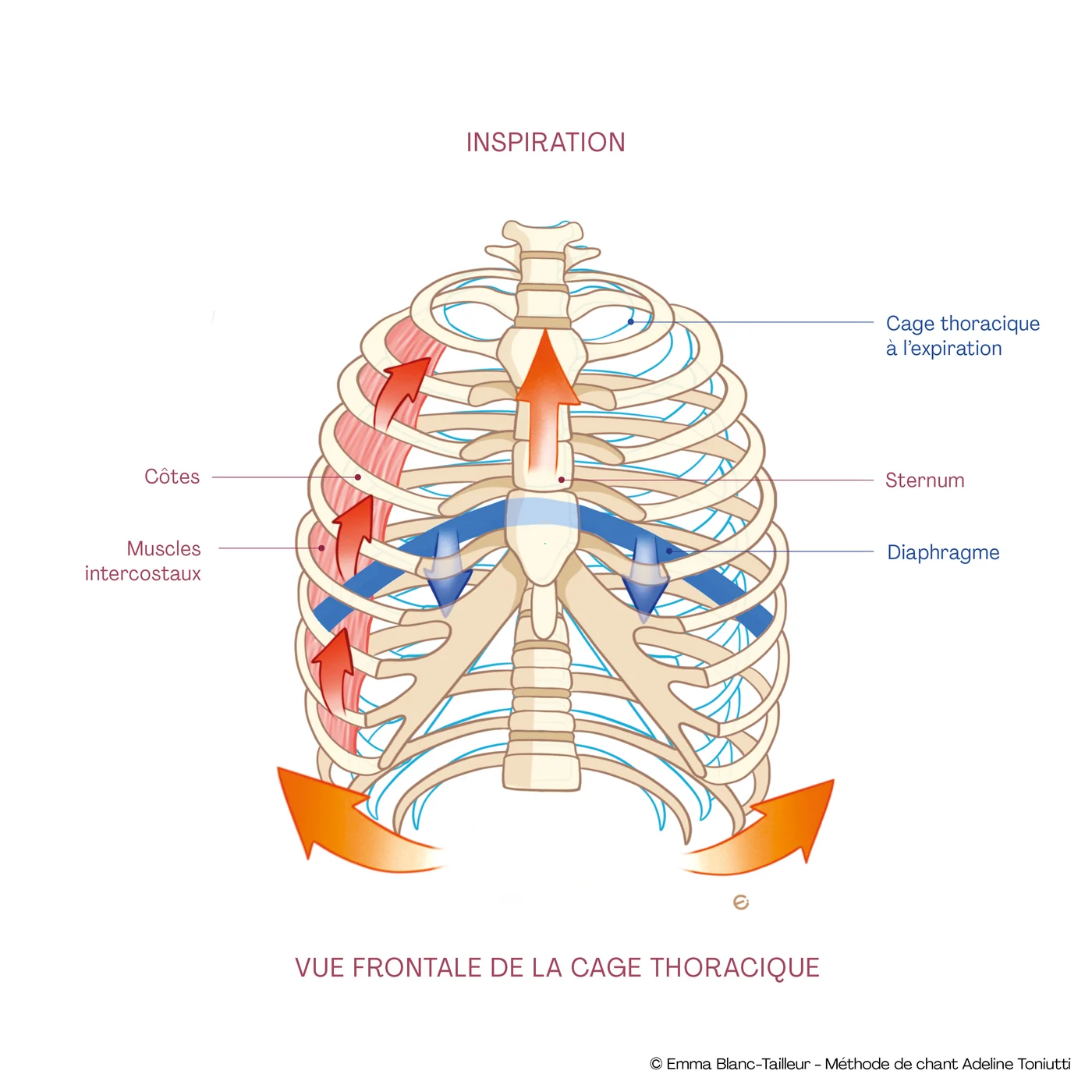
Illustration © Emma Blanc-Tailleur, Anatomie du Chant, Adeline Toniutti
CLINICAL POINTS USEFUL TO SINGERS
- 1.Ribs locked on inspiration: the diaphragm can no longer descend freely; usable volume and phrase flexibility drop.
- 2.Inactive abdominal wall: expiration is no longer metered; the sound runs out of air or is forced.
- 3.Larynx held low: freeing the neck (including through oriented movements, such as head rotation in certain exercises of the method) can restore better laryngeal freedom and sound relief, without replacing a medical diagnosis.
RESPIRATORY REHABILITATION
When parenchyma is damaged, one trains what remains
Respiratory rehabilitation is not reducible to exercise retraining. In many chronic diseases, parenchymal destruction is partly irreversible: one does not "train" a destroyed lung. One works instead on peripheral muscles, exercise tolerance, dyspnoea management and, above all, the patient's sense of control over their air.
During exacerbations, panic is often linked to loss of mastery: the event is threatening, unexpected, out of control. Singing, in this setting, is not an accessory pastime. It is a tool of metering and regulation: phrase, end of phrase, return to calm. Prof. Sinowski puts it this way: the goal is not to mourn the breath that was lost, but to help patients use the breath that remains. Singing is decisive because singing is control.
Adeline Toniutti for her part recalls the role of vocal coaches, singing teachers and choirs in that dynamic: regular training of breath, emotional expression, social bond. Access to vocal work should not be refused a priori to people with respiratory disease; it should be designed in articulation with medical follow-up.
"A large part of rehab is helping people use the breath that remains. Singing is decisive for that, because singing is control."
Prof. Thomas Sinowski, pulmonologist, Pitié-Salpêtrière
SYNTHESIS
What this dialogue brings to the Voice Clinic
Three conclusions emerge for singers, speakers and patients in vocal rehabilitation:
- Measuring is not enough: vital capacity informs; it does not program performance.
- The gesture is trained: diaphragm, ribs, obliques and laryngeal coordination belong to a method, not to improvisation.
- Medicine and coaching are not opposed: the clinic measures and treats; vocal method rebuilds control and the aesthetics of sound.
That is the spirit of the CALYP Voice Clinic: bringing vocal coaching into dialogue with medical expertise (ENT, phoniatrics, osteopathy, psychiatry), without confusing roles and without reducing the singer to a volume equation.
THE ADELINE TONIUTTI METHOD
Go further with CALYP
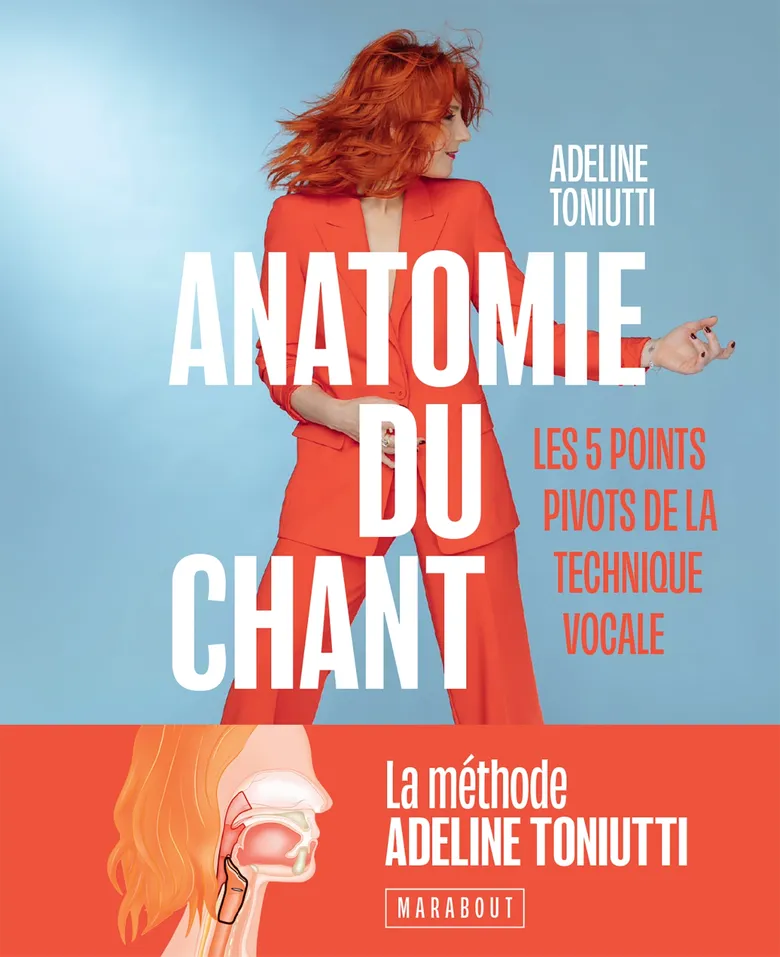
These principles bring together pulmonology and the vocal method developed and tested by Adeline Toniutti, set out in her book Anatomie du Chant (Marabout, 2024). To work on the respiratory gesture, expiration control and vocal health with the CALYP team, contact the Voice Clinic.