Vocal Registers
VOICE CLINIC
Laryngeal mechanisms, registers and passaggi: explore the full sound palette of the singer, from chest voice to whistle voice.
What Is a Vocal Register?
"A classical singer can't sing pop! It's impossible to do both!" And yet, everyone has the same larynx! Registers are as many wonderful colors that shade our singing and lead us to new areas of our repertoire and career.
The term register is used to define several things in vocal language. On one hand, it classifies voice parts in an ensemble — bass, tenor, alto, soprano — since the earliest traces of written music.
On the other hand, it defines the various vocal techniques that make up the palette of the modern or classical singer. For classical singers, we speak of head voice register, chest voice register, falsetto, and whistle voice. In contemporary singing, we can add distorted voice, mixed voice, fry, and other variations.
These registers represent real laryngeal and resonant mechanisms. Let's explore them to fuel our creativity!
Laryngeal Mechanisms
The vibratory laryngeal mechanisms depend on vocal cord adduction. Scientists have classified them into four categories:
- Mechanism 0 (M0): vocal fry
- Mechanism 1 (M1): chest voice (also called heavy mechanism)
- Mechanism 2 (M2): head voice (also called light mechanism)
- Mechanism 3 (M3): whistle voice
The explanations of laryngeal mechanisms are supported by observations from a phoniatric examination conducted with Dr. Bruno Coulombeau and Dr. Romain Pérouse.
Mechanism 0: Vocal Fry
Vocal fry is mechanism zero. It is produced by singing in mechanism 1 and considerably reducing airflow. The vibrations at the glottal plane become irregular.
Two types of fry can be distinguished:
- "Adeline Toniutti-style" fry: a marked vestibular constriction similar to distorted voice, but with much less air pressure. Partial vibration of the ventricular bands is also observed.
- "Classic" fry: a subtle vestibular narrowing with unstable vibration without squeezing. The vibratory cycles become random.
Mechanism 0 without excessive tension cannot harm the vocal cords. The air generally comes with too little flow to sustain a regular vibration.
When well executed, vocal fry has many benefits: it helps target the location of the vocal cords and develop their sensation. Performed while maintaining laryngeal suspension, fry can effectively wake up the voice or prepare work on a new register.
Examples: Size Doesn't Matter by Nina Hagen, Demolisher by Slaughter to Prevail
Mechanism 1: Chest Voice
In mechanism 1, the cricothyroid muscles are minimally active and the vocal cords are thick and relatively slack. They vibrate with wide amplitude. The vocal muscle is active and contracted, giving mass to the vocal cord.
Because the vocal cords are massive and loosely tensed, vibration produces lower-pitched sounds. They make broader contact than in mechanism 2.
Examples: Golden Eye by Tina Turner, My Way by Frank Sinatra
Mechanism 2: Head Voice
In mechanism 2, the cricothyroid muscles are much more active than in mechanism 1. Their contraction tilts the thyroid cartilage onto the cricoid cartilage, allowing the vocal cords to be tensioned.
Mechanically, the vocal cords stretch and become much thinner and longer. Their reduced thickness, high tension, and lower mass result in faster vibration, allowing higher frequencies to be reached.
Examples: Stayin' Alive by the Bee Gees, Rêver by Mylène Farmer
Expert Insight: Dr. Bruno Coulombeau, Phoniatrician
"In mechanism 1, the recurrent nerve allows the vocal cords to have significant mass, and therefore a slower vibratory frequency. In mechanism 2, the contraction of the cricothyroid muscles causes considerable lengthening of the vocal cords, which are also much thinner. They therefore vibrate much more rapidly."
Mechanism 3: Whistle Voice
In mechanism 3, the vocal cords undergo extremely strong tension. This causes part of the vibrating portion of the vocal cords to lock, resulting in vibration over a much shorter portion, enabling the production of ultra-high-pitched sounds.
During Adeline Toniutti's phoniatric examination, Dr. Coulombeau and Dr. Pérouse observed that only a very small portion of the vocal cord length was vibrating, with a dual mechanism of lateral compression and high cord tension.
The ultra-high notes of the coloratura soprano, beyond high C5, can be produced using whistle voice (M3) or head voice (M2).
Examples: Emotions by Mariah Carey, Antoine Delie's whistle voice in Don't Speed Up by Adeline Toniutti
Vocal Registers
The production of vocal registers does not depend solely on vocal cord adduction mechanisms. They also involve phenomena related to the action of resonators.
Belting
Belting is a register that allows maintaining mechanism 1 as high as possible in the vocal range. The laryngeal function remains in M1, but with increased subglottic air pressure through abdominal compression and higher laryngeal resistance.
To maintain mechanism 1 while ascending to higher pitches, the larynx compensates for the additional subglottic pressure by increasing containment at the level of the laryngeal vestibule.
"In belting, there is moderate vestibular narrowing with slight epiglottic retraction. During the same phrase performed in mixed voice or head voice, there is very little vestibular narrowing." — Dr. Bruno Coulombeau, Phoniatrician
Examples: River Deep, Mountain High by Tina Turner and Céline Dion, Allumer le feu by Johnny Hallyday
Distorted Voice
Distorted voice is characterized by a narrowing of the laryngeal vestibule accompanying vocal cord contact. This lateral compression often causes the ventricular bands to come into contact.
Unlike belting where vestibular narrowing is moderate, distorted voice features vibration of the ventricular bands due to intense vestibular narrowing.
During Adeline Toniutti's examination, vestibular contact was observed, generating an additional vibration superimposed on that of the vocal cords.
Examples: the end of Dream On by Aerosmith, the end of Stairway to Heaven by Led Zeppelin, Monstre by Adeline Toniutti
Mixed Voice
Mixed voice can use both mechanism 1 and mechanism 2. What changes the vocal color doesn't happen at the vocal cord level, but in the area above, in the resonators: hypopharynx, oropharynx, pharynx.
Mixed voice therefore combines a laryngeal vibratory mechanism with a resonant mechanism. It is a variation of M1 or M2.
To the ear, mixed voice offers a sensation of both head voice and chest voice; it is found when singing at medium volume. It is a color to seek out.
"Franco Fussi explains that mixed voice can be achieved in mechanism 1 as well as mechanism 2. Sometimes modifications that occur only in the resonators affect the singer's perception." — Dr. Bruno Coulombeau, Phoniatrician
Examples: I Love You by Woodkid, Mad About You by Hooverphonic
Falsetto
Falsetto is the male head voice. It is the vocal register corresponding to a man's use of mechanism 2 — the same laryngeal mechanism used by women in head voice. It is the highest register in the male singing voice.
Men can use falsetto in contemporary singing, depending on their artistic identity and musical style (such as Michel Polnareff, Klaus Nomi…).
In classical singing, countertenors use their falsetto in the baroque repertoire to sing alto parts, and sopranists use their falsetto to sing soprano parts.
Vocal Cord Closure Quotient
Between each laryngeal mechanism, the contact between vocal cords differs. This can be measured using electroglottography (EGG): the closure quotient (Qx) represents the vocal cord adduction time over a complete vibratory cycle, expressed as a percentage.
The Qx is on average higher in mechanism 1 (chest voice) than in mechanism 2 (head voice). Vocal cord contact is therefore greater in M1 than in M2.
- Qx in M1: between 40% and 60% in singers
- Qx in M2: between 25% and 40% in singers
An interesting observation: in opera singers with vocal cord lesions, using chest voice (M1) improved head voice (M2), thanks to improved adduction.
Managing the Passaggio
It is often said that the passaggio is a fixed point that doesn't move. In reality, the passaggio zone can be modified depending on our body's limits and what we are seeking.
We can transition between different mechanisms and registers according to our goals, aesthetics, and the required function:
- In classical singing, the aim is a consistently homogeneous voice: it is a rule not to hear a break between different registers, unless the composer requires it.
- In pop singing, breaks can be an asset in the artist's performance, giving them a highly recognizable vocal signature.
This agility requires optimal vocal technique. The passaggio is neither a fixed point nor a bodily change.
First Passaggio
The first passaggio occurs at the edge of the speaking voice range (estimated at one octave). A decrease or cessation of chest vibrations can be observed in the singer.
Second Passaggio
The second passaggio is found approximately a fourth above the first. It may be accompanied by a register change — into belting, head voice, or distorted voice.
Other Vibratory Phenomena
Vibrato
Vibrato is a vocal cord vibration featuring a slight, harmonious frequency change of approximately four cycles per second. It is prominent in opera, present in musical theater, and more sparse in contemporary music.
Trill
The trill features a wider frequency change — an alternation between two notes. The entire laryngeal structure moves, along with the pharynx, unlike vibrato which only involves a slight change at the vocal cord level.
White Voice
This vocal color presents no danger to vocal health when performed consciously without laryngeal collapse. It features a slight intentional air leak at the vocal cord adduction level. It is only safe to use with microphone amplification.
Anatomy of Singing
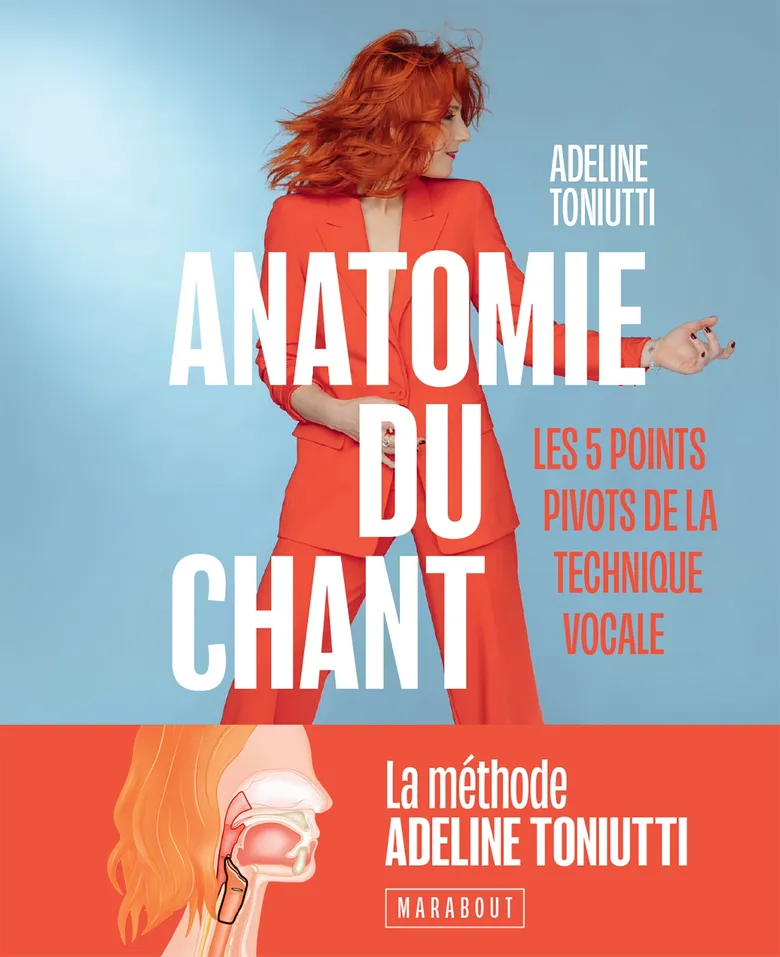
This article is taken from Chapter 3 of Anatomy of Singing by Adeline Toniutti, published by Marabout. To delve deeper into vocal registers, laryngeal mechanisms, and all aspects of vocal technique, discover the complete book.
Discover the Book