
Vocal Cord Diseases
VOICE CLINIC
A comprehensive guide to vocal cord pathologies, their causes, modern diagnostic methods, and treatment approaches developed by CALYP's medical team.
Understanding Vocal Cord Pathologies
The vocal cords are delicate structures that can be affected by a range of pathologies -- from benign lesions caused by vocal misuse to serious conditions requiring urgent medical attention. Understanding these conditions is the first step toward prevention and effective treatment.
At CALYP, our multidisciplinary team of ENT surgeons, phoniatrists, and vocal coaches works together to provide comprehensive diagnosis, treatment, and rehabilitation for all vocal cord pathologies.
BENIGN LESIONS
Common Benign Vocal Cord Lesions
These conditions are treatable and do not end careers when properly managed.
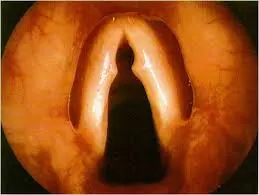
Vocal Nodules
Bilateral, symmetrical growths at the junction of the anterior and middle thirds of the vocal cords. Caused by repeated mechanical trauma from vocal misuse or overuse.
Treatment: Vocal rehabilitation (often sufficient), microsurgery for persistent cases.
Learn more about nodules →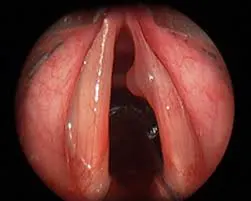
Vocal Polyps
Unlike nodules, polyps are typically unilateral (appearing on one cord) and are often the result of a single traumatic event -- such as screaming or an episode of intense vocal strain. They can be sessile (broad-based) or pedunculated (on a stalk).
Treatment: Surgical removal via microlaryngoscopy, followed by vocal rehabilitation.
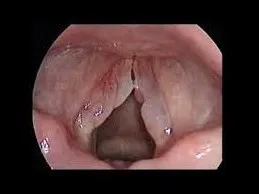
Reinke's Edema
A diffuse swelling of the Reinke's space (the superficial layer of the vocal cord), resulting in a characteristic deepening of the voice. Most commonly associated with chronic smoking, but also with vocal overuse and gastroesophageal reflux.
Treatment: Cessation of irritants (smoking), surgical reduction, vocal rehabilitation.
Vocal Cord Cysts
Fluid-filled or mucus-filled sacs within the vocal cord tissue. Cysts can be congenital (epidermoid cysts) or acquired (retention cysts from blocked glands). They cause localized stiffness that disrupts the vibratory wave.
Treatment: Surgical excision is typically required, as cysts rarely resolve spontaneously. Careful dissection preserves surrounding tissue.
Sulcus Vocalis
A groove or furrow along the edge of the vocal cord, where the epithelium adheres abnormally to the underlying vocal ligament. This condition creates stiffness and prevents normal mucosal wave propagation, resulting in a breathy, weak voice.
Treatment: Specialized microsurgery (often involving mucosal bridge techniques), as documented in the "Operation Opera" film directed by Dr. Perouse's team.
SERIOUS CONDITIONS
Conditions Requiring Urgent Attention
Vocal Cord Cancer
Laryngeal cancer, particularly glottic (vocal cord) cancer, most commonly affects men over 50, with strong associations to tobacco and alcohol use. Key warning signs include:
- Persistent hoarseness lasting more than 3 weeks
- Progressive voice deterioration
- Difficulty or pain when swallowing
- Unexplained ear pain
- A lump in the neck
Any persistent hoarseness in a smoker must be evaluated by an ENT specialist without delay.
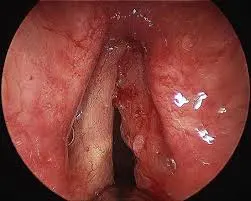
Laryngeal Paralysis
Vocal cord paralysis occurs when one or both vocal cords cannot move due to nerve damage. The recurrent laryngeal nerve, which controls vocal cord movement, can be affected by:
- Thyroid surgery or other neck/chest procedures
- Tumors of the thyroid, trachea, or esophagus
- Neurological conditions (multiple sclerosis, Guillain-Barre syndrome)
- Viral infections
- Diabetic neuropathy
Treatment depends on whether one or both cords are affected and may include vocal rehabilitation, injection laryngoplasty, or medialization thyroplasty.
Chronic Laryngitis
While acute laryngitis is typically self-limiting, chronic laryngitis represents a persistent inflammatory condition of the larynx. Principal causes include:
- Tobacco use (primary factor)
- Alcohol consumption
- Chronic vocal overuse
- Gastroesophageal reflux
- Environmental irritants (dust, chemicals, vapors)
Chronic laryngitis requires ongoing management and monitoring, as some forms can progress to dysplasia or carcinoma.
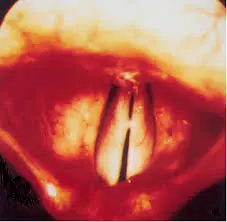
DIAGNOSIS
Diagnostic Methods
Videolaryngoscopy
Direct visualization of the vocal cords using a flexible or rigid endoscope with a camera, allowing detailed examination of vocal cord anatomy.
Videostroboscopy
Stroboscopic light reveals the vibratory pattern of the vocal cords in apparent slow motion, essential for detecting subtle lesions and mucosal wave disruptions.
Acoustic Analysis
Computer-based analysis of voice parameters (fundamental frequency, jitter, shimmer, harmonic-to-noise ratio) provides objective measures of vocal function.
Perceptual Assessment
Standardized voice quality evaluation by trained clinicians (GRBAS or CAPE-V scales) complements instrumental findings with expert clinical judgment.

EXPERT CARE
CALYP's Medical Team
Specialists dedicated to vocal health
CALYP brings together a multidisciplinary team of specialists who work together for comprehensive vocal care:
- Dr. Romain Perouse — ENT Surgeon
- Dr. Bruno Coulombeau — Phoniatrist
- Dr. Albert Jacobs — ENT/Cervicofacial Surgeon
- Dr. Natalie Malitchenko — Phoniatrist
- Dr. Jean Charmoille — Psychiatrist/Psychoanalyst
- Maryse Beaupied — Osteopath/Etiopath
This team approach ensures that every aspect of vocal pathology is addressed -- from surgical treatment to psychological support and vocal technique rehabilitation.
DOCUMENTARY
Operation Opera
A 2017 documentary film shot at Clinique des Portes du Sud in Venissieux, directed by Dr. Perouse's surgical team. The film provides full operating room immersion, documenting the treatment of complex pathologies including open cysts and sulcus with mucosal bridges.
This pioneering documentation of vocal cord surgery has been featured in the festival circuit and serves as both an educational resource and a testament to the advanced techniques available for treating vocal cord diseases.