The Twang
VOICE CLINIC
The vocal technique that enables projection, brightness, and vocal power without strain. Scientific analysis and practical methodology.
The Twang — The Vocal Technique Everyone Is Talking About
The twang is a distinct vocal quality, often perceived as “bright,” “piercing,” or “brassy.” Contrary to a common misconception, it is not a nasal sound, as it is produced with the soft palate raised (as it is for non-nasal vowels, closing the nasal passage).[1]
It is a quality omnipresent in contemporary music, especially pop, rock, country, and musical theater.[2]
Adeline Toniutti has been teaching it for several years, using her five pivot points© method as a physiological starting point. In her television and everyday jargon, Adeline affectionately calls it “singing American-style.”
Its primary utility lies in its capacity to increase vocal power and efficiency (sound level) without requiring additional respiratory effort, by acting on the vocal tract (the filter) rather than the source (increasing vocal power by altering the epilarynx or the sound filter).[1]
The pitfall to avoid: Many people and far too many internet videos claim that twang is produced through extreme nasalization of the sound. This is a kind of twang imitation that is not the real thing. Indeed, by nasalizing in an extreme manner, one keeps the soft palate down, which will not produce the expected qualities of twang at all. This is all the more true as people associate lowering the soft palate for nasalization with lowering the larynx, which endangers vocal cord health. This is why we have called upon specialists and the most recent scientific literature to explain the twang phenomenon to you.
A Brief History: Where Does the Name Come From?
1855 – Manuel Garcia (Spanish singer and voice pedagogue, inventor of the laryngoscope, 1805-1906): He was the first to observe that narrowing above the larynx contributed to vocal brilliance.[3] 1930 – Sir Richard Paget (British physicist and phonetician, 1869-1955): He used the term “twang” to describe a vocal quality he called “so-called nasal.”[3] 1930s – Belting: This powerful sound, physiologically very close to twang, is historically associated with singer Ethel Merman from the mid-1930s.[3] Cultural context: Twang is strongly identified with Country & Western music, and is sometimes called the “Nashville” or Appalachian sound.[3] Jo Estill: Researcher and voice specialist, she is credited with advocating the use of twang as therapy and for defining it as a distinct quality (1980s-90s).[1]The Twang According to Dr. Marie Mailly
Twang is a vocal technique used in many musical genres. It is commonly heard in country music, rock, and musicals. It is characterized by a clear, piercing sound, often wrongly described as “nasal,” and is considered an effective mechanism for increasing acoustic intensity. It amplifies the high frequencies of a singer’s voice (i.e., the “singer’s formant”). Theoretically, twang allows increasing perceived volume without a corresponding increase in vocal effort.
Imaging studies and simulations have provided evidence that the cross-sectional area of the vocal tract is smaller in twang than in other vocal qualities. Other vocal tract adjustments, such as shortening of the vocal tract, narrowing of the oropharynx and aryepiglottic sphincter (AES), and widening of the mouth opening, have been reported.
It has been observed that singers modify the shape of the laryngeal vestibule by contracting or relaxing the AES. When the sphincter is contracted, the epiglottis and arytenoid cartilages move slightly closer together (in the same way as during complete closure of the laryngeal vestibule during swallowing, but “stopped halfway”).
Scientific studies have been carried out to observe the size of singers’ vocal tracts. Tract dimensions during speech were compared with tract dimensions during twang using magnetic resonance imaging (MRI). A notable reduction in the oropharyngeal area and AES was observed during twang. Participants used combinations of anteroposterior (AP) and mediolateral (ML) narrowings to achieve this area reduction.
In summary, during twang, specific physiological strategies exist (e.g., pharyngeal wall constriction, wider mouth opening, epilaryngeal tube narrowing) distinct from those used in speech. Individual variations in executing these strategies may reflect a high degree of personal adaptation, with singers using unique combinations of narrowing maneuvers. The presence of such variability underscores the importance of tailored vocal training and therapeutic approaches that account for individual variations in vocal tract physiology.[4][7]
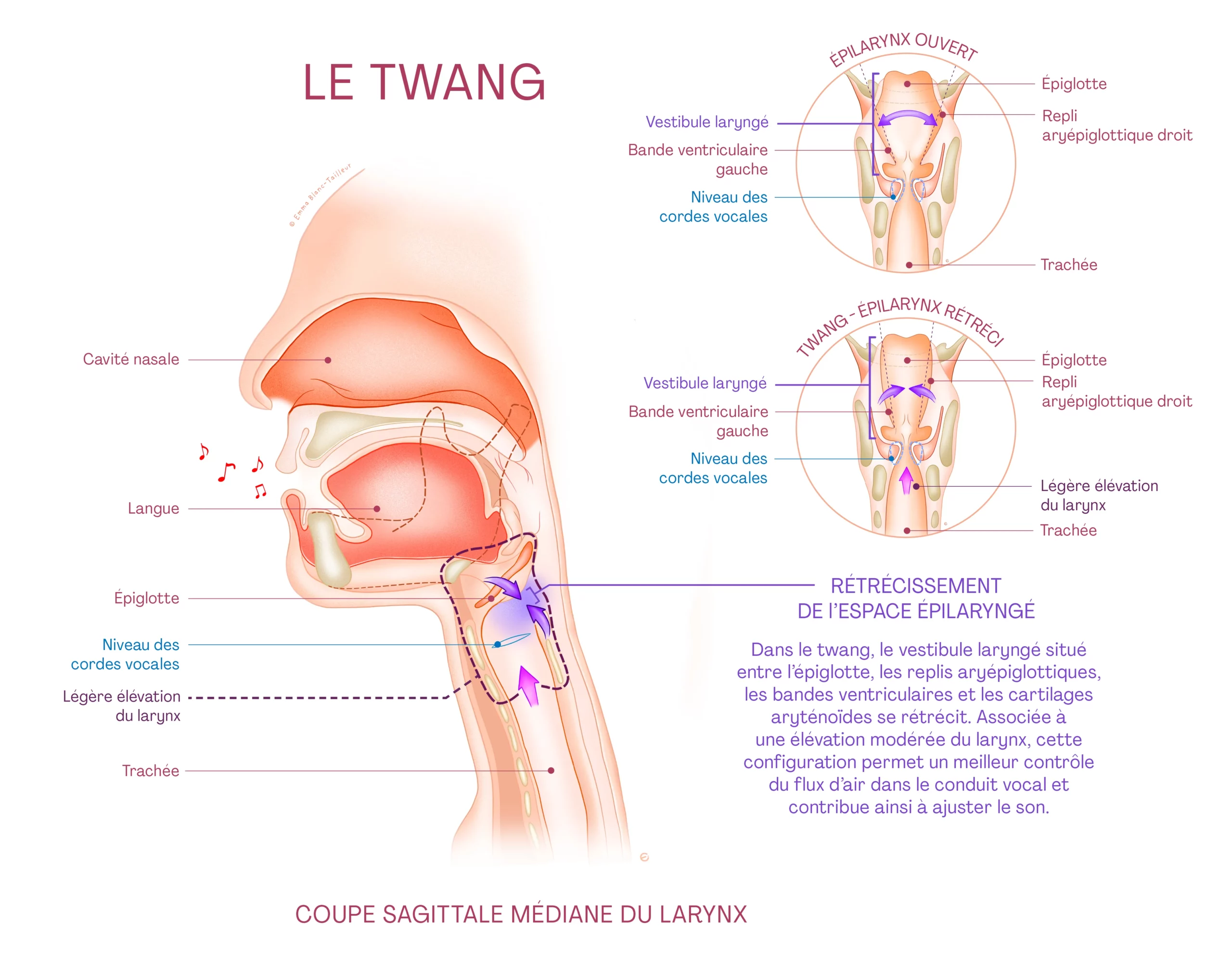
Figure: Anatomical representation of the twang mechanism — aryepiglottic sphincter (AES) narrowing
What the Scientific Literature Says
Perceptual Characteristics
The sound is described as unpleasant or piercing when isolated, reminiscent of a duck’s quacking, a witch’s cackle, or childhood taunting (“nya-nya”). It can also be compared to the timbre of instruments like the oboe or bagpipe.[1][3]
Physiological Characteristics
Aryepiglottic Narrowing (Epilarynx): This is the primary marker. The laryngeal vestibule just above the vocal cords narrows.
“Megaphone” Shape: The vocal tract adopts an inverted funnel shape: the epilarynx and pharynx are narrow, while the mouth opening is wider.
Soft Palate Closure: The velopharyngeal sphincter is closed, preventing air from passing through the nose, proving it is not nasality.
Vocal Cord Adduction: The vocal cords remain closed longer during each vibration cycle (increased closure quotient, meaning the contact time of vocal cords during the vibratory cycle increases).
⚠️ The nasalization trap: Nasalizing to try to produce twang, instead of performing the true laryngeal manipulation (AES narrowing), is the artificial counterfeit. Nasalization blocks the soft palate and larynx. Yet scientific literature demonstrates the opposite: in true twang, the soft palate is raised and closed, and it is an epilaryngeal manipulation that produces the characteristic sound.[3][4][5][2]
Acoustic Characteristics
Formant Cluster (Singer’s Formant): There is a concentration of energy in the singing formant (found between 2 and 4 kHz in the acoustic spectrum), notably through reinforcement of formants 3, 4, and 5. This applies for pitches of at least 400 Hz, i.e., G3. This creates brilliance (“ring”).
Elevated F1 and F2 Formants: The first two resonance frequencies are higher than in the neutral voice. According to Dr. Coulombeau, this implies that vowels are modified.
Volume Increase (SPL): Twang generates a higher sound pressure level.[3][2]
Larynx Position During Twang
Studies agree that the larynx adopts an elevated or higher position than in neutral speech. This elevation contributes to the shortening of the vocal tract necessary for the twang sound.
In the MRI study, the larynx was slightly elevated.[5]
In the loud twang study, the high laryngeal position shortens the tract.[4]
Titze (Ingo Titze, professor of voice sciences, University of Iowa, USA) confirms that shortening of the vocal tract (via larynx elevation) increases the perception of twang.[6]
Explaining Twang to the General Public
“Contrary to what people often think, this sound does not come out through the nose. It is actually an acoustic trick that happens in the throat: by narrowing a small part above the vocal cords (like a funnel or megaphone), the sound is naturally amplified. This allows singing or speaking much louder and being heard over the music, without needing to strain one’s voice or exhaust oneself.”[1]
“In a way, the search for twang in contemporary music could be compared to the search for the mask and projection in lyric opera — seeking sound and projection with less effort.”
How to Achieve Twang — Adeline Toniutti
“Just as surely as people think it’s enough to yawn to achieve the quality of a lyric sound, it is not enough to nasalize to get twang. Twang is the result of a more complex equation that must be developed alongside a specialist or voice expert.
Certain nasalizations may resemble twang, but that does not mean they truly are twang, and on the contrary, simplifying the gesture to a mere imitation can, with extended practice, lead to voice problems.”
Adeline Toniutti has been teaching twang for several years, using her five pivot points© method as a physiological starting point. In her television and everyday jargon, Adeline affectionately calls it “singing American-style.”
“Beware of the pedagogical pitfall of imagery: many teachers use images to achieve an acoustic result, especially with a ‘magic’ effect on television. The problem is that the artist receives this image without the anatomical explanation and therefore will have great difficulty reproducing it alone. I will never say it enough: singing is a choreography of complex movements that must be apprehended, understood, identified in order to coordinate them all. Let us always remember that we always have the choice to use our full sound palette and registers when the technical gesture is healthy. When that choice narrows, it means the gesture is becoming less and less optimized, even dangerous. In this regard, I wish to thank all the specialists who work with us in service of artists.”
The 5 Pivot Points
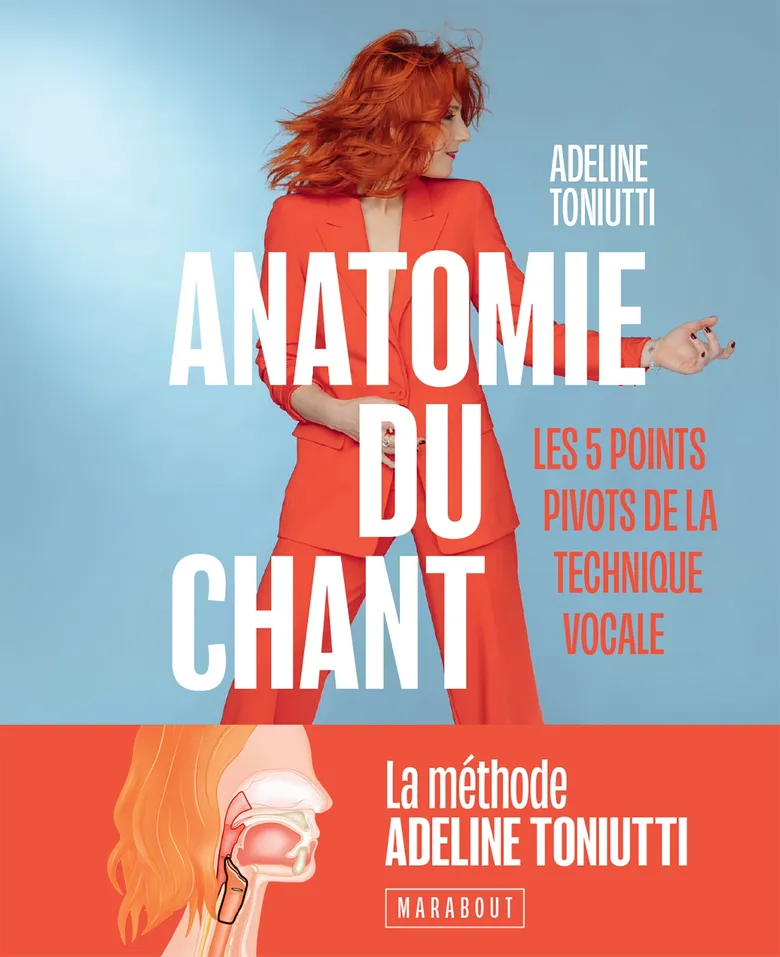
Adeline’s singing method rests on 5 essential pivot points that constitute the vital and indispensable checklist for the singer:
Maintain proper posture
Trigger the correct laryngeal movement
Optimize exhalation
Enable sound resonance
Articulate vowels and consonants
The 5 pivot points compose an anatomo-physiological framework and provide the bodily reference points necessary for singing. The goal: to feel the mechanisms in action within one’s own body related to vocal technique. These pivot points free the singer from constraints to meet the demands of multiple repertoires, from contemporary music to lyric singing. The student is guided to compose a true artistic palette of colors from which they can draw according to their identity and their path.
The Search for Color Through Imagination
“You are more likely to achieve the desired sound when you have imagined it beforehand.”
The 2 Criteria for Technique
1. Neuromuscular choreography
2. Requesting a specific color from the brain
Some Examples of Artists Who Twang
Lady Gaga, Céline Dion, Beyoncé, Freddie Mercury, Robert Plant, Steven Tyler, Ariana Grande, Aretha Franklin…
The English Language Favors Twang
Diphthongs
A diphthong occurs when, in the pronunciation of a word, the vowel changes during emission. The second vowel intervenes at the end of the sound.
Examples:
- Away: you pronounce 4 open “e” sounds for 1 “i” that comes at the sound’s cutoff.
- To cry: you’ll think a bit more “i”, proportionally compared to “away,” at the end of the word.
Generally speaking, when singing on a diphthong, you sing and vibrate the longer vowel: away > aw EEEE i
Musical examples:
- Mama, ooh, didn’t mean to make you cry (Bohemian Rhapsody, Queen)
- Anyway the wind blows (Bohemian Rhapsody, Queen)
“The multiplicity of diphthongs in the English language as well as in the American accent, with significant vowel length that moves through just a tongue movement, favors the search for twang. It’s not for nothing that I call it ‘singing American-style.’ Singers like Céline Dion and Diane Dufresne use twang when singing in French, giving their songs a distinctive color and an ability to produce impressive vibes and vocal virtuosity within their French-language repertoire. A professional singer must be able to use twang and remove it, depending on the desired color — brighter or more intimate.”
Frequencies and Harmonics
View frequency and harmonics tables
Harmonics by Fundamental Note
| Formants/ Pitch | 196 | 247 | 294 | 349 | 392 | 494 | 587 | 784 | 988 | 1175 | 1568 | 1976 |
|---|---|---|---|---|---|---|---|---|---|---|---|---|
| G2 | B2 | D3 | F3 | G3 | B3 | D4 | G4 | B4 | D5 | G5 | B5 | |
| 1 | 392 | 494 | 588 | 698 | 784 | 988 | 1174 | 1568 | 1976 | 2350 | 3136 | 3952 |
| 2 | 588 | 741 | 882 | 1047 | 1176 | 1482 | 1761 | 2352 | 2964 | 3525 | 4704 | 5928 |
| 3 | 784 | 988 | 1176 | 1396 | 1568 | 1976 | 2348 | 3136 | 3952 | 4700 | 6272 | 7904 |
| 4 | 980 | 1235 | 1470 | 1745 | 1960 | 2470 | 2935 | 3920 | 4940 | 5875 | 7840 | 9880 |
| 5 | 1176 | 1482 | 1764 | 2094 | 2352 | 2964 | 3522 | 4704 | 5928 | 7050 | 9408 | 11856 |
| 6 | 1372 | 1729 | 2058 | 2443 | 2744 | 3458 | 4109 | 5488 | 6916 | 8225 | 10976 | 13832 |
| 7 | 1568 | 1976 | 2352 | 2792 | 3136 | 3952 | 4696 | 6272 | 7904 | 9400 | 12544 | 15808 |
| 8 | 1764 | 2223 | 2646 | 3141 | 3528 | 4446 | 5283 | 7056 | 8892 | 10575 | 14112 | 17784 |
| 9 | 1960 | 2470 | 2940 | 3490 | 3920 | 4940 | 5870 | 7840 | 9880 | 11750 | 15680 | 19760 |
Chromatic Equal Temperament Scale (A = 440 Hz)
| Octave/ Notes | C | C# | D | D# | E | F | F# | G | G# | A | A# | B |
|---|---|---|---|---|---|---|---|---|---|---|---|---|
| 0 | 32.7 | 34.6 | 36.7 | 38.9 | 41.2 | 43.7 | 46.2 | 49.0 | 51.9 | 55 | 58.3 | 61.7 |
| 1 | 65.4 | 69.3 | 73.4 | 77.8 | 82.4 | 87.3 | 92.5 | 98.0 | 103.8 | 110 | 116.5 | 123.5 |
| 2 | 130.8 | 138.6 | 146.8 | 155.6 | 164.8 | 174.6 | 185.0 | 196.0 | 207.7 | 220 | 233.1 | 246.9 |
| 3 | 261.6 | 277.2 | 293.7 | 311.1 | 329.6 | 349.2 | 370.0 | 392.0 | 415.3 | 440 | 466.2 | 493.9 |
| 4 | 523.3 | 554.4 | 587.3 | 622.3 | 659.3 | 698.5 | 740.0 | 784.0 | 830.6 | 880 | 932.3 | 987.8 |
| 5 | 1046.5 | 1108.7 | 1174.7 | 1244.5 | 1318.5 | 1396.9 | 1480.0 | 1568.0 | 1661.2 | 1760 | 1864.7 | 1975.5 |
Our Specialists
Dr Marie Mailly
Dr Marie Mailly is an ENT specialist in voice and botulinum toxin injections.
A medical doctor who graduated in 2011, she specialized in Otorhinolaryngology and Cervicofacial Surgery. At the end of her clinical residency, she began a hospital career in 2014 specializing in laryngology/phoniatrics. There she developed expertise in laryngeal microsurgery, laryngeal electromyography, and botulinum toxin injections in the larynx.
In 2021, she founded her private practice in Paris’ 7th arrondissement. In 2023, she joined the renowned laryngology team at Hôpital Foch (Suresnes).
She also teaches in Inter-University Diploma programs in laryngo-phoniatrics. Dr Mailly wrote the Surgical Atlas of Benign Vocal Cord Lesions. She also participated in drafting guidelines for the management of unilateral laryngeal paralysis in 2022. She has written numerous scientific articles on botulinum toxin in ENT. Since 2023, she has partnered with the Conservatoire National Supérieur de Musique et de Danse and the Paris Opera to prevent vocal disorders in lyric singers.
She regularly publishes under the alias @docteurdelavoix on social media with accessible posts about her medical specialty, and regularly appears in the media to discuss voice.
She is delighted to join Adeline Toniutti in the media for specific voice interventions, notably on the Magazine de la Santé on France 5.
Dr Bruno Coulombeau, Phoniatrist
After obtaining his medical degree, he pursued singing studies and phoniatry specialization in parallel at the Lyon Faculty of Medicine.
Passionate about the voice, he maintains teaching and singing activities alongside his private phoniatry practice. He is regularly invited to present and share his experience in clinical phoniatrics, particularly regarding the speaking and singing voice.
Also partnered with Dr Romain Pérouse, phono-surgeon, he organizes a biennial phono-surgery course in Vénissieux.
Together with Dr. Pérouse, they opened the operating room doors of the Clinique des Portes du Sud in Vénissieux to cameras for Adeline Toniutti’s final vocal cord surgery following her accident. They regularly participate in international colloquia and are dedicated contributors to CALYP – Centre d’Art Lyrique de Paris.
Notes and References
- [1] Lombard & Steinhauer (2007) – A Novel Treatment for Hypophonic Voice: Twang Therapy
This article presents twang as an effective therapy for hypophonia (weak voice due to paralysis or atrophy). The study shows that teaching twang allows patients to increase vocal intensity and reduce breathiness by modifying the “filter” (epilarynx) rather than forcing damaged vocal cords.
p. 290: “The ‘twang’ voice quality is a distinct quality, described as ‘bright’, ‘brassy’, or ‘penetrating’ and is distinct from nasality.”
p. 290: “Twang voice quality was examined in this study as an alternative technique for increasing vocal power by altering the epilarynx or the sound filter.”
p. 291: “…descriptors such as the ‘witch’s cackle’, the ‘duck’s quack’, or the childhood taunt ‘nya-nya’…”
p. 291: “Estill, a singing voice specialist and voice researcher, advocates the use of twang therapy… Estill suggests that twang is a distinct quality…” - [2] Sundberg & Thalén (2010) – What is “Twang”? – PubMed
Acoustic analysis of a professional singer shows that twang differs from the neutral voice through higher subglottic pressure and elevated F1 and F2 formants. The study suggests that resonator modification (formants) is the main cause of the perceived volume increase.
p. 1: “The term ‘twang’ is frequently used in descriptions of vocal styles, particularly those used in some contemporary popular music, for example, pop, rock, country, and musical theater.”
p. 1: “In ‘twang,’ as compared with neutral, the closed quotient was greater…”
p. 1: “…formants 1 and 2 were higher and 3 and 5 were lower.” / “…the sound pressure level (SPL) was invariably higher.”
p. 1: “The formant differences, which appeared to be the main cause of the SPL differences, were more important than the source differences for the perception of ‘twanginess’.” - [3] Yanagisawa et al. (1989) – The Contribution of Aryepiglottic Constriction to “Ringing” Voice Quality
This pioneering videolaryngoscopy study revealed that aryepiglottic sphincter narrowing is the common denominator between twang, belting, and opera for achieving a brilliant (“ringing”) voice.
p. 342: “Aryepiglottic constriction was present in all singers in twang, belting, and opera qualities.”
p. 343: “Acoustically, this quality is characterized by a large energy concentration (cluster of formants 3, 4, and 5) between 2 and 4 kHz.”
p. 343: “Historically, this sound has been identified with Ethel Merman in the mid-1930s…”
p. 343: “Culturally, twang quality is identified with Country and Western music… This voice quality is often referred to as the ‘Nashville’ or ‘Appalachian’ sound.”
p. 344: “…imitating the sound of a ‘bagpipe’ or an ‘oboe’.”
p. 348: “This was first described in 1855 by Garcia (10), who noted that aryepiglottic narrowing contributed to the brilliance of the voice…”
p. 348: “Sir Richard Paget, in 1930, used the term ‘twang’ to describe a ‘so-called nasal quality’…” - [4] Saldías et al. (2021) – The Vocal Tract in Loud Twang-Like Singing While Producing High and Low Pitches – PubMed
Marcelo Saldías, Anne-Maria Laukkanen, Marco Guzmán, Gonzalo Miranda, Justin Stoney, Paavo Alku, Johan Sundberg. J Voice. 2021 Sep;35(5):807.e1-807.e23.
Analyzing a male singer by CT scan, researchers observed that to produce loud twang, the vocal tract takes a “megaphone” shape (narrow pharynx, open mouth). This configuration, coupled with strong vocal fold adduction, optimizes sound energy transfer.
p. 1: “Twang-like vocal qualities have been related to a megaphone-like shape of the vocal tract (epilaryngeal tube and pharyngeal narrowing, and a wider mouth opening)…”
p. 1: “Both loud twang-like voices showed a megaphone-like shape of the vocal tract… low-frequency spectral changes, and tighter and/or increased vocal fold adduction.”
p. 7: “…shortening of the vocal tract due to a higher laryngeal position.” - [5] Perta et al. (2020) – A pilot investigation of twang quality using MRI
This pilot study uses MRI to examine the vocal tract configuration of two singers producing twang. It demonstrates that twang involves a physiological adjustment distinct from nasality, characterized by transverse pharyngeal narrowing and laryngeal elevation.
p. 1: “MRI revealed separate physiological adjustments for twang versus nasal qualities… Twang production involved transverse narrowing of the pharynx…”
p. 4: “The velum was closed for all participants across all tokens, preventing nasal airflow.”
p. 5: “The larynx was slightly elevated during twang production in comparison to the neutral/speech condition.” - [6] Titze et al. (2003) – Source and filter adjustments affecting the perception of the vocal qualities Twang and Yawn
This study uses vocal synthesis to test auditory perception. It concludes that for a sound to be perceived as “twangy,” three main ingredients are needed: a narrowed pharynx, a shortened vocal tract, and prolonged glottal closure (elevated closed quotient).
p. 147: “Narrowing the pharynx and shortening the vocal tract increased the perception of twang… Decreasing the open quotient also increased the perception of twang.”
p. 153: “A shortening of the vocal tract… increased the perception of twang.” - [7] Jelinger et al. (2024) – Oropharyngeal and Aryepiglottic Narrowing for Twang: A Magnetic Resonance Imaging Study – PubMed
Jessica Jelinger, Karen Perta, Jennifer Lee, Nicole Wiksten, Youkyung Bae. J Voice. 2024 Jul 3:S0892-1997(24)00192-9.
Related searches: twang vocal, what is twang, twang technique, twang singing, what is the twang, learn twang, twang lessons Paris, twang Adeline Toniutti